Section 3.7 Using the Metric System By Ms. Dewey-Hoffman October 1 st , 2008
Identifying Appropriate Metric Measures Mass Capacity Length Type Kilogram (kg) Gram (g) Milligram (mg) Liter (L) Milliliter (mL) Kilometer (km) Centimeter (cm) Millimeter (mm) Unit Half the mass of the math book. Mass of a paper clip Mass of a speck of sawdust Quart of milk About 5 drops of water Distance from doorknob to floor Width of a thumbnail Thickness of a dime Reference Examples
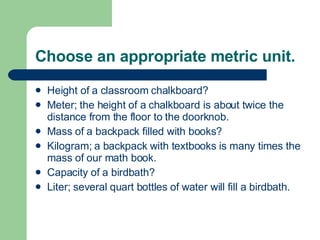
Choose an appropriate metric unit. Height of a classroom chalkboard? Meter; the height of a chalkboard is about twice the distance from the floor to the doorknob. Mass of a backpack filled with books? Kilogram; a backpack with textbooks is many times the mass of our math book. Capacity of a birdbath? Liter; several quart bottles of water will fill a birdbath.
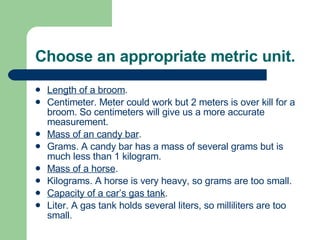
Choose an appropriate metric unit. Length of a broom . Centimeter. Meter could work but 2 meters is over kill for a broom. So centimeters will give us a more accurate measurement. Mass of an candy bar . Grams. A candy bar has a mass of several grams but is much less than 1 kilogram. Mass of a horse . Kilograms. A horse is very heavy, so grams are too small. Capacity of a car’s gas tank . Liter. A gas tank holds several liters, so milliliters are too small.
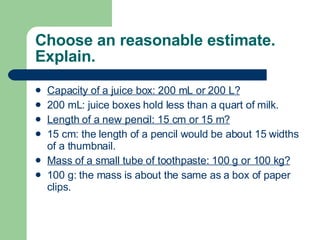
Choose an reasonable estimate. Explain. Capacity of a juice box: 200 mL or 200 L? 200 mL: juice boxes hold less than a quart of milk. Length of a new pencil: 15 cm or 15 m? 15 cm: the length of a pencil would be about 15 widths of a thumbnail. Mass of a small tube of toothpaste: 100 g or 100 kg? 100 g: the mass is about the same as a box of paper clips.
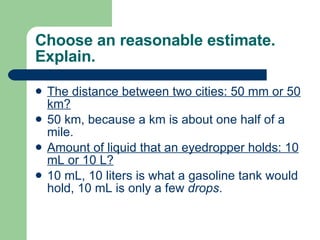
Choose an reasonable estimate. Explain. The distance between two cities: 50 mm or 50 km? 50 km, because a km is about one half of a mile. Amount of liquid that an eyedropper holds: 10 mL or 10 L? 10 mL, 10 liters is what a gasoline tank would hold, 10 mL is only a few  drops .
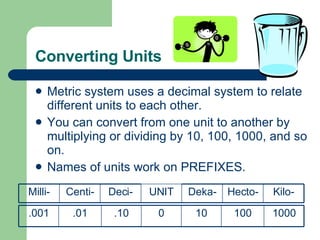
Converting Units Metric system uses a decimal system to relate different units to each other. You can convert from one unit to another by multiplying or dividing by 10, 100, 1000, and so on. Names of units work on PREFIXES. Kilo- Hecto- Deka- UNIT Deci- Centi- Milli- 1000 100 10 0 .10 .01 .001
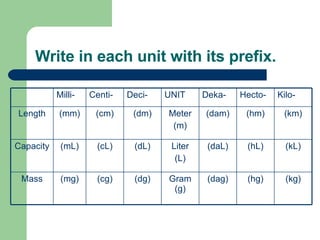
Write in each unit with its prefix. (kg) (hg) (dag) Gram (g) (dg) (cg) (mg) Mass (kL) (hL) (daL) Liter (L) (dL) (cL) (mL) Capacity (km) (hm) (dam) Meter (m) (dm) (cm) (mm) Length Kilo- Hecto- Deka- UNIT Deci- Centi- Milli-
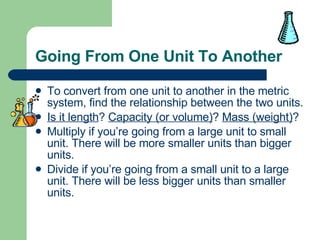
Going From One Unit To Another To convert from one unit to another in the metric system, find the relationship between the two units.  Is it length ?  Capacity (or volume) ?  Mass (weight) ? Multiply if you’re going from a large unit to small unit. There will be more smaller units than bigger units. Divide if you’re going from a small unit to a large unit. There will be less bigger units than smaller units.
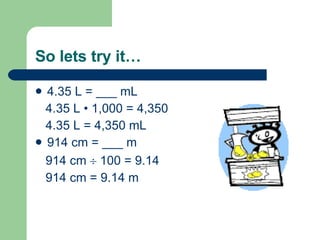
So lets try it… 4.35 L = ___ mL 4.35 L  • 1,000 = 4,350 4.35 L = 4,350 mL 914 cm = ___ m 914 cm    100 = 9.14 914 cm = 9.14 m
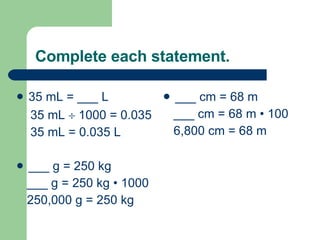
Complete each statement. 35 mL = ___ L 35 mL    1000 = 0.035  35 mL = 0.035 L ___ g = 250 kg ___ g = 250 kg  • 1000 250,000 g = 250 kg ___ cm = 68 m ___ cm = 68 m  • 100 6,800 cm = 68 m
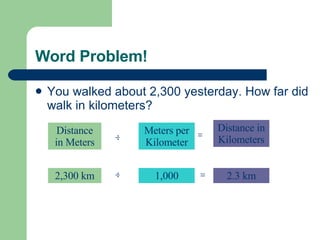
Word Problem! You walked about 2,300 yesterday. How far did walk in kilometers? Distance in Meters  Meters per Kilometer  Distance in Kilometers 2,300 km  1,000  2.3 km
Two More Word Problems! The record for the highest a kite has flown is 3.8 km. Find the height of the kite in meters. You have a recipe that requires 0.25 L of milk. Your measuring cup is marked only in milliliters. How many milliliters of milk do you need?
Assignment #17 Page 153 – 154: 27-38 all, 45, 54-60 all.

Section 3.7 Using The Metric System

  • 1.
    Section 3.7 Usingthe Metric System By Ms. Dewey-Hoffman October 1 st , 2008
  • 2.
    Identifying Appropriate MetricMeasures Mass Capacity Length Type Kilogram (kg) Gram (g) Milligram (mg) Liter (L) Milliliter (mL) Kilometer (km) Centimeter (cm) Millimeter (mm) Unit Half the mass of the math book. Mass of a paper clip Mass of a speck of sawdust Quart of milk About 5 drops of water Distance from doorknob to floor Width of a thumbnail Thickness of a dime Reference Examples
  • 3.
    Choose an appropriatemetric unit. Height of a classroom chalkboard? Meter; the height of a chalkboard is about twice the distance from the floor to the doorknob. Mass of a backpack filled with books? Kilogram; a backpack with textbooks is many times the mass of our math book. Capacity of a birdbath? Liter; several quart bottles of water will fill a birdbath.
  • 4.
    Choose an appropriatemetric unit. Length of a broom . Centimeter. Meter could work but 2 meters is over kill for a broom. So centimeters will give us a more accurate measurement. Mass of an candy bar . Grams. A candy bar has a mass of several grams but is much less than 1 kilogram. Mass of a horse . Kilograms. A horse is very heavy, so grams are too small. Capacity of a car’s gas tank . Liter. A gas tank holds several liters, so milliliters are too small.
  • 5.
    Choose an reasonableestimate. Explain. Capacity of a juice box: 200 mL or 200 L? 200 mL: juice boxes hold less than a quart of milk. Length of a new pencil: 15 cm or 15 m? 15 cm: the length of a pencil would be about 15 widths of a thumbnail. Mass of a small tube of toothpaste: 100 g or 100 kg? 100 g: the mass is about the same as a box of paper clips.
  • 6.
    Choose an reasonableestimate. Explain. The distance between two cities: 50 mm or 50 km? 50 km, because a km is about one half of a mile. Amount of liquid that an eyedropper holds: 10 mL or 10 L? 10 mL, 10 liters is what a gasoline tank would hold, 10 mL is only a few drops .
  • 7.
    Converting Units Metricsystem uses a decimal system to relate different units to each other. You can convert from one unit to another by multiplying or dividing by 10, 100, 1000, and so on. Names of units work on PREFIXES. Kilo- Hecto- Deka- UNIT Deci- Centi- Milli- 1000 100 10 0 .10 .01 .001
  • 8.
    Write in eachunit with its prefix. (kg) (hg) (dag) Gram (g) (dg) (cg) (mg) Mass (kL) (hL) (daL) Liter (L) (dL) (cL) (mL) Capacity (km) (hm) (dam) Meter (m) (dm) (cm) (mm) Length Kilo- Hecto- Deka- UNIT Deci- Centi- Milli-
  • 9.
    Going From OneUnit To Another To convert from one unit to another in the metric system, find the relationship between the two units. Is it length ? Capacity (or volume) ? Mass (weight) ? Multiply if you’re going from a large unit to small unit. There will be more smaller units than bigger units. Divide if you’re going from a small unit to a large unit. There will be less bigger units than smaller units.
  • 10.
    So lets tryit… 4.35 L = ___ mL 4.35 L • 1,000 = 4,350 4.35 L = 4,350 mL 914 cm = ___ m 914 cm  100 = 9.14 914 cm = 9.14 m
  • 11.
    Complete each statement.35 mL = ___ L 35 mL  1000 = 0.035 35 mL = 0.035 L ___ g = 250 kg ___ g = 250 kg • 1000 250,000 g = 250 kg ___ cm = 68 m ___ cm = 68 m • 100 6,800 cm = 68 m
  • 12.
    Word Problem! Youwalked about 2,300 yesterday. How far did walk in kilometers? Distance in Meters  Meters per Kilometer  Distance in Kilometers 2,300 km  1,000  2.3 km
  • 13.
    Two More WordProblems! The record for the highest a kite has flown is 3.8 km. Find the height of the kite in meters. You have a recipe that requires 0.25 L of milk. Your measuring cup is marked only in milliliters. How many milliliters of milk do you need?
  • 14.
    Assignment #17 Page153 – 154: 27-38 all, 45, 54-60 all.