Presented by:
Katherine Pike, RDN, CD
Lizzie Severson, RDN, CD
School Nutrition Team
and the
New Meal Pattern
Farm to School
Healthy Hunger – Free Kids Act of 2010 (HHFKA)
“This is a historic victory for our nation’s youngsters. This legislation will
allow USDA, for the first time in over 30 years, the chance to make real
reforms to the school lunch and breakfast programs by improving the
critical nutrition and hunger safety net for millions of children.”
- Tom Vilsack, United States Secretary of Agriculture
Child Nutrition Reauthorization
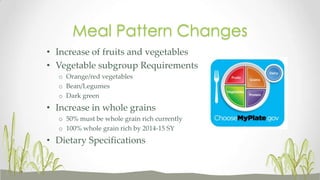
Meal Pattern Changes
• Increase of fruits and vegetables
• Vegetable subgroup Requirements
o Orange/red vegetables
o Bean/Legumes
o Dark green
• Increase in whole grains
o 50% must be whole grain rich currently
o 100% whole grain rich by 2014-15 SY
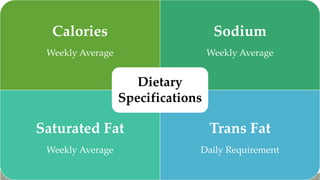
• Dietary Specifications
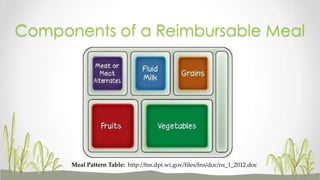
Components of a Reimbursable Meal
Meal Pattern Table: http://fns.dpi.wi.gov/files/fns/doc/ns_1_2012.doc
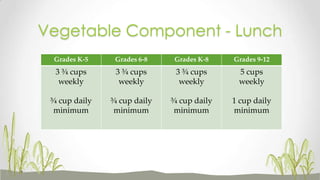
Vegetable Component - Lunch
Grades K-5 Grades 6-8 Grades K-8 Grades 9-12
3 ¾ cups
weekly
¾ cup daily
minimum
3 ¾ cups
weekly
¾ cup daily
minimum
3 ¾ cups
weekly
¾ cup daily
minimum
5 cups
weekly
1 cup daily
minimum
• There are no maximums for the vegetable component, except for juice
o No more than half of the weekly vegetable offering may be in the form of juice
o If juice is offered, it must be pasteurized, 100% full-strength vegetable juice
• The minimum creditable serving of vegetable is 1/8 cup
• Raw, dark leafy green vegetables credit as half the volume served
o Example: 1 cup of raw spinach counts as ½ cup of dark green vegetables
• Cooked, dark leafy green vegetables credit as the volume served
o Example: ½ cup of sautéed spinach counts as ½ cup of dark green vegetables
Vegetable Component - Lunch
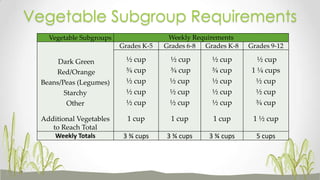
Vegetable Subgroup Requirements
Vegetable Subgroups Weekly Requirements
Dark Green
Red/Orange
Beans/Peas (Legumes)
Starchy
Other
Additional Vegetables
to Reach Total
Grades K-5 Grades 6-8 Grades K-8 Grades 9-12
½ cup
¾ cup
½ cup
½ cup
½ cup
1 cup
½ cup
¾ cup
½ cup
½ cup
½ cup
1 cup
½ cup
¾ cup
½ cup
½ cup
½ cup
1 cup
½ cup
1 ¼ cups
½ cup
½ cup
¾ cup
1 ½ cup
Weekly Totals 3 ¾ cups 3 ¾ cups 3 ¾ cups 5 cups
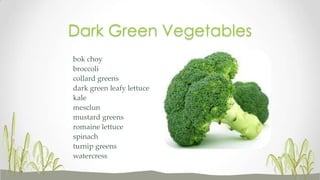
Dark Green Vegetables
bok choy
broccoli
collard greens
dark green leafy lettuce
kale
mesclun
mustard greens
romaine lettuce
spinach
turnip greens
watercress
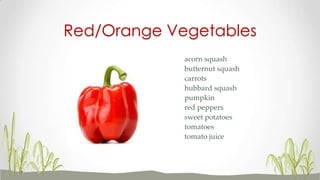
acorn squash
butternut squash
carrots
hubbard squash
pumpkin
red peppers
sweet potatoes
tomatoes
tomato juice
Red/Orange Vegetables
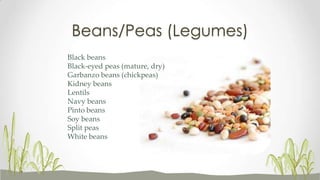
Black beans
Black-eyed peas (mature, dry)
Garbanzo beans (chickpeas)
Kidney beans
Lentils
Navy beans
Pinto beans
Soy beans
Split peas
White beans
Beans/Peas (Legumes)
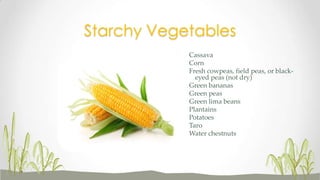
Cassava
Corn
Fresh cowpeas, field peas, or black-
eyed peas (not dry)
Green bananas
Green peas
Green lima beans
Plantains
Potatoes
Taro
Water chestnuts
Starchy Vegetables
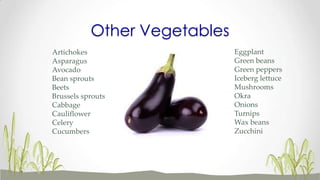
Eggplant
Green beans
Green peppers
Iceberg lettuce
Mushrooms
Okra
Onions
Turnips
Wax beans
Zucchini
Artichokes
Asparagus
Avocado
Bean sprouts
Beets
Brussels sprouts
Cabbage
Cauliflower
Celery
Cucumbers
Other Vegetables
Whole Grain-Rich Foods
• SY 2012-13, SY 2013-14: At least half must be whole grain-rich
• SY 2014-15 and beyond: All grains must be whole-grain rich
Whole grain-rich products must contain at
least 50% whole grain and the remaining
grain must be enriched
Grains Component
14
Calories
Weekly Average
Sodium
Weekly Average
Saturated Fat
Weekly Average
Trans Fat
Daily Requirement
Dietary
Specifications
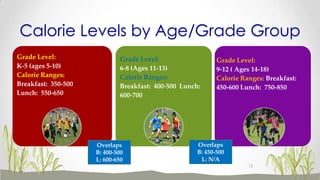
Calorie Levels by Age/Grade Group
15
Grade Level:
K-5 (ages 5-10)
Calorie Ranges:
Breakfast: 350-500
Lunch: 550-650
Grade Level:
6-8 (Ages 11-13)
Calorie Ranges:
Breakfast: 400-500 Lunch:
600-700
Grade Level:
9-12 ( Ages 14-18)
Calorie Ranges: Breakfast:
450-600 Lunch: 750-850
Overlaps
B: 400-500
L: 600-650
Overlaps
B: 450-500
L: N/A
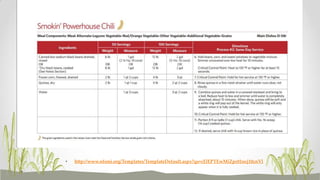
• http://www.nfsmi.org/Templates/TemplateDefault.aspx?qs=cElEPTEwMiZpc01ncj10cnVl
Katherine Pike, RDN, CD
Nutrition Program Consultant
Wisconsin Dept of Public Instruction
katherine.pike@dpi.wi.gov
(608) 266-2410
Lizzie Severson, RDN, CD
Nutrition Program Consultant
Wisconsin Dept of Public Instruction
elizabeth.severson@dpi.wi.gov
(608) 267-9233
Contact
USDA Nondiscrimination Statement
• The U.S Department of Agriculture prohibits discrimination against its customers, employees, and applicants for employment on the bases of
race, color, national origin, age, disability, sex, gender identity, religion, reprisal, and where applicable, political beliefs, marital status, familial or
parental status, sexual orientation, or all or part of an individual’s income is derived from any public assistance program, or protected genetic
information in employment or in any program or activity conducted or funded by the Department. (Not all prohibited bases will apply to all
programs and/or employment activities.)
• If you wish to file a Civil Rights program complaint of discrimination, complete the USDA Program Discrimination Complaint
Form, found online at http://www.ascr.usda.gov/complaint_filing_cust.html, or at any USDA office, or call (866) 632-9992 to request the form.
You may also write a letter containing all of the information requested in the form. Send your completed complaint form or letter to us by mail
at U.S. Department of Agriculture, Director, Office of Adjudication, 1400 Independence Avenue, S.W., Washington, D.C. 20250-9410, by fax (202)
690-7442 or email at program.intake@usda.gov.
• Individuals who are deaf, hard of hearing or have speech disabilities may contact USDA through the Federal Relay Service at (800) 877-8339; or
(800) 845-6136 (Spanish).
• For any other information dealing with Supplemental Nutrition Assistance Program (SNAP) issues, persons should either contact the USDA
SNAP Hotline Number at (800) 221-5689, which is also in Spanish or call the State Information/Hotline Numbers (click the link for a listing of
hotline numbers by State); found online at http://www.fns.usda.gov/snap/contact_info/hotlines.htm.
• USDA is an equal opportunity provider and employer.

HHFKA Meal Pattern

  • 1.
    Presented by: Katherine Pike,RDN, CD Lizzie Severson, RDN, CD School Nutrition Team and the New Meal Pattern Farm to School
  • 2.
    Healthy Hunger –Free Kids Act of 2010 (HHFKA) “This is a historic victory for our nation’s youngsters. This legislation will allow USDA, for the first time in over 30 years, the chance to make real reforms to the school lunch and breakfast programs by improving the critical nutrition and hunger safety net for millions of children.” - Tom Vilsack, United States Secretary of Agriculture Child Nutrition Reauthorization
  • 3.
    Meal Pattern Changes •Increase of fruits and vegetables • Vegetable subgroup Requirements o Orange/red vegetables o Bean/Legumes o Dark green • Increase in whole grains o 50% must be whole grain rich currently o 100% whole grain rich by 2014-15 SY • Dietary Specifications
  • 4.
    Components of aReimbursable Meal Meal Pattern Table: http://fns.dpi.wi.gov/files/fns/doc/ns_1_2012.doc
  • 5.
    Vegetable Component -Lunch Grades K-5 Grades 6-8 Grades K-8 Grades 9-12 3 ¾ cups weekly ¾ cup daily minimum 3 ¾ cups weekly ¾ cup daily minimum 3 ¾ cups weekly ¾ cup daily minimum 5 cups weekly 1 cup daily minimum
  • 6.
    • There areno maximums for the vegetable component, except for juice o No more than half of the weekly vegetable offering may be in the form of juice o If juice is offered, it must be pasteurized, 100% full-strength vegetable juice • The minimum creditable serving of vegetable is 1/8 cup • Raw, dark leafy green vegetables credit as half the volume served o Example: 1 cup of raw spinach counts as ½ cup of dark green vegetables • Cooked, dark leafy green vegetables credit as the volume served o Example: ½ cup of sautéed spinach counts as ½ cup of dark green vegetables Vegetable Component - Lunch
  • 7.
    Vegetable Subgroup Requirements VegetableSubgroups Weekly Requirements Dark Green Red/Orange Beans/Peas (Legumes) Starchy Other Additional Vegetables to Reach Total Grades K-5 Grades 6-8 Grades K-8 Grades 9-12 ½ cup ¾ cup ½ cup ½ cup ½ cup 1 cup ½ cup ¾ cup ½ cup ½ cup ½ cup 1 cup ½ cup ¾ cup ½ cup ½ cup ½ cup 1 cup ½ cup 1 ¼ cups ½ cup ½ cup ¾ cup 1 ½ cup Weekly Totals 3 ¾ cups 3 ¾ cups 3 ¾ cups 5 cups
  • 8.
    Dark Green Vegetables bokchoy broccoli collard greens dark green leafy lettuce kale mesclun mustard greens romaine lettuce spinach turnip greens watercress
  • 9.
    acorn squash butternut squash carrots hubbardsquash pumpkin red peppers sweet potatoes tomatoes tomato juice Red/Orange Vegetables
  • 10.
    Black beans Black-eyed peas(mature, dry) Garbanzo beans (chickpeas) Kidney beans Lentils Navy beans Pinto beans Soy beans Split peas White beans Beans/Peas (Legumes)
  • 11.
    Cassava Corn Fresh cowpeas, fieldpeas, or black- eyed peas (not dry) Green bananas Green peas Green lima beans Plantains Potatoes Taro Water chestnuts Starchy Vegetables
  • 12.
    Eggplant Green beans Green peppers Iceberglettuce Mushrooms Okra Onions Turnips Wax beans Zucchini Artichokes Asparagus Avocado Bean sprouts Beets Brussels sprouts Cabbage Cauliflower Celery Cucumbers Other Vegetables
  • 13.
    Whole Grain-Rich Foods •SY 2012-13, SY 2013-14: At least half must be whole grain-rich • SY 2014-15 and beyond: All grains must be whole-grain rich Whole grain-rich products must contain at least 50% whole grain and the remaining grain must be enriched Grains Component
  • 14.
    14 Calories Weekly Average Sodium Weekly Average SaturatedFat Weekly Average Trans Fat Daily Requirement Dietary Specifications
  • 15.
    Calorie Levels byAge/Grade Group 15 Grade Level: K-5 (ages 5-10) Calorie Ranges: Breakfast: 350-500 Lunch: 550-650 Grade Level: 6-8 (Ages 11-13) Calorie Ranges: Breakfast: 400-500 Lunch: 600-700 Grade Level: 9-12 ( Ages 14-18) Calorie Ranges: Breakfast: 450-600 Lunch: 750-850 Overlaps B: 400-500 L: 600-650 Overlaps B: 450-500 L: N/A
  • 16.
  • 18.
    Katherine Pike, RDN,CD Nutrition Program Consultant Wisconsin Dept of Public Instruction katherine.pike@dpi.wi.gov (608) 266-2410 Lizzie Severson, RDN, CD Nutrition Program Consultant Wisconsin Dept of Public Instruction elizabeth.severson@dpi.wi.gov (608) 267-9233 Contact
  • 19.
    USDA Nondiscrimination Statement •The U.S Department of Agriculture prohibits discrimination against its customers, employees, and applicants for employment on the bases of race, color, national origin, age, disability, sex, gender identity, religion, reprisal, and where applicable, political beliefs, marital status, familial or parental status, sexual orientation, or all or part of an individual’s income is derived from any public assistance program, or protected genetic information in employment or in any program or activity conducted or funded by the Department. (Not all prohibited bases will apply to all programs and/or employment activities.) • If you wish to file a Civil Rights program complaint of discrimination, complete the USDA Program Discrimination Complaint Form, found online at http://www.ascr.usda.gov/complaint_filing_cust.html, or at any USDA office, or call (866) 632-9992 to request the form. You may also write a letter containing all of the information requested in the form. Send your completed complaint form or letter to us by mail at U.S. Department of Agriculture, Director, Office of Adjudication, 1400 Independence Avenue, S.W., Washington, D.C. 20250-9410, by fax (202) 690-7442 or email at program.intake@usda.gov. • Individuals who are deaf, hard of hearing or have speech disabilities may contact USDA through the Federal Relay Service at (800) 877-8339; or (800) 845-6136 (Spanish). • For any other information dealing with Supplemental Nutrition Assistance Program (SNAP) issues, persons should either contact the USDA SNAP Hotline Number at (800) 221-5689, which is also in Spanish or call the State Information/Hotline Numbers (click the link for a listing of hotline numbers by State); found online at http://www.fns.usda.gov/snap/contact_info/hotlines.htm. • USDA is an equal opportunity provider and employer.

Editor's Notes

  • #5 These are the 5 components that must be offered every day. They include:Meat or Meat Alternates; the term “meat alternate” refers to other protein sources such as eggs, cheese, beans and protein that can be served in place of meat. Milk, Grains, Fruit and VegetablesThere is definitely more of an emphasis now on half of the plate, or in this case tray, being fruits and vegetables and the meat and grains being side items. The original meal pattern that was implemented July 1 of 2012, required that schools limit the amount of protein and grains that they served throughout the week. Because of the menu planning difficulties this regulation caused, the USDA has lifted this maximum requirement through the 2013-2014 school year
  • #16 The first dietary specification is calorie ranges. These calorie ranges are to be met on average over the school week.The calorie requirements went into effect July 1, 2012 for lunch and will go into effect in the 2013-14 school year for breakfast. Based on the age/grade groups, there are different calorie minimums and maximums. For grades K-5, lunches, on average, should contain between 550 and 650 calories. For grades 6-8, the average lunch should contain 600-700 calories. And for grades 9-12, the average lunch should contain 750-850 calories. A school could offer a single menu for grades K-8 that falls within a range of 600-650 average calories per week since there is some overlap between grades K-6 and grades 6-8. The intent is not to reduce the amount of food but to avoid excessive calories. The meal patterns provide more fruits, vegetables and whole grains than current school meals and should result in nutrient-dense meals – foods that give you the most “bang for your buck” so to speak. Foods that are high in nutrients, and not empty calories. The required maximum calorie levels are expected to drive menu planners to select nutrient dense foods and ingredients to prepare meals, and avoid products that are high in fats and added sugars.