GROUP 1
 Patience Hall: Grocery Store Products and
Availability

 Gabrielle Stern: Organic vs. Conventional Produce
 Chelsie Pauletti: Social Trends in Organic Foods
and Diets in Our Culture/Society
 Darnell Tucker: Fast Food
 Maryann Sanchez: Federal Nutrition Programs:
WIC & SNAP
 Allen Craig: Media Influence on Public Perception
of Health and Federal Government Efforts Against
Child Obesity
Federal Nutrition Programs:
Women, Infants, and Children
&
Supplemental Nutrition Assistance
Program
By
Maryann Sanchez
Women, Infants, and Children/WIC
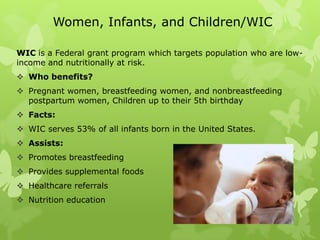
WIC is a Federal grant program which targets population who are lowincome and nutritionally at risk.
 Who benefits?
 Pregnant women, breastfeeding women, and nonbreastfeeding
postpartum women, and children up to their 5th birthday
 Facts:
 WIC serves 53% of all infants born in the United States.
 Assists:
 Promotes breastfeeding
 Provides supplemental foods
 Healthcare referrals
 Nutrition education
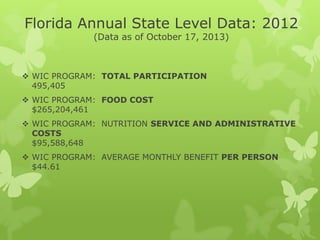
Florida Annual State Level Data: 2012
(Data as of October 17, 2013)

 WIC PROGRAM: TOTAL PARTICIPATION
495,405
 WIC PROGRAM: FOOD COST
$265,204,461
 WIC PROGRAM: NUTRITION SERVICE AND ADMINISTRATIVE
COSTS
$95,588,648
 WIC PROGRAM: AVERAGE MONTHLY BENEFIT PER PERSON
$44.61
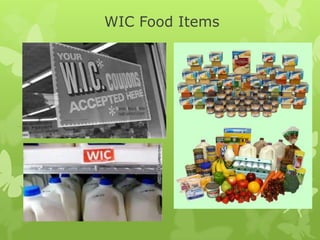
Visual used by Florida Department of health
in Broward County
Visuals & Demographics
• Visuals are used by grocery store
owners to communicate with WIC
assisted members of South Florida
communities.
• These signs can be found in stores
such as Walmart Supercenters,
Publix, Sedano’s Supermarket, and
Winn-Dixie throughout South
Florida according to a list of vendors
provided by the Florida Department
of Health. However, these sings are
less conspicuous in low-income
areas, for example, parts of
Hollywood (east), parts of Miami,
Hallandale, etc.
The use of visual by the Florida Health
Department to provide instruction on how to read
and understand a WIC check
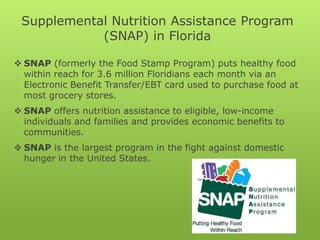
Supplemental Nutrition Assistance Program
(SNAP) in Florida
 SNAP (formerly the Food Stamp Program) puts healthy food
within reach for 3.6 million Floridians each month via an
Electronic Benefit Transfer/EBT card used to purchase food at
most grocery stores.
 SNAP offers nutrition assistance to eligible, low-income
individuals and families and provides economic benefits to
communities.
 SNAP is the largest program in the fight against domestic
hunger in the United States.

The logo for
SNAP
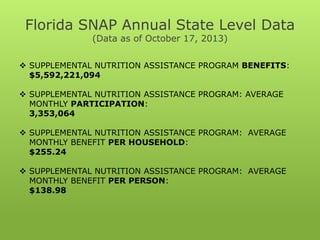
Florida SNAP Annual State Level Data
(Data as of October 17, 2013)

 SUPPLEMENTAL NUTRITION ASSISTANCE PROGRAM BENEFITS:
$5,592,221,094
 SUPPLEMENTAL NUTRITION ASSISTANCE PROGRAM: AVERAGE
MONTHLY PARTICIPATION:
3,353,064
 SUPPLEMENTAL NUTRITION ASSISTANCE PROGRAM: AVERAGE
MONTHLY BENEFIT PER HOUSEHOLD:
$255.24
 SUPPLEMENTAL NUTRITION ASSISTANCE PROGRAM: AVERAGE
MONTHLY BENEFIT PER PERSON:
$138.98
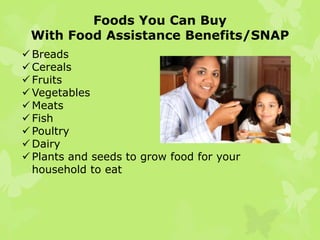
Foods You Can Buy
With Food Assistance Benefits/SNAP
 Breads
 Cereals
 Fruits
 Vegetables
 Meats
 Fish
 Poultry
 Dairy
 Plants and seeds to grow food for your
household to eat
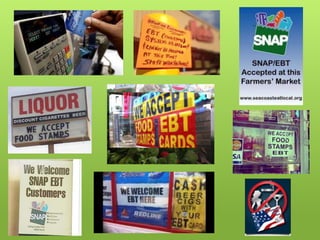
Visual anthropology in South Florida communities
communicating on the use of SNAP
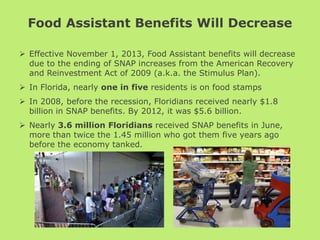
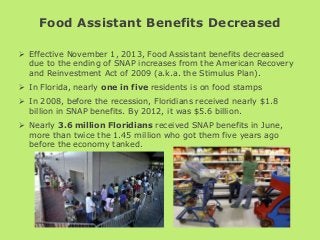
Food Assistant Benefits Decreased
 Effective November 1, 2013, Food Assistant benefits decreased
due to the ending of SNAP increases from the American Recovery
and Reinvestment Act of 2009 (a.k.a. the Stimulus Plan).
 In Florida, nearly one in five residents is on food stamps
 In 2008, before the recession, Floridians received nearly $1.8
billion in SNAP benefits. By 2012, it was $5.6 billion.
 Nearly 3.6 million Floridians received SNAP benefits in June,
more than twice the 1.45 million who got them five years ago
before the economy tanked.
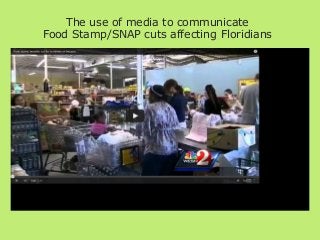
The use of media to communicate
Food Stamp/SNAP cuts affecting Floridians
Information for Florida Food
Stamps/SNAP and WIC
http://www.fns.usda.gov/snap/outreach/states/florida.htm
DCF Headquarters
1317 Winewood Blvd.
Building 1, Room 202
Tallahassee, Florida
32399-0700
Phone: (850) 487-1111
Fax: (850) 922-2993
http://www.floridahealth.gov/healthy-people-and-families/wic/
Contact the Florida WIC Program
1-800-342-3556
Mailing Address
4052 Bald Cypress Way, Bin A16
Tallahassee FL 32399

Maryann Sanchez Wiki Presentation Group 1 ANT3391

  • 2.
    GROUP 1  PatienceHall: Grocery Store Products and Availability  Gabrielle Stern: Organic vs. Conventional Produce  Chelsie Pauletti: Social Trends in Organic Foods and Diets in Our Culture/Society  Darnell Tucker: Fast Food  Maryann Sanchez: Federal Nutrition Programs: WIC & SNAP  Allen Craig: Media Influence on Public Perception of Health and Federal Government Efforts Against Child Obesity
  • 3.
    Federal Nutrition Programs: Women,Infants, and Children & Supplemental Nutrition Assistance Program By Maryann Sanchez
  • 4.
    Women, Infants, andChildren/WIC WIC is a Federal grant program which targets population who are lowincome and nutritionally at risk.  Who benefits?  Pregnant women, breastfeeding women, and nonbreastfeeding postpartum women, and children up to their 5th birthday  Facts:  WIC serves 53% of all infants born in the United States.  Assists:  Promotes breastfeeding  Provides supplemental foods  Healthcare referrals  Nutrition education
  • 5.
    Florida Annual StateLevel Data: 2012 (Data as of October 17, 2013)  WIC PROGRAM: TOTAL PARTICIPATION 495,405  WIC PROGRAM: FOOD COST $265,204,461  WIC PROGRAM: NUTRITION SERVICE AND ADMINISTRATIVE COSTS $95,588,648  WIC PROGRAM: AVERAGE MONTHLY BENEFIT PER PERSON $44.61
  • 6.
    Visual used byFlorida Department of health in Broward County
  • 7.
    Visuals & Demographics •Visuals are used by grocery store owners to communicate with WIC assisted members of South Florida communities. • These signs can be found in stores such as Walmart Supercenters, Publix, Sedano’s Supermarket, and Winn-Dixie throughout South Florida according to a list of vendors provided by the Florida Department of Health. However, these sings are less conspicuous in low-income areas, for example, parts of Hollywood (east), parts of Miami, Hallandale, etc.
  • 8.
    The use ofvisual by the Florida Health Department to provide instruction on how to read and understand a WIC check
  • 9.
    Supplemental Nutrition AssistanceProgram (SNAP) in Florida  SNAP (formerly the Food Stamp Program) puts healthy food within reach for 3.6 million Floridians each month via an Electronic Benefit Transfer/EBT card used to purchase food at most grocery stores.  SNAP offers nutrition assistance to eligible, low-income individuals and families and provides economic benefits to communities.  SNAP is the largest program in the fight against domestic hunger in the United States. The logo for SNAP
  • 10.
    Florida SNAP AnnualState Level Data (Data as of October 17, 2013)  SUPPLEMENTAL NUTRITION ASSISTANCE PROGRAM BENEFITS: $5,592,221,094  SUPPLEMENTAL NUTRITION ASSISTANCE PROGRAM: AVERAGE MONTHLY PARTICIPATION: 3,353,064  SUPPLEMENTAL NUTRITION ASSISTANCE PROGRAM: AVERAGE MONTHLY BENEFIT PER HOUSEHOLD: $255.24  SUPPLEMENTAL NUTRITION ASSISTANCE PROGRAM: AVERAGE MONTHLY BENEFIT PER PERSON: $138.98
  • 11.
    Foods You CanBuy With Food Assistance Benefits/SNAP  Breads  Cereals  Fruits  Vegetables  Meats  Fish  Poultry  Dairy  Plants and seeds to grow food for your household to eat
  • 12.
    Visual anthropology inSouth Florida communities communicating on the use of SNAP
  • 13.
    Food Assistant BenefitsDecreased  Effective November 1, 2013, Food Assistant benefits decreased due to the ending of SNAP increases from the American Recovery and Reinvestment Act of 2009 (a.k.a. the Stimulus Plan).  In Florida, nearly one in five residents is on food stamps  In 2008, before the recession, Floridians received nearly $1.8 billion in SNAP benefits. By 2012, it was $5.6 billion.  Nearly 3.6 million Floridians received SNAP benefits in June, more than twice the 1.45 million who got them five years ago before the economy tanked.
  • 14.
    The use ofmedia to communicate Food Stamp/SNAP cuts affecting Floridians
  • 15.
    Information for FloridaFood Stamps/SNAP and WIC http://www.fns.usda.gov/snap/outreach/states/florida.htm DCF Headquarters 1317 Winewood Blvd. Building 1, Room 202 Tallahassee, Florida 32399-0700 Phone: (850) 487-1111 Fax: (850) 922-2993 http://www.floridahealth.gov/healthy-people-and-families/wic/ Contact the Florida WIC Program 1-800-342-3556 Mailing Address 4052 Bald Cypress Way, Bin A16 Tallahassee FL 32399