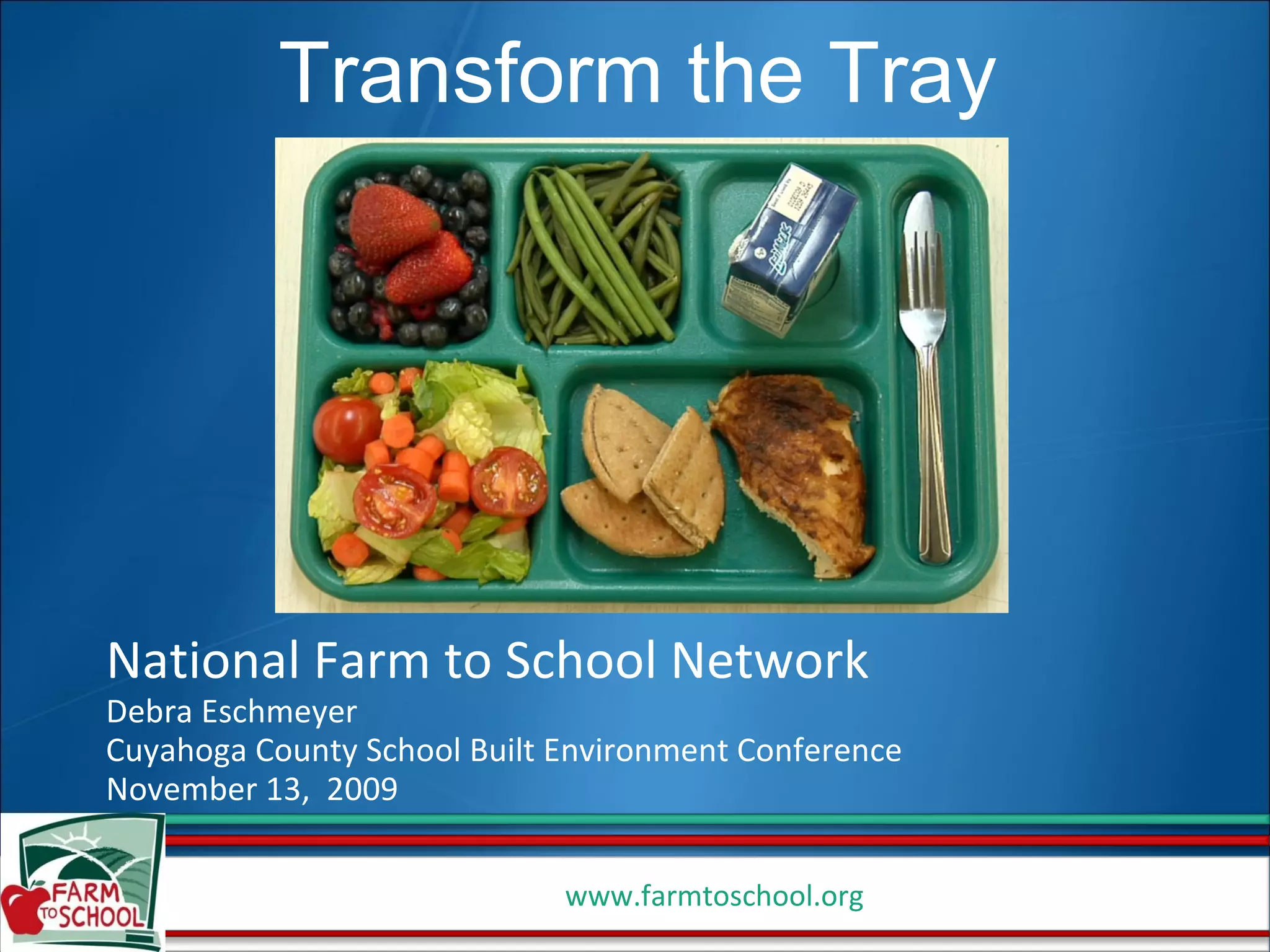
National Farm to School Network Debra Eschmeyer Cuyahoga County School Built Environment Conference November 13,  2009 Transform the Tray
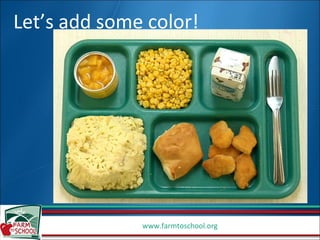
Let’s add some color!
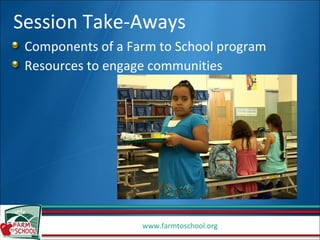
Session Take-Aways Components of a Farm to School program Resources to engage communities
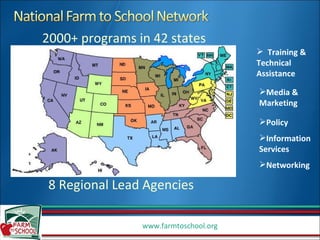
8 Regional Lead Agencies  Training & Technical Assistance  Policy  Networking Media & Marketing Information Services  2000+ programs in 42 states
 
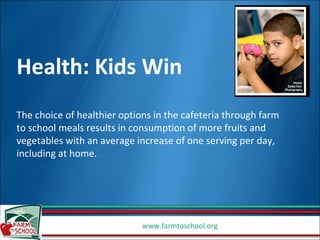
Health: Kids Win The choice of healthier options in the cafeteria through farm to school meals results in consumption of more fruits and vegetables with an average increase of one serving per day, including at home.
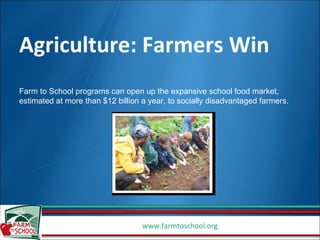
Agriculture: Farmers Win Farm to School programs can open up the expansive school food market, estimated at more than $12 billion a year, to socially disadvantaged farmers.
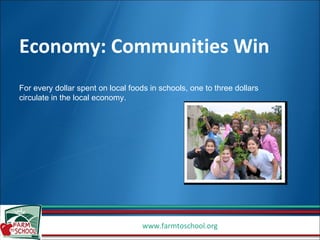
Economy: Communities Win For every dollar spent on local foods in schools, one to three dollars circulate in the local economy.
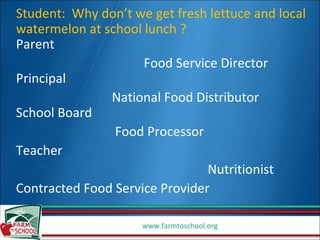
Student:  Why don’t we get fresh lettuce and local watermelon at school lunch ? Parent Food Service Director  Principal National Food Distributor School Board    Food Processor  Teacher Nutritionist  Contracted Food Service Provider
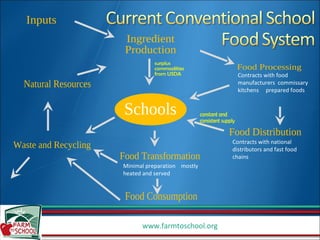
Inputs Food Consumption Food Distribution Food Processing Ingredient Production Natural Resources Waste and Recycling Food Transformation Schools Contracts with food manufacturers  commissary kitchens  prepared foods Contracts with national distributors and fast food chains Minimal preparation  mostly heated and served surplus  commodities from USDA constant and  consistent supply
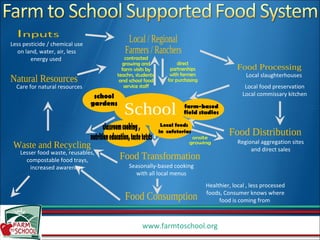
Food Consumption Food Distribution Food Processing Local / Regional  Farmers / Ranchers  Natural Resources Waste and Recycling Food Transformation School Local slaughterhouses  Local food preservation Local commissary kitchen Regional aggregation sites and direct sales Seasonally-based cooking with all local menus direct  partnerships  with farmers for purchasing onsite  growing contracted growing and farm visits by  teachrs, students,  and school food  service staff school  gardens classroom cooking ,  nutrition education, taste tetsts  farm-based field studies Local foods  in  cafeterias Lesser food waste, reusables, compostable food trays, increased awareness  Less pesticide / chemical use on land, water, air, less energy used  Care for natural resources Healthier, local , less processed foods, Consumer knows where food is coming from
“ Farm to School programs connect school food with local agriculture to create a strategy that increases the profitability of farming, improves the quality of school meals, and re- create relationships in the community among consumers and the people who grow their food. ”
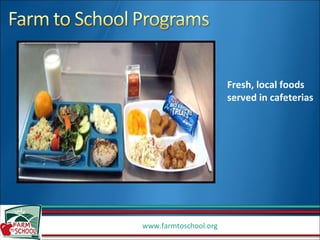
Fresh, local foods served in cafeterias
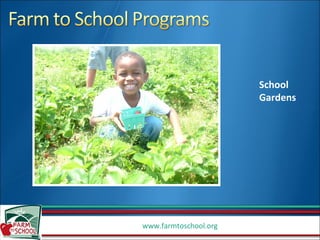
School Gardens
Cooking and Taste Tests
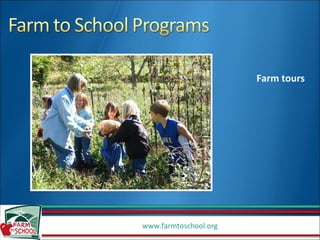
Farm tours
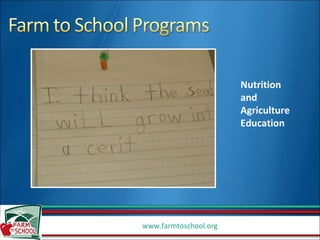
Nutrition and Agriculture Education
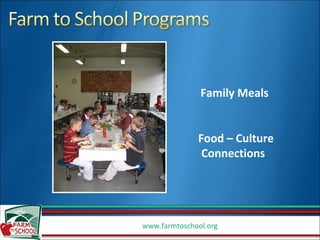
Family Meals  Food – Culture Connections
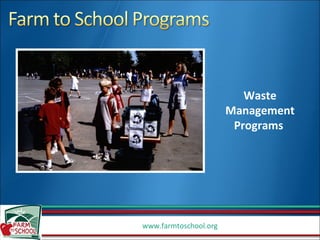
Waste Management Programs
Farm to School: VERMONT Vermont FEED (Food Education Every Day) A community-based approach to school food systems change through 3 C’s: Classroom, Cafeteria, and Community 10 years and over 150 Vermont schools Farm to school movement in Vermont is building on food system partnerships and relationships: –  farmers and food service  - distributors and farmers – schools and communities  - government and non-profit
Farm to School: PENNSYLVANIA The Kindergarten Initiative www.thefoodtrust.org Healthy Snacks made with locally sourced fruit, vegetable, grain and dairy products Integration of Nutrition and Agriculture Education Parent outreach and involvement activities Educational Farm Trips 2004 , 4 schools, 1 district 2009-  67 schools, 10 districts, 3 states
Farm to School: FLORIDA New North Florida Cooperative Farmer-led: 60-100 farmers 72 School Districts 1,000,000 students Leafy greens, sweet potato sticks, green beans, watermelon, okra, strawberries, muscadine
Farm to School: WASHINGTON  2002 one school, Olympia District, organic salad bar, local purchasing Fruit and Vegetable consumption increased 30%, participation 16% Washington State Department of Agriculture, Office of State Procurement, Environmental Council To protect farmland, improve kid’s health, and reduce energy and waste, all by promoting local foods  March of 2008 –  Local Farms-Healthy Kids HB 2798 / SB 6483 passes
Local Farms-Healthy Kids Act Policy alliance was spearheaded by environmental group with farm preservation, public  health,  anti-poverty advocates Comprehensive legislation: 2 Full Time positions to coordinate local food procurement inside of Departments of Ag and Education Requires all state food contracts to include a plan to maximize the availability of Washington grown food purchased through the contract. Expands and increases funding for the Farmers Market Nutrition Program- WIC and low-income seniors Washington Fresh Fruit and Vegetable Program to low-income schools Farmers Market Technology Program- for wireless EBT cards Food Bank Pilot for fresh, locally grown product
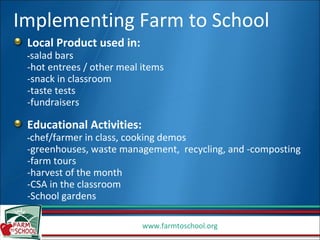
Local Product used in: - salad bars  -hot entrees / other meal items -snack in classroom -taste tests -fundraisers Educational Activities:  - chef/farmer in class, cooking demos -greenhouses, waste management,  recycling, and -composting -farm tours -harvest of the month -CSA in the classroom -School gardens Implementing Farm to School
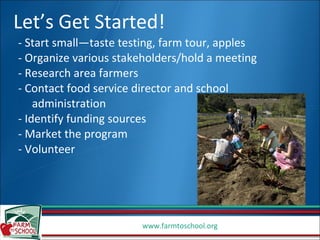
Let’s Get Started! - Start small—taste testing, farm tour, apples - Organize various stakeholders/hold a meeting - Research area farmers - Contact food service director and school  administration - Identify funding sources - Market the program - Volunteer
 
www.farmtoschool.org Debra Eschmeyer [email_address] 419-753-3412
 

Cuyahoga Farm to School Presentation

  • 1.
    National Farm toSchool Network Debra Eschmeyer Cuyahoga County School Built Environment Conference November 13, 2009 Transform the Tray
  • 2.
  • 3.
    Session Take-Aways Componentsof a Farm to School program Resources to engage communities
  • 4.
    8 Regional LeadAgencies Training & Technical Assistance Policy Networking Media & Marketing Information Services 2000+ programs in 42 states
  • 5.
  • 6.
    Health: Kids WinThe choice of healthier options in the cafeteria through farm to school meals results in consumption of more fruits and vegetables with an average increase of one serving per day, including at home.
  • 7.
    Agriculture: Farmers WinFarm to School programs can open up the expansive school food market, estimated at more than $12 billion a year, to socially disadvantaged farmers.
  • 8.
    Economy: Communities WinFor every dollar spent on local foods in schools, one to three dollars circulate in the local economy.
  • 9.
    Student: Whydon’t we get fresh lettuce and local watermelon at school lunch ? Parent Food Service Director Principal National Food Distributor School Board Food Processor Teacher Nutritionist Contracted Food Service Provider
  • 10.
    Inputs Food ConsumptionFood Distribution Food Processing Ingredient Production Natural Resources Waste and Recycling Food Transformation Schools Contracts with food manufacturers commissary kitchens prepared foods Contracts with national distributors and fast food chains Minimal preparation mostly heated and served surplus commodities from USDA constant and consistent supply
  • 11.
    Food Consumption FoodDistribution Food Processing Local / Regional Farmers / Ranchers Natural Resources Waste and Recycling Food Transformation School Local slaughterhouses Local food preservation Local commissary kitchen Regional aggregation sites and direct sales Seasonally-based cooking with all local menus direct partnerships with farmers for purchasing onsite growing contracted growing and farm visits by teachrs, students, and school food service staff school gardens classroom cooking , nutrition education, taste tetsts farm-based field studies Local foods in cafeterias Lesser food waste, reusables, compostable food trays, increased awareness Less pesticide / chemical use on land, water, air, less energy used Care for natural resources Healthier, local , less processed foods, Consumer knows where food is coming from
  • 12.
    “ Farm toSchool programs connect school food with local agriculture to create a strategy that increases the profitability of farming, improves the quality of school meals, and re- create relationships in the community among consumers and the people who grow their food. ”
  • 13.
    Fresh, local foodsserved in cafeterias
  • 14.
  • 15.
  • 16.
  • 17.
  • 18.
    Family Meals Food – Culture Connections
  • 19.
  • 20.
    Farm to School:VERMONT Vermont FEED (Food Education Every Day) A community-based approach to school food systems change through 3 C’s: Classroom, Cafeteria, and Community 10 years and over 150 Vermont schools Farm to school movement in Vermont is building on food system partnerships and relationships: – farmers and food service - distributors and farmers – schools and communities - government and non-profit
  • 21.
    Farm to School:PENNSYLVANIA The Kindergarten Initiative www.thefoodtrust.org Healthy Snacks made with locally sourced fruit, vegetable, grain and dairy products Integration of Nutrition and Agriculture Education Parent outreach and involvement activities Educational Farm Trips 2004 , 4 schools, 1 district 2009- 67 schools, 10 districts, 3 states
  • 22.
    Farm to School:FLORIDA New North Florida Cooperative Farmer-led: 60-100 farmers 72 School Districts 1,000,000 students Leafy greens, sweet potato sticks, green beans, watermelon, okra, strawberries, muscadine
  • 23.
    Farm to School:WASHINGTON 2002 one school, Olympia District, organic salad bar, local purchasing Fruit and Vegetable consumption increased 30%, participation 16% Washington State Department of Agriculture, Office of State Procurement, Environmental Council To protect farmland, improve kid’s health, and reduce energy and waste, all by promoting local foods March of 2008 – Local Farms-Healthy Kids HB 2798 / SB 6483 passes
  • 24.
    Local Farms-Healthy KidsAct Policy alliance was spearheaded by environmental group with farm preservation, public health, anti-poverty advocates Comprehensive legislation: 2 Full Time positions to coordinate local food procurement inside of Departments of Ag and Education Requires all state food contracts to include a plan to maximize the availability of Washington grown food purchased through the contract. Expands and increases funding for the Farmers Market Nutrition Program- WIC and low-income seniors Washington Fresh Fruit and Vegetable Program to low-income schools Farmers Market Technology Program- for wireless EBT cards Food Bank Pilot for fresh, locally grown product
  • 25.
    Local Product usedin: - salad bars -hot entrees / other meal items -snack in classroom -taste tests -fundraisers Educational Activities: - chef/farmer in class, cooking demos -greenhouses, waste management, recycling, and -composting -farm tours -harvest of the month -CSA in the classroom -School gardens Implementing Farm to School
  • 26.
    Let’s Get Started!- Start small—taste testing, farm tour, apples - Organize various stakeholders/hold a meeting - Research area farmers - Contact food service director and school administration - Identify funding sources - Market the program - Volunteer
  • 27.
  • 28.
    www.farmtoschool.org Debra Eschmeyer[email_address] 419-753-3412
  • 29.

Editor's Notes

  • #2 10/28/09 19:23 © 2007 Microsoft Corporation. All rights reserved. Microsoft, Windows, Windows Vista and other product names are or may be registered trademarks and/or trademarks in the U.S. and/or other countries. The information herein is for informational purposes only and represents the current view of Microsoft Corporation as of the date of this presentation. Because Microsoft must respond to changing market conditions, it should not be interpreted to be a commitment on the part of Microsoft, and Microsoft cannot guarantee the accuracy of any information provided after the date of this presentation. MICROSOFT MAKES NO WARRANTIES, EXPRESS, IMPLIED OR STATUTORY, AS TO THE INFORMATION IN THIS PRESENTATION.
  • #5 We hope that you leave with an understanding of how farm to school programs work and that the national farm to school network, contribute to food security inside of a community and that you are comfortable reaching out to community members to initiate a farm to school program in your home state.
  • #6 Even though this was initiated under a farm to school guise- the policy was far reaching and applied to many of washingtons public food services and state contracts- an example of an initiative – by using farm to school- worked on increasing access to local foods for low income participants $600,000 for Fresh Fruit and Vegetable Program all together
  • #7 Even though this was initiated under a farm to school guise- the policy was far reaching and applied to many of washingtons public food services and state contracts- an example of an initiative – by using farm to school- worked on increasing access to local foods for low income participants $600,000 for Fresh Fruit and Vegetable Program all together
  • #8 Even though this was initiated under a farm to school guise- the policy was far reaching and applied to many of washingtons public food services and state contracts- an example of an initiative – by using farm to school- worked on increasing access to local foods for low income participants $600,000 for Fresh Fruit and Vegetable Program all together
  • #9 Even though this was initiated under a farm to school guise- the policy was far reaching and applied to many of washingtons public food services and state contracts- an example of an initiative – by using farm to school- worked on increasing access to local foods for low income participants $600,000 for Fresh Fruit and Vegetable Program all together
  • #12 What can farm to school do in our vision of the Food System Important to keep in mind that we are working under the current food system – tweaking it. Inputs and Natural Resources (less pesticides, fertilizers, oil to produce food) – Processing (opportunities for local processing , direct relationships ) – Distribution (local and regional systems, shorter distances, less oil use – Locavore movement ) – Transformation (need kitchen staff training, equipment, systems in place) – Consumption (healthier, better for the food system) SCHOOLS CAN PLAY A ROLE IN TRANSFORMING THE FOOD SYSTEM
  • #13 And all these contribute to and add to food security – micro-cosim of local food systems Current Food System- Complex and Centralized We have lost nearly 67% of our farms since 1920. There are now more prisoners in the US than full-time farmers. Family farmers in 2002 earned their lowest real net cash income since 1940. Buying locally helps preserve local food sources, increasing food security
  • #19 Activities to involve parents and community members – parents invited to a meal cooked by students
  • #21 Started in 2000, one school- brought together three non-profits that work with different populations
  • #22 Washington Environmental Coalition – environmental lobby- broading of coalitions across nutrition and ag folks –farm to school
  • #23 In Philadelphia currently, the KI runs in 27 schools – 3,510 dollars a week going back to independent locally owned businesses – Lancaster Farm Fresh Cooperative is a cooperative of organic fruit and vegetable farmers- started with 5 farmers and sold only to high end restaurants, they needed to find a market for farmers that had a couple of items that weren’t so high end- and in quantity- they now are our sole source of produce they have 47 farmers- and are part of a pilot in 5 high schools the first time ever Philadelphia school district has written a contract for fresh fruits and vegetables Joe was a independent coffee bar in a city full of star bucks – sourced sustainable beans and was struggling to make ends meet- he worked with us to develop healthy baked products- such as butternut squash muffins and fruit leathers- out of local product- he loved developing the recipes and started sourcing local product for his store as well developing soups etc. but developed the baked goods into a product he now sells across the city at farmers markets and directly to schools and aftercare programs- schools now hire him for recipe development and directly purchase his product Pequea Valley Yogurt is an grass based Amish dairy that was selling their yogurt in specialty shops, we contacted them and tried their yogurt- we loved it but they only had a high fat version and were using a higher sugar fruit base- for the KI they developed a low fat yogurt in a smaller container- 20,000 yogurts were sold last year and many schools are interested if they can increase capacity Iovine brothers had a large produce stand- they process all of our fruits and vegetables and provide us with tropical produce in the winter- we also serve pineapple, mangoes, and citrus fruits to demonstrate what does not grow local - they have started sourcing locally for their stand and purchased a truck for distribution- with the new fresh fruit and vegetable dollars schools are now contracting with Bovines- an independent and locally owned family business for the FFV program- and Bovines knows exactly how to source locally when possible
  • #24 Seattle was next district- advocates started to ask state departments for help- in 2004 Dept of Ag put out a guide supporting schools to purchase local- and set recommenations around state procurement - now a state wide program
  • #25 Even though this was initiated under a farm to school guise- the policy was far reaching and applied to many of washingtons public food services and state contracts- an example of an initiative – by using farm to school- worked on increasing access to local foods for low income participants $600,000 for Fresh Fruit and Vegetable Program all together