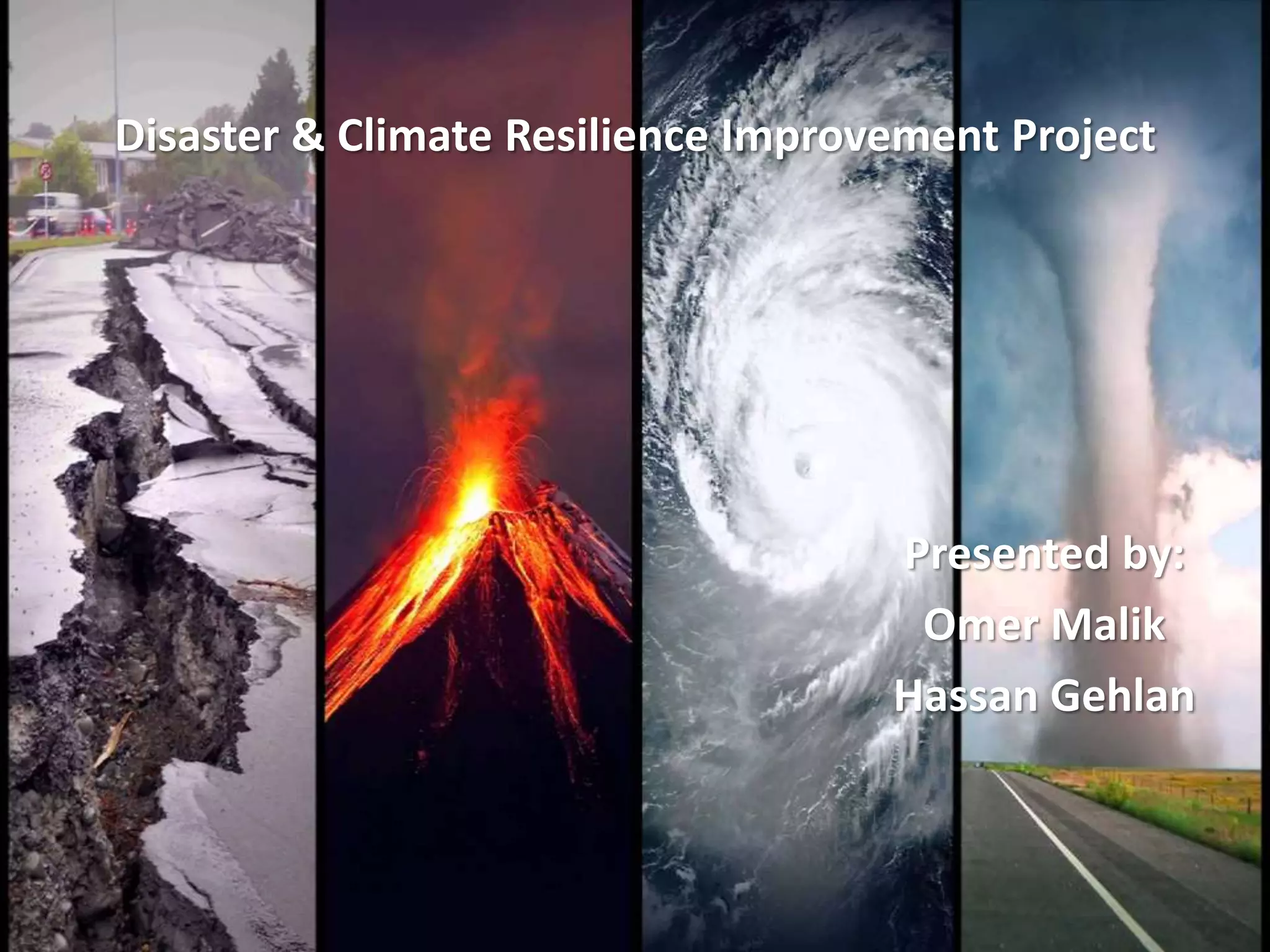
Disaster & Climate Resilience Improvement Project
Presented by:
Omer Malik
Hassan Gehlan
Disaster & Climate Resilience Improvement Project
Learning Objectives
 Overview
 Project Partners & Donors
 M&E Process
 Research Date & Types
 Stakeholder Analysis
 Results Framework
 Log Framework
 Impact Evaluation
 Project Costing
 Conclusion
 Q & A Session
Overview
3
Disaster & Climate Resilience Improvement Project
 Total Project Cost: USD 125 Million
 Funded by World Bank
 Scope and focus of project
Overview
4
Disaster & Climate Resilience Improvement Project
Mission
To cope complete range of disasters by reducing disaster hazards
by planning and development at all levels and through
enhancing institutional capabilities for disaster alertness,
response and recovery.
Vision
To attain viable community, economic and environmental
improvement in Pakistan by reducing vulnerabilities and hazards
specifically of the deprived and marginalized groups by
effectually responding and recovering from all kinds of disasters.
5
Disaster & Climate Resilience Improvement Project
 Expanding, upgrading, & improving earthquake research capacity
 Upgrading floods early warning systems
 Institutional arrangements of early warnings including (Fire
services, rescue, police, health, irrigation departments etc.)
 International consultancy taken by UNDP
 Curriculum development for National Disaster Management
Authority (NDMA), Provincial Disaster Management Authority
(PDMA), District Disaster Management Authority (DDMA)
 Awareness for policy makers
 Promote disaster risk management planning
 Developing multi-hazards early warning systems
Description of Services
6
Disaster & Climate Resilience Improvement Project
 Project Duration: The priorities set for this project shall be
accomplished in five-(5) years of duration.
 Phases: Five-(5)
 Project Location: Punjab, KPK, Baluchistan, FATA, Sindh etc.
Pakistan (South Asia)
7
Project Partners & Donors
8
Disaster & Climate Resilience Improvement Project
 World Bank
 Government of Pakistan
 Community based organizations
 NGO’s
9
Monitoring & Evaluation Process
10
Disaster & Climate Resilience Improvement Project
 Regular monthly meetings for progress and updates.
 Developing institutional arrangements and technical capacities of
stakeholders to undertake risk assessments in multiple
development sectors
 Integrate and implement disaster risk reduction strategies
 Synchronizing disaster risk management plans
 Making risk sensitive development polices, planning and
implementation at every level
 Designing a framework for disaster risk management
 Pre disaster
 During disaster
 Post disaster
Monitoring & Evaluation Process
11
Disaster & Climate Resilience Improvement Project
 Reviewing monthly and periodic budgetary and financial reports
 Development and strengthening institutions that can systematically
contribute to building resilience to hazards
 Designing the emergency preparedness, response and recovery
programs
 Monitoring the development and regular testing of warning
systems
 Conducting disaster risk management trainings
12
Disaster & Climate Resilience Improvement Project
 Disaster and climate resilience improvement project began on June
2nd, 2015 with the approval as of board presentation.
Secondary Data:
 Annual reports by Natural Disaster Management Authority of
Pakistan
 Statistics of national briefing of number of people affected by
natural disasters in Pakistan by Lead.
 Figures from Pakistan disaster and risk profile
http://www.preventionweb.net/countries/pak/data/
Research Date & Types
13
Stakeholder Analysis
14
Disaster & Climate Resilience Improvement Project
 Donor Agencies (United nations,
World bank)
 National Disaster Management
Authority of Pakistan (NDMA)
 WASA (Water and Sanitation
Agency)
 Banks
 Insurance Sector
 Rescue-(1122)
 World Health Organization (WHO)
 Government of Pakistan
 Earthquake Reconstruction and
Rehabilitation Authority (ERRA)
 International Strategy for Disaster
Reduction (ISDR)
 Pakistan Armed Forces
 Police Service of Pakistan
 NGO’s
 Media
Identified Stakeholders
15
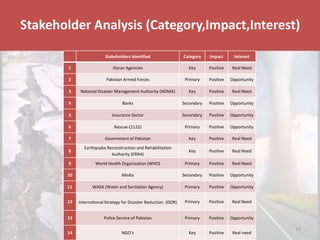
Disaster & Climate Resilience Improvement ProjectStakeholder Analysis (Category,Impact,Interest)
Stakeholders Identified Category Impact Interest
1 Donor Agencies Key Positive Real Need
2 Pakistan Armed Forces Primary Positive Opportunity
3 National Disaster Management Authority (NDMA) Key Positive Real Need
4 Banks Secondary Positive Opportunity
5 Insurance Sector Secondary Positive Opportunity
6 Rescue-(1122) Primary Positive Opportunity
7 Government of Pakistan Key Positive Real Need
8
Earthquake Reconstruction and Rehabilitation
Authority (ERRA)
Key Positive Real Need
9 World Health Organization (WHO) Primary Positive Real Need
10 Media Secondary Positive Opportunity
11 WASA (Water and Sanitation Agency) Primary Positive Opportunity
12 International Strategy for Disaster Reduction (ISDR) Primary Positive Real Need
13 Police Service of Pakistan Primary Positive Opportunity
14 NGO’s Key Positive Real need
16
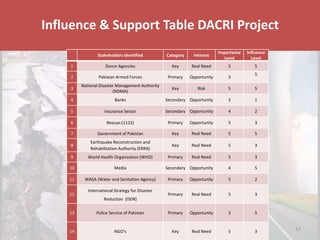
Disaster & Climate Resilience Improvement ProjectInfluence & Support Table DACRI Project
Stakeholders Identified Category Interest
Importance
Level
Influence
Level
1 Donor Agencies Key Real Need 5 5
2 Pakistan Armed Forces Primary Opportunity 3
5
3
National Disaster Management Authority
(NDMA)
Key Risk 5 5
4 Banks Secondary Opportunity 3 1
5 Insurance Sector Secondary Opportunity 4 2
6 Rescue-(1122) Primary Opportunity 5 3
7 Government of Pakistan Key Real Need 5 5
8
Earthquake Reconstruction and
Rehabilitation Authority (ERRA)
Key Real Need 5 3
9 World Health Organization (WHO) Primary Real Need 5 3
10 Media Secondary Opportunity 4 5
11 WASA (Water and Sanitation Agency) Primary Opportunity 5 2
12
International Strategy for Disaster
Reduction (ISDR)
Primary Real Need 5 3
13 Police Service of Pakistan Primary Opportunity 3 5
14 NGO’s Key Real Need 5 3 17
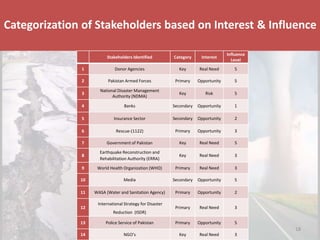
Disaster & Climate Resilience Improvement ProjectCategorization of Stakeholders based on Interest & Influence
Stakeholders Identified Category Interest
Influence
Level
1 Donor Agencies Key Real Need 5
2 Pakistan Armed Forces Primary Opportunity 5
3
National Disaster Management
Authority (NDMA)
Key Risk 5
4 Banks Secondary Opportunity 1
5 Insurance Sector Secondary Opportunity 2
6 Rescue-(1122) Primary Opportunity 3
7 Government of Pakistan Key Real Need 5
8
Earthquake Reconstruction and
Rehabilitation Authority (ERRA)
Key Real Need 3
9 World Health Organization (WHO) Primary Real Need 3
10 Media Secondary Opportunity 5
11 WASA (Water and Sanitation Agency) Primary Opportunity 2
12
International Strategy for Disaster
Reduction (ISDR)
Primary Real Need 3
13 Police Service of Pakistan Primary Opportunity 5
14 NGO’s Key Real Need 3
18
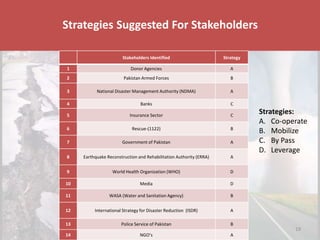
Disaster & Climate Resilience Improvement ProjectStrategies Suggested For Stakeholders
19
Stakeholders Identified Strategy
1 Donor Agencies A
2 Pakistan Armed Forces B
3 National Disaster Management Authority (NDMA) A
4 Banks C
5 Insurance Sector C
6 Rescue-(1122) B
7 Government of Pakistan A
8 Earthquake Reconstruction and Rehabilitation Authority (ERRA) A
9 World Health Organization (WHO) D
10 Media D
11 WASA (Water and Sanitation Agency) B
12 International Strategy for Disaster Reduction (ISDR) A
13 Police Service of Pakistan B
14 NGO’s A
Strategies:
A. Co-operate
B. Mobilize
C. By Pass
D. Leverage
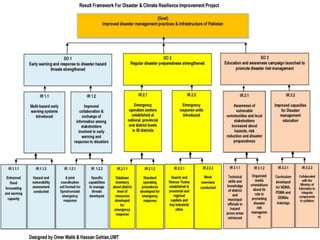
Results Framework
20
21
Disaster & Climate Resilience Improvement Project
Critical Assumptions:
 All the stakeholders and related government departments remain
committed
 Reduction in adversity and disaster risk
 Improvement in rehabilitation activities for natural disasters
 New technological changes take place
 Emergency communications are challenging
 Lessening the disruption in emergency transportation
22
Log Framework
23
Impact Evaluation
24
Disaster & Climate
Resilience
Improvement
Project
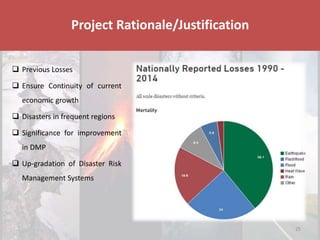
 Previous Losses
 Ensure Continuity of current
economic growth
 Disasters in frequent regions
 Significance for improvement
in DMP
 Up-gradation of Disaster Risk
Management Systems
25
Project Rationale/Justification
Indicators
26
27
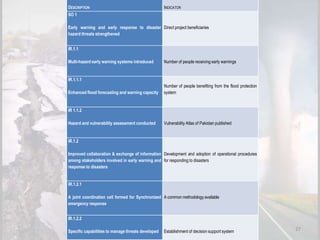
DESCRIPTION INDICATOR
SO 1
Early warning and early response to disaster
hazard threats strengthened
Direct project beneficiaries
IR.1.1
Multi-hazard early warning systems introduced Number of people receiving early warnings
IR.1.1.1
Enhanced flood forecasting and warning capacity
Number of people benefiting from the flood protection
system
IR 1.1.2
Hazard and vulnerability assessment conducted Vulnerability Atlas of Pakistan published
IR.1.2
Improved collaboration & exchange of information
among stakeholders involved in early warning and
response to disasters
Development and adoption of operational procedures
for responding to disasters
IR.1.2.1
A joint coordination cell formed for Synchronized
emergency response
A common methodologyavailable
IR.1.2.2
Specific capabilities to manage threats developed Establishment of decision support system
28
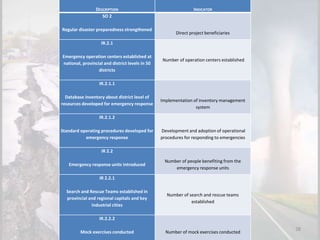
DESCRIPTION INDICATOR
SO 2
Regular disaster preparedness strengthened
Direct project beneficiaries
IR.2.1
Emergency operation centers established at
national, provincial and district levels in 50
districts
Number of operation centers established
IR.2.1.1
Database inventory about district level of
resources developed for emergency response
Implementation of inventory management
system
IR.2.1.2
Standard operating procedures developed for
emergency response
Development and adoption of operational
procedures for responding to emergencies
IR 2.2
Emergency response units introduced
Number of people benefiting from the
emergency response units
IR 2.2.1
Search and Rescue Teams established in
provincial and regional capitals and key
industrial cities
Number of search and rescue teams
established
IR.2.2.2
Mock exercises conducted Number of mock exercises conducted
29
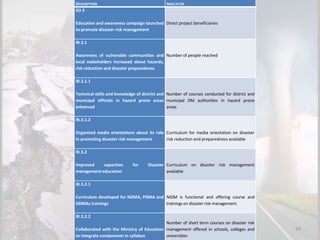
DESCRIPTION INDICATOR
SO 3
Education and awareness campaign launched
to promote disaster risk management
Direct project beneficiaries
IR.3.1
Awareness of vulnerable communities and
local stakeholders increased about hazards,
risk reduction and disaster preparedness
Number of people reached
IR.3.1.1
Technical skills and knowledge of district and
municipal officials in hazard prone areas
enhanced
Number of courses conducted for district and
municipal DM authorities in hazard prone
areas
IR.3.1.2
Organized media orientations about its role
in promoting disaster risk management
Curriculum for media orientation on disaster
risk reduction and preparedness available
IR.3.2
Improved capacities for Disaster
management education
Curriculum on disaster risk management
available
IR.3.2.1
Curriculum developed for NDMA, PDMA and
DDMAs trainings
NIDM is functional and offering course and
trainings on disaster risk management.
IR.3.2.2
Collaborated with the Ministry of Education
to integrate components in syllabus
Number of short term courses on disaster risk
management offered in schools, colleges and
universities
Project Costing
30
31
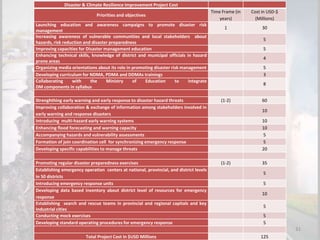
Disaster & Climate Resilience Improvement Project Cost
Priorities and objectives
Time Frame (in
years)
Cost in USD-$
(Millions)
Launching education and awareness campaigns to promote disaster risk
management
1 30
Increasing awareness of vulnerable communities and local stakeholders about
hazards, risk reduction and disaster preparedness
5
Improving capacities for Disaster management education 5
Enhancing technical skills, knowledge of district and municipal officials in hazard
prone areas
4
Organizing media orientations about its role in promoting disaster risk management 5
Developing curriculum for NDMA, PDMA and DDMAs trainings 3
Collaborating with the Ministry of Education to integrate
DM components in syllabus
8
Strenghthing early warning and early response to disaster hazard threats (1-2) 60
Improving collaboration & exchange of information among stakeholders involved in
early warning and response disasters
10
Introducing multi-hazard early warning systems 10
Enhancing flood forecasting and warning capacity 10
Accompanying hazards and vulnerability assessments 5
Formation of join coordination cell for synchronizing emergency response 5
Developing specific capabilities to manage threats 20
Promoting regular disaster preparedness exercises (1-2) 35
Establishing emergency operation centers at national, provincial, and district levels
in 50 districts
5
Introducing emergency response units 5
Developing data based inventory about district level of resources for emergency
response
10
Establishing search and rescue teams in provincial and regional capitals and key
industrial cities
5
Conducting mock exercises 5
Developing standard operating procedures for emergency response 5
Total Project Cost in $USD Millions 125
Conclusion
32
Disaster & Climate Resilience Improvement Project
33
 The journey towards a safer Pakistan
 Lessons from the past
 Need for resilient institutional and policy arrangements
 Collaboration between all key stakeholders
 Improvement in DMP (Disaster Management Practices)
 Achieve sustainable social and environmental development
Thank you
34

Disaster & Climate Resilience Improvement Project

  • 1.
    Disaster & ClimateResilience Improvement Project Presented by: Omer Malik Hassan Gehlan
  • 2.
    Disaster & ClimateResilience Improvement Project Learning Objectives  Overview  Project Partners & Donors  M&E Process  Research Date & Types  Stakeholder Analysis  Results Framework  Log Framework  Impact Evaluation  Project Costing  Conclusion  Q & A Session
  • 3.
  • 4.
    Disaster & ClimateResilience Improvement Project  Total Project Cost: USD 125 Million  Funded by World Bank  Scope and focus of project Overview 4
  • 5.
    Disaster & ClimateResilience Improvement Project Mission To cope complete range of disasters by reducing disaster hazards by planning and development at all levels and through enhancing institutional capabilities for disaster alertness, response and recovery. Vision To attain viable community, economic and environmental improvement in Pakistan by reducing vulnerabilities and hazards specifically of the deprived and marginalized groups by effectually responding and recovering from all kinds of disasters. 5
  • 6.
    Disaster & ClimateResilience Improvement Project  Expanding, upgrading, & improving earthquake research capacity  Upgrading floods early warning systems  Institutional arrangements of early warnings including (Fire services, rescue, police, health, irrigation departments etc.)  International consultancy taken by UNDP  Curriculum development for National Disaster Management Authority (NDMA), Provincial Disaster Management Authority (PDMA), District Disaster Management Authority (DDMA)  Awareness for policy makers  Promote disaster risk management planning  Developing multi-hazards early warning systems Description of Services 6
  • 7.
    Disaster & ClimateResilience Improvement Project  Project Duration: The priorities set for this project shall be accomplished in five-(5) years of duration.  Phases: Five-(5)  Project Location: Punjab, KPK, Baluchistan, FATA, Sindh etc. Pakistan (South Asia) 7
  • 8.
  • 9.
    Disaster & ClimateResilience Improvement Project  World Bank  Government of Pakistan  Community based organizations  NGO’s 9
  • 10.
  • 11.
    Disaster & ClimateResilience Improvement Project  Regular monthly meetings for progress and updates.  Developing institutional arrangements and technical capacities of stakeholders to undertake risk assessments in multiple development sectors  Integrate and implement disaster risk reduction strategies  Synchronizing disaster risk management plans  Making risk sensitive development polices, planning and implementation at every level  Designing a framework for disaster risk management  Pre disaster  During disaster  Post disaster Monitoring & Evaluation Process 11
  • 12.
    Disaster & ClimateResilience Improvement Project  Reviewing monthly and periodic budgetary and financial reports  Development and strengthening institutions that can systematically contribute to building resilience to hazards  Designing the emergency preparedness, response and recovery programs  Monitoring the development and regular testing of warning systems  Conducting disaster risk management trainings 12
  • 13.
    Disaster & ClimateResilience Improvement Project  Disaster and climate resilience improvement project began on June 2nd, 2015 with the approval as of board presentation. Secondary Data:  Annual reports by Natural Disaster Management Authority of Pakistan  Statistics of national briefing of number of people affected by natural disasters in Pakistan by Lead.  Figures from Pakistan disaster and risk profile http://www.preventionweb.net/countries/pak/data/ Research Date & Types 13
  • 14.
  • 15.
    Disaster & ClimateResilience Improvement Project  Donor Agencies (United nations, World bank)  National Disaster Management Authority of Pakistan (NDMA)  WASA (Water and Sanitation Agency)  Banks  Insurance Sector  Rescue-(1122)  World Health Organization (WHO)  Government of Pakistan  Earthquake Reconstruction and Rehabilitation Authority (ERRA)  International Strategy for Disaster Reduction (ISDR)  Pakistan Armed Forces  Police Service of Pakistan  NGO’s  Media Identified Stakeholders 15
  • 16.
    Disaster & ClimateResilience Improvement ProjectStakeholder Analysis (Category,Impact,Interest) Stakeholders Identified Category Impact Interest 1 Donor Agencies Key Positive Real Need 2 Pakistan Armed Forces Primary Positive Opportunity 3 National Disaster Management Authority (NDMA) Key Positive Real Need 4 Banks Secondary Positive Opportunity 5 Insurance Sector Secondary Positive Opportunity 6 Rescue-(1122) Primary Positive Opportunity 7 Government of Pakistan Key Positive Real Need 8 Earthquake Reconstruction and Rehabilitation Authority (ERRA) Key Positive Real Need 9 World Health Organization (WHO) Primary Positive Real Need 10 Media Secondary Positive Opportunity 11 WASA (Water and Sanitation Agency) Primary Positive Opportunity 12 International Strategy for Disaster Reduction (ISDR) Primary Positive Real Need 13 Police Service of Pakistan Primary Positive Opportunity 14 NGO’s Key Positive Real need 16
  • 17.
    Disaster & ClimateResilience Improvement ProjectInfluence & Support Table DACRI Project Stakeholders Identified Category Interest Importance Level Influence Level 1 Donor Agencies Key Real Need 5 5 2 Pakistan Armed Forces Primary Opportunity 3 5 3 National Disaster Management Authority (NDMA) Key Risk 5 5 4 Banks Secondary Opportunity 3 1 5 Insurance Sector Secondary Opportunity 4 2 6 Rescue-(1122) Primary Opportunity 5 3 7 Government of Pakistan Key Real Need 5 5 8 Earthquake Reconstruction and Rehabilitation Authority (ERRA) Key Real Need 5 3 9 World Health Organization (WHO) Primary Real Need 5 3 10 Media Secondary Opportunity 4 5 11 WASA (Water and Sanitation Agency) Primary Opportunity 5 2 12 International Strategy for Disaster Reduction (ISDR) Primary Real Need 5 3 13 Police Service of Pakistan Primary Opportunity 3 5 14 NGO’s Key Real Need 5 3 17
  • 18.
    Disaster & ClimateResilience Improvement ProjectCategorization of Stakeholders based on Interest & Influence Stakeholders Identified Category Interest Influence Level 1 Donor Agencies Key Real Need 5 2 Pakistan Armed Forces Primary Opportunity 5 3 National Disaster Management Authority (NDMA) Key Risk 5 4 Banks Secondary Opportunity 1 5 Insurance Sector Secondary Opportunity 2 6 Rescue-(1122) Primary Opportunity 3 7 Government of Pakistan Key Real Need 5 8 Earthquake Reconstruction and Rehabilitation Authority (ERRA) Key Real Need 3 9 World Health Organization (WHO) Primary Real Need 3 10 Media Secondary Opportunity 5 11 WASA (Water and Sanitation Agency) Primary Opportunity 2 12 International Strategy for Disaster Reduction (ISDR) Primary Real Need 3 13 Police Service of Pakistan Primary Opportunity 5 14 NGO’s Key Real Need 3 18
  • 19.
    Disaster & ClimateResilience Improvement ProjectStrategies Suggested For Stakeholders 19 Stakeholders Identified Strategy 1 Donor Agencies A 2 Pakistan Armed Forces B 3 National Disaster Management Authority (NDMA) A 4 Banks C 5 Insurance Sector C 6 Rescue-(1122) B 7 Government of Pakistan A 8 Earthquake Reconstruction and Rehabilitation Authority (ERRA) A 9 World Health Organization (WHO) D 10 Media D 11 WASA (Water and Sanitation Agency) B 12 International Strategy for Disaster Reduction (ISDR) A 13 Police Service of Pakistan B 14 NGO’s A Strategies: A. Co-operate B. Mobilize C. By Pass D. Leverage
  • 20.
  • 21.
  • 22.
    Disaster & ClimateResilience Improvement Project Critical Assumptions:  All the stakeholders and related government departments remain committed  Reduction in adversity and disaster risk  Improvement in rehabilitation activities for natural disasters  New technological changes take place  Emergency communications are challenging  Lessening the disruption in emergency transportation 22
  • 23.
  • 24.
  • 25.
    Disaster & Climate Resilience Improvement Project Previous Losses  Ensure Continuity of current economic growth  Disasters in frequent regions  Significance for improvement in DMP  Up-gradation of Disaster Risk Management Systems 25 Project Rationale/Justification
  • 26.
  • 27.
    27 DESCRIPTION INDICATOR SO 1 Earlywarning and early response to disaster hazard threats strengthened Direct project beneficiaries IR.1.1 Multi-hazard early warning systems introduced Number of people receiving early warnings IR.1.1.1 Enhanced flood forecasting and warning capacity Number of people benefiting from the flood protection system IR 1.1.2 Hazard and vulnerability assessment conducted Vulnerability Atlas of Pakistan published IR.1.2 Improved collaboration & exchange of information among stakeholders involved in early warning and response to disasters Development and adoption of operational procedures for responding to disasters IR.1.2.1 A joint coordination cell formed for Synchronized emergency response A common methodologyavailable IR.1.2.2 Specific capabilities to manage threats developed Establishment of decision support system
  • 28.
    28 DESCRIPTION INDICATOR SO 2 Regulardisaster preparedness strengthened Direct project beneficiaries IR.2.1 Emergency operation centers established at national, provincial and district levels in 50 districts Number of operation centers established IR.2.1.1 Database inventory about district level of resources developed for emergency response Implementation of inventory management system IR.2.1.2 Standard operating procedures developed for emergency response Development and adoption of operational procedures for responding to emergencies IR 2.2 Emergency response units introduced Number of people benefiting from the emergency response units IR 2.2.1 Search and Rescue Teams established in provincial and regional capitals and key industrial cities Number of search and rescue teams established IR.2.2.2 Mock exercises conducted Number of mock exercises conducted
  • 29.
    29 DESCRIPTION INDICATOR SO 3 Educationand awareness campaign launched to promote disaster risk management Direct project beneficiaries IR.3.1 Awareness of vulnerable communities and local stakeholders increased about hazards, risk reduction and disaster preparedness Number of people reached IR.3.1.1 Technical skills and knowledge of district and municipal officials in hazard prone areas enhanced Number of courses conducted for district and municipal DM authorities in hazard prone areas IR.3.1.2 Organized media orientations about its role in promoting disaster risk management Curriculum for media orientation on disaster risk reduction and preparedness available IR.3.2 Improved capacities for Disaster management education Curriculum on disaster risk management available IR.3.2.1 Curriculum developed for NDMA, PDMA and DDMAs trainings NIDM is functional and offering course and trainings on disaster risk management. IR.3.2.2 Collaborated with the Ministry of Education to integrate components in syllabus Number of short term courses on disaster risk management offered in schools, colleges and universities
  • 30.
  • 31.
    31 Disaster & ClimateResilience Improvement Project Cost Priorities and objectives Time Frame (in years) Cost in USD-$ (Millions) Launching education and awareness campaigns to promote disaster risk management 1 30 Increasing awareness of vulnerable communities and local stakeholders about hazards, risk reduction and disaster preparedness 5 Improving capacities for Disaster management education 5 Enhancing technical skills, knowledge of district and municipal officials in hazard prone areas 4 Organizing media orientations about its role in promoting disaster risk management 5 Developing curriculum for NDMA, PDMA and DDMAs trainings 3 Collaborating with the Ministry of Education to integrate DM components in syllabus 8 Strenghthing early warning and early response to disaster hazard threats (1-2) 60 Improving collaboration & exchange of information among stakeholders involved in early warning and response disasters 10 Introducing multi-hazard early warning systems 10 Enhancing flood forecasting and warning capacity 10 Accompanying hazards and vulnerability assessments 5 Formation of join coordination cell for synchronizing emergency response 5 Developing specific capabilities to manage threats 20 Promoting regular disaster preparedness exercises (1-2) 35 Establishing emergency operation centers at national, provincial, and district levels in 50 districts 5 Introducing emergency response units 5 Developing data based inventory about district level of resources for emergency response 10 Establishing search and rescue teams in provincial and regional capitals and key industrial cities 5 Conducting mock exercises 5 Developing standard operating procedures for emergency response 5 Total Project Cost in $USD Millions 125
  • 32.
  • 33.
    Disaster & ClimateResilience Improvement Project 33  The journey towards a safer Pakistan  Lessons from the past  Need for resilient institutional and policy arrangements  Collaboration between all key stakeholders  Improvement in DMP (Disaster Management Practices)  Achieve sustainable social and environmental development
  • 34.