Department of EnvironmentalScience
State University of Bangladesh
Certificate Course on
“Understanding Disaster Risk and Resilience”
Lecture on:
Disaster Recovery Framework
Dr. M.M. Majedul Islam
18th
January, 2019
2.
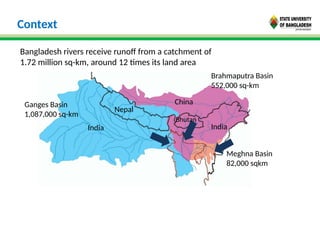
Bangladesh rivers receiverunoff from a catchment of
1.72 million sq-km, around 12 times its land area
Ganges Basin
1,087,000 sq-km
Brahmaputra Basin
552,000 sq-km
Meghna Basin
82,000 sqkm
India India
Nepal
Bhutan
China
Context
3.
Context
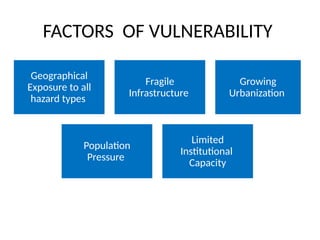
Bangladesh ranksglobally among the most climate vulnerable
Fifth rank in the world risk index 2016
Bangladesh suffers from increasingly
frequent and devastating natural
calamities due to its –
Geographical location
Environmental situation
Climate change
Population density and
Development stage.
About 68% of the
country is vulnerable
to flood
25 to 30% of the area
is inundated during
normal flood
4.
DRR Why Importantin Bangladesh?
• Bangladesh is one of the worst disaster prone country of the
world.
• Catastrophic Hazards ---Floods (1988,1998 and 2004),
Cyclones and Storm Surges (1970,1991,2007 SIDR and
2009 AILA), Tornado (1974, 1977, 2005 etc), River Bank
Erosion, Earthquake, Drought, Arsenic Contamination,
Salinity Intrusion, Fire, Infrastructure Collapse (RANA
Plaza), Tsunami and Landslide.
5.
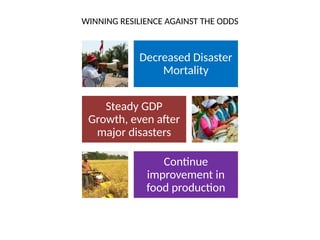
WINNING RESILIENCE AGAINSTTHE ODDS
Decreased Disaster
Mortality
Steady GDP
Growth, even after
major disasters
Continue
improvement in
food production
6.
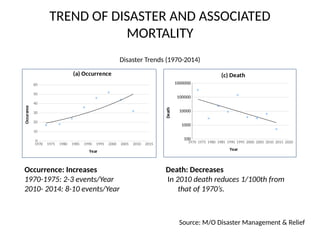
TREND OF DISASTERAND ASSOCIATED
MORTALITY
1970 1975 1980 1985 1990 1995 2000 2005 2010 2015
0
10
20
30
40
50
60
(a) Occurrence
Year
Occurance
1970 1975 1980 1985 1990 1995 2000 2005 2010 2015 2020
100
1000
10000
100000
1000000
(c) Death
Year
Death
Occurrence: Increases
1970-1975: 2-3 events/Year
2010- 2014: 8-10 events/Year
Death: Decreases
In 2010 death reduces 1/100th from
that of 1970’s.
Disaster Trends (1970-2014)
Source: M/O Disaster Management & Relief
7.
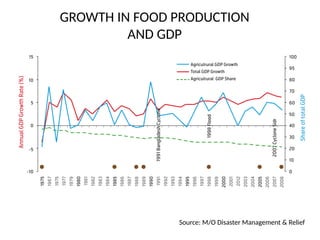
GROWTH IN FOODPRODUCTION
AND GDP
Source: M/O Disaster Management & Relief
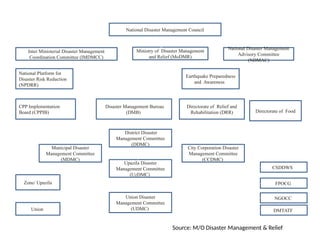
Disaster Management Institutionsin Bangladesh
National Disaster Management Council
Inter Ministerial Disaster Management
Coordination Committee (IMDMCC)
Ministry of Disaster Management
and Relief (MoDMR)
National Disaster Management
Advisory Committee
(NDMAC)
National Platform for
Disaster Risk Reduction
(NPDRR)
Earthquake Preparedness
and Awareness
CPP Implementation
Board (CPPIB)
Directorate of Relief and
Rehabilitation (DRR)
Disaster Management Bureau
(DMB)
District Disaster
Management Committee
(DDMC)
Municipal Disaster
Management Committee
(MDMC)
Union Disaster
Management Committee
(UDMC)
City Corporation Disaster
Management Committee
(CCDMC)
Upazila Disaster
Management Committee
(UzDMC)
Zone/ Upazila
Union
CSDDWS
FPOCG
NGOCC
DMTATF
Source: M/O Disaster Management & Relief
Directorate of Food
11.
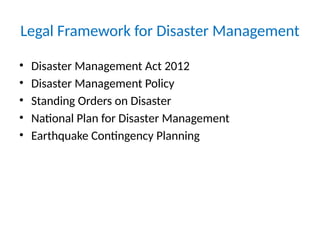
Legal Framework forDisaster Management
• Disaster Management Act 2012
• Disaster Management Policy
• Standing Orders on Disaster
• National Plan for Disaster Management
• Earthquake Contingency Planning
12.
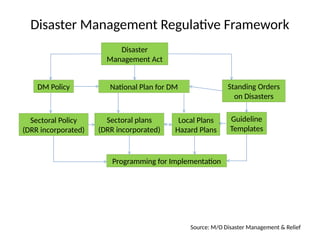
Disaster Management RegulativeFramework
Disaster
Management Act
National Plan for DM
DM Policy Standing Orders
on Disasters
Guideline
Templates
Local Plans
Hazard Plans
Sectoral plans
(DRR incorporated)
Sectoral Policy
(DRR incorporated)
Programming for Implementation
Source: M/O Disaster Management & Relief
13.
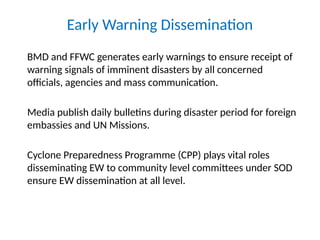
Early Warning Dissemination
BMDand FFWC generates early warnings to ensure receipt of
warning signals of imminent disasters by all concerned
officials, agencies and mass communication.
Media publish daily bulletins during disaster period for foreign
embassies and UN Missions.
Cyclone Preparedness Programme (CPP) plays vital roles
disseminating EW to community level committees under SOD
ensure EW dissemination at all level.
14.
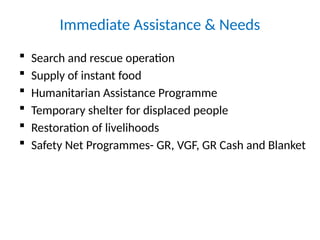
Immediate Assistance &Needs
Search and rescue operation
Supply of instant food
Humanitarian Assistance Programme
Temporary shelter for displaced people
Restoration of livelihoods
Safety Net Programmes- GR, VGF, GR Cash and Blanket
15.
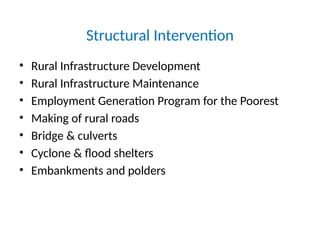
Structural Intervention
• RuralInfrastructure Development
• Rural Infrastructure Maintenance
• Employment Generation Program for the Poorest
• Making of rural roads
• Bridge & culverts
• Cyclone & flood shelters
• Embankments and polders
16.
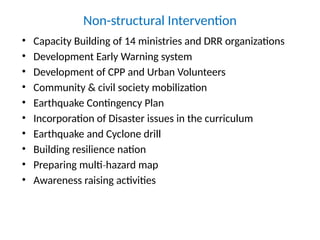
Non-structural Intervention
• CapacityBuilding of 14 ministries and DRR organizations
• Development Early Warning system
• Development of CPP and Urban Volunteers
• Community & civil society mobilization
• Earthquake Contingency Plan
• Incorporation of Disaster issues in the curriculum
• Earthquake and Cyclone drill
• Building resilience nation
• Preparing multi hazard map
‐
• Awareness raising activities
17.
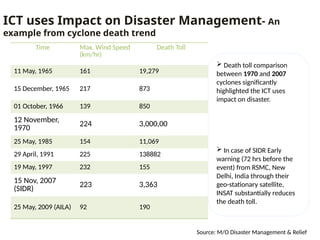
Time Max. WindSpeed
(km/hr)
Death Toll
11 May, 1965 161 19,279
15 December, 1965 217 873
01 October, 1966 139 850
12 November,
1970
224 3,000,00
25 May, 1985 154 11,069
29 April, 1991 225 138882
19 May, 1997 232 155
15 Nov, 2007
(SIDR)
223 3,363
25 May, 2009 (AILA) 92 190
ICT uses Impact on Disaster Management- An
example from cyclone death trend
Death toll comparison
between 1970 and 2007
cyclones significantly
highlighted the ICT uses
impact on disaster.
In case of SIDR Early
warning (72 hrs before the
event) from RSMC, New
Delhi, India through their
geo-stationary satellite,
INSAT substantially reduces
the death toll.
Source: M/O Disaster Management & Relief
18.
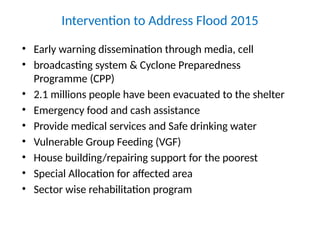
Intervention to AddressFlood 2015
• Early warning dissemination through media, cell
• broadcasting system & Cyclone Preparedness
Programme (CPP)
• 2.1 millions people have been evacuated to the shelter
• Emergency food and cash assistance
• Provide medical services and Safe drinking water
• Vulnerable Group Feeding (VGF)
• House building/repairing support for the poorest
• Special Allocation for affected area
• Sector wise rehabilitation program
19.
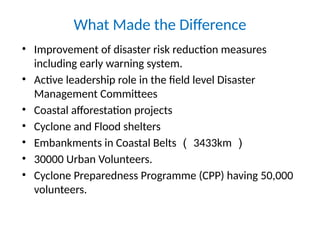
What Made theDifference
• Improvement of disaster risk reduction measures
including early warning system.
• Active leadership role in the field level Disaster
Management Committees
• Coastal afforestation projects
• Cyclone and Flood shelters
• Embankments in Coastal Belts ( 3433km )
• 30000 Urban Volunteers.
• Cyclone Preparedness Programme (CPP) having 50,000
volunteers.
20.
Bangladesh: The BestPractices
• Established the DM Regulatory Framework – identified the
actors and their roles related to DRR and Emergency Response
• Professionalizing the DM system – inclusion of disaster and
climate risks in education curricula at primary, secondary and
tertiary levels
• Introduction of a bottom up approach in development
planning
• Seismic vulnerability mapping and contingency planning
• Information sharing through DMIC network from central to
community level
• Promoted volunteerism both in urban and rural
21.
National Priorities for2011 2020
‐
• Implementation of the National Plan for Disaster
Management (2015 2020)
‐
• Strengthen institutional capacity of all actors as per the
revised SOD
• Coordinated social safety net to reduce vulnerable
population
• Strengthen mechanisms for sectoral and local level
implementation of DRR measures
22.
What are CommonIssues Need to Addressed in
Long-term Recovery?
Housing
Transportation
Schools
Employment
Health and social services
Disability services and supports
Community resources
Development and capacity-building
Cultural and recreational programs
Emergency preparedness
Alerts and warnings
Hazard mitigation
23.
Bangladesh havesigned United Nations Sustainable
Development Goal (SDG) 2030.
Signatory of DRR Sendai framework, 2015-2030
UN-ESCAP is working for promoting use of ICT as a key tool
for mainstreaming DRR into development planning.
SDG and DRR framework
24.
Department ofDisaster Management Program namely
“Comprehensive Disaster Management Program (CDMP)”
took an initiative for earthquake hazard and risk assessment of
three major cities (Dhaka, Chittagong and Sylhet) in
Bangladesh.
Early Landslide warning saves life due to earlier evacuation
in Chittagong.
CDMP makes available cyclone shelter database information
online
Achievements
25.
Disaster ManagementInformation Centre (DMIC) introduce
Early warning through Cell Broadcast in two districts- Sirajgonj
for flood and Cox’s Bazaar for cyclones
Interactive Voice Response – 10941dial updated message is
available for weather, disaster info and early warning. >1 lakh
responses were made in 2013 through IVR (Interactive Voice
Response)
SMS- Mobile no. database is formed for the key actors at the
root level. They are instructed through SMS
Achievements
26.
Bangladesh issigned a contract with SAARC Disaster
Management Centre (SDMC) to develop “Bangladesh Disaster
Knowledge Network” under “South Asian Disaster Knowledge
Network” project.
National Disaster Management Council amended Standing
order on Disaster through including orders on Earthquake,
Tsunami and fire hazards in SOD in 2010.
Government initiative in DRR decrease casualties in the
Business sector.
Climate Change Trust Fund and Climate Change Resilient
Fund is key to infrastructure development in DRR
Policy Achievements
27.
Disaster ReductionChapter include in Class III to Class X
curriculum. Disaster Management and Climate Change
Related Subject is included in Class XI and XII
Disaster Management is sensitize through UDC (Union
Digital Center). 10000 booklets are distributed in 4500 UDC.
Solution Exchange a email based communication system was
formed for the actors of Disaster Management and Climate
Change Adaptation.
Sensitization/ Educative Program
28.
Almost 98%of Bangladesh is under the coverage of Mobile
network.
DoICT along with Bangladesh Meteorological Department
can establish huge weather information repository.
Real time data on weather parameters like Rainfall,
Humidity, Air Pressure, Wind Velocity, Temperature etc. can
be stored for information generation.
Data Collection can be done through mobile network.
Way Forward
29.
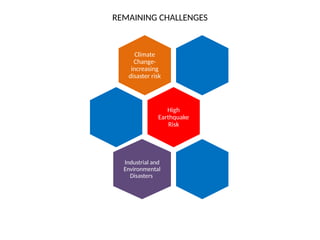
• Earthquake forecastingsystem is not well developed.
• Due to rapid urbanization/ huge unsafe buildings, buildings developed
mostly violating Bangladesh national building codes subject to make
Bangladesh an earthquake vulnerable.
• To develop good governance in this sector through e-governance is a
key challenging area for us.
Challenges
30.
Challenges
• Early warningwith adequate lead time in community language.
• The capacity of coordination and making relationship between
emergency responders.
• The capacity to produce the appropriate information timely.
• Integrated framework for incident management and communication.
• Resilient embankment, green belt along the coast.
• Expansion of regional and global networks for real time data/
information sharing.
• Mainstreaming disaster risk reduction and climate change adaptation
in development process.
• Strengthening linkage with regional and international organizations
involved in DRR in line with SDG.
#5 In the last few decades country has invested heavily on disaster risk reduction and public investment. As a result,
disaster mortality has reduced significantly.
Despite, frequent disasters the country was able to maintain at least 6% GDP growth.
Improvement in food security.
We have achieved almost all the MDGs despite xx million people were affected since the MDG was adopted in 2005.
#7 The major cropping seasons overlap with the drought, cyclone and flooding seasons in the coast of Bay of Bengal.
During 1970-2004, Bangladesh lost an estimated amount of over half a million hectares of crop land. The cyclone Sidr of 2007 hit the coast of Bangladesh and part of West Bengal, India causing an estimated damage to crop livestock and fisheries worth US Dollar half a billion (GoB, 2008). Again, cyclone Aila hit the same coast in May 2009 causing destruction of 350,000 acres of cropland and death of 100,000 livestock (GoB, 2010).
#8
On climate change:
With climate change, frequency of cyclones during November and May over the North Indian Ocean has increased twofold in the past 122 years. Using the Bay of Bengal in a hydrodynamic model, the World Bank estimates that cyclone exposed areas in Bangladesh will increase by 26% and the affected population will grow as high as 122% by 2050.
#10 CSDDWS: Committee for Speedy Dissemination of Disaster Related Warning/ Signals
Focal Point Operation Coordination Group of Disaster Management (FPOCG)
NGO Coordination Committee on Disaster Management (NGOCC)
Disaster Management Training and Public Awareness Building Task Force (DMTATF)
#12 The Bangladesh Standing Orders were prepared with the objective of making the concerned persons understand their duties and responsibilities regarding disaster management at all levels, and accomplishing them.
All Bangladesh Ministries, Divisions/Departments and Agencies shall prepare their own Action Plans in respect of their responsibilities under the Standing Orders for efficient implementation.