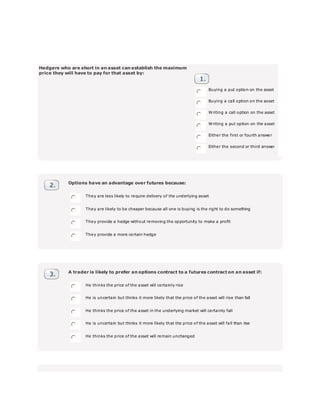
Hedgers who are short in an asset can establish the maximum
price they will have to pay for that asset by:
Buying a put option on the asset
Buying a call option on the asset
Writing a call option on the asset
Writing a put option on the asset
Either the first or fourth answer
Either the second or third answer
Options have an advantage over futures because:
They are less likely to require delivery of the underlying asset
They are likely to be cheaper because all one is buying is the right to do something
They provide a hedge without removing the opportunity to make a profit
They provide a more certain hedge
A trader is likely to prefer an options contract to a futures contract on an asset if:
He thinks the price of the asset will certainly rise
He is uncertain but thinks it more likely that the price of the asset will rise than fall
He thinks the price of the asset in the underlying market will certainly fall
He is uncertain but thinks it more likely that the price of the asset will fall than rise
He thinks the price of the asset will remain unchanged
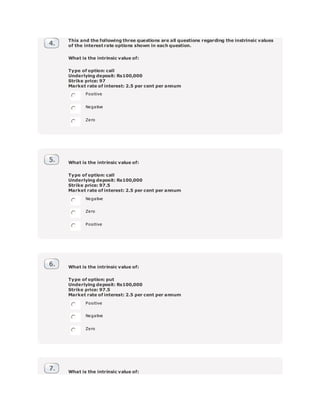
This and the following three questions are all questions regarding the instrinsic values
of the interest rate options shown in each question.
What is the intrinsic value of:
Type of option: call
Underlying deposit: Rs100,000
Strike price: 97
Market rate of interest: 2.5 per cent per annum
Positive
Negative
Zero
What is the intrinsic value of:
Type of option: call
Underlying deposit: Rs100,000
Strike price: 97.5
Market rate of interest: 2.5 per cent per annum
Negative
Zero
Positive
What is the intrinsic value of:
Type of option: put
Underlying deposit: Rs100,000
Strike price: 97.5
Market rate of interest: 2.5 per cent per annum
Positive
Negative
Zero
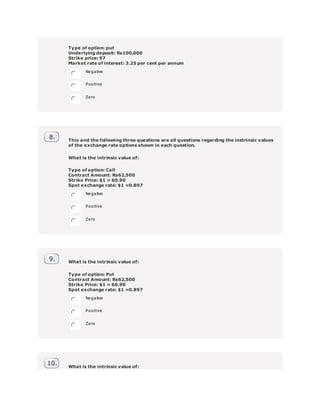
What is the intrinsic value of:
Type of option: put
Underlying deposit: Rs100,000
Strike price: 97
Market rate of interest: 3.25 per cent per annum
Negative
Positive
Zero
This and the following three questions are all questions regarding the instrinsic values
of the exchange rate options shown in each question.
What is the intrinsic value of:
Type of option: Call
Contract Amount: Rs62,500
Strike Price: $1 = 60.90
Spot exchange rate: $1 =0.897
Negative
Positive
Zero
What is the intrinsic value of:
Type of option: Put
Contract Amount: Rs62,500
Strike Price: $1 = 60.90
Spot exchange rate: $1 =0.897
Negative
Positive
Zero
What is the intrinsic value of:
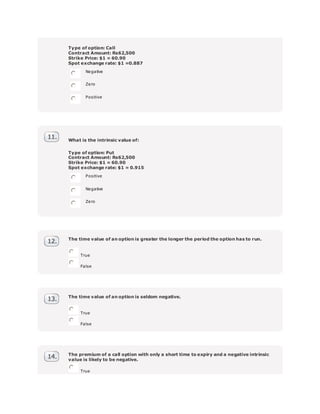
Type of option: Call
Contract Amount: Rs62,500
Strike Price: $1 = 60.90
Spot exchange rate: $1 =0.887
Negative
Zero
Positive
What is the intrinsic value of:
Type of option: Put
Contract Amount: Rs62,500
Strike Price: $1 = 60.90
Spot exchange rate: $1 = 0.915
Positive
Negative
Zero
The time value of an option is greater the longer the period the option has to run.
True
False
The time value of an option is seldom negative.
True
False
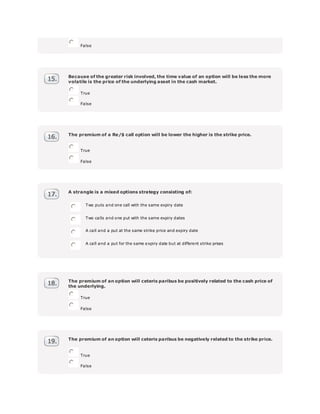
The premium of a call option with only a short time to expiry and a negative intrinsic
value is likely to be negative.
True
False
Because of the greater risk involved, the time value of an option will be less the more
volatile is the price of the underlying asset in the cash market.
True
False
The premium of a Re/$ call option will be lower the higher is the strike price.
True
False
A strangle is a mixed options strategy consisting of:
Two puts and one call with the same expiry date
Two calls and one put with the same expiry dates
A call and a put at the same strike price and expiry date
A call and a put for the same expiry date but at different strike prices
The premium of an option will ceteris paribus be positively related to the cash price of
the underlying.
True
False
The premium of an option will ceteris paribus be negatively related to the strike price.
True
False
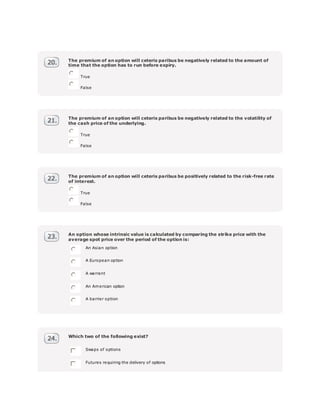
The premium of an option will ceteris paribus be negatively related to the amount of
time that the option has to run before expiry.
True
False
The premium of an option will ceteris paribus be negatively related to the volatility of
the cash price of the underlying.
True
False
The premium of an option will ceteris paribus be positively related to the risk-free rate
of interest.
True
False
An option whose intrinsic value is calculated by comparing the strike price with the
average spot price over the period of the option is:
An Asian option
A European option
A warrant
An American option
A barrier option
Which two of the following exist?
Swaps of options
Futures requiring the delivery of options
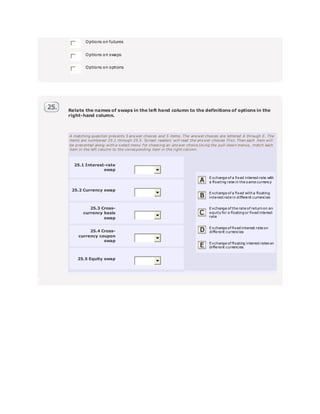
Options on futures
Options on swaps
Options on options
Relate the names of swaps in the left hand column to the definitions of options in the
right-hand column.
A matching question presents 5 answer choices and 5 items. The answer choices are lettered A through E. The
items are numbered 25.1 through 25.5. Screen readers will read the answer choices first. Then each item will
be presented along with a select menu for choosing an answer choice.Using the pull-down menus, match each
item in the left column to the corresponding item in the right column.
Exchange of a fixed interest rate with
a floating rate in the same currency
Exchange of a fixed witha floating
interest rate in different currencies
Exchange of the rate of returnon an
equity for a floating or fixed interest
rate
Exchange of fixed interest rate on
different currencies
Exchange of floating interest rateson
different currencies
25.1 Interest-rate
swap
25.2 Currency swap
25.3 Cross-
currency basis
swap
25.4 Cross-
currency coupon
swap
25.5 Equity swap

Mcq s in forex derivatives

  • 1.
    Hedgers who areshort in an asset can establish the maximum price they will have to pay for that asset by: Buying a put option on the asset Buying a call option on the asset Writing a call option on the asset Writing a put option on the asset Either the first or fourth answer Either the second or third answer Options have an advantage over futures because: They are less likely to require delivery of the underlying asset They are likely to be cheaper because all one is buying is the right to do something They provide a hedge without removing the opportunity to make a profit They provide a more certain hedge A trader is likely to prefer an options contract to a futures contract on an asset if: He thinks the price of the asset will certainly rise He is uncertain but thinks it more likely that the price of the asset will rise than fall He thinks the price of the asset in the underlying market will certainly fall He is uncertain but thinks it more likely that the price of the asset will fall than rise He thinks the price of the asset will remain unchanged
  • 2.
    This and thefollowing three questions are all questions regarding the instrinsic values of the interest rate options shown in each question. What is the intrinsic value of: Type of option: call Underlying deposit: Rs100,000 Strike price: 97 Market rate of interest: 2.5 per cent per annum Positive Negative Zero What is the intrinsic value of: Type of option: call Underlying deposit: Rs100,000 Strike price: 97.5 Market rate of interest: 2.5 per cent per annum Negative Zero Positive What is the intrinsic value of: Type of option: put Underlying deposit: Rs100,000 Strike price: 97.5 Market rate of interest: 2.5 per cent per annum Positive Negative Zero What is the intrinsic value of:
  • 3.
    Type of option:put Underlying deposit: Rs100,000 Strike price: 97 Market rate of interest: 3.25 per cent per annum Negative Positive Zero This and the following three questions are all questions regarding the instrinsic values of the exchange rate options shown in each question. What is the intrinsic value of: Type of option: Call Contract Amount: Rs62,500 Strike Price: $1 = 60.90 Spot exchange rate: $1 =0.897 Negative Positive Zero What is the intrinsic value of: Type of option: Put Contract Amount: Rs62,500 Strike Price: $1 = 60.90 Spot exchange rate: $1 =0.897 Negative Positive Zero What is the intrinsic value of:
  • 4.
    Type of option:Call Contract Amount: Rs62,500 Strike Price: $1 = 60.90 Spot exchange rate: $1 =0.887 Negative Zero Positive What is the intrinsic value of: Type of option: Put Contract Amount: Rs62,500 Strike Price: $1 = 60.90 Spot exchange rate: $1 = 0.915 Positive Negative Zero The time value of an option is greater the longer the period the option has to run. True False The time value of an option is seldom negative. True False The premium of a call option with only a short time to expiry and a negative intrinsic value is likely to be negative. True
  • 5.
    False Because of thegreater risk involved, the time value of an option will be less the more volatile is the price of the underlying asset in the cash market. True False The premium of a Re/$ call option will be lower the higher is the strike price. True False A strangle is a mixed options strategy consisting of: Two puts and one call with the same expiry date Two calls and one put with the same expiry dates A call and a put at the same strike price and expiry date A call and a put for the same expiry date but at different strike prices The premium of an option will ceteris paribus be positively related to the cash price of the underlying. True False The premium of an option will ceteris paribus be negatively related to the strike price. True False
  • 6.
    The premium ofan option will ceteris paribus be negatively related to the amount of time that the option has to run before expiry. True False The premium of an option will ceteris paribus be negatively related to the volatility of the cash price of the underlying. True False The premium of an option will ceteris paribus be positively related to the risk-free rate of interest. True False An option whose intrinsic value is calculated by comparing the strike price with the average spot price over the period of the option is: An Asian option A European option A warrant An American option A barrier option Which two of the following exist? Swaps of options Futures requiring the delivery of options
  • 7.
    Options on futures Optionson swaps Options on options Relate the names of swaps in the left hand column to the definitions of options in the right-hand column. A matching question presents 5 answer choices and 5 items. The answer choices are lettered A through E. The items are numbered 25.1 through 25.5. Screen readers will read the answer choices first. Then each item will be presented along with a select menu for choosing an answer choice.Using the pull-down menus, match each item in the left column to the corresponding item in the right column. Exchange of a fixed interest rate with a floating rate in the same currency Exchange of a fixed witha floating interest rate in different currencies Exchange of the rate of returnon an equity for a floating or fixed interest rate Exchange of fixed interest rate on different currencies Exchange of floating interest rateson different currencies 25.1 Interest-rate swap 25.2 Currency swap 25.3 Cross- currency basis swap 25.4 Cross- currency coupon swap 25.5 Equity swap