Mechanics of Options Markets Chapter 8
Review of Option Types A call is an option to buy A put is an option to sell A European option can be exercised only at the end of its life An American option can be exercised at any time
Option Positions Long call Long put Short call Short put
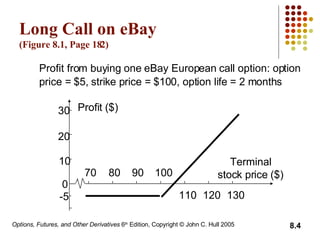
Long Call on eBay (Figure 8.1, Page 18 2 ) Profit from buying one eBay European call option: option price = $5, strike price = $100, option life = 2 months 30 20 10 0 -5 70 80 90 100 110 120 130 Profit ($) Terminal stock price ($)
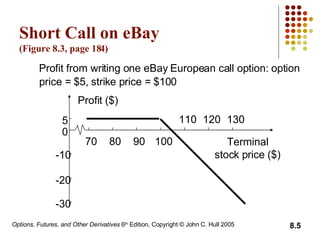
Short Call on eBay  (Figure 8.3, page 18 4 ) Profit from writing one eBay European call option: option price = $5, strike price = $100 -30 -20 -10 0 5 70 80 90 100 110 120 130 Profit ($) Terminal stock price ($)
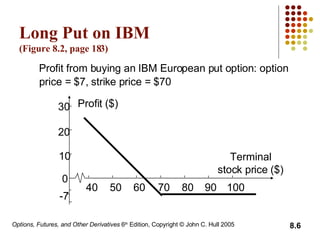
Long Put on IBM  (Figure 8.2, page 18 3 ) Profit from buying an IBM European put option: option price = $7, strike price = $70 30 20 10 0 -7 70 60 50 40 80 90 100 Profit ($) Terminal stock price ($)
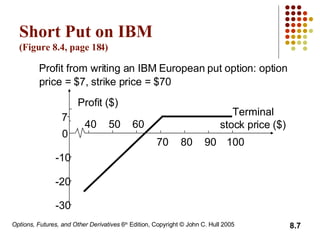
Short Put on IBM  (Figure 8.4, page 18 4 ) Profit from writing an IBM European put option: option price = $7, strike price = $70 -30 -20 -10 7 0 70 60 50 40 80 90 100 Profit ($) Terminal stock price ($)
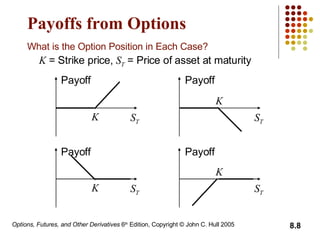
Payoffs from Options What is the Option Position in Each Case?   K  = Strike price,  S T   = Price of asset at maturity Payoff Payoff S T S T K K Payoff Payoff S T S T K K
Assets Underlying Exchange-Traded Options Page 18 5 -18 6 Stocks Foreign Currency Stock Indices Futures
Specification of Exchange-Traded Options Expiration date Strike price European or American Call or Put (option class)
Terminology Moneyness : At-the-money option In-the-money option Out-of-the-money option
Terminology (continued) Option class Option series Intrinsic value Time value
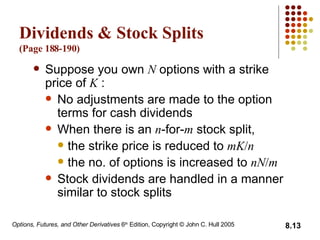
Dividends & Stock Splits  (Page 18 8 -1 90 ) Suppose you own  N  options with a strike price of  K  : No adjustments are made to the option terms for cash dividends When there is an  n -for- m  stock split, the strike price is reduced to  mK / n   the no. of options is increased to  nN / m Stock dividends are handled in a manner similar to stock splits
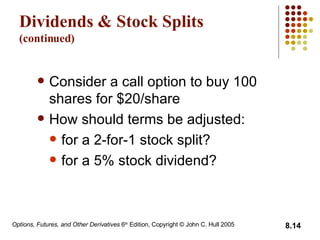
Dividends & Stock Splits (continued) Consider a call option to buy 100 shares for $20/share How should terms be adjusted: for a 2-for-1 stock split? for a 5% stock dividend?
Market Makers Most exchanges use market makers to facilitate options trading A market maker quotes both bid and ask prices when requested The market maker does not know whether the individual requesting the quotes wants to buy or sell
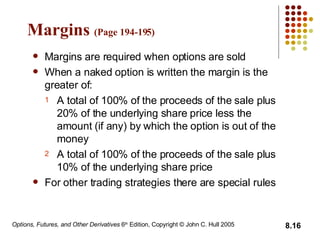
Margins  (Page 194-19 5 ) Margins are required when options are sold When a naked option is written the margin is the greater of: A total of 100% of the proceeds of the sale plus 20% of the underlying share price less the amount (if any) by which the option is out of the money A total of 100% of the proceeds of the sale plus 10% of the underlying share price For other trading strategies there are special rules
Warrants Warrants are options that are issued by a   corporation or a financial institution The number of warrants outstanding is determined by the size of the original issue  and  changes only when they are exercised or when they expire
Warrants (continued) The issuer settles up with the holder when a warrant is exercised When call warrants are issued by a corporation on its own stock, exercise will lead to new treasury stock being issued
Executive Stock Options Executive stock options are a form of remuneration  issued by a company to  its  executives They are usually at the money when issued When option s   are  exercised the company issues more stock  and sells it to the option holder for the strike price
Executive Stock Options  continued They become vested after a period of time (usually 1 to 4 years) They cannot be sold They often last for as long as 10 or 15 years Accounting standards  now  require the expensing of executive stock options
Convertible Bonds Convertible bonds are regular bonds that can be exchanged for equity at certain times in the future according to a predetermined exchange ratio Very often a convertible is callable The call provision is a way in which the issuer can force conversion at a time earlier than the holder might otherwise choose

Chap 8

  • 1.
    Mechanics of OptionsMarkets Chapter 8
  • 2.
    Review of OptionTypes A call is an option to buy A put is an option to sell A European option can be exercised only at the end of its life An American option can be exercised at any time
  • 3.
    Option Positions Longcall Long put Short call Short put
  • 4.
    Long Call oneBay (Figure 8.1, Page 18 2 ) Profit from buying one eBay European call option: option price = $5, strike price = $100, option life = 2 months 30 20 10 0 -5 70 80 90 100 110 120 130 Profit ($) Terminal stock price ($)
  • 5.
    Short Call oneBay (Figure 8.3, page 18 4 ) Profit from writing one eBay European call option: option price = $5, strike price = $100 -30 -20 -10 0 5 70 80 90 100 110 120 130 Profit ($) Terminal stock price ($)
  • 6.
    Long Put onIBM (Figure 8.2, page 18 3 ) Profit from buying an IBM European put option: option price = $7, strike price = $70 30 20 10 0 -7 70 60 50 40 80 90 100 Profit ($) Terminal stock price ($)
  • 7.
    Short Put onIBM (Figure 8.4, page 18 4 ) Profit from writing an IBM European put option: option price = $7, strike price = $70 -30 -20 -10 7 0 70 60 50 40 80 90 100 Profit ($) Terminal stock price ($)
  • 8.
    Payoffs from OptionsWhat is the Option Position in Each Case? K = Strike price, S T = Price of asset at maturity Payoff Payoff S T S T K K Payoff Payoff S T S T K K
  • 9.
    Assets Underlying Exchange-TradedOptions Page 18 5 -18 6 Stocks Foreign Currency Stock Indices Futures
  • 10.
    Specification of Exchange-TradedOptions Expiration date Strike price European or American Call or Put (option class)
  • 11.
    Terminology Moneyness :At-the-money option In-the-money option Out-of-the-money option
  • 12.
    Terminology (continued) Optionclass Option series Intrinsic value Time value
  • 13.
    Dividends & StockSplits (Page 18 8 -1 90 ) Suppose you own N options with a strike price of K : No adjustments are made to the option terms for cash dividends When there is an n -for- m stock split, the strike price is reduced to mK / n the no. of options is increased to nN / m Stock dividends are handled in a manner similar to stock splits
  • 14.
    Dividends & StockSplits (continued) Consider a call option to buy 100 shares for $20/share How should terms be adjusted: for a 2-for-1 stock split? for a 5% stock dividend?
  • 15.
    Market Makers Mostexchanges use market makers to facilitate options trading A market maker quotes both bid and ask prices when requested The market maker does not know whether the individual requesting the quotes wants to buy or sell
  • 16.
    Margins (Page194-19 5 ) Margins are required when options are sold When a naked option is written the margin is the greater of: A total of 100% of the proceeds of the sale plus 20% of the underlying share price less the amount (if any) by which the option is out of the money A total of 100% of the proceeds of the sale plus 10% of the underlying share price For other trading strategies there are special rules
  • 17.
    Warrants Warrants areoptions that are issued by a corporation or a financial institution The number of warrants outstanding is determined by the size of the original issue and changes only when they are exercised or when they expire
  • 18.
    Warrants (continued) Theissuer settles up with the holder when a warrant is exercised When call warrants are issued by a corporation on its own stock, exercise will lead to new treasury stock being issued
  • 19.
    Executive Stock OptionsExecutive stock options are a form of remuneration issued by a company to its executives They are usually at the money when issued When option s are exercised the company issues more stock and sells it to the option holder for the strike price
  • 20.
    Executive Stock Options continued They become vested after a period of time (usually 1 to 4 years) They cannot be sold They often last for as long as 10 or 15 years Accounting standards now require the expensing of executive stock options
  • 21.
    Convertible Bonds Convertiblebonds are regular bonds that can be exchanged for equity at certain times in the future according to a predetermined exchange ratio Very often a convertible is callable The call provision is a way in which the issuer can force conversion at a time earlier than the holder might otherwise choose