Communicate in Plain Language
Cheryl Stephens
Plain Language Solutions
Agenda:
Plain Language
Process
Writing Guidelines
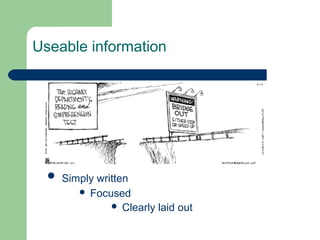
Useable information
 Simply written
 Focused
 Clearly laid out
Elements
Clear design
Simple, logical, or familiar
organization
Simple or familiar format
Plain language
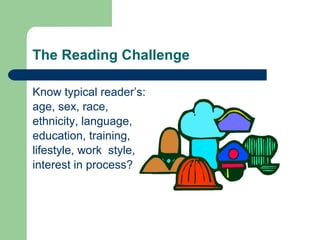
The Reading Challenge
Know typical reader’s:
age, sex, race,
ethnicity, language,
education, training,
lifestyle, work style,
interest in process?
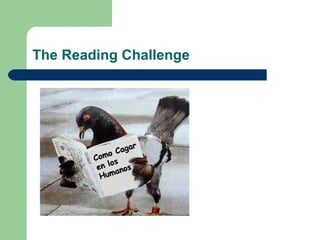
The Reading Challenge
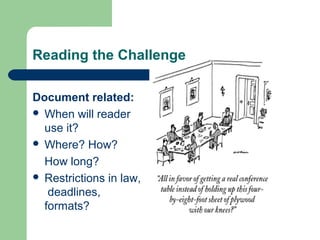
Reading the Challenge
Document related:
 When will reader
use it?
 Where? How?
How long?
 Restrictions in law,
deadlines,
formats?
Be Brief
Change
The number of applications to schools of
business is on the increase.
to
Business school applications are increasing.
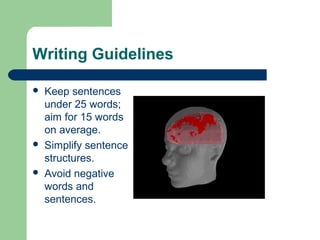
Writing Guidelines
 Keep sentences
under 25 words;
aim for 15 words
on average.
 Simplify sentence
structures.
 Avoid negative
words and
sentences.
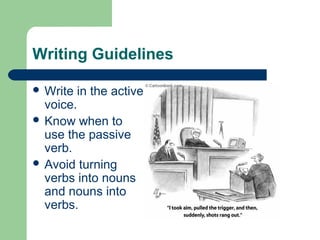
Writing Guidelines
 Write in the active
voice.
 Know when to
use the passive
verb.
 Avoid turning
verbs into nouns
and nouns into
verbs.
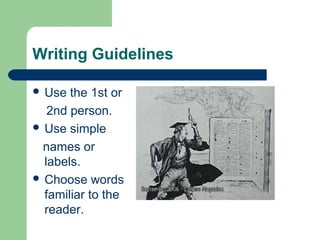
Writing Guidelines
 Use the 1st or
2nd person.
 Use simple
names or
labels.
 Choose words
familiar to the
reader.
Commandments
for Plain Language Drafting
Consider your reader;
write to reader's point of view.
Say what you have to say,
and no more.
The Canadian Bar Association
/Canadian Bankers' Association
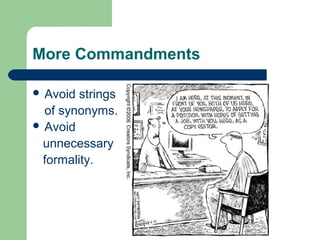
More Commandments
 Avoid strings
of synonyms.
 Avoid
unnecessary
formality.
Even More Commandments
Organize your text:
in a logical sequence,
with informative headings, and
with a table of contents for long documents.
Make the document attractive and
designed for easy reading.
The Canadian Bar Association/Canadian Bankers' Association
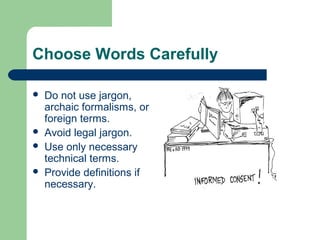
Choose Words Carefully
 Do not use jargon,
archaic formalisms, or
foreign terms.
 Avoid legal jargon.
 Use only necessary
technical terms.
 Provide definitions if
necessary.
A True Term of Art?
A genuine, technical,
term of art has an
uncontroversial core
meaning that cannot be
conveyed succinctly in
any other way.
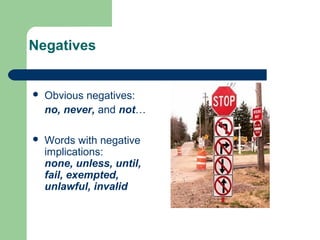
Negatives
 Obvious negatives:
no, never, and not…
 Words with negative
implications:
none, unless, until,
fail, exempted,
unlawful, invalid
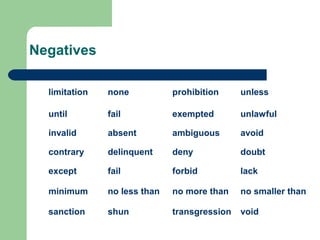
Negatives
limitation none prohibition unless
until fail exempted unlawful
invalid absent ambiguous avoid
contrary delinquent deny doubt
except fail forbid lack
minimum no less than no more than no smaller than
sanction shun transgression void
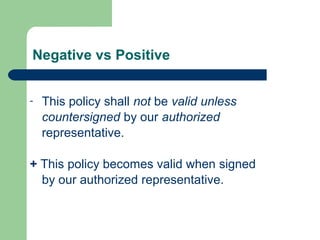
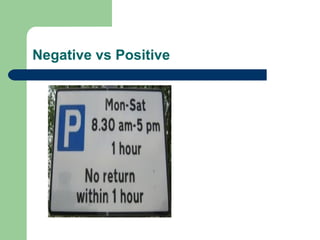
Negative vs Positive
- This policy shall not be valid unless
countersigned by our authorized
representative.
+ This policy becomes valid when signed
by our authorized representative.
Negative vs Positive
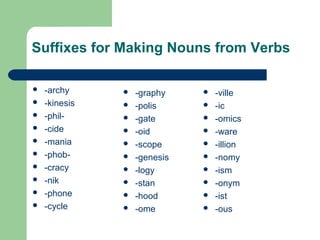
Suffixes for Making Nouns from Verbs
 -archy
 -kinesis
 -phil-
 -cide
 -mania
 -phob-
 -cracy
 -nik
 -phone
 -cycle
 -graphy
 -polis
 -gate
 -oid
 -scope
 -genesis
 -logy
 -stan
 -hood
 -ome
 -ville
 -ic
 -omics
 -ware
 -illion
 -nomy
 -ism
 -onym
 -ist
 -ous
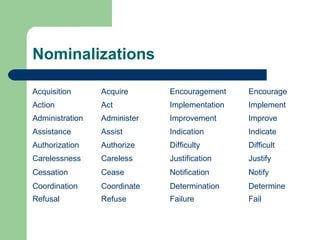
Nominalizations
Acquisition Acquire Encouragement Encourage
Action Act Implementation Implement
Administration Administer Improvement Improve
Assistance Assist Indication Indicate
Authorization Authorize Difficulty Difficult
Carelessness Careless Justification Justify
Cessation Cease Notification Notify
Coordination Coordinate Determination Determine
Refusal Refuse Failure Fail
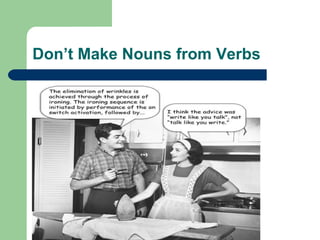
Don’t Make Nouns from Verbs
Convert Nominalizations
 When they made a decision...
When they decided...
 The Court, in its ruling, held that...
The Court ruled...
 Submit an application...
Apply...
 Take into consideration...
Consider...
Organization
 Organize the information, logic, and structure
 Put the topics in an order which suits your
audience and purpose.
 Use indents and lists to visually display
relationships.
 Use parallel forms of grammar for equivalent
ideas.
Effective paragraphs
 Paragraphs develop a single idea through
example, elaboration, and detail.
 Keep paragraphs short:
– no more than 5-6 lines of text.
 Start from old information, then introduce
new.
Effective lists
 Use lists with parallel grammar forms—when
possible.
 Use three items in lists if you want them
remembered. Rethink the categories to
create shorter lists.
 Number a list of items only if it shows steps,
priorities, or values. Use bullets.
Organization: Conceptual
Use signal words to link and show the logical
flow:
 Connections:
so, also, besides, and then, next, still
 Differences:
unless, but then, on the other hand
 Summary:
finally, in brief, in short, to put it differently,
in other words
Transitions…
Preserve coherence through
 use of transitions,
 repeating key words and phrases,
 using pronoun references, and
 using parallel form
Transitions… (cont’d)
Most people do not know that...
These are the facts: 1) 2) 3)
Given this situation...
But this problem also arose because....
These steps should have been taken to solve the
problem
Smith might have tried...
Sidhu could have...
Kahn Inc. must now consider...
Design
 Enhance the message with
– format
– layout
– design
 Use design to
– emphasize
– organize
– illustrate content
Language Can Be Confusing
Something Went Wrong in Jet Crash, Expert Says
Police Begin Campaign to Run Down Jaywalkers
Panda Mating Fails; Veterinarian Takes Over
Teacher Strikes Idle Kids
Miners Refuse to Work after Death
Juvenile Court to Try Shooting Defendant
War Dims Hope for Peace
Language Can Be Confusing (cont’d)
Red Tape Holds Up New Bridges
Man Struck By Lightning Faces Battery Charge
Kids Make Nutritious Snacks
Feed Needy Local High School
Dropouts Cut in Half
Hospitals are Sued by 7 Foot Doctors
Typhoon Rips Through Cemetery; Hundreds Dead
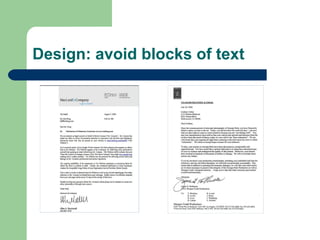
Design: avoid blocks of text
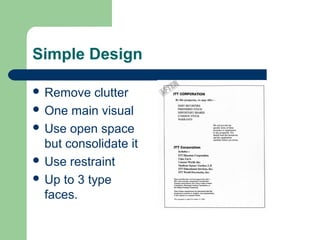
Simple Design
 Remove clutter
 One main visual
 Use open space
but consolidate it
 Use restraint
 Up to 3 type
faces.
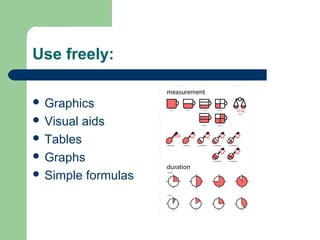
Use freely:
 Graphics
 Visual aids
 Tables
 Graphs
 Simple formulas
Readability Measures
Desirable ranges for writing to adults:
 Flesch Readability Scale 60 -75 points
 Gunning's Fog Index in Years of Education
Grade 6 to 8
 Flesch-Kincaid Reading Grade Level 4 to 6
 Average Sentence Length 15-20 words
 Passivity Index 0-35

Plain Language 2016

  • 1.
    Communicate in PlainLanguage Cheryl Stephens
  • 2.
    Plain Language Solutions Agenda: PlainLanguage Process Writing Guidelines
  • 3.
    Useable information  Simplywritten  Focused  Clearly laid out
  • 4.
    Elements Clear design Simple, logical,or familiar organization Simple or familiar format Plain language
  • 5.
    The Reading Challenge Knowtypical reader’s: age, sex, race, ethnicity, language, education, training, lifestyle, work style, interest in process?
  • 6.
  • 7.
    Reading the Challenge Documentrelated:  When will reader use it?  Where? How? How long?  Restrictions in law, deadlines, formats?
  • 8.
    Be Brief Change The numberof applications to schools of business is on the increase. to Business school applications are increasing.
  • 9.
    Writing Guidelines  Keepsentences under 25 words; aim for 15 words on average.  Simplify sentence structures.  Avoid negative words and sentences.
  • 10.
    Writing Guidelines  Writein the active voice.  Know when to use the passive verb.  Avoid turning verbs into nouns and nouns into verbs.
  • 11.
    Writing Guidelines  Usethe 1st or 2nd person.  Use simple names or labels.  Choose words familiar to the reader.
  • 12.
    Commandments for Plain LanguageDrafting Consider your reader; write to reader's point of view. Say what you have to say, and no more. The Canadian Bar Association /Canadian Bankers' Association
  • 13.
    More Commandments  Avoidstrings of synonyms.  Avoid unnecessary formality.
  • 14.
    Even More Commandments Organizeyour text: in a logical sequence, with informative headings, and with a table of contents for long documents. Make the document attractive and designed for easy reading. The Canadian Bar Association/Canadian Bankers' Association
  • 15.
    Choose Words Carefully Do not use jargon, archaic formalisms, or foreign terms.  Avoid legal jargon.  Use only necessary technical terms.  Provide definitions if necessary.
  • 16.
    A True Termof Art? A genuine, technical, term of art has an uncontroversial core meaning that cannot be conveyed succinctly in any other way.
  • 17.
    Negatives  Obvious negatives: no,never, and not…  Words with negative implications: none, unless, until, fail, exempted, unlawful, invalid
  • 18.
    Negatives limitation none prohibitionunless until fail exempted unlawful invalid absent ambiguous avoid contrary delinquent deny doubt except fail forbid lack minimum no less than no more than no smaller than sanction shun transgression void
  • 19.
    Negative vs Positive -This policy shall not be valid unless countersigned by our authorized representative. + This policy becomes valid when signed by our authorized representative.
  • 20.
  • 21.
    Suffixes for MakingNouns from Verbs  -archy  -kinesis  -phil-  -cide  -mania  -phob-  -cracy  -nik  -phone  -cycle  -graphy  -polis  -gate  -oid  -scope  -genesis  -logy  -stan  -hood  -ome  -ville  -ic  -omics  -ware  -illion  -nomy  -ism  -onym  -ist  -ous
  • 22.
    Nominalizations Acquisition Acquire EncouragementEncourage Action Act Implementation Implement Administration Administer Improvement Improve Assistance Assist Indication Indicate Authorization Authorize Difficulty Difficult Carelessness Careless Justification Justify Cessation Cease Notification Notify Coordination Coordinate Determination Determine Refusal Refuse Failure Fail
  • 23.
  • 24.
    Convert Nominalizations  Whenthey made a decision... When they decided...  The Court, in its ruling, held that... The Court ruled...  Submit an application... Apply...  Take into consideration... Consider...
  • 25.
    Organization  Organize theinformation, logic, and structure  Put the topics in an order which suits your audience and purpose.  Use indents and lists to visually display relationships.  Use parallel forms of grammar for equivalent ideas.
  • 26.
    Effective paragraphs  Paragraphsdevelop a single idea through example, elaboration, and detail.  Keep paragraphs short: – no more than 5-6 lines of text.  Start from old information, then introduce new.
  • 27.
    Effective lists  Uselists with parallel grammar forms—when possible.  Use three items in lists if you want them remembered. Rethink the categories to create shorter lists.  Number a list of items only if it shows steps, priorities, or values. Use bullets.
  • 28.
    Organization: Conceptual Use signalwords to link and show the logical flow:  Connections: so, also, besides, and then, next, still  Differences: unless, but then, on the other hand  Summary: finally, in brief, in short, to put it differently, in other words
  • 29.
    Transitions… Preserve coherence through use of transitions,  repeating key words and phrases,  using pronoun references, and  using parallel form
  • 30.
    Transitions… (cont’d) Most peopledo not know that... These are the facts: 1) 2) 3) Given this situation... But this problem also arose because.... These steps should have been taken to solve the problem Smith might have tried... Sidhu could have... Kahn Inc. must now consider...
  • 31.
    Design  Enhance themessage with – format – layout – design  Use design to – emphasize – organize – illustrate content
  • 32.
    Language Can BeConfusing Something Went Wrong in Jet Crash, Expert Says Police Begin Campaign to Run Down Jaywalkers Panda Mating Fails; Veterinarian Takes Over Teacher Strikes Idle Kids Miners Refuse to Work after Death Juvenile Court to Try Shooting Defendant War Dims Hope for Peace
  • 33.
    Language Can BeConfusing (cont’d) Red Tape Holds Up New Bridges Man Struck By Lightning Faces Battery Charge Kids Make Nutritious Snacks Feed Needy Local High School Dropouts Cut in Half Hospitals are Sued by 7 Foot Doctors Typhoon Rips Through Cemetery; Hundreds Dead
  • 34.
  • 35.
    Simple Design  Removeclutter  One main visual  Use open space but consolidate it  Use restraint  Up to 3 type faces.
  • 36.
    Use freely:  Graphics Visual aids  Tables  Graphs  Simple formulas
  • 37.
    Readability Measures Desirable rangesfor writing to adults:  Flesch Readability Scale 60 -75 points  Gunning's Fog Index in Years of Education Grade 6 to 8  Flesch-Kincaid Reading Grade Level 4 to 6  Average Sentence Length 15-20 words  Passivity Index 0-35