The Millon Clinical
Multiaxial Inventory-III


    王偉信
長庚醫院精神科臨床心理師
                           1
2
測驗解釋流程與原則
   Determine Profile Validity
   Interpret the Personality Disorder Scales
   Interpret Clinical Syndrome Scales
   Review Noteworthy Responses (Critical
    Items)
   Provide Diagnostic Impressions
   Elaborate on Treatment Implications and
    Recommendations
MODIFYING INDICES-1
   Validity index (Scale V)
   Disclosure Index (Scale X)
   Desirability Index (Scale Y)
   Debasement Index (Scale Z)
MODIFYING INDICES-2
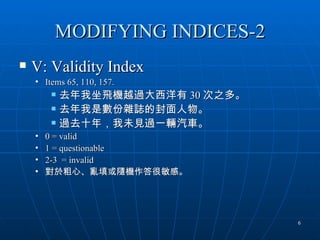
   V: Validity Index
    • Items 65, 110, 157.
           去年我坐飛機越過大西洋有 30 次之多。
           去年我是數份雜誌的封面人物。
           過去十年,我未見過一輛汽車。
    •   0 = valid
    •   1 = questionable
    •   2-3 = invalid
    •   對於粗心、亂填或隨機作答很敏感。


                                   6
MODIFYING INDICES-3
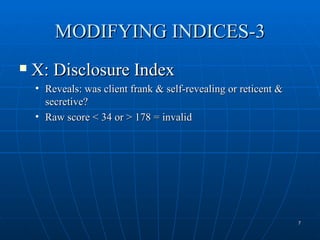
   X: Disclosure Index
    • Reveals: was client frank & self-revealing or reticent &
      secretive?
    • Raw score < 34 or > 178 = invalid


                                                                 7
MODIFYING INDICES-4
   Y: Desirability Index
    • To what degree are results influenced by Ss’ desire to look
      good.
    • BR scores > 75 = putting oneself in a favorable light.
    • Higher the score, more likely to be hiding something.


                                                                8
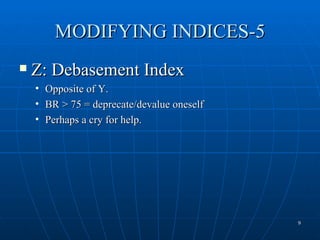
MODIFYING INDICES-5
   Z: Debasement Index
    •   Opposite of Y.
    •   BR > 75 = deprecate/devalue oneself
    •   Perhaps a cry for help.


                                              9
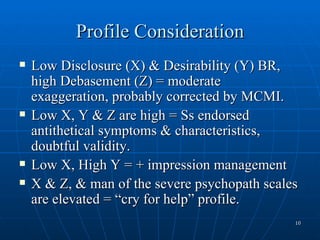
Profile Consideration
   Low Disclosure (X) & Desirability (Y) BR,
    high Debasement (Z) = moderate
    exaggeration, probably corrected by MCMI.
   Low X, Y & Z are high = Ss endorsed
    antithetical symptoms & characteristics,
    doubtful validity.
   Low X, High Y = + impression management
   X & Z, & man of the severe psychopath scales
    are elevated = “cry for help” profile.
                                               10
Test Invalidity Conditions
   No gender indicated
   Age <18, or unknown
   Missing items > 11
   Two or more Validity items = True
   Raw X (Disclosure) < 34 or > 178.
   No BR scores on Clinical Personality Patterns
    (1 – 8B) are above 59.
    • No clear personality pattern = no interpretation
                                                         11
12
CLINICAL PERSONALITY
            PATTERNS
   Principles of Interpretation
    • Individual Scales:
          BR points > 75 or 85.
          Severe Personality Pathology and Severe Syndromes
           scale.
    • Configurations:
          Interpret configurally only the two or three highest
           elevations among basic personality style scales.


                                                                  13
CLINICAL PERSONALITY
            PATTERNS
   Haddy et al. (2005)

    • 14 two-point code-types that occurred frequently
      in sample of clinical inpatients and outpatients.
    • Accounted for 72.2 % of these patients.


                                                          14
Picture 4


            15
Schizoid(1)-Avodiance(2A)
   Characterize people who keep a significant
    emotional distance from others.
    “Remote schizoids”


                                                 16
Schizoid
   嚴重關係缺損、情感表達的侷限的指標。
   易發展出 anxiety reaction 、 somatoform
    disorder 與 reactive psychosis 。
   若同時 Scale 8A ( passive-aggressive )提
    高:常出現於 alcoholic subtypes and PTSD


                                           17
Frequent Code Types
   Clinical scales: Anxiety 、 Thought Disorder
   Personality scales:Avoidant 、 Passive-
    Aggressive 、 Dependent 、 Compulsive
    • ( 例 )Schizoid+Avoidant: 對人際關係不感興趣與社交技
      巧拙劣外,在人群當中極為不安與害怕被拒絕。假若
      Schizoid 與 Avoidant 都高,進一步確認 Alcohol 、
      Drug Dependence 。
    • 若 Passive-Aggressive 同時亦高時,對於人際關係貧乏
      可能存有衝突,憤慨感受。若 Dependent 亦高時,憤慨
      可能起因於希望他人可滋養與指導,但又害怕被拒絕
      。
Treatment Implications
   主要目標
    • 鼓勵參與些許的社交互動
    • 協助提昇經驗愉悅的能力
   治療技巧
    • 可運用的技巧 :audio/videotape feedback of their
      behavior, cognitive monitoring, re-orientation of
      their internal processes
    • Operant conditioning, Insight 可能是很困難的
Avoidant
   發展成 Social phobia 高危險因子。
   Scale 2A+Scale 8A ( passive-aggressive )
    :預測心理不適應的有效指標


                                           20
Depressive
   檢視 Dysthymic Disorder (Scale D) 與 Major
    Depression (Scale CC) 兩量尺,進一步確認
    並非臨床憂鬱症狀。
   新的量尺,少有研究檢驗!!


                                          21
Dependent
   與其他自陳式測量間具良好一致性。
   臨床憂鬱患者在此量尺也容易高,需進一
    步確認並非目前情緒問題的表現(狀態)
    。


                         22
Histrionic
   大量研究資料顯示, style 而非 disorder 。
    • 與外向特質、心理健康指標具正相關,與不適
      應指標呈現負相關。
    • 除 substance abuse disorder ,在精神科病患鮮少
      出現。
    • 與相似構念之精神科結構式訪談:低相關。


                                         23
Narcissistic
   大量研究顯示, style 而非 disorder 。
    • 與外向特質、心理健康指標具正相關,與不適
      應指標呈現負相關。
    • 除 substance abuse disorder ,在精神科病患鮮少
      出現。
    • MMPI ( Narcissistic )及 Narcissistic
      Personality Inventory 正相關。
    • 與精神科結構式訪談:低相關。

                                         24
Antisocial
   與精神病態( psychopath ),或不論紙筆
    或結構式精神科會談,呈現中度相關。
   進一步確認犯罪史。


                                25
Sadistic (Aggressive)
   攻擊及控制特質
   會談確認配偶與孩子的虐待史
   可能是語言而非肢體暴力
   臨床診斷: BR scores > 84 ,考慮
    Personality Disorder NOS, with prominent
    aggressive traits 。


                                               26
Compulsive
   有大量研究顯示,測量 style 而非
    disorder :
    •   很少出現在精神科病患族群。
    •   行為與情緒控制經常是情緒適應的指標。
    •   與精神科問題之間呈現負相關。
    •   與心理健康存正相關,而情緒不適應負相關。
    •   聚斂效度( convergent validity )差。


                                        27
Negativistic (Passive-Aggressive)
   易怒、衝動、語言攻擊、無法控制憤怒、
    苛刻傷人言語。
   是情緒失控非常良好的預測指標,暗示存
    在嚴重精神科疾病的可能。


                                        28
Self-Defeating
   自我犧牲,自認理應受苦,順從,在關係
    中居於劣勢位置,輕度憂鬱,允許別人暫
    便宜。
   在許多精神疾病組群的分數組型中,此量
    尺經常偏高。
   進一步確認問題行為與受虐模式。


                         29
Schizotypal
   理應與精神病( psychosis )及精神分裂症
    有關。但是實徵資料的結果並不一致。
   與其他 Schizotypal personality disorder 的測
    量一致性落在低至中範圍,臨床效標不佳
    。


                                              30
Borderline
   高分表示高情緒波動性。
   足夠資料顯示,與其他相似測量間具中至
    強程度的相關性。


                         31
Paranoid
   Drug addict 常在此量尺上會略微上升。
   若 scale T(Drug dependence) 也高,進一步
    臨床會談確認 paranoia 。
   在實徵研究上,與其他測量一致性低。


                                        32
Moderately Severe Clinical
             Syndromes
   A: Anxiety
    • 神經緊張、哭泣、無法做決定、憂慮及身體抱怨。
    • 與其他焦慮測量高相關,精神受苦與不適應良好指標
      。
    • 與 Scale D 高相關,不能區分焦慮與憂鬱。假如 Scale
      D 也高,則強調憂鬱症狀,若不高則強調焦慮症狀。
    • 診斷考量: GAD , other anxiety-related disorder 。
                    Picture 6


                                                     33
Moderately Severe Clinical
            Syndromes
   H: Somatoform
    • 模糊身體抱怨、憂慮、哭泣、不能做決定、疲倦。

   高分意義:
    • 身體化或慮病傾向。
      (心理問題轉化為身體形式)

    • 存在醫學問題,因疾病因應不佳,
      同時出現心理症狀 。


                                   34
Moderately Severe Clinical
              Syndromes
   N: Bipolar-Manic
    •   自大、膨脹自尊
    •   意念飛耀
    •   衝動、精力及活動過多

   高分可能有幻覺
    • 需要進一步確認 :
           SS ( Thought Disorder )
           PP ( Delusional Disorder )
           CC ( Major Depression )
           T (Drug )
                                         35
Moderately Severe Clinical
            Syndromes
   D: Dysthymia
    • 長久存在自責、缺乏動力、低自尊及冷漠等問題,但
      尚能維持一般作息。
    • 僅代表 prototypal Dysthymic disorder 病患
      的表現,每個人憂鬱表現不同,需要進
      一步完整評估個別症狀。
    • 實徵顯示,為 Major Depression 最佳預測。
      亦是,慢性、輕度憂鬱的良好測量。


                                             36
Moderately Severe Clinical
             Syndromes
   B: Alcohol Dependence:
    • 酒精濫用問題,以及與問題飲酒相關性格特質
      (如,衝動、合理化、無法遵守社會規範)。
    • 有時,高分不代表有酒精依賴的問題。
    • 臨床會談,以確認酒癮相關問題。


                                    37
Moderately Severe Clinical
            Syndromes
   T: Drug Dependence
    • 藥物濫用(藥物濫用史及重複模式,人際關係損害,
      衝動控制問題)
    • 相關性格特質(如,牽涉法律問題,遵循社會標準困
      難,反社會,獨立,無同理心,不負責任,合理化)
      。
    • 實徵資料顯示,能有效排除藥癮可能性。


                                   38
Moderately Severe Clinical
             Syndromes
   R: Post-Traumatic Stress Disorder
    • 痛苦記憶、夜驚( nightmares ),創傷事件、
      經驗再現( flashbacks )。
    • 特定於戰爭壓力,可能無法類化至其他類型的
      創傷。
    • 若澄清後並無創傷史,高分可能代表非創傷性
      質( non-traumatic nature )引起的情緒混亂。


                                          39
Severe Clinical Syndromes
   SS : Thought Disorder
    • 高分可能被診斷為: schizophrenia, shizophreniform, or
      brief reactive psychosis.
    • 混亂行為、混淆( confused )、失去定向感、幻覺、
      情感平乏、不適切情緒表達、社交退縮


                                                     40
Severe Clinical Syndromes
   CC : Major Depression
    •   重大功能損害
    •   嚴重程度的憂鬱症狀
    •   生理性症狀( Vegetative symptoms )
    •   自殺意念或行動


                                       41
Severe Clinical Syndromes
   PP Delusional Disorder
    •   Paranoid, suspicious, irrational.
    •   Jealous, persecutory, grandiose.
    •   Ideas of reference


                                            42
Critical Items
              (Noteworthy Responses)
   These Noteworthy response are divided into six
    category:
    •   Health Preoccupations
    •   Interpersonal Alienation
    •   Emotional Dyscontrol
    •   Self-Destructive Potential
    •   Childhood Abuse
    •   Eating Disorders
   Suicide attempts and ideation:
    • Items 154 and 171
                                                     43
實徵資料


       46
1994 External Validity Study
                 norms
   包含各類臨床診斷,來自私人診所、心理健康中
    心、司法、醫院及社區,共 998 名 。

   定義量尺與發展 base rate 分數。( N=600 )

   交叉檢驗。( N=398 )


                                     47
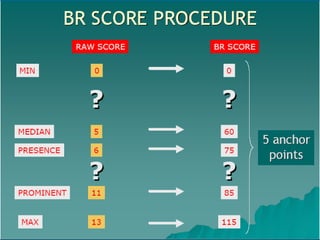
Base Rates Vs. Norm Reference
   populations prevalence vs. Statistical cut offs .


                                                    48
50
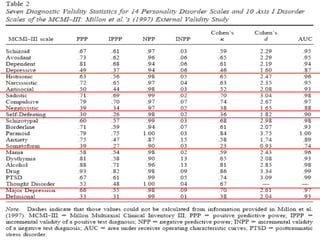
Diagnostic Validity Statistics
   Positive Predictive Power ( PPP )
   Incremental validity of a Positive test
    diagnosis ( IPPP )
   Incremental validity of a Negative
    test diagnosis ( INPP )
   Cohen’s Kappa
   Cohen’s Effect Size (d)
   Areas under ROC Curves (AUCs)
                                          52
Classification Efficiency Terminology
54
臨床運用現況


         55
臨床運用現況
   除了轉介單訊息外,短時間施測,能快速
    提供個案概略臨床圖像( Axis I 、 II )。
   依轉介目的及 MCMI-III 結果,決定衡鑑重
    點及策略。
   提供思考人格特質對適應不良之影響的心
    理病理學架構。
    • Million's theory


                             56
57
58
參考資料
   Hsu, L. M. (2002). Diagnostic Validity
    Statistics and the MCMI-III.
    Psychological Assessment, 14,
    410-422.
   Strack, S. (1999). Essentials of
    Millon inventories assessment.
   Weiner, I. B. & Greene, R. L. (2008).
    Handbook of Personality Assessment.

參考資料
   http://www.cps.nova.edu/~cpphelp/clas
   http://www.cps.nova.edu/~cpphelp/
    class/psy0608/mcmi1pt.html
THANK YOU FOR
  ATTENTION

MCMI-III施測與解釋介紹 王偉信

  • 1.
    The Millon Clinical MultiaxialInventory-III 王偉信 長庚醫院精神科臨床心理師 1
  • 2.
  • 4.
    測驗解釋流程與原則  Determine Profile Validity  Interpret the Personality Disorder Scales  Interpret Clinical Syndrome Scales  Review Noteworthy Responses (Critical Items)  Provide Diagnostic Impressions  Elaborate on Treatment Implications and Recommendations
  • 5.
    MODIFYING INDICES-1  Validity index (Scale V)  Disclosure Index (Scale X)  Desirability Index (Scale Y)  Debasement Index (Scale Z)
  • 6.
    MODIFYING INDICES-2  V: Validity Index • Items 65, 110, 157.  去年我坐飛機越過大西洋有 30 次之多。  去年我是數份雜誌的封面人物。  過去十年,我未見過一輛汽車。 • 0 = valid • 1 = questionable • 2-3 = invalid • 對於粗心、亂填或隨機作答很敏感。 6
  • 7.
    MODIFYING INDICES-3  X: Disclosure Index • Reveals: was client frank & self-revealing or reticent & secretive? • Raw score < 34 or > 178 = invalid 7
  • 8.
    MODIFYING INDICES-4  Y: Desirability Index • To what degree are results influenced by Ss’ desire to look good. • BR scores > 75 = putting oneself in a favorable light. • Higher the score, more likely to be hiding something. 8
  • 9.
    MODIFYING INDICES-5  Z: Debasement Index • Opposite of Y. • BR > 75 = deprecate/devalue oneself • Perhaps a cry for help. 9
  • 10.
    Profile Consideration  Low Disclosure (X) & Desirability (Y) BR, high Debasement (Z) = moderate exaggeration, probably corrected by MCMI.  Low X, Y & Z are high = Ss endorsed antithetical symptoms & characteristics, doubtful validity.  Low X, High Y = + impression management  X & Z, & man of the severe psychopath scales are elevated = “cry for help” profile. 10
  • 11.
    Test Invalidity Conditions  No gender indicated  Age <18, or unknown  Missing items > 11  Two or more Validity items = True  Raw X (Disclosure) < 34 or > 178.  No BR scores on Clinical Personality Patterns (1 – 8B) are above 59. • No clear personality pattern = no interpretation 11
  • 12.
  • 13.
    CLINICAL PERSONALITY PATTERNS  Principles of Interpretation • Individual Scales:  BR points > 75 or 85.  Severe Personality Pathology and Severe Syndromes scale. • Configurations:  Interpret configurally only the two or three highest elevations among basic personality style scales. 13
  • 14.
    CLINICAL PERSONALITY PATTERNS  Haddy et al. (2005) • 14 two-point code-types that occurred frequently in sample of clinical inpatients and outpatients. • Accounted for 72.2 % of these patients. 14
  • 15.
  • 16.
    Schizoid(1)-Avodiance(2A)  Characterize people who keep a significant emotional distance from others.  “Remote schizoids” 16
  • 17.
    Schizoid  嚴重關係缺損、情感表達的侷限的指標。  易發展出 anxiety reaction 、 somatoform disorder 與 reactive psychosis 。  若同時 Scale 8A ( passive-aggressive )提 高:常出現於 alcoholic subtypes and PTSD 17
  • 18.
    Frequent Code Types  Clinical scales: Anxiety 、 Thought Disorder  Personality scales:Avoidant 、 Passive- Aggressive 、 Dependent 、 Compulsive • ( 例 )Schizoid+Avoidant: 對人際關係不感興趣與社交技 巧拙劣外,在人群當中極為不安與害怕被拒絕。假若 Schizoid 與 Avoidant 都高,進一步確認 Alcohol 、 Drug Dependence 。 • 若 Passive-Aggressive 同時亦高時,對於人際關係貧乏 可能存有衝突,憤慨感受。若 Dependent 亦高時,憤慨 可能起因於希望他人可滋養與指導,但又害怕被拒絕 。
  • 19.
    Treatment Implications  主要目標 • 鼓勵參與些許的社交互動 • 協助提昇經驗愉悅的能力  治療技巧 • 可運用的技巧 :audio/videotape feedback of their behavior, cognitive monitoring, re-orientation of their internal processes • Operant conditioning, Insight 可能是很困難的
  • 20.
    Avoidant  發展成 Social phobia 高危險因子。  Scale 2A+Scale 8A ( passive-aggressive ) :預測心理不適應的有效指標 20
  • 21.
    Depressive  檢視 Dysthymic Disorder (Scale D) 與 Major Depression (Scale CC) 兩量尺,進一步確認 並非臨床憂鬱症狀。  新的量尺,少有研究檢驗!! 21
  • 22.
    Dependent  與其他自陳式測量間具良好一致性。  臨床憂鬱患者在此量尺也容易高,需進一 步確認並非目前情緒問題的表現(狀態) 。 22
  • 23.
    Histrionic  大量研究資料顯示, style 而非 disorder 。 • 與外向特質、心理健康指標具正相關,與不適 應指標呈現負相關。 • 除 substance abuse disorder ,在精神科病患鮮少 出現。 • 與相似構念之精神科結構式訪談:低相關。 23
  • 24.
    Narcissistic  大量研究顯示, style 而非 disorder 。 • 與外向特質、心理健康指標具正相關,與不適 應指標呈現負相關。 • 除 substance abuse disorder ,在精神科病患鮮少 出現。 • MMPI ( Narcissistic )及 Narcissistic Personality Inventory 正相關。 • 與精神科結構式訪談:低相關。 24
  • 25.
    Antisocial  與精神病態( psychopath ),或不論紙筆 或結構式精神科會談,呈現中度相關。  進一步確認犯罪史。 25
  • 26.
    Sadistic (Aggressive)  攻擊及控制特質  會談確認配偶與孩子的虐待史  可能是語言而非肢體暴力  臨床診斷: BR scores > 84 ,考慮 Personality Disorder NOS, with prominent aggressive traits 。 26
  • 27.
    Compulsive  有大量研究顯示,測量 style 而非 disorder : • 很少出現在精神科病患族群。 • 行為與情緒控制經常是情緒適應的指標。 • 與精神科問題之間呈現負相關。 • 與心理健康存正相關,而情緒不適應負相關。 • 聚斂效度( convergent validity )差。 27
  • 28.
    Negativistic (Passive-Aggressive)  易怒、衝動、語言攻擊、無法控制憤怒、 苛刻傷人言語。  是情緒失控非常良好的預測指標,暗示存 在嚴重精神科疾病的可能。 28
  • 29.
    Self-Defeating  自我犧牲,自認理應受苦,順從,在關係 中居於劣勢位置,輕度憂鬱,允許別人暫 便宜。  在許多精神疾病組群的分數組型中,此量 尺經常偏高。  進一步確認問題行為與受虐模式。 29
  • 30.
    Schizotypal  理應與精神病( psychosis )及精神分裂症 有關。但是實徵資料的結果並不一致。  與其他 Schizotypal personality disorder 的測 量一致性落在低至中範圍,臨床效標不佳 。 30
  • 31.
    Borderline  高分表示高情緒波動性。  足夠資料顯示,與其他相似測量間具中至 強程度的相關性。 31
  • 32.
    Paranoid  Drug addict 常在此量尺上會略微上升。  若 scale T(Drug dependence) 也高,進一步 臨床會談確認 paranoia 。  在實徵研究上,與其他測量一致性低。 32
  • 33.
    Moderately Severe Clinical Syndromes  A: Anxiety • 神經緊張、哭泣、無法做決定、憂慮及身體抱怨。 • 與其他焦慮測量高相關,精神受苦與不適應良好指標 。 • 與 Scale D 高相關,不能區分焦慮與憂鬱。假如 Scale D 也高,則強調憂鬱症狀,若不高則強調焦慮症狀。 • 診斷考量: GAD , other anxiety-related disorder 。 Picture 6 33
  • 34.
    Moderately Severe Clinical Syndromes  H: Somatoform • 模糊身體抱怨、憂慮、哭泣、不能做決定、疲倦。  高分意義: • 身體化或慮病傾向。 (心理問題轉化為身體形式) • 存在醫學問題,因疾病因應不佳, 同時出現心理症狀 。 34
  • 35.
    Moderately Severe Clinical Syndromes  N: Bipolar-Manic • 自大、膨脹自尊 • 意念飛耀 • 衝動、精力及活動過多  高分可能有幻覺 • 需要進一步確認 :  SS ( Thought Disorder )  PP ( Delusional Disorder )  CC ( Major Depression )  T (Drug ) 35
  • 36.
    Moderately Severe Clinical Syndromes  D: Dysthymia • 長久存在自責、缺乏動力、低自尊及冷漠等問題,但 尚能維持一般作息。 • 僅代表 prototypal Dysthymic disorder 病患 的表現,每個人憂鬱表現不同,需要進 一步完整評估個別症狀。 • 實徵顯示,為 Major Depression 最佳預測。 亦是,慢性、輕度憂鬱的良好測量。 36
  • 37.
    Moderately Severe Clinical Syndromes  B: Alcohol Dependence: • 酒精濫用問題,以及與問題飲酒相關性格特質 (如,衝動、合理化、無法遵守社會規範)。 • 有時,高分不代表有酒精依賴的問題。 • 臨床會談,以確認酒癮相關問題。 37
  • 38.
    Moderately Severe Clinical Syndromes  T: Drug Dependence • 藥物濫用(藥物濫用史及重複模式,人際關係損害, 衝動控制問題) • 相關性格特質(如,牽涉法律問題,遵循社會標準困 難,反社會,獨立,無同理心,不負責任,合理化) 。 • 實徵資料顯示,能有效排除藥癮可能性。 38
  • 39.
    Moderately Severe Clinical Syndromes  R: Post-Traumatic Stress Disorder • 痛苦記憶、夜驚( nightmares ),創傷事件、 經驗再現( flashbacks )。 • 特定於戰爭壓力,可能無法類化至其他類型的 創傷。 • 若澄清後並無創傷史,高分可能代表非創傷性 質( non-traumatic nature )引起的情緒混亂。 39
  • 40.
    Severe Clinical Syndromes  SS : Thought Disorder • 高分可能被診斷為: schizophrenia, shizophreniform, or brief reactive psychosis. • 混亂行為、混淆( confused )、失去定向感、幻覺、 情感平乏、不適切情緒表達、社交退縮 40
  • 41.
    Severe Clinical Syndromes  CC : Major Depression • 重大功能損害 • 嚴重程度的憂鬱症狀 • 生理性症狀( Vegetative symptoms ) • 自殺意念或行動 41
  • 42.
    Severe Clinical Syndromes  PP Delusional Disorder • Paranoid, suspicious, irrational. • Jealous, persecutory, grandiose. • Ideas of reference 42
  • 43.
    Critical Items (Noteworthy Responses)  These Noteworthy response are divided into six category: • Health Preoccupations • Interpersonal Alienation • Emotional Dyscontrol • Self-Destructive Potential • Childhood Abuse • Eating Disorders  Suicide attempts and ideation: • Items 154 and 171 43
  • 46.
  • 47.
    1994 External ValidityStudy norms  包含各類臨床診斷,來自私人診所、心理健康中 心、司法、醫院及社區,共 998 名 。  定義量尺與發展 base rate 分數。( N=600 )  交叉檢驗。( N=398 ) 47
  • 48.
    Base Rates Vs.Norm Reference  populations prevalence vs. Statistical cut offs . 48
  • 50.
  • 52.
    Diagnostic Validity Statistics  Positive Predictive Power ( PPP )  Incremental validity of a Positive test diagnosis ( IPPP )  Incremental validity of a Negative test diagnosis ( INPP )  Cohen’s Kappa  Cohen’s Effect Size (d)  Areas under ROC Curves (AUCs) 52
  • 53.
  • 54.
  • 55.
  • 56.
    臨床運用現況  除了轉介單訊息外,短時間施測,能快速 提供個案概略臨床圖像( Axis I 、 II )。  依轉介目的及 MCMI-III 結果,決定衡鑑重 點及策略。  提供思考人格特質對適應不良之影響的心 理病理學架構。 • Million's theory 56
  • 57.
  • 58.
  • 59.
    參考資料  Hsu, L. M. (2002). Diagnostic Validity Statistics and the MCMI-III. Psychological Assessment, 14, 410-422.  Strack, S. (1999). Essentials of Millon inventories assessment.  Weiner, I. B. & Greene, R. L. (2008). Handbook of Personality Assessment.
  • 60.
    參考資料  http://www.cps.nova.edu/~cpphelp/clas  http://www.cps.nova.edu/~cpphelp/clas  http://www.cps.nova.edu/~cpphelp/ class/psy0608/mcmi1pt.html
  • 61.
    THANK YOU FOR ATTENTION

Editor's Notes

  • #3 效度量尺:三題 反應傾向:三種量尺 12 到 24 題
  • #8 Frank 坦率 Reticent 不情願
  • #11 Antithetical 正相反的
  • #37 即使憂鬱也能執行日常作息 冷漠、 feeling discouraged ,缺乏精力, crying spells , self-deprecatory cognitions ,自責 每個人憂鬱表現不同,此量尺僅代表 prototypal Dysthymic disorder 病患,需要盡一不完整評估個別症狀 實徵上是 Major Depression 最佳預測因子,比 Scale SS 佳 慢性、輕度憂鬱的良好測量
  • #38 衝動,合理化,對社會標準缺乏遵從, selfishness ,對於家庭成員攻擊   研究顯示,與 Scale T ( drug dependence )相關 0.70 高分有時不代表酒精依賴問題,全部回答 nonprotypical items 之 BR=79 臨床會談,確認酒癮問題及相關領域問題,如醫學,心理 / 精神,社會法律,職業育樂靈性 相關行為與特質:憂鬱,依賴,焦慮,內向
  • #39 14 題,藥物賴用( 6 題),相關特質( 8 題,法律問題,遵循社會標準,返社會活動,獨立,無同理心,不負責任,合理化) 藥物賴用歷史及重複模式,人際關係破壞,衝動控制問題 排除藥癮有優秀表現
  • #41 The scale detected thought disorders in patients who were willing to report psychotic symptoms, but misses in patients who trying to conceal them
  • #43 嚴重關係缺損、情感表達的侷限 同時 scale 8A 提高:亦常出現 alcoholic subtypes and PTSD
  • #49 在醫院中,症狀嚴重度一定高於一般人 極端中的區分性不高
  • #51 Presence: 有此問題的組別最低分數 Prominent: 以此問題為主的最低分數 Median: 所有病人群的平均分數 正常組群平均分數 ;30
  • #53 Ppp :測驗結果說有,實際上也真的是 Npp :測驗說沒有,實際上也沒有 Cohen’s k :正確分類 / 隨機正確分類,高過 0 Cohen’s effect size :特定疾病與無此疾病組的差異 Auc 亦是