Why are reflected random walks
      so hard to simulate ?
Sean Meyn
Department of Electrical and Computer Engineering
and the Coordinated Science Laboratory
    University of Illinois


   Joint work with Ken Duffy - Hamilton Institute, National University of Ireland

   NSF support: ECS-0523620
References


             (Skip this advertisement)
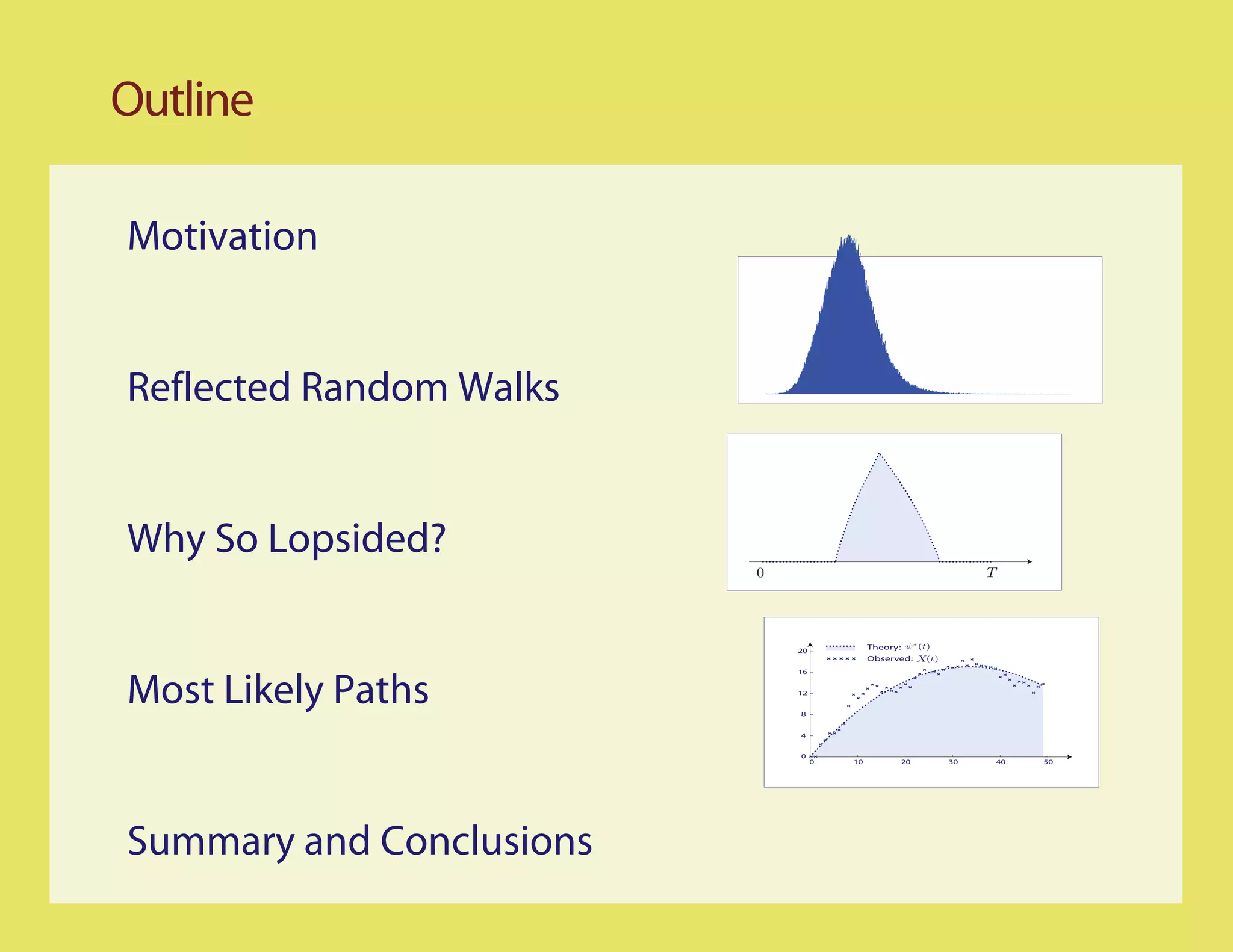
Outline

Motivation


Reflected Random Walks


Why So Lopsided?
                          0                                      T


                              20
                                            Theory:
                                            Observed:   X


Most Likely Paths
                              16


                              12


                              8


                              4


                              0
                                   0   10         20        30       40   50


Summary and Conclusions
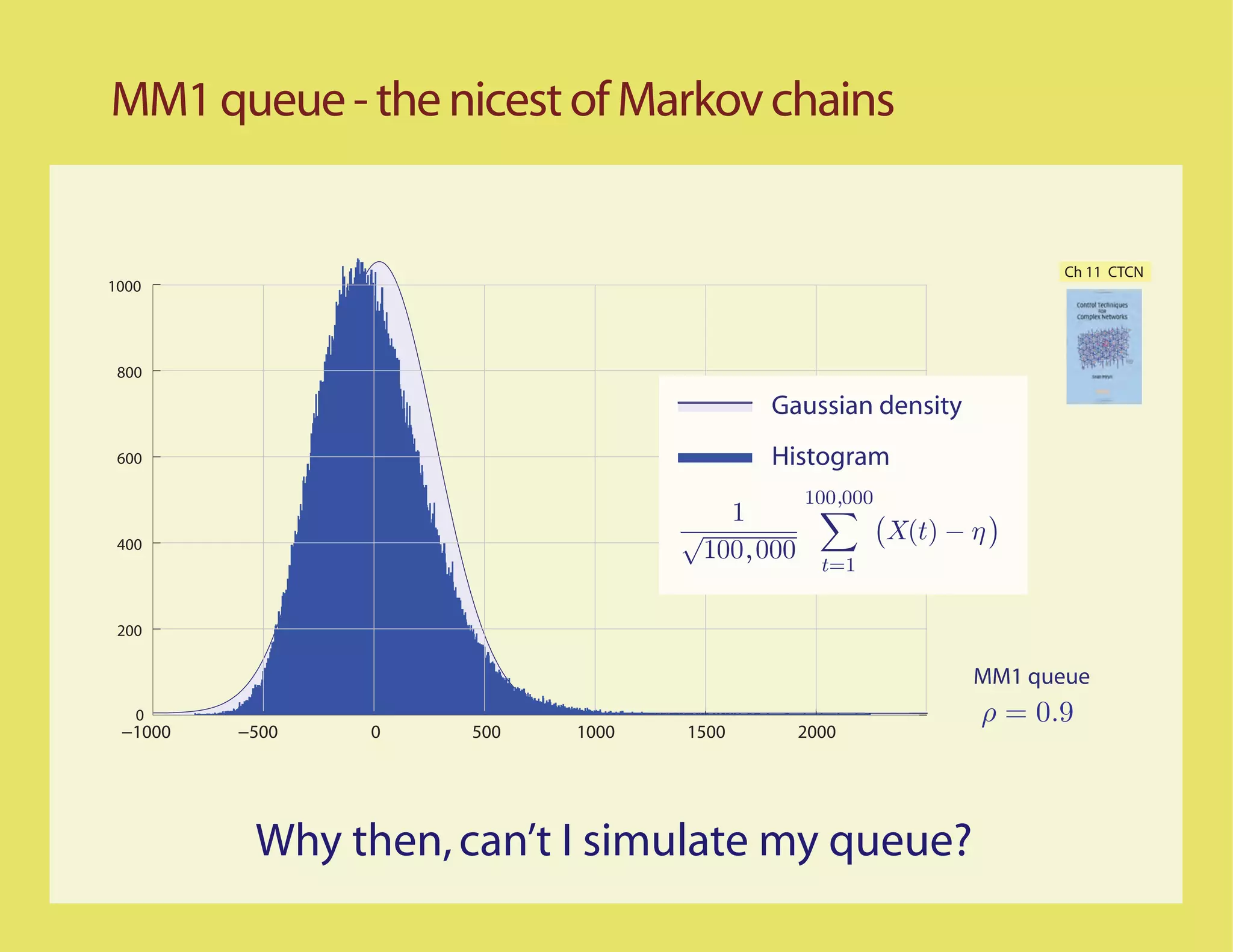
MM1 queue - the nicest of Markov chains


For the stable queue, with load strictly less than one, it is

             •   Reversible
             •   Skip-free
             •   Monotone
             •   Marginal distribution geometric
             •   Geometrically ergodic
MM1 queue - the nicest of Markov chains


For the stable queue, with load strictly less than one, it is

             •   Reversible
             •   Skip-free
             •   Monotone
             •   Marginal distribution geometric
             •   Geometrically ergodic


          Why then, can’t I simulate my queue?
MM1 queue - the nicest of Markov chains


                                                                    Ch 11 CTCN
1000


 800

                                        Gaussian density
 600                                    Histogram
                                            100,000
                                    1
 400
                                 √                    X(t) − η
                                  100,000     t=1


 200

                                                             MM1 queue
   0                                                         ρ = 0.9
 −1000   −500   0   500   1000   1500       2000


          Why then, can’t I simulate my queue?
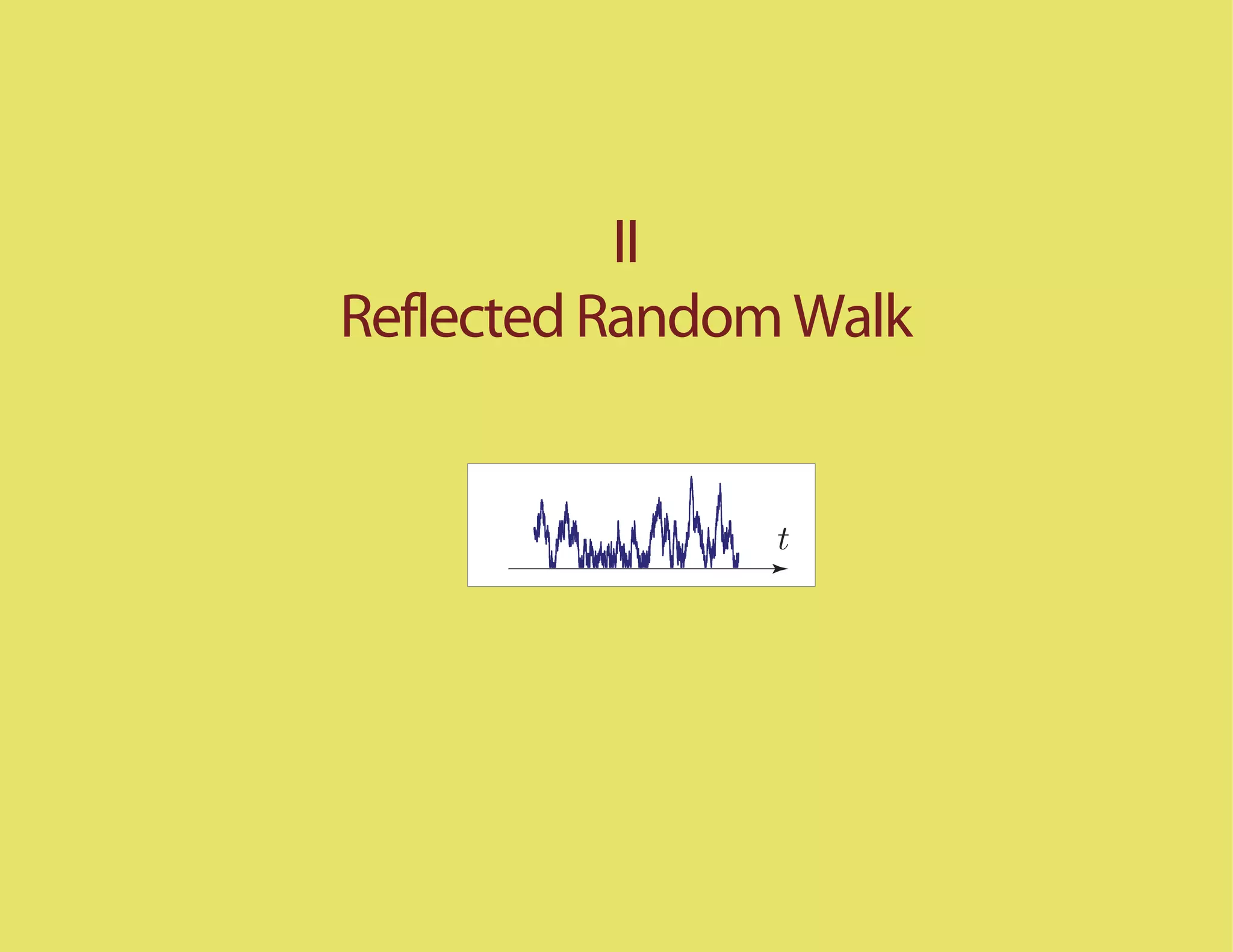
II
Reflected Random Walk


                t
Reflected Random Walk

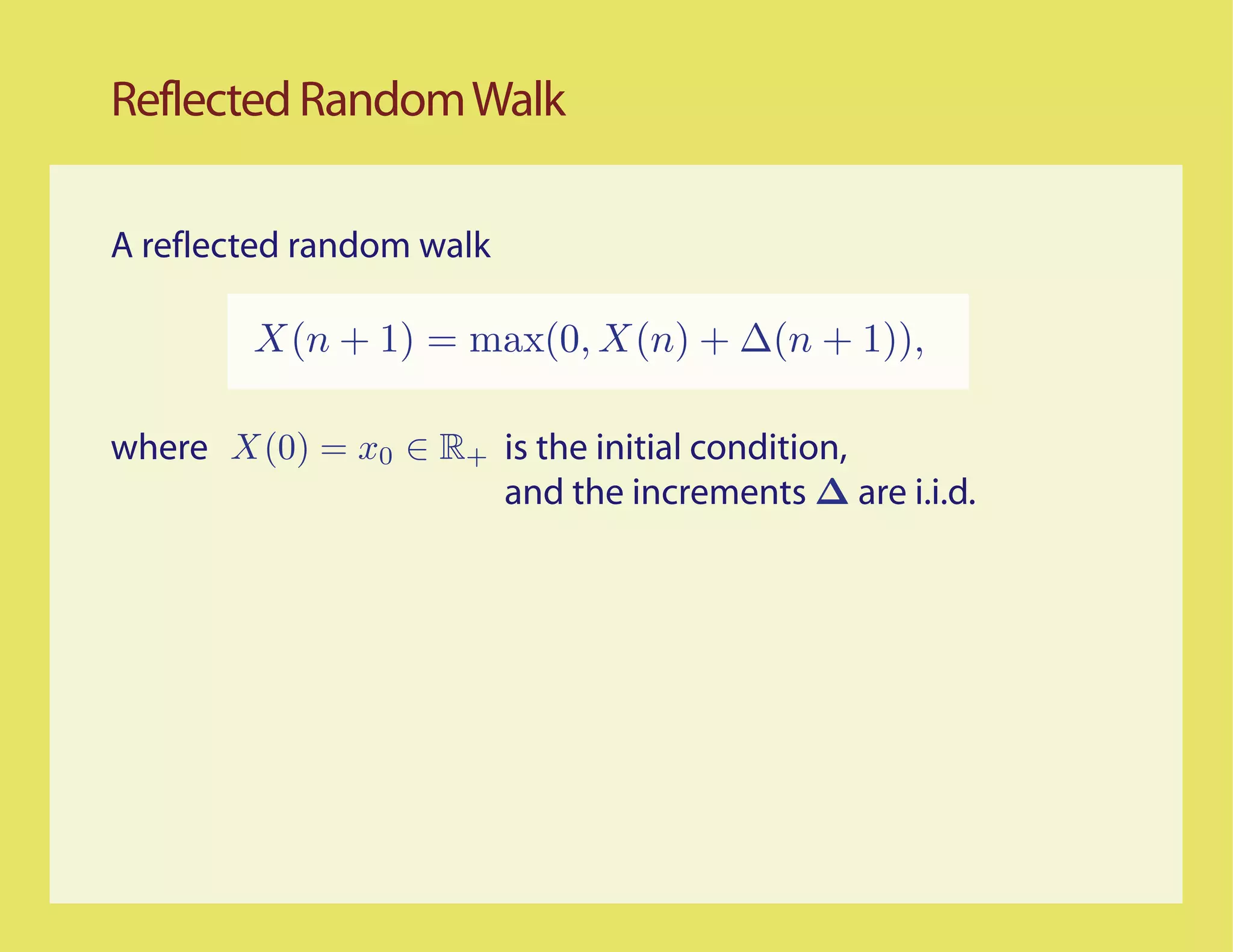
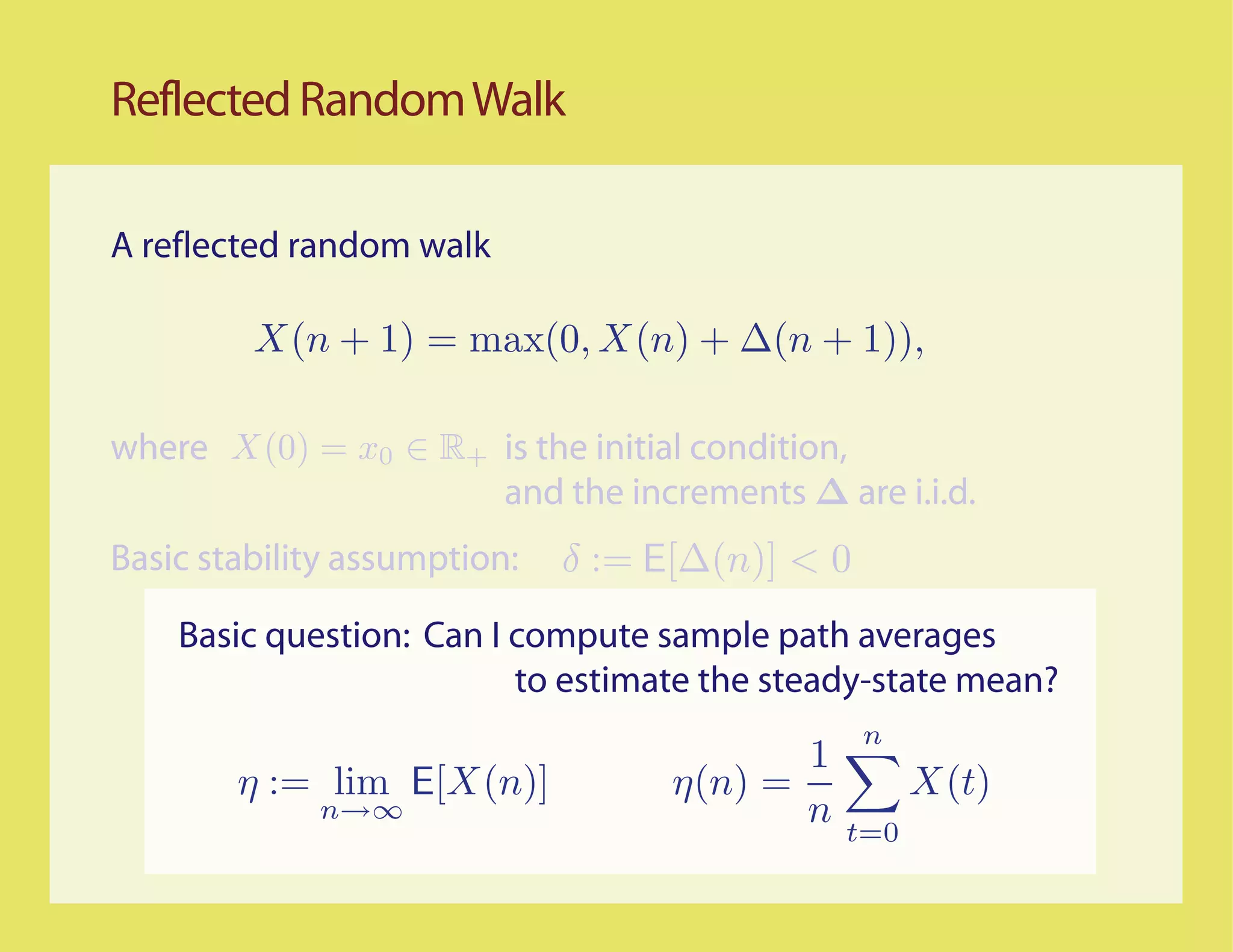
A reflected random walk


where                     is the initial condition,
                          and the increments ∆ are i.i.d.
Reflected Random Walk

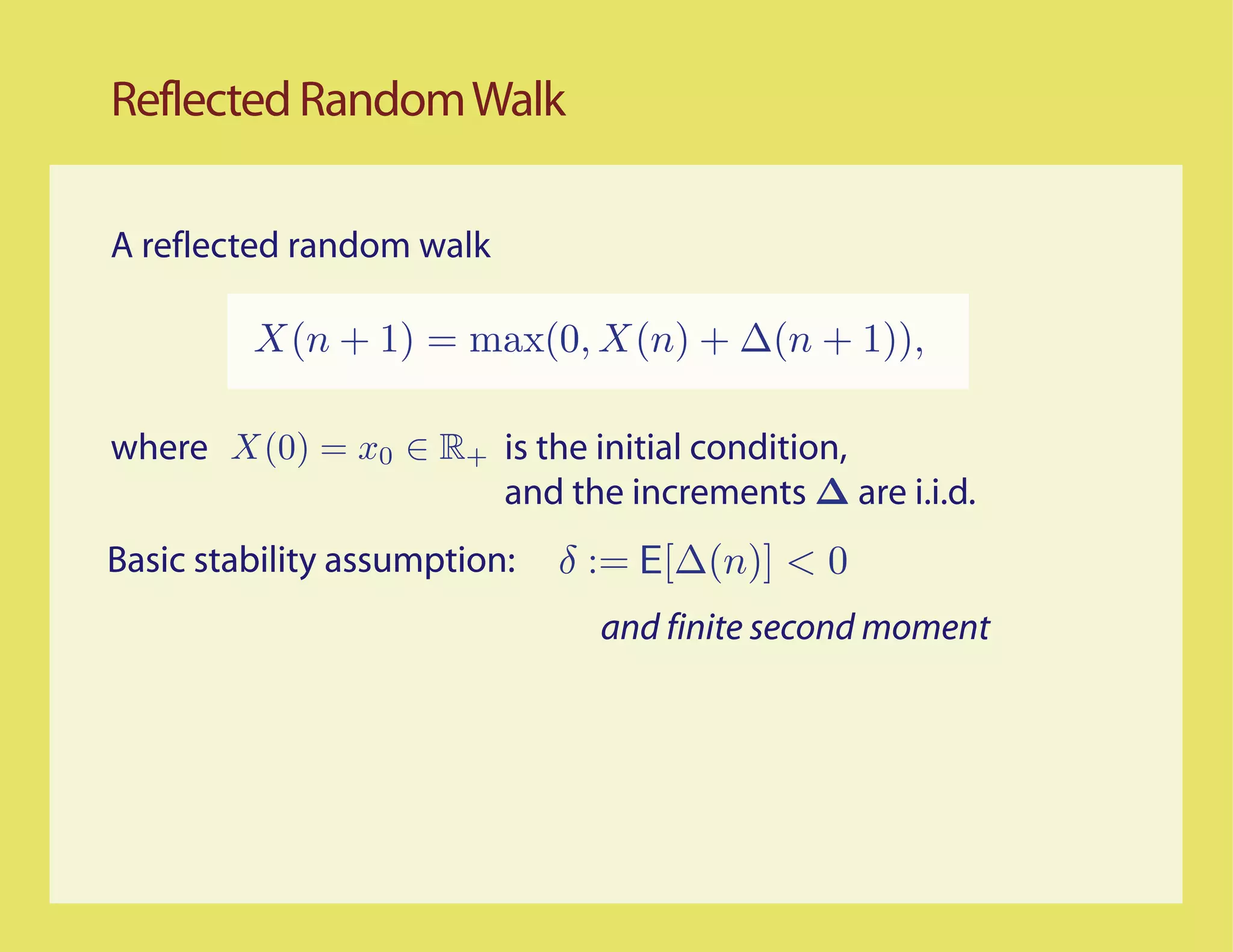
A reflected random walk


where                     is the initial condition,
                          and the increments ∆ are i.i.d.
Basic stability assumption:
                                and finite second moment
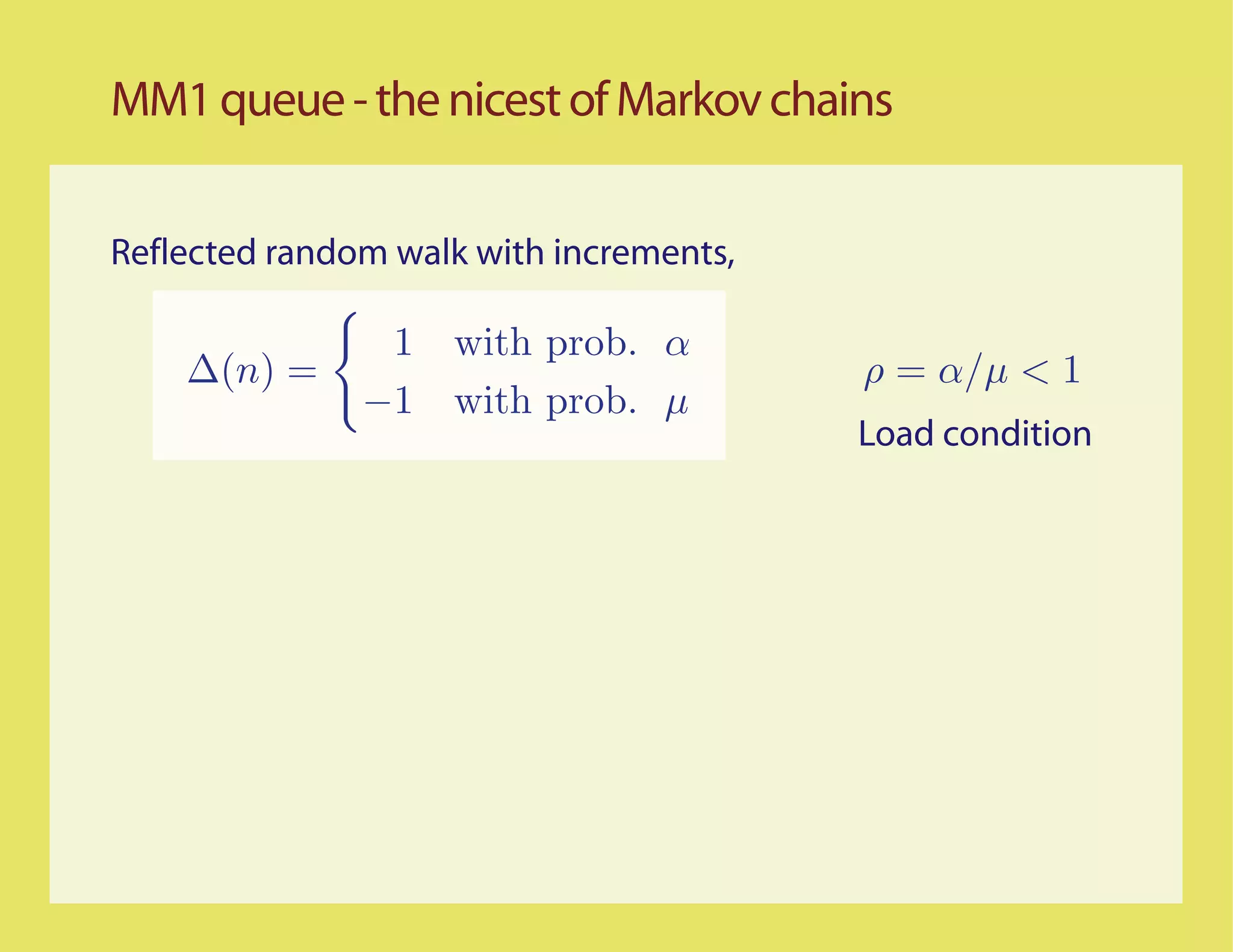
MM1 queue - the nicest of Markov chains

Reflected random walk with increments,


                                         Load condition
Reflected Random Walk

A reflected random walk


where                     is the initial condition,
                          and the increments ∆ are i.i.d.
Basic stability assumption:

    Basic question: Can I compute sample path averages
                          to estimate the steady-state mean?
Simulating the RRW: Asymptotic Variance

The CLT requires a third moment for the increments
                                      E[∆(0)] < 0 and E[∆(0)3 ] < ∞
                           1
Asymptotic variance = O
                        (1 − ρ)4      Whitt 1989
                                      Asmussen 1992
Simulating the RRW: Asymptotic Variance

The CLT requires a third moment for the increments
                                      E[∆(0)] < 0 and E[∆(0)3 ] < ∞
                           1
Asymptotic variance = O
                        (1 − ρ)4
                                                                        Ch 11 CTCN
 1000


  800

                                            Gaussian density
  600                                       Histogram
                                                100,000
                                        1
  400
                                     √                    X(t) − η
                                      100,000     t=1


  200

                                                                 MM1 queue
    0                                                            ρ = 0.9
  −1000   −500   0      500   1000   1500       2000
Simulating the RRW: Lopsided Statistics

Assume only negative drift, and finite second moment:
                                      E[∆(0)] < 0 and E[∆(0)2 ] < ∞


Lower LDP asymptotics: For each r < η ,

                       1
                    lim log P η(n) ≤ r
                   n→∞ n
                                          = −I(r) < 0
                                                              M 2006
Simulating the RRW: Lopsided Statistics

Assume only negative drift, and finite second moment:
                                      E[∆(0)] < 0 and E[∆(0)2 ] < ∞


Lower LDP asymptotics: For each r < η ,

                       1
                    lim log P η(n) ≤ r
                   n→∞ n
                                          = −I(r) < 0
                                                              M 2006


Upper LDP asymptotics are null: For each r ≥ η ,

                       1
                    lim log P η(n) ≥ r = 0                    M 2006
                   n→∞ n                                      CTCN


                                          even for the MM1 queue!
III
Why So Lopsided?
Lower LDP


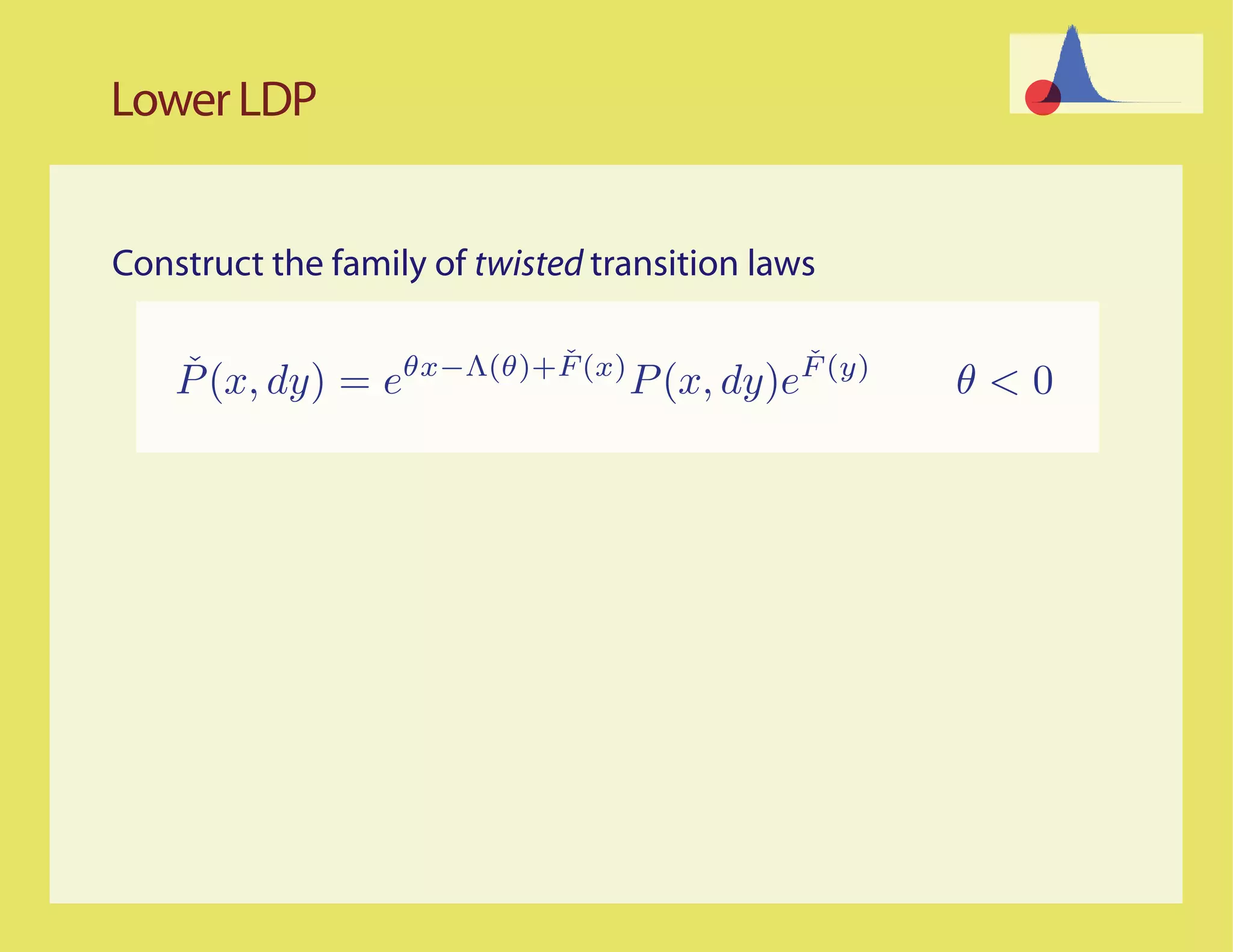
Construct the family of twisted transition laws

                         ˇ               ˇ
    ˇ (x, dy) = eθx−Λ(θ)+F (x) P (x, dy)eF (y)
    P                                             θ<0
Lower LDP


Construct the family of twisted transition laws

                         ˇ               ˇ
    ˇ (x, dy) = eθx−Λ(θ)+F (x) P (x, dy)eF (y)
    P                                                     θ<0


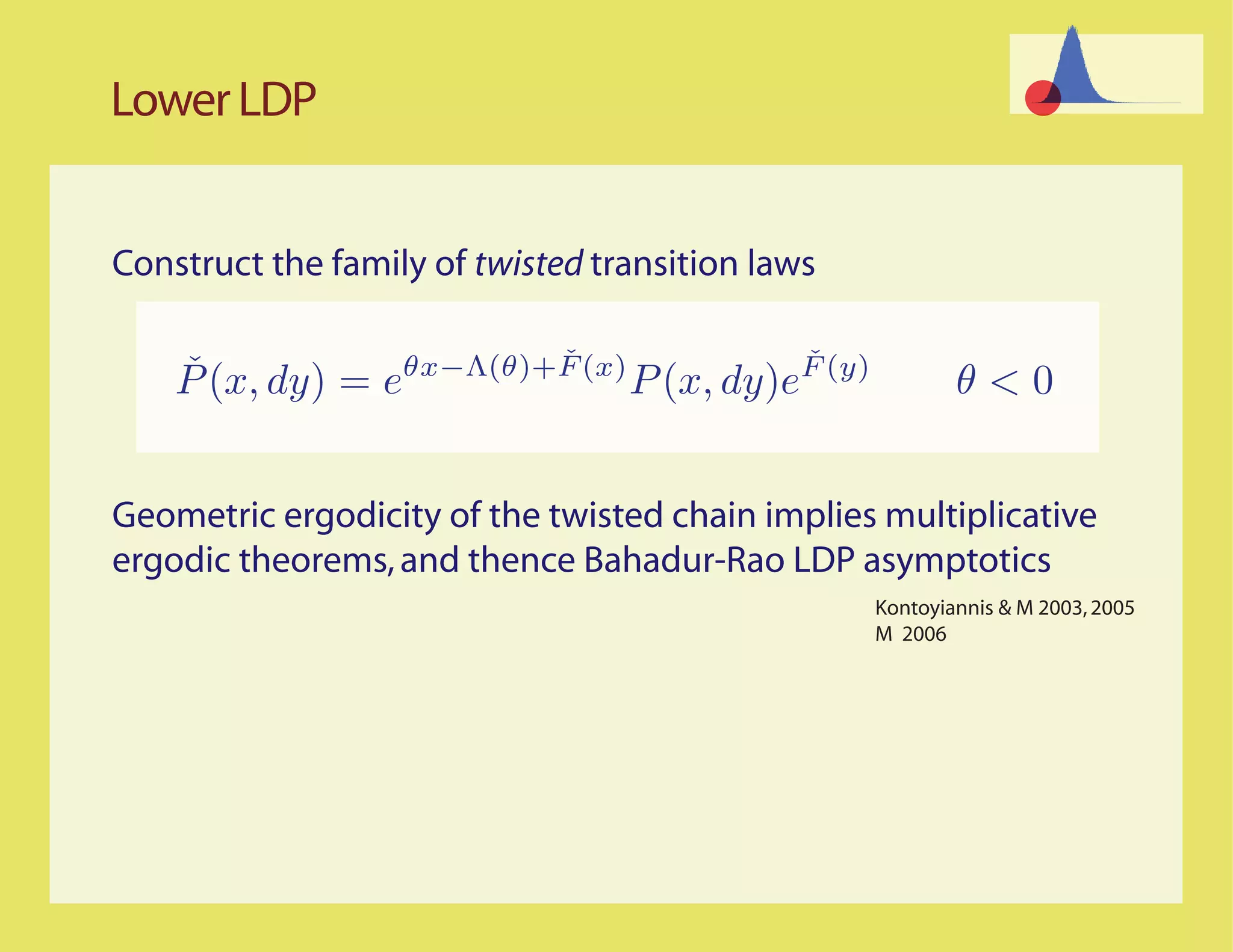
Geometric ergodicity of the twisted chain implies multiplicative
ergodic theorems, and thence Bahadur-Rao LDP asymptotics
                                                  Kontoyiannis & M 2003, 2005
                                                  M 2006
Lower LDP


Construct the family of twisted transition laws

                         ˇ               ˇ
    ˇ (x, dy) = eθx−Λ(θ)+F (x) P (x, dy)eF (y)
    P                                                     θ<0


Geometric ergodicity of the twisted chain implies multiplicative
ergodic theorems, and thence Bahadur-Rao LDP asymptotics
                                                  Kontoyiannis & M 2003, 2005
                                                  M 2006


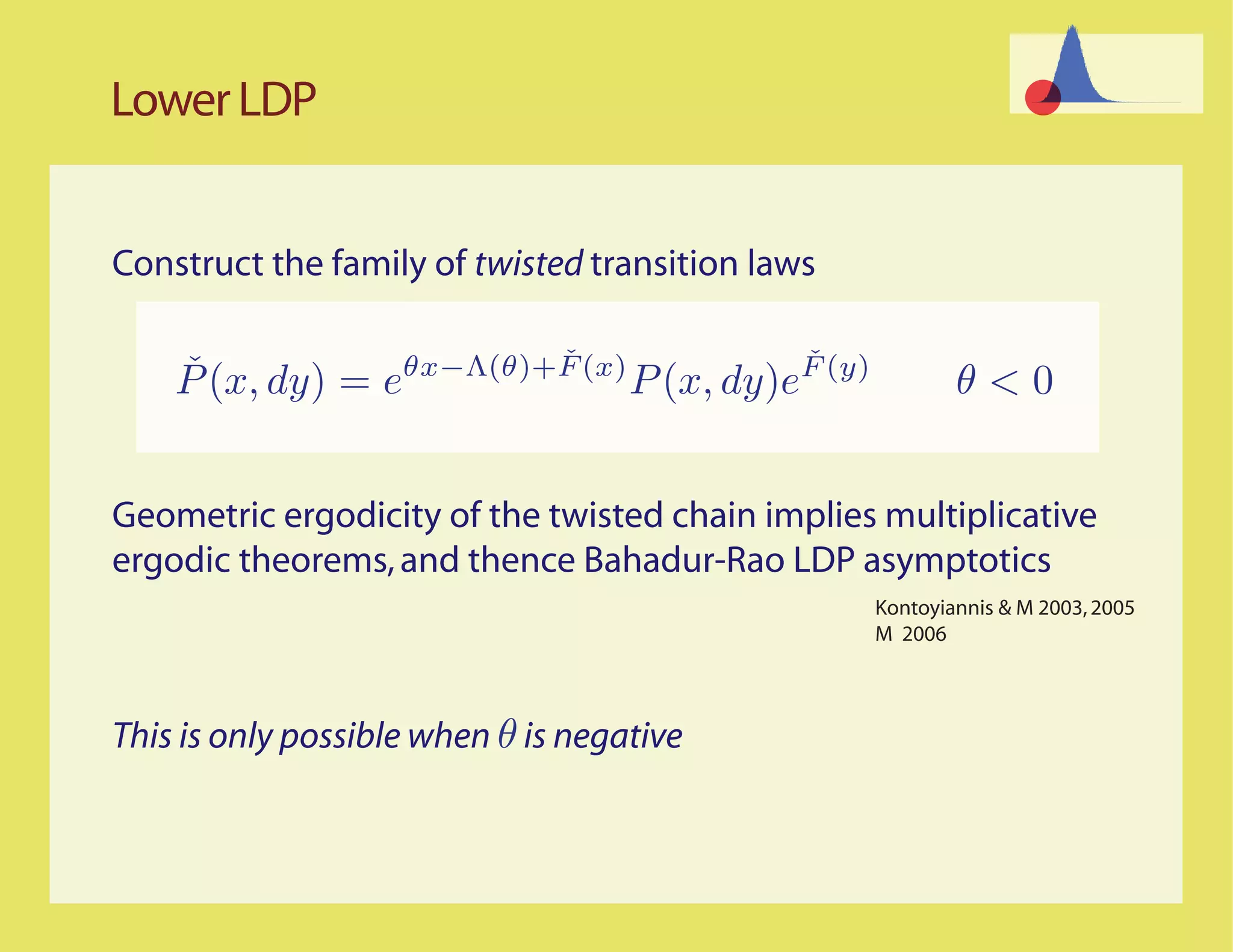
This is only possible when θ is negative
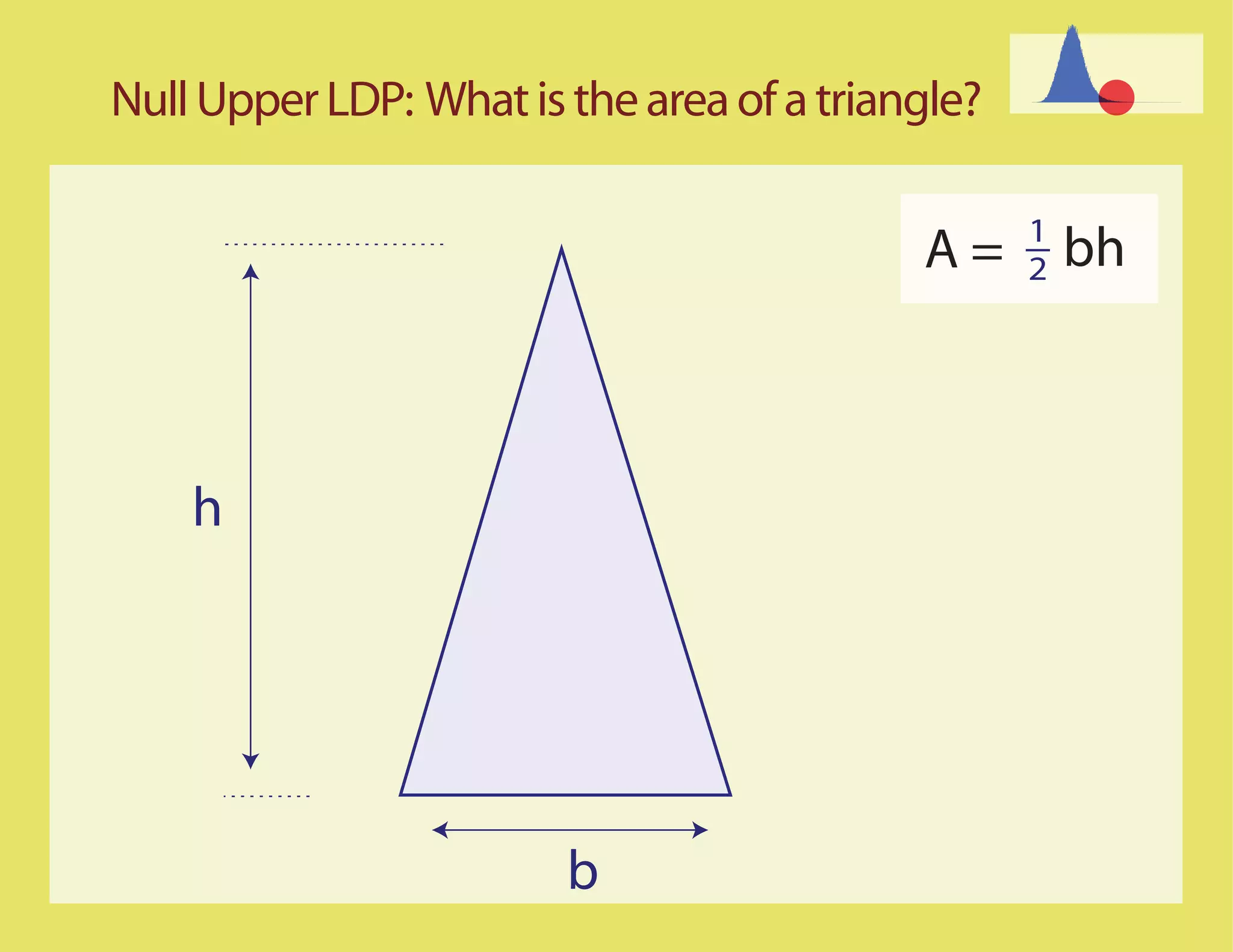
Null Upper LDP: What is the area of a triangle?

                                                  1
                                           A=     2   bh


    h


                        b
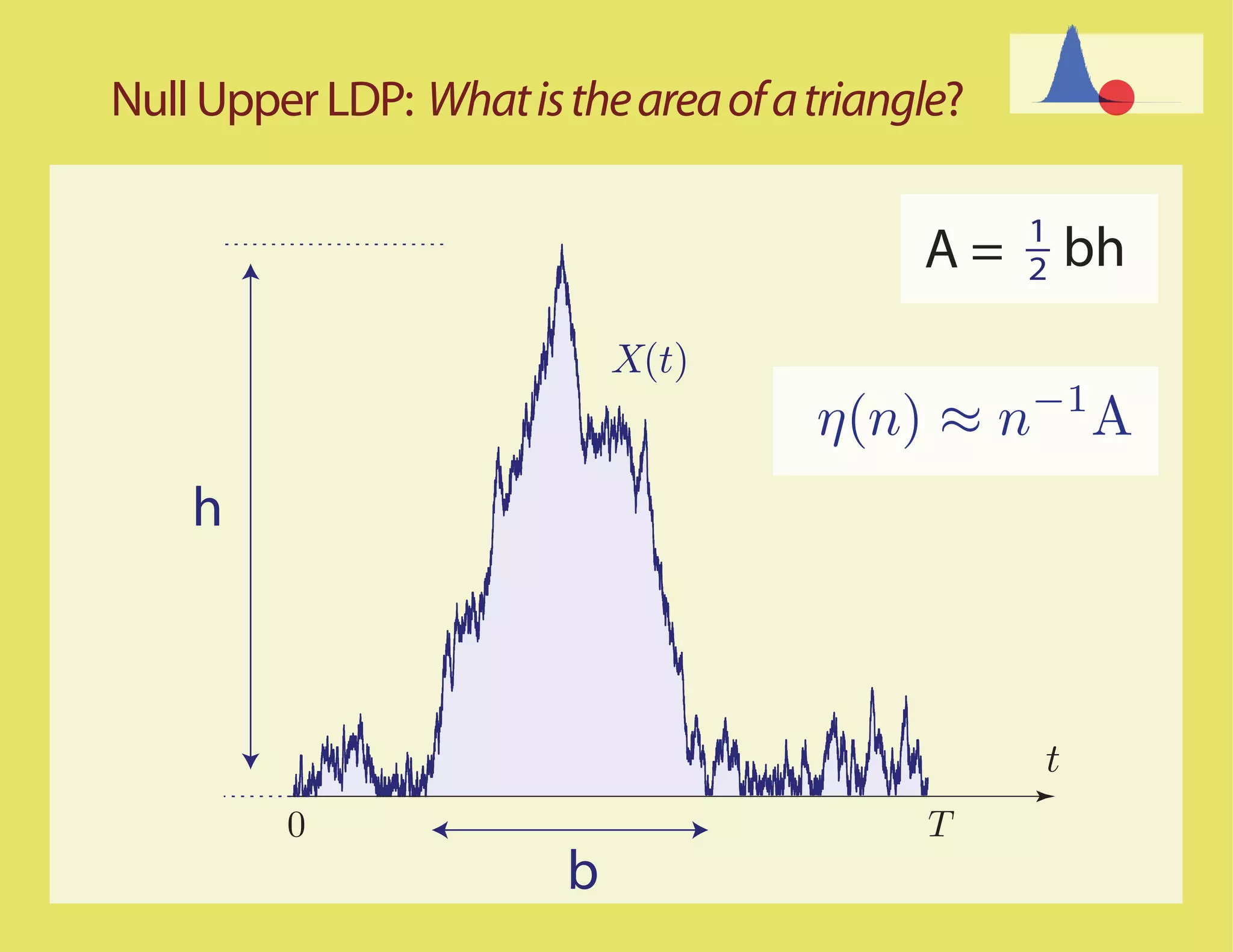
Null Upper LDP: What is the area of a triangle?

                                                  1
                                            A=    2   bh
                             X(t)
                                      η(n) ≈ n−1 A
    h


                                                  t
         0                                  T
                         b
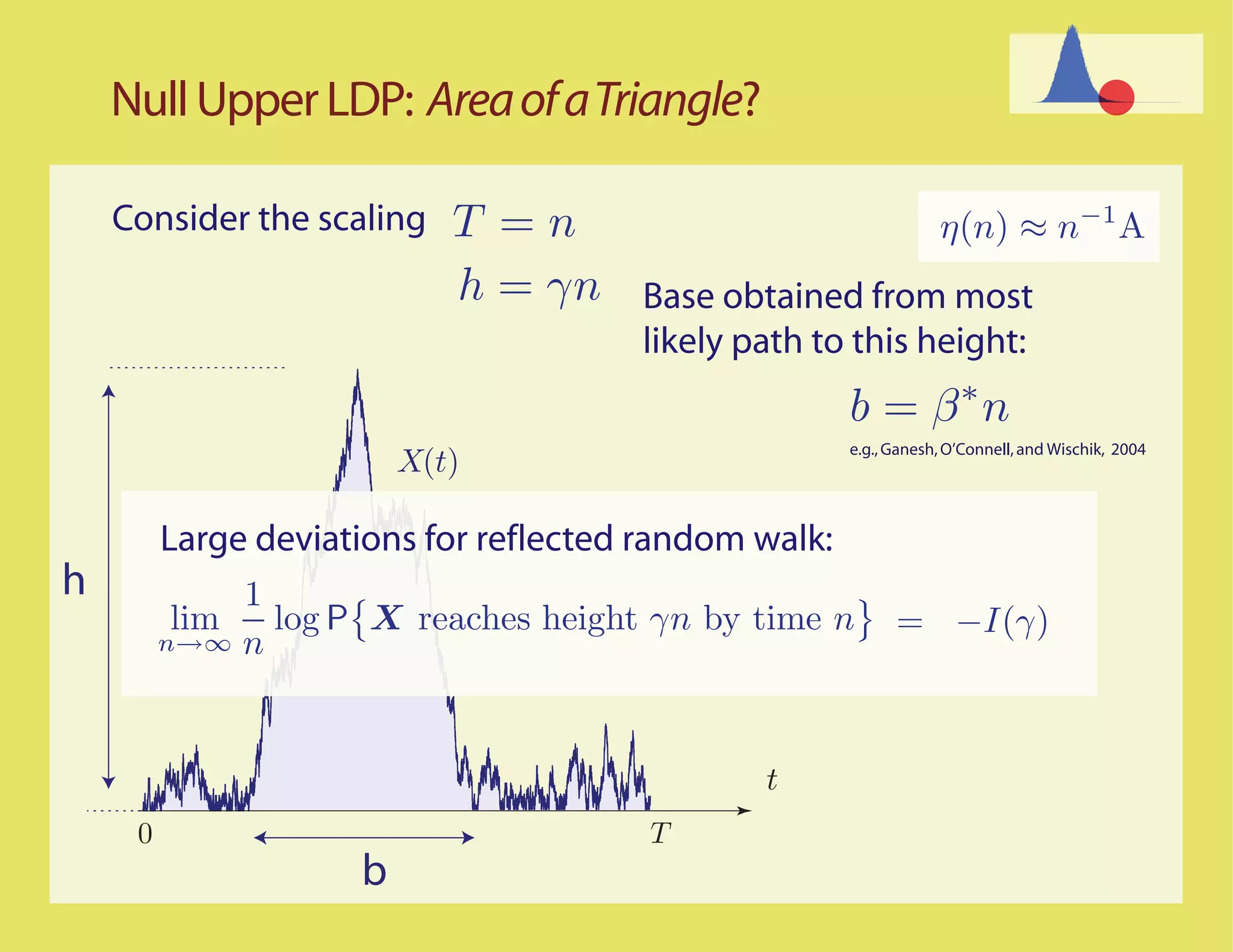
Null Upper LDP: Area of a Triangle?

    Consider the scaling    T =n                     η(n) ≈ n−1 A
                            h = γn Base obtained from most
                                       likely path to this height:
                                                       b = β∗n
                                                       e.g., Ganesh, O’Connell, and Wischik, 2004
                         X(t)

         Large deviations for reflected random walk:
h


                                               t
     0                                  T
                     b
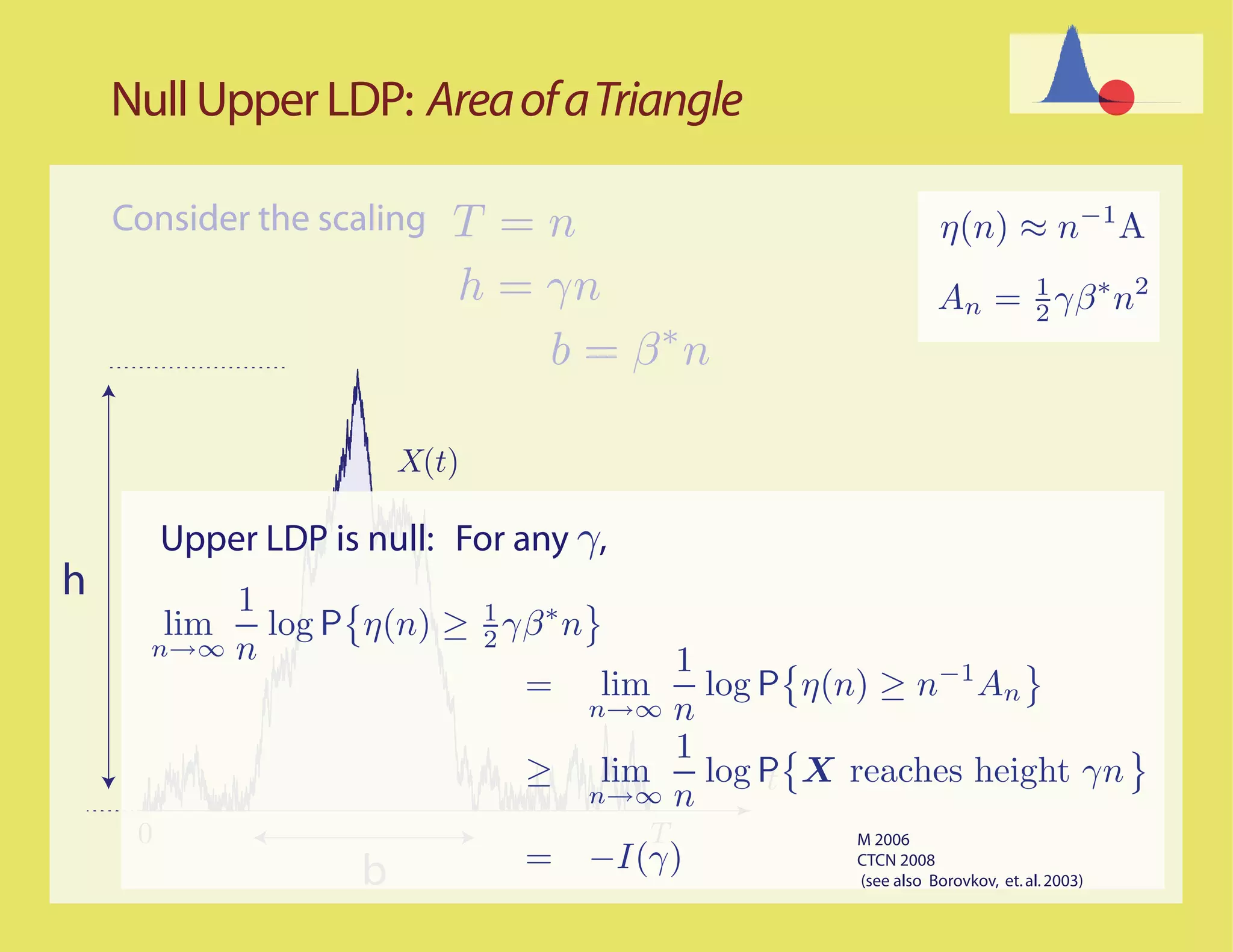
Null Upper LDP: Area of a Triangle

    Consider the scaling     T =n                            η(n) ≈ n−1 A
                             h = γn                         An = 1 γβ ∗ n2
                                                                 2
                                 b = β∗n

                          X(t)

         Upper LDP is null: For any γ,
h


                                             t
     0                                   T       M 2006

                      b                          CTCN 2008
                                                 (see also Borovkov, et. al. 2003)
IV
Most Likely Paths
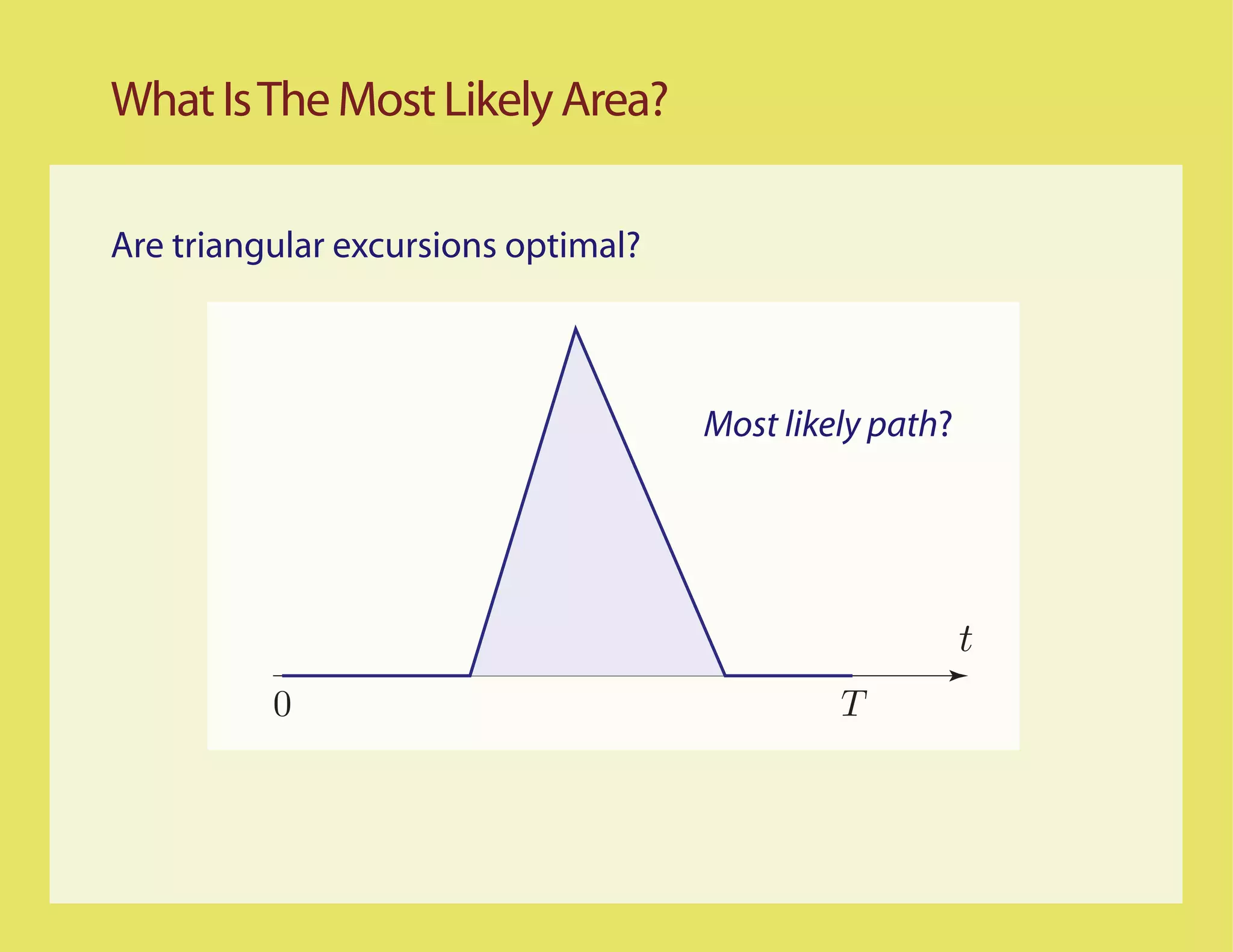
What Is The Most Likely Area?

Are triangular excursions optimal?


                                     Most likely path?


                                                         t
          0                                   T
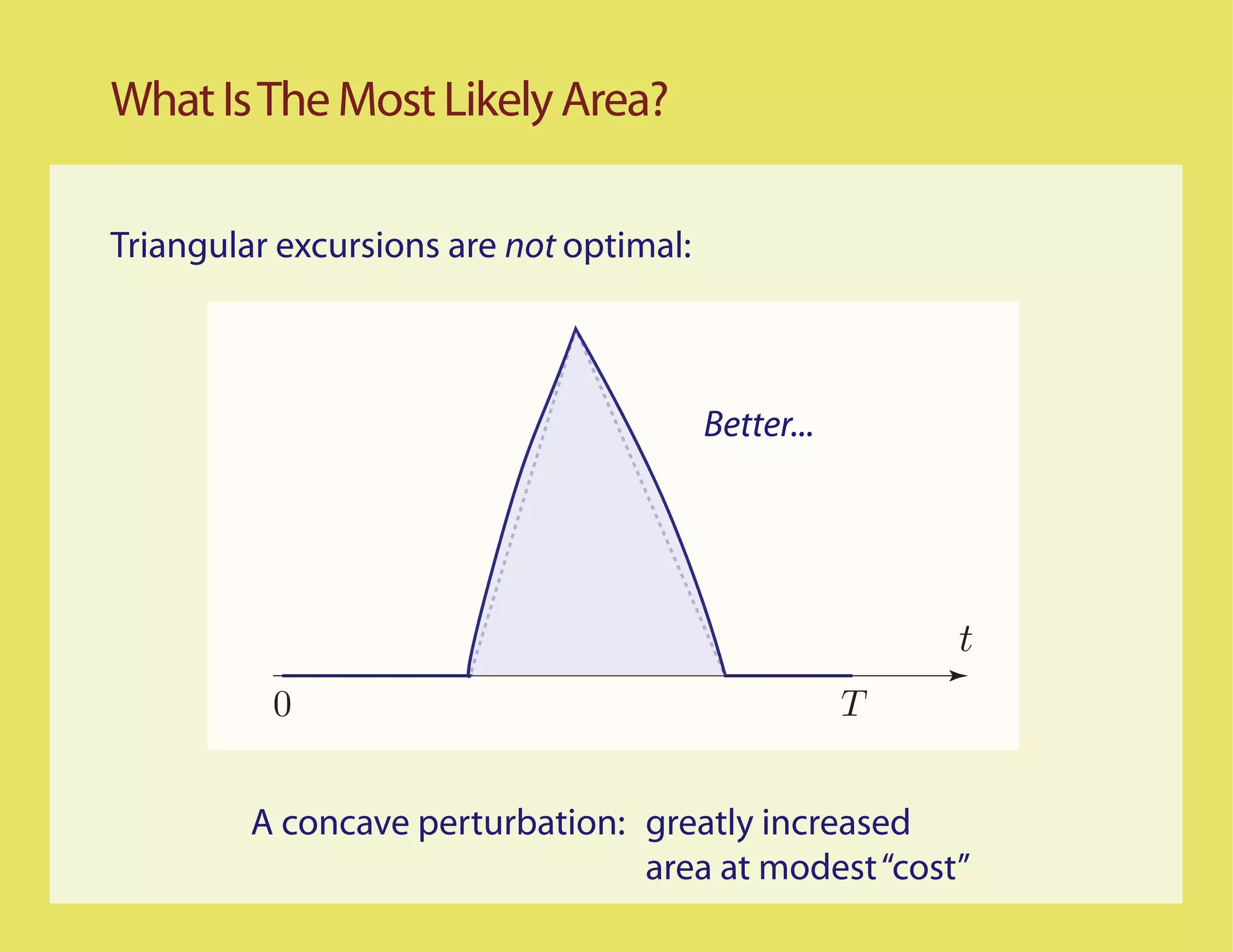
What Is The Most Likely Area?

Triangular excursions are not optimal:


                                         Better...


                                                         t
          0                                          T


         A concave perturbation: greatly increased
                                 area at modest “cost”
Better...


Most Likely Paths                                                                   t
                                                      0                       T


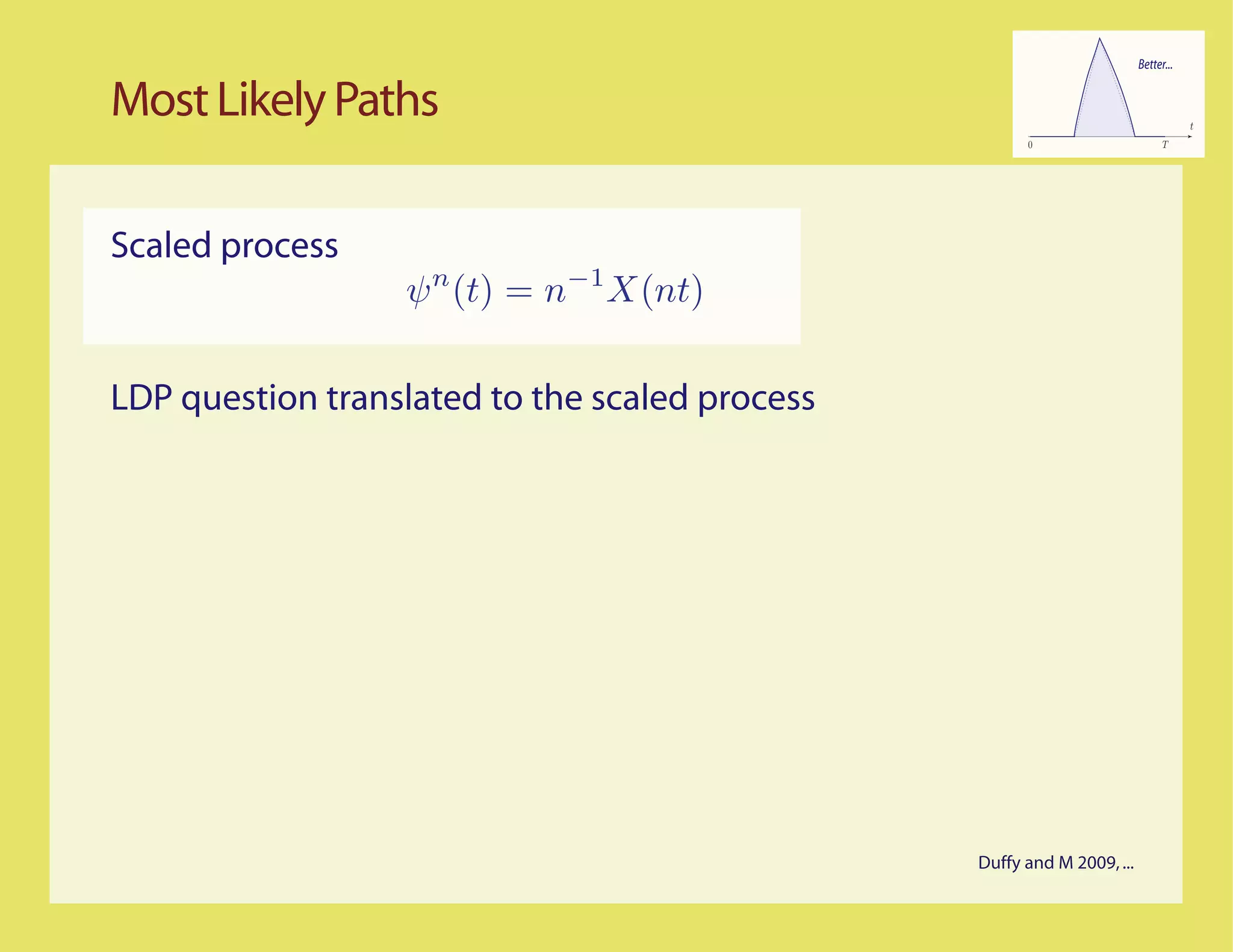
Scaled process
                  ψ n (t) = n−1 X(nt)

LDP question translated to the scaled process


                                                Duffy and M 2009, ...
Better...


Most Likely Paths                                               t
                                                0         T


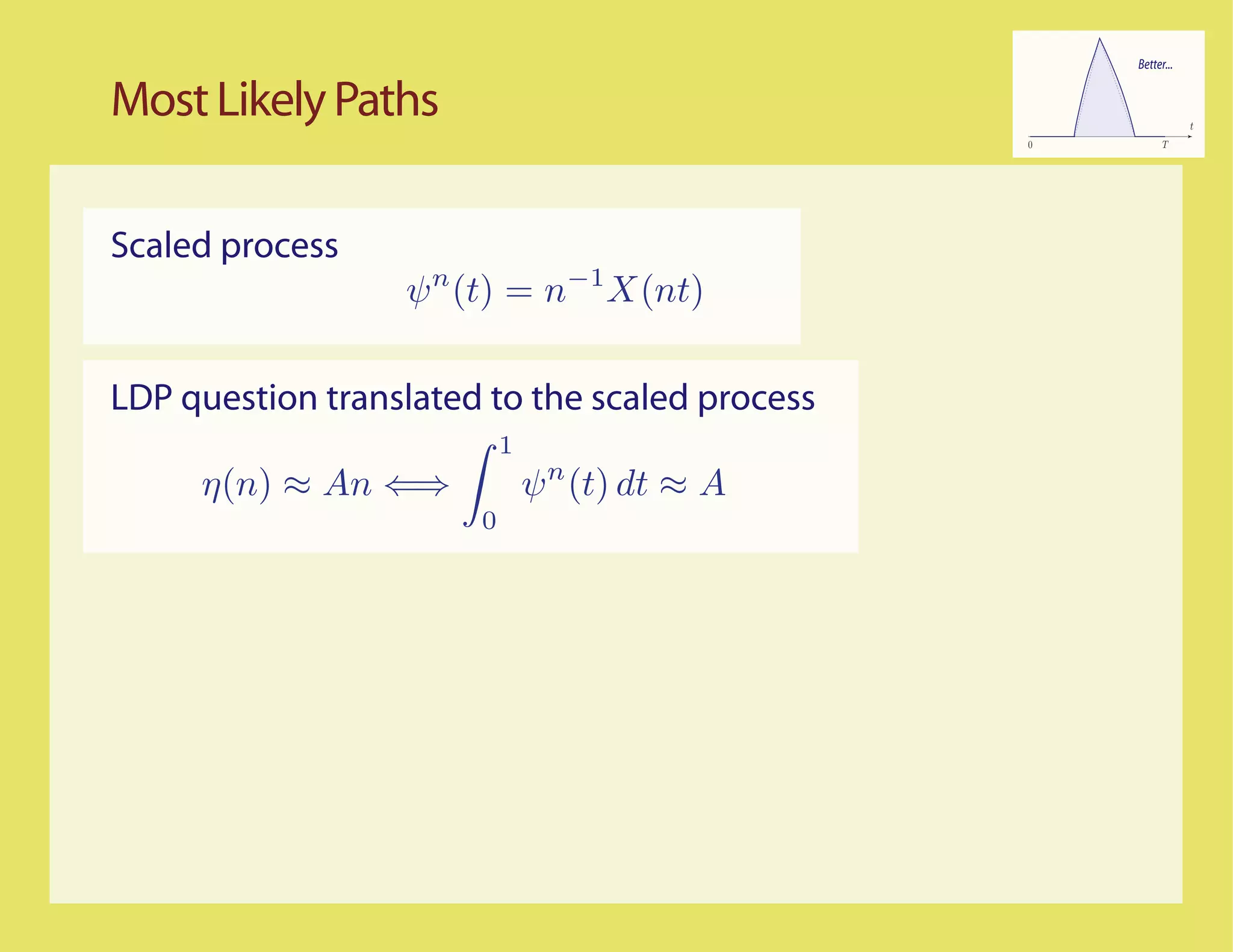
Scaled process
                  ψ n (t) = n−1 X(nt)

LDP question translated to the scaled process
                           1
     η(n) ≈ An ⇐⇒              ψ n (t) dt ≈ A
                       0
Better...


Most Likely Paths                                                          t
                                                        0            T


Scaled process
                  ψ n (t) = n−1 X(nt)

LDP question translated to the scaled process
                           1
     η(n) ≈ An ⇐⇒              ψ n (t) dt ≈ A
                       0


Basic assumption: The sample paths for the unconstrained
random walk with increments ∆ satisfy the LDP in D[0,1] with
good rate function IX
Better...


Most Likely Paths                                                                          t
                                                                     0               T


Scaled process
                  ψ n (t) = n−1 X(nt)

LDP question translated to the scaled process
                           1
     η(n) ≈ An ⇐⇒              ψ n (t) dt ≈ A
                       0


Basic assumption: The sample paths for the unconstrained
random walk with increments ∆ satisfy the LDP in D[0,1] with
good rate function IX
                                      1
           ¯
  IX (ψ) = ϑ+ ψ(0+) +                         ˙
                                          I∆ (ψ(t)) dt   For concave ψ, with
                                                         no downward jumps
                                  0
Better...


Most Likely Path Via Dynamic Programming                                    t
                                                            0         T


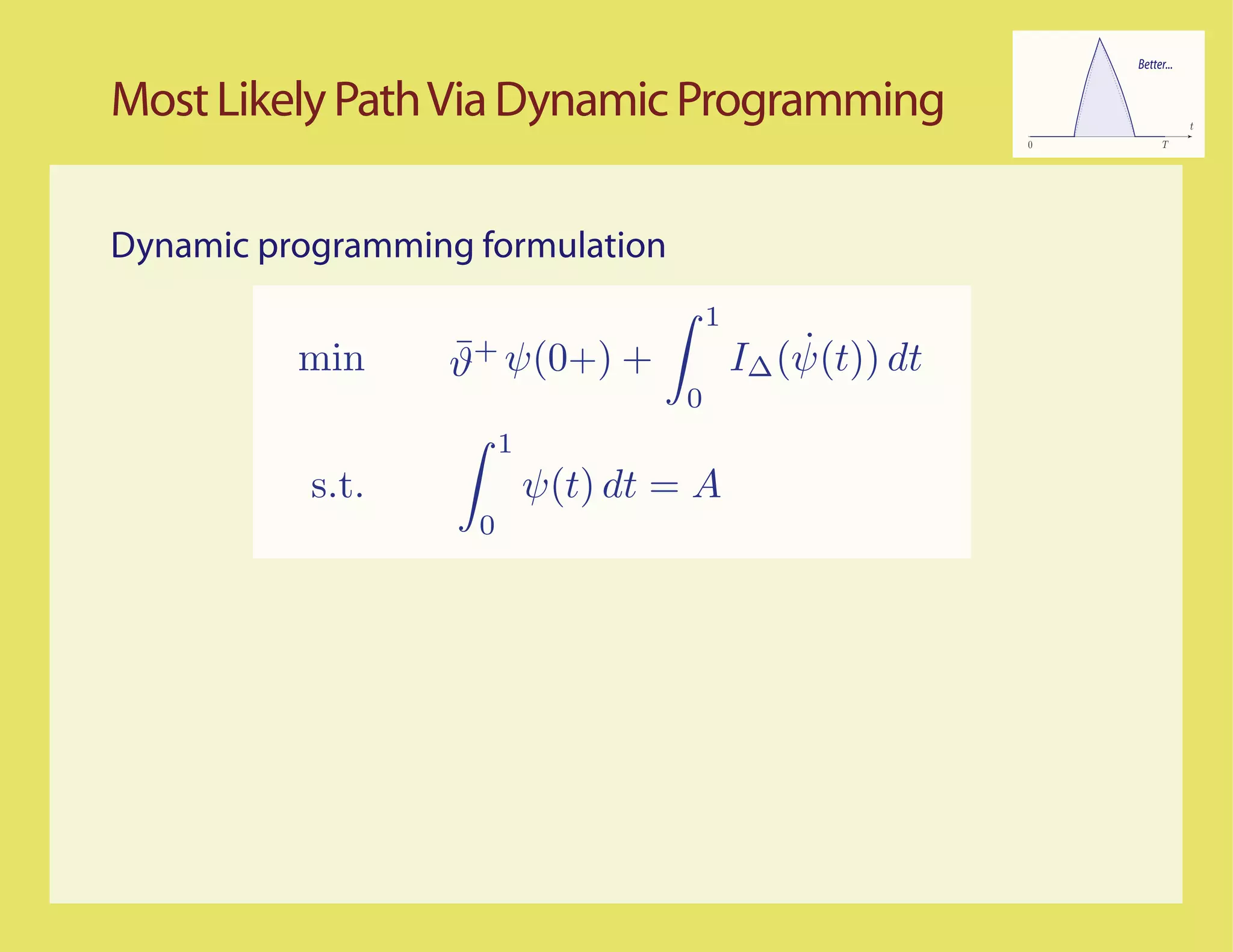
Dynamic programming formulation
                                         1
          min     ¯
                  ϑ+ ψ(0+) +                     ˙
                                             I∆ (ψ(t)) dt
                                     0
                        1
           s.t.             ψ(t) dt = A
                    0
Better...


 Most Likely Path Via Dynamic Programming                                                             t
                                                                                0               T


 Dynamic programming formulation
                                                    1
             min             ¯
                             ϑ+ ψ(0+) +                     ˙
                                                        I∆ (ψ(t)) dt
                                                0
                                   1
              s.t.                     ψ(t) dt = A
                               0


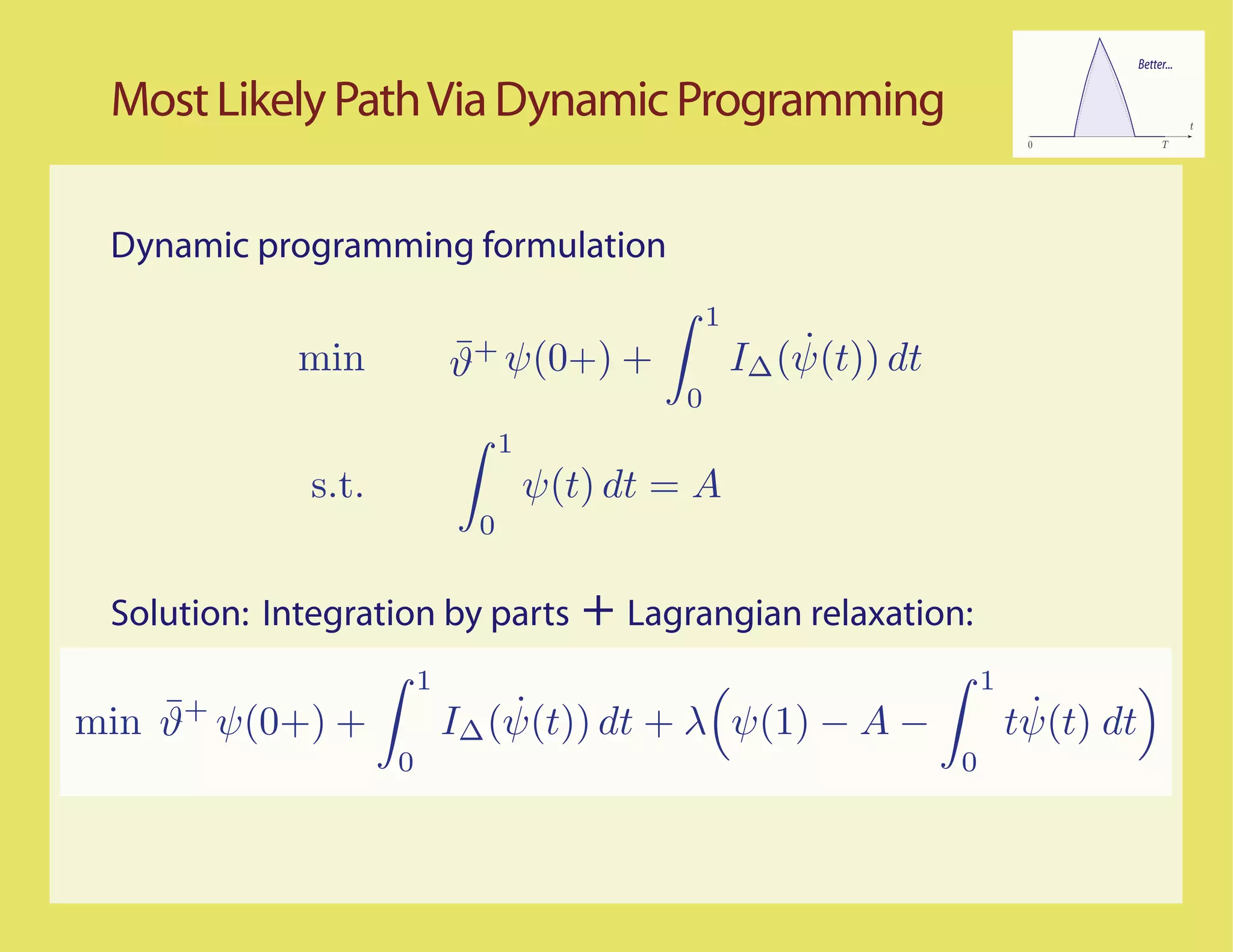
 Solution: Integration by parts           + Lagrangian relaxation:
                         1                                                 1
    ¯
min ϑ+ ψ(0+) +                   ˙
                             I∆ (ψ(t)) dt + λ ψ(1) − A −                        ˙
                                                                               tψ(t) dt
                     0                                                 0
Better...


 Most Likely Path Via Dynamic Programming                                                          t
                                                                             0               T


                                1                                       1
    ¯
min ϑ+ ψ(0+) +                          ˙
                                    I∆ (ψ(t)) dt + λ ψ(1) − A −              ˙
                                                                            tψ(t) dt
                            0                                       0


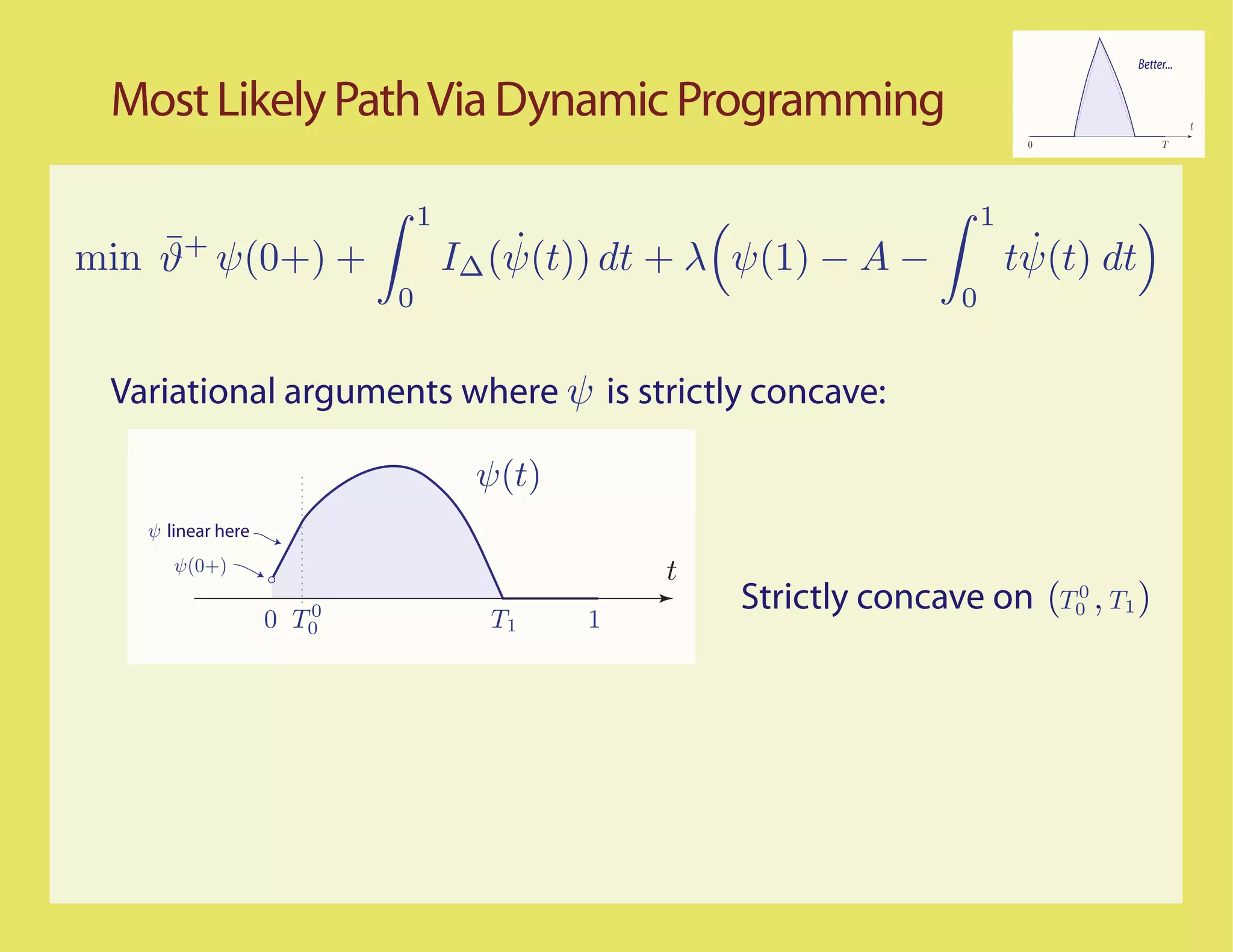
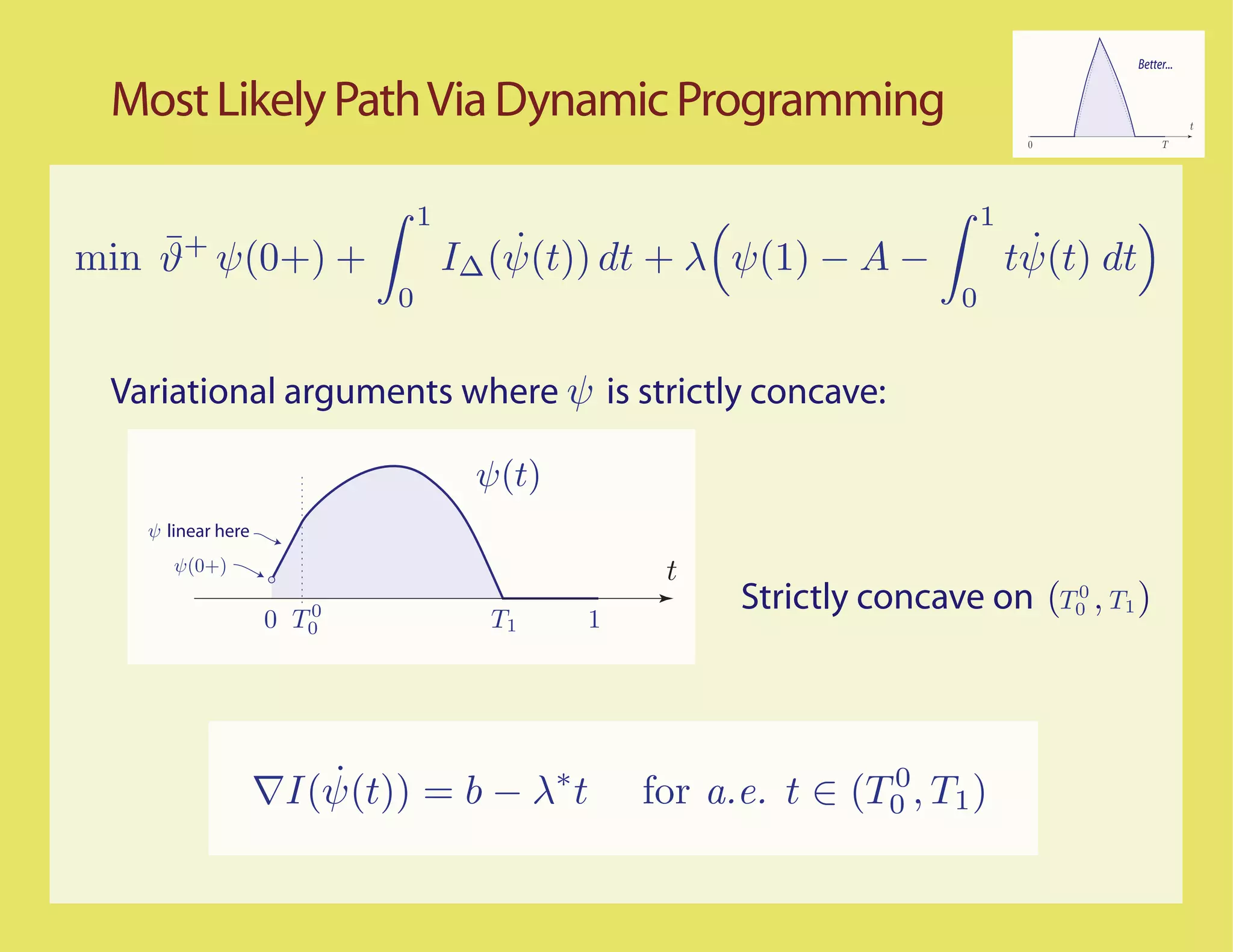
 Variational arguments where ψ is strictly concave:

                                     ψ(t)
   ψ linear here
      ψ(0+)                                     t
                        0                           Strictly concave on (T00 , T1 )
                   0   T0             T1    1
Better...


 Most Likely Path Via Dynamic Programming                                                             t
                                                                                0               T


                                 1                                         1
    ¯
min ϑ+ ψ(0+) +                           ˙
                                     I∆ (ψ(t)) dt + λ ψ(1) − A −                ˙
                                                                               tψ(t) dt
                             0                                         0


 Variational arguments where ψ is strictly concave:

                                      ψ(t)
   ψ linear here
      ψ(0+)                                       t
                        0                              Strictly concave on (T00 , T1 )
                   0   T0              T1    1


                         ˙
                       I(ψ(t)) = b − λ∗ t                       0
                                                 for a.e. t ∈ (T0 , T1 )
ψ(t)


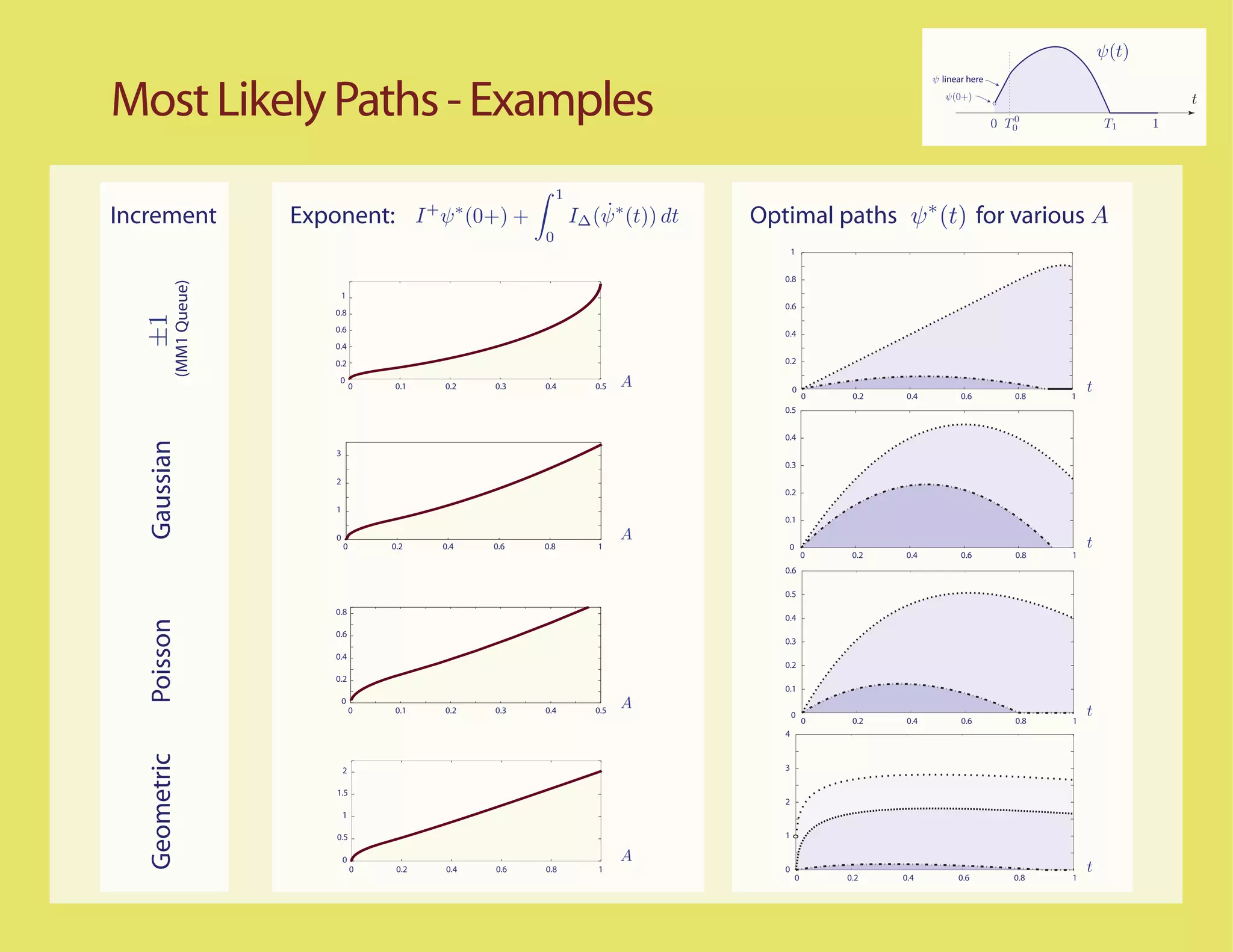
Most Likely Paths - Examples
                                                                                                                          ψ linear here
                                                                                                                             ψ(0+)                                      t
                                                                                                                                               0
                                                                                                                                          0   T0             T1     1


                                                                      1
Increment               Exponent: I ψ (0+) +  +         ∗                     ˙
                                                                          I∆ (ψ ∗ (t)) dt   Optimal paths ψ ∗ (t) for various A
                                                                  0
                                                                                                   1


                                                                                               0.8
          (MM1 Queue)


                               1
                                                                                               0.6
                           0.8
   ±1


                           0.6                                                                 0.4
                           0.4
                           0.2                                                                 0.2

                            0
                                   0   0.1        0.2       0.3   0.4        0.5   A               0                                                     t
                                                                                                        0    0.2    0.4          0.6           0.8   1
                                                                                               0.5


                                                                                               0.4
   Gaussian


                           3
                                                                                               0.3
                           2
                                                                                               0.2
                           1
                                                                                               0.1

                           0                                                       A                                                                     t
                               0       0.2        0.4       0.6   0.8         1                 0
                                                                                                        0    0.2   0.4           0.6           0.8   1
                                                                                               0.6

                                                                                               0.5

                           0.8
                                                                                               0.4
   Poisson


                           0.6
                                                                                               0.3
                           0.4
                                                                                               0.2
                           0.2
                                                                                               0.1
                               0
                                   0   0.1        0.2       0.3   0.4        0.5
                                                                                   A                                                                     t
                                                                                                   0
                                                                                                        0    0.2    0.4          0.6           0.8   1
                                                                                               4
   Geometric


                               2                                                               3

                           1.5
                                                                                               2
                               1

                           0.5                                                                 1

                               0                                                   A
                                   0    0.2       0.4       0.6   0.8         1                0                                                         t
                                                                                                    0       0.2    0.4          0.6            0.8   1
ψ(t)


     Most Likely Paths - Examples
                                                                        ψ linear here
                                                                           ψ(0+)                            t
                                                                                             0
                                                                                        0   T0   T1     1


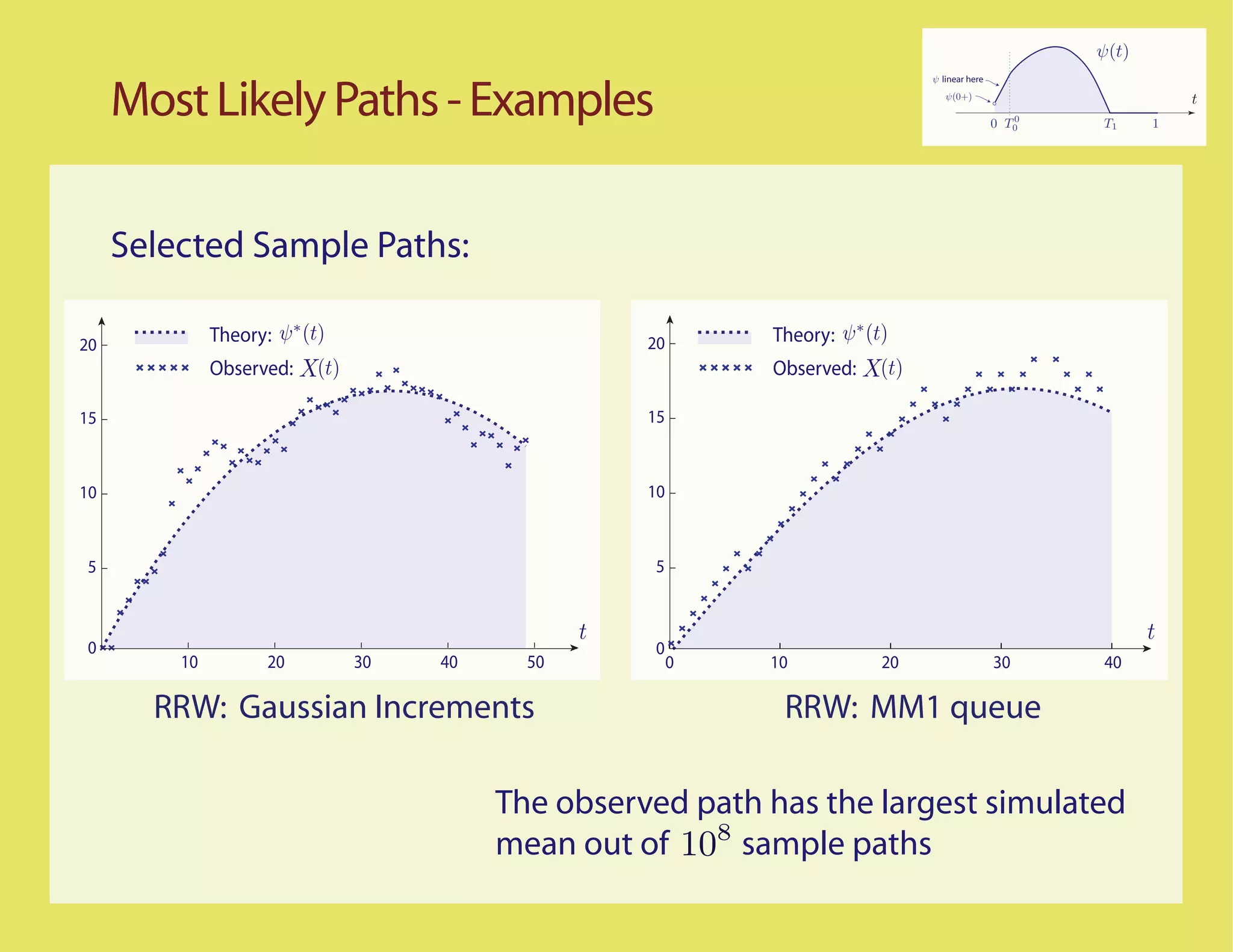
     Selected Sample Paths:

20
              Theory:                           20       Theory:
              Observed: X                                Observed: X

15                                              15


10                                              10


5                                               5


0                                               0
         10         20      30   40     50           0   10        20                   30       40

       RRW: Gaussian Increments                           RRW: MM1 queue

                                      The observed path has the largest simulated
                                      mean out of 108 sample paths
Conclusions
Summary

It is widely known that simulation variance
is high in “heavy traffic” for queueing models
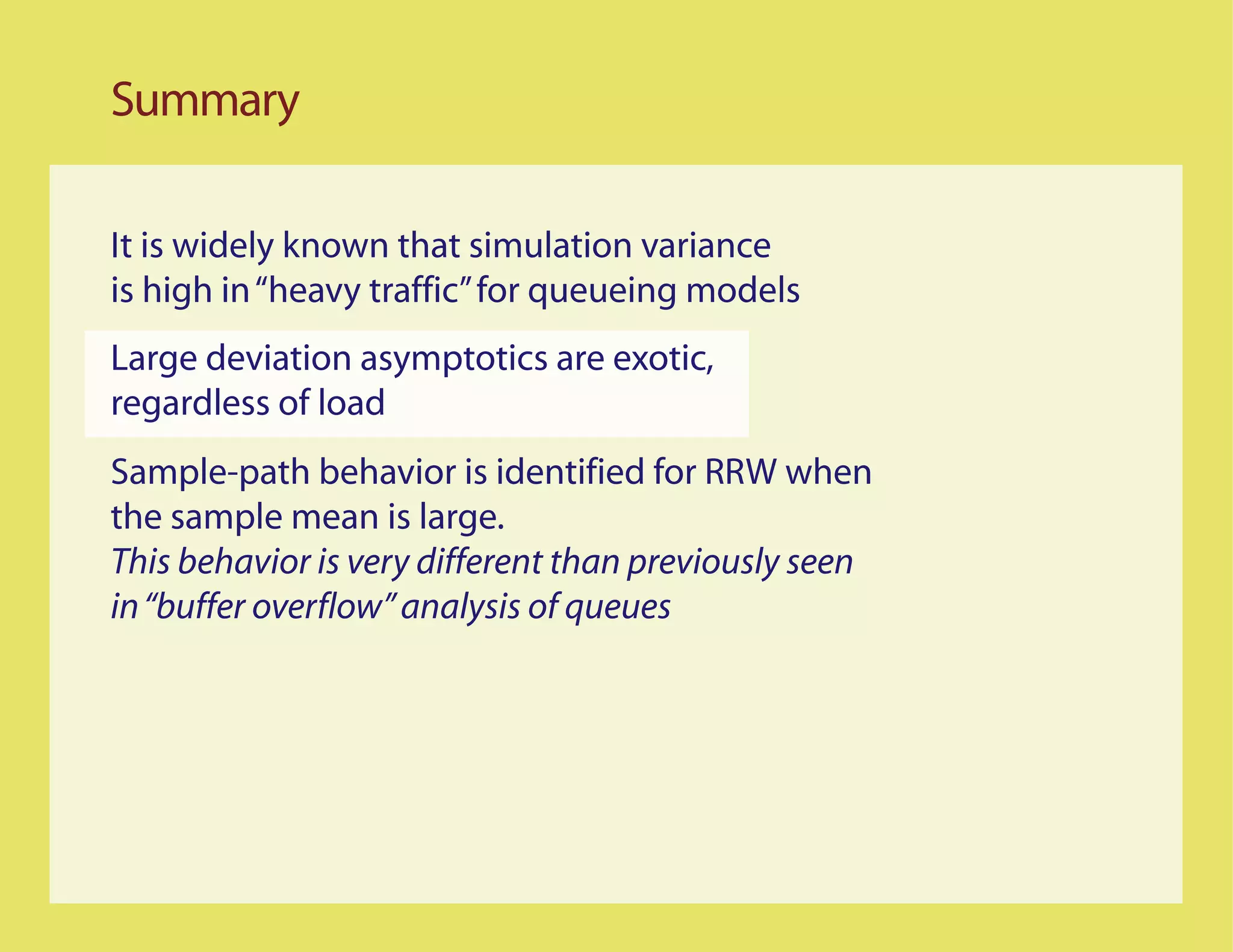
Large deviation asymptotics are exotic,
regardless of load
Sample-path behavior is identified for RRW when
the sample mean is large.
This behavior is very different than previously seen
in “buffer overflow” analysis of queues
Summary

It is widely known that simulation variance
is high in “heavy traffic” for queueing models
Large deviation asymptotics are exotic,
regardless of load
Sample-path behavior is identified for RRW when
the sample mean is large.
This behavior is very different than previously seen
in “buffer overflow” analysis of queues


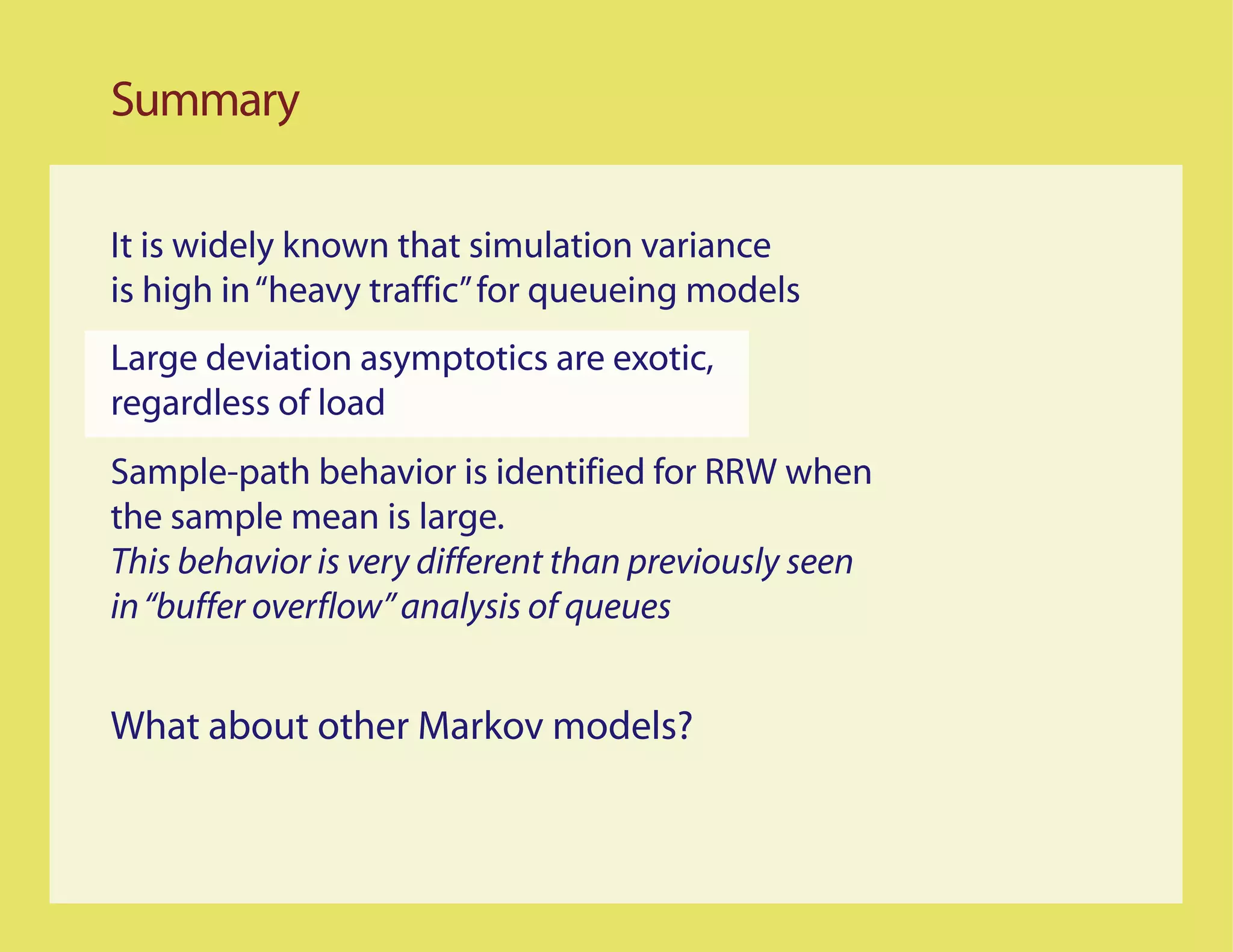
What about other Markov models?
MM1 queue - the nicest of Markov chains


What about other Markov models?

           •   Reversible
           •   Skip-free
           •   Monotone
           •   Marginal distribution geometric
           •   Geometrically ergodic
MM1 queue - the nicest of Markov chains


What about other Markov models?

             •   Reversible
             •   Skip-free
             •   Monotone
             •   Marginal distribution geometric
             •   Geometrically ergodic

The skip-free property makes
the fluid model analysis possible. Similar behavior in
                                    • Fixed-gain SA
                                    • Some MCMC algorithms
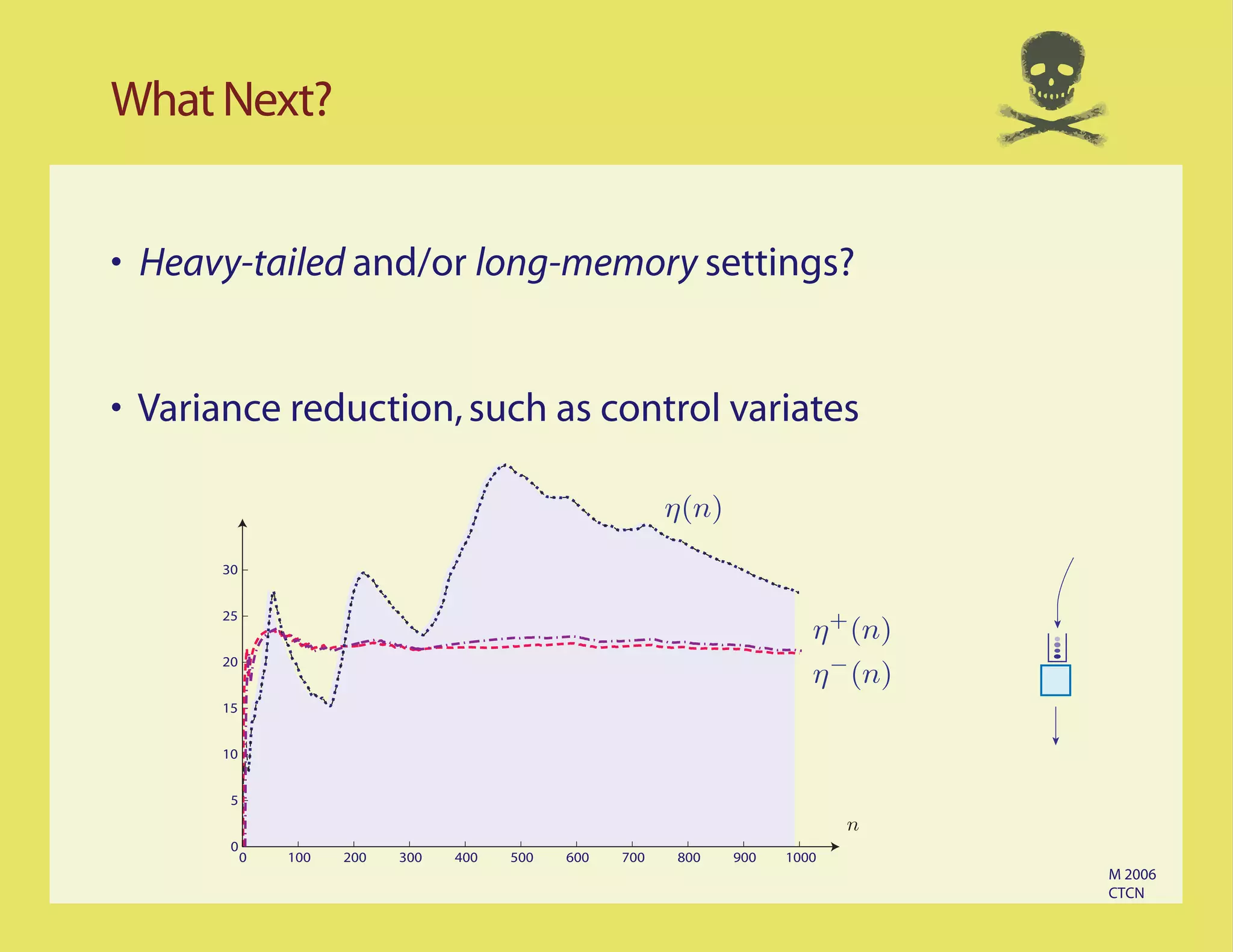
What Next?


• Heavy-tailed and/or long-memory settings?
What Next?


• Heavy-tailed and/or long-memory settings?


• Variance reduction, such as control variates

                                                         η(n)
      30


      25
                                                                         η + (n)
                                                                         η − (n)
      20


      15


      10


       5
                                                                             n
       0
           0   100   200   300   400   500   600   700   800    900   1000
                                                                                   M 2006
                                                                                   CTCN
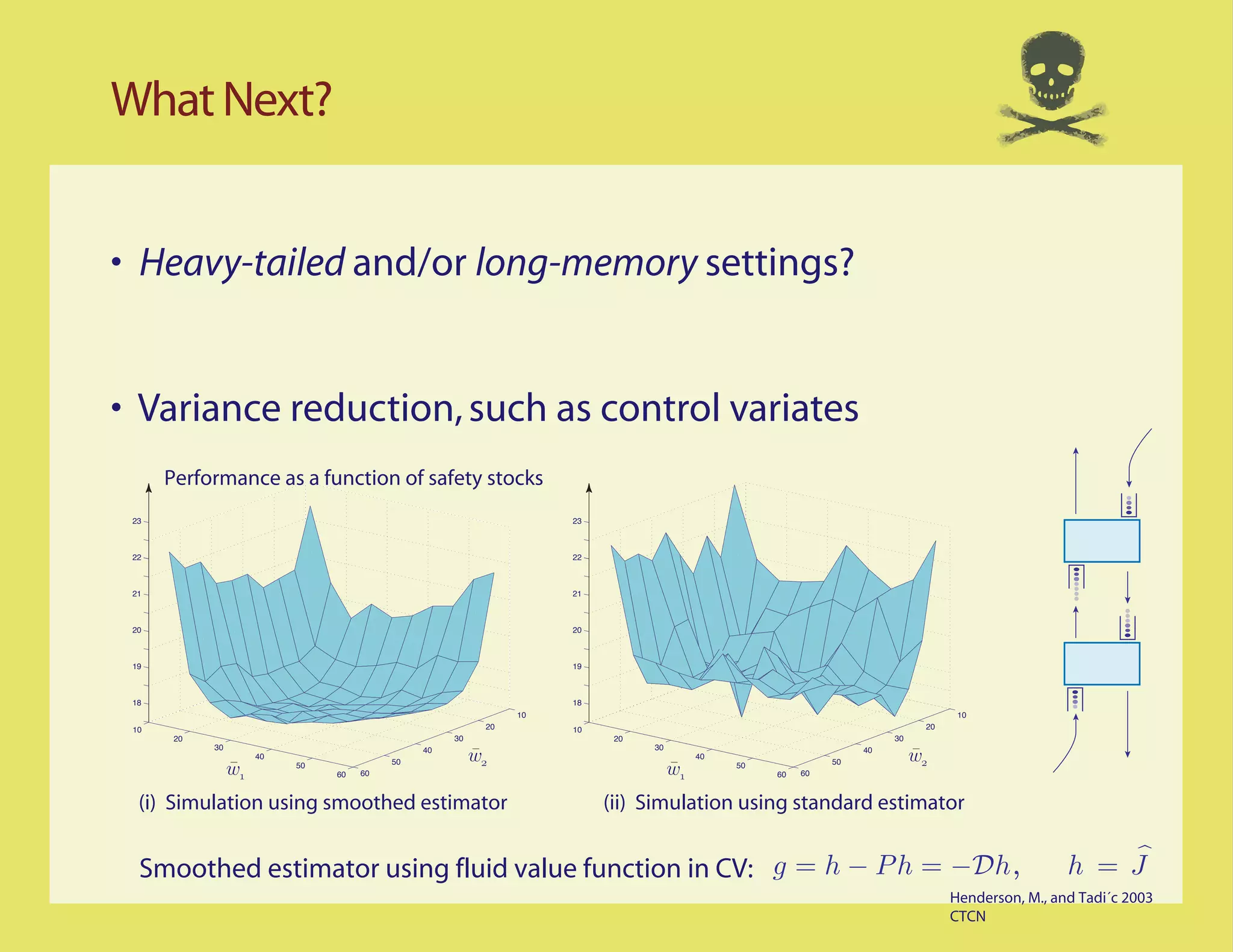
What Next?


• Heavy-tailed and/or long-memory settings?


• Variance reduction, such as control variates
      Performance as a function of safety stocks
 23                                                                 23


 22                                                                 22


 21                                                                 21


 20                                                                 20


 19                                                                 19


 18                                                                 18
                                                               10                                                                  10
 10                                                       20        10                                                       20
       20                                           30                    20                                           30
            30                                 40                              30                                 40
                      40
                           50             50             w                              40
                                                                                              50             50             w
                 w             60   60                                             w             60   60


  (i) Simulation using smoothed estimator                                (ii) Simulation using standard estimator

                                                                                                                                                       ˆ
  Smoothed estimator using fluid value function in CV: g = h − P h = −Dh,                                                                          h = J
                                                                                                                                  Henderson, M., and Tadi´c 2003
                                                                                                                                  CTCN
What Next?


• Heavy-tailed and/or long-memory settings?


• Variance reduction, such as control variates


• Original question? Conjecture,

          1
     lim √ log P η(n) ≥ r = −Jη (r) < 0,            r>η
    n→∞    n

                                          for some range of r
[1] S. P. Meyn. Large deviation asymptotics and control variates for simulating large functions. Ann. Appl.
                                                                                                                      Probab., 16(1):310–339, 2006.

                                                                                                                  [2] S. P. Meyn. Control Techniques for Complex Networks. Cambridge University Press, Cambridge, 2007.

                                                                                                                  [3] K. R. Duffy and S. P. Meyn. Most likely paths to error when estimating the mean of a reflected random
                                                                                                                      walk. http://arxiv.org/abs/0906.4514, June 2009.


         References                                                                                               [1] I. Kontoyiannis and S. P. Meyn. Spectral theory and limit theorems for geometrically ergodic Markov
                                                                                                                      processes. Ann. Appl. Probab., 13:304–362, 2003. Presented at the INFORMS Applied Probability
                                                                                                                      Conference, NYC, July, 2001.

                                                                                                                  [2] I. Kontoyiannis and S. P. Meyn. Large deviations asymptotics and the spectral theory of multiplicatively
                                                                                                                      regular Markov processes. Electron. J. Probab., 10(3):61–123 (electronic), 2005.


                                                                                                                  [1] G. Fort, S. Meyn, E. Moulines, and P. Priouret. ODE methods for skip-free Markov chain stability with
                                                                                                                      applications to MCMC. Ann. Appl. Probab., 18(2):664–707, 2008.
                                                                                                                  [2] V. S. Borkar and S. P. Meyn. The O.D.E. method for convergence of stochastic approximation and
                                                                                                                      reinforcement learning. SIAM J. Control Optim., 38(2):447–469, 2000.
LDPs for RRW


               [1] S. P. Meyn. Large deviation asymptotics and control variates for simulating large functions. Ann. Appl.
                   Probab., 16(1):310–339, 2006.

               [2] S. P. Meyn. Control Techniques for Complex Networks. Cambridge University Press, Cambridge, 2007.

               [3] K. R. Duffy and S. P. Meyn. Most likely paths to error when estimating the mean of a reflected random
                   walk. http://arxiv.org/abs/0906.4514, June 2009.
Exact LDPs


               [1] I. Kontoyiannis and S. P. Meyn. Spectral theory and limit theorems for geometrically ergodic Markov
                   processes. Ann. Appl. Probab., 13:304–362, 2003.
               [2] I. Kontoyiannis and S. P. Meyn. Large deviations asymptotics and the spectral theory of multiplicatively
                   regular Markov processes. Electron. J. Probab., 10(3):61–123 (electronic), 2005.
Simulation


               [1] S. G. Henderson, S. P. Meyn, and V. B. Tadi´. Performance evaluation and policy selection in multiclass
                                                                c
                   networks. Discrete Event Dynamic Systems: Theory and Applications, 13(1-2):149–189, 2003. Special
                   issue on learning, optimization and decision making (invited).
               [2] S. P. Meyn. Control Techniques for Complex Networks. Cambridge University Press, Cambridge, 2007.


               [1] G. Fort, S. Meyn, E. Moulines, and P. Priouret. ODE methods for skip-free Markov chain stability with
                   applications to MCMC. Ann. Appl. Probab., 18(2):664–707, 2008.

               [2] V. S. Borkar and S. P. Meyn. The ODE method for convergence of stochastic approximation and
                   reinforcement learning. SIAM J. Control Optim., 38(2):447–469, 2000.

Why are stochastic networks so hard to simulate?

  • 1.
    Why are reflectedrandom walks so hard to simulate ? Sean Meyn Department of Electrical and Computer Engineering and the Coordinated Science Laboratory University of Illinois Joint work with Ken Duffy - Hamilton Institute, National University of Ireland NSF support: ECS-0523620
  • 2.
    References (Skip this advertisement)
  • 3.
    Outline Motivation Reflected Random Walks WhySo Lopsided? 0 T 20 Theory: Observed: X Most Likely Paths 16 12 8 4 0 0 10 20 30 40 50 Summary and Conclusions
  • 4.
    MM1 queue -the nicest of Markov chains For the stable queue, with load strictly less than one, it is • Reversible • Skip-free • Monotone • Marginal distribution geometric • Geometrically ergodic
  • 5.
    MM1 queue -the nicest of Markov chains For the stable queue, with load strictly less than one, it is • Reversible • Skip-free • Monotone • Marginal distribution geometric • Geometrically ergodic Why then, can’t I simulate my queue?
  • 6.
    MM1 queue -the nicest of Markov chains Ch 11 CTCN 1000 800 Gaussian density 600 Histogram 100,000 1 400 √ X(t) − η 100,000 t=1 200 MM1 queue 0 ρ = 0.9 −1000 −500 0 500 1000 1500 2000 Why then, can’t I simulate my queue?
  • 7.
  • 8.
    Reflected Random Walk Areflected random walk where is the initial condition, and the increments ∆ are i.i.d.
  • 9.
    Reflected Random Walk Areflected random walk where is the initial condition, and the increments ∆ are i.i.d. Basic stability assumption: and finite second moment
  • 10.
    MM1 queue -the nicest of Markov chains Reflected random walk with increments, Load condition
  • 11.
    Reflected Random Walk Areflected random walk where is the initial condition, and the increments ∆ are i.i.d. Basic stability assumption: Basic question: Can I compute sample path averages to estimate the steady-state mean?
  • 12.
    Simulating the RRW:Asymptotic Variance The CLT requires a third moment for the increments E[∆(0)] < 0 and E[∆(0)3 ] < ∞ 1 Asymptotic variance = O (1 − ρ)4 Whitt 1989 Asmussen 1992
  • 13.
    Simulating the RRW:Asymptotic Variance The CLT requires a third moment for the increments E[∆(0)] < 0 and E[∆(0)3 ] < ∞ 1 Asymptotic variance = O (1 − ρ)4 Ch 11 CTCN 1000 800 Gaussian density 600 Histogram 100,000 1 400 √ X(t) − η 100,000 t=1 200 MM1 queue 0 ρ = 0.9 −1000 −500 0 500 1000 1500 2000
  • 14.
    Simulating the RRW:Lopsided Statistics Assume only negative drift, and finite second moment: E[∆(0)] < 0 and E[∆(0)2 ] < ∞ Lower LDP asymptotics: For each r < η , 1 lim log P η(n) ≤ r n→∞ n = −I(r) < 0 M 2006
  • 15.
    Simulating the RRW:Lopsided Statistics Assume only negative drift, and finite second moment: E[∆(0)] < 0 and E[∆(0)2 ] < ∞ Lower LDP asymptotics: For each r < η , 1 lim log P η(n) ≤ r n→∞ n = −I(r) < 0 M 2006 Upper LDP asymptotics are null: For each r ≥ η , 1 lim log P η(n) ≥ r = 0 M 2006 n→∞ n CTCN even for the MM1 queue!
  • 16.
  • 17.
    Lower LDP Construct thefamily of twisted transition laws ˇ ˇ ˇ (x, dy) = eθx−Λ(θ)+F (x) P (x, dy)eF (y) P θ<0
  • 18.
    Lower LDP Construct thefamily of twisted transition laws ˇ ˇ ˇ (x, dy) = eθx−Λ(θ)+F (x) P (x, dy)eF (y) P θ<0 Geometric ergodicity of the twisted chain implies multiplicative ergodic theorems, and thence Bahadur-Rao LDP asymptotics Kontoyiannis & M 2003, 2005 M 2006
  • 19.
    Lower LDP Construct thefamily of twisted transition laws ˇ ˇ ˇ (x, dy) = eθx−Λ(θ)+F (x) P (x, dy)eF (y) P θ<0 Geometric ergodicity of the twisted chain implies multiplicative ergodic theorems, and thence Bahadur-Rao LDP asymptotics Kontoyiannis & M 2003, 2005 M 2006 This is only possible when θ is negative
  • 20.
    Null Upper LDP:What is the area of a triangle? 1 A= 2 bh h b
  • 21.
    Null Upper LDP:What is the area of a triangle? 1 A= 2 bh X(t) η(n) ≈ n−1 A h t 0 T b
  • 22.
    Null Upper LDP:Area of a Triangle? Consider the scaling T =n η(n) ≈ n−1 A h = γn Base obtained from most likely path to this height: b = β∗n e.g., Ganesh, O’Connell, and Wischik, 2004 X(t) Large deviations for reflected random walk: h t 0 T b
  • 23.
    Null Upper LDP:Area of a Triangle Consider the scaling T =n η(n) ≈ n−1 A h = γn An = 1 γβ ∗ n2 2 b = β∗n X(t) Upper LDP is null: For any γ, h t 0 T M 2006 b CTCN 2008 (see also Borovkov, et. al. 2003)
  • 24.
  • 25.
    What Is TheMost Likely Area? Are triangular excursions optimal? Most likely path? t 0 T
  • 26.
    What Is TheMost Likely Area? Triangular excursions are not optimal: Better... t 0 T A concave perturbation: greatly increased area at modest “cost”
  • 27.
    Better... Most Likely Paths t 0 T Scaled process ψ n (t) = n−1 X(nt) LDP question translated to the scaled process Duffy and M 2009, ...
  • 28.
    Better... Most Likely Paths t 0 T Scaled process ψ n (t) = n−1 X(nt) LDP question translated to the scaled process 1 η(n) ≈ An ⇐⇒ ψ n (t) dt ≈ A 0
  • 29.
    Better... Most Likely Paths t 0 T Scaled process ψ n (t) = n−1 X(nt) LDP question translated to the scaled process 1 η(n) ≈ An ⇐⇒ ψ n (t) dt ≈ A 0 Basic assumption: The sample paths for the unconstrained random walk with increments ∆ satisfy the LDP in D[0,1] with good rate function IX
  • 30.
    Better... Most Likely Paths t 0 T Scaled process ψ n (t) = n−1 X(nt) LDP question translated to the scaled process 1 η(n) ≈ An ⇐⇒ ψ n (t) dt ≈ A 0 Basic assumption: The sample paths for the unconstrained random walk with increments ∆ satisfy the LDP in D[0,1] with good rate function IX 1 ¯ IX (ψ) = ϑ+ ψ(0+) + ˙ I∆ (ψ(t)) dt For concave ψ, with no downward jumps 0
  • 31.
    Better... Most Likely PathVia Dynamic Programming t 0 T Dynamic programming formulation 1 min ¯ ϑ+ ψ(0+) + ˙ I∆ (ψ(t)) dt 0 1 s.t. ψ(t) dt = A 0
  • 32.
    Better... Most LikelyPath Via Dynamic Programming t 0 T Dynamic programming formulation 1 min ¯ ϑ+ ψ(0+) + ˙ I∆ (ψ(t)) dt 0 1 s.t. ψ(t) dt = A 0 Solution: Integration by parts + Lagrangian relaxation: 1 1 ¯ min ϑ+ ψ(0+) + ˙ I∆ (ψ(t)) dt + λ ψ(1) − A − ˙ tψ(t) dt 0 0
  • 33.
    Better... Most LikelyPath Via Dynamic Programming t 0 T 1 1 ¯ min ϑ+ ψ(0+) + ˙ I∆ (ψ(t)) dt + λ ψ(1) − A − ˙ tψ(t) dt 0 0 Variational arguments where ψ is strictly concave: ψ(t) ψ linear here ψ(0+) t 0 Strictly concave on (T00 , T1 ) 0 T0 T1 1
  • 34.
    Better... Most LikelyPath Via Dynamic Programming t 0 T 1 1 ¯ min ϑ+ ψ(0+) + ˙ I∆ (ψ(t)) dt + λ ψ(1) − A − ˙ tψ(t) dt 0 0 Variational arguments where ψ is strictly concave: ψ(t) ψ linear here ψ(0+) t 0 Strictly concave on (T00 , T1 ) 0 T0 T1 1 ˙ I(ψ(t)) = b − λ∗ t 0 for a.e. t ∈ (T0 , T1 )
  • 35.
    ψ(t) Most Likely Paths- Examples ψ linear here ψ(0+) t 0 0 T0 T1 1 1 Increment Exponent: I ψ (0+) + + ∗ ˙ I∆ (ψ ∗ (t)) dt Optimal paths ψ ∗ (t) for various A 0 1 0.8 (MM1 Queue) 1 0.6 0.8 ±1 0.6 0.4 0.4 0.2 0.2 0 0 0.1 0.2 0.3 0.4 0.5 A 0 t 0 0.2 0.4 0.6 0.8 1 0.5 0.4 Gaussian 3 0.3 2 0.2 1 0.1 0 A t 0 0.2 0.4 0.6 0.8 1 0 0 0.2 0.4 0.6 0.8 1 0.6 0.5 0.8 0.4 Poisson 0.6 0.3 0.4 0.2 0.2 0.1 0 0 0.1 0.2 0.3 0.4 0.5 A t 0 0 0.2 0.4 0.6 0.8 1 4 Geometric 2 3 1.5 2 1 0.5 1 0 A 0 0.2 0.4 0.6 0.8 1 0 t 0 0.2 0.4 0.6 0.8 1
  • 36.
    ψ(t) Most Likely Paths - Examples ψ linear here ψ(0+) t 0 0 T0 T1 1 Selected Sample Paths: 20 Theory: 20 Theory: Observed: X Observed: X 15 15 10 10 5 5 0 0 10 20 30 40 50 0 10 20 30 40 RRW: Gaussian Increments RRW: MM1 queue The observed path has the largest simulated mean out of 108 sample paths
  • 37.
  • 38.
    Summary It is widelyknown that simulation variance is high in “heavy traffic” for queueing models Large deviation asymptotics are exotic, regardless of load Sample-path behavior is identified for RRW when the sample mean is large. This behavior is very different than previously seen in “buffer overflow” analysis of queues
  • 39.
    Summary It is widelyknown that simulation variance is high in “heavy traffic” for queueing models Large deviation asymptotics are exotic, regardless of load Sample-path behavior is identified for RRW when the sample mean is large. This behavior is very different than previously seen in “buffer overflow” analysis of queues What about other Markov models?
  • 40.
    MM1 queue -the nicest of Markov chains What about other Markov models? • Reversible • Skip-free • Monotone • Marginal distribution geometric • Geometrically ergodic
  • 41.
    MM1 queue -the nicest of Markov chains What about other Markov models? • Reversible • Skip-free • Monotone • Marginal distribution geometric • Geometrically ergodic The skip-free property makes the fluid model analysis possible. Similar behavior in • Fixed-gain SA • Some MCMC algorithms
  • 42.
    What Next? • Heavy-tailedand/or long-memory settings?
  • 43.
    What Next? • Heavy-tailedand/or long-memory settings? • Variance reduction, such as control variates η(n) 30 25 η + (n) η − (n) 20 15 10 5 n 0 0 100 200 300 400 500 600 700 800 900 1000 M 2006 CTCN
  • 44.
    What Next? • Heavy-tailedand/or long-memory settings? • Variance reduction, such as control variates Performance as a function of safety stocks 23 23 22 22 21 21 20 20 19 19 18 18 10 10 10 20 10 20 20 30 20 30 30 40 30 40 40 50 50 w 40 50 50 w w 60 60 w 60 60 (i) Simulation using smoothed estimator (ii) Simulation using standard estimator ˆ Smoothed estimator using fluid value function in CV: g = h − P h = −Dh, h = J Henderson, M., and Tadi´c 2003 CTCN
  • 45.
    What Next? • Heavy-tailedand/or long-memory settings? • Variance reduction, such as control variates • Original question? Conjecture, 1 lim √ log P η(n) ≥ r = −Jη (r) < 0, r>η n→∞ n for some range of r
  • 46.
    [1] S. P.Meyn. Large deviation asymptotics and control variates for simulating large functions. Ann. Appl. Probab., 16(1):310–339, 2006. [2] S. P. Meyn. Control Techniques for Complex Networks. Cambridge University Press, Cambridge, 2007. [3] K. R. Duffy and S. P. Meyn. Most likely paths to error when estimating the mean of a reflected random walk. http://arxiv.org/abs/0906.4514, June 2009. References [1] I. Kontoyiannis and S. P. Meyn. Spectral theory and limit theorems for geometrically ergodic Markov processes. Ann. Appl. Probab., 13:304–362, 2003. Presented at the INFORMS Applied Probability Conference, NYC, July, 2001. [2] I. Kontoyiannis and S. P. Meyn. Large deviations asymptotics and the spectral theory of multiplicatively regular Markov processes. Electron. J. Probab., 10(3):61–123 (electronic), 2005. [1] G. Fort, S. Meyn, E. Moulines, and P. Priouret. ODE methods for skip-free Markov chain stability with applications to MCMC. Ann. Appl. Probab., 18(2):664–707, 2008. [2] V. S. Borkar and S. P. Meyn. The O.D.E. method for convergence of stochastic approximation and reinforcement learning. SIAM J. Control Optim., 38(2):447–469, 2000. LDPs for RRW [1] S. P. Meyn. Large deviation asymptotics and control variates for simulating large functions. Ann. Appl. Probab., 16(1):310–339, 2006. [2] S. P. Meyn. Control Techniques for Complex Networks. Cambridge University Press, Cambridge, 2007. [3] K. R. Duffy and S. P. Meyn. Most likely paths to error when estimating the mean of a reflected random walk. http://arxiv.org/abs/0906.4514, June 2009. Exact LDPs [1] I. Kontoyiannis and S. P. Meyn. Spectral theory and limit theorems for geometrically ergodic Markov processes. Ann. Appl. Probab., 13:304–362, 2003. [2] I. Kontoyiannis and S. P. Meyn. Large deviations asymptotics and the spectral theory of multiplicatively regular Markov processes. Electron. J. Probab., 10(3):61–123 (electronic), 2005. Simulation [1] S. G. Henderson, S. P. Meyn, and V. B. Tadi´. Performance evaluation and policy selection in multiclass c networks. Discrete Event Dynamic Systems: Theory and Applications, 13(1-2):149–189, 2003. Special issue on learning, optimization and decision making (invited). [2] S. P. Meyn. Control Techniques for Complex Networks. Cambridge University Press, Cambridge, 2007. [1] G. Fort, S. Meyn, E. Moulines, and P. Priouret. ODE methods for skip-free Markov chain stability with applications to MCMC. Ann. Appl. Probab., 18(2):664–707, 2008. [2] V. S. Borkar and S. P. Meyn. The ODE method for convergence of stochastic approximation and reinforcement learning. SIAM J. Control Optim., 38(2):447–469, 2000.