Team Management...

?
?
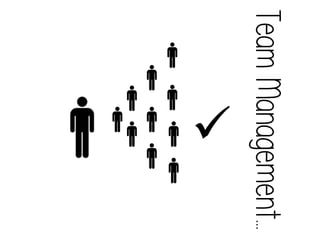
Team management refers to
techniques, processes and tools
for organizing and coordination
a group of individual working
towards a common goal
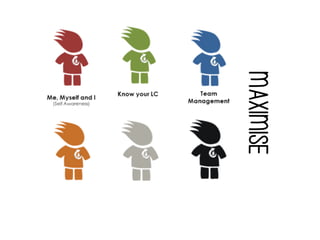
MAXIMISE


Self
Awareness
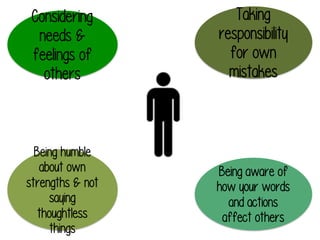
Considering
needs &
feelings of
others

Taking
responsibility
for own
mistakes

Being humble
about own
strengths & not
saying
thoughtless
things

Being aware of
how your words
and actions
affect others
Dress Rehearsal
Conflict Resolution
A conflict is a clash of interests of
at least two persons or groups,
which at least particularly are
contradictory to each other
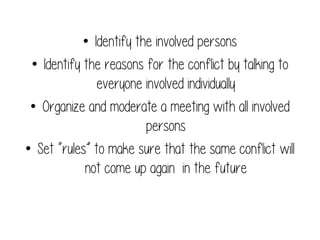
•  Identify the involved persons
•  Identify the reasons for the conflict by talking to
everyone involved individually
•  Organize and moderate a meeting with all involved
persons
•  Set “rules” to make sure that the same conflict will
not come up again in the future
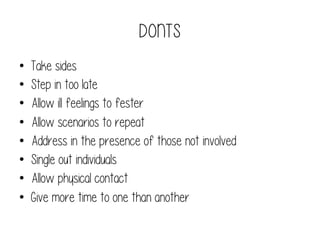
DONTS
• 
• 
• 
• 
• 
• 
• 
• 

Take sides
Step in too late
Allow ill feelings to fester
Allow scenarios to repeat
Address in the presence of those not involved
Single out individuals
Allow physical contact
Give more time to one than another
Feedback Talks
information about reactions to a
product, a person's performance of
a task, etc. which is used as a basis
for improvement.
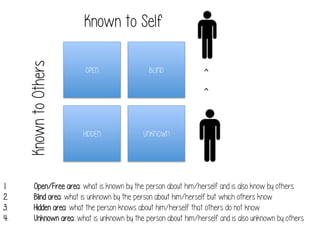
Known to Others

Known to Self

1. 
2. 
3. 
4. 

OPEN

BLIND

HIDDEN

UNKNOWN

^
^

Open/Free area: what is known by the person about him/herself and is also know by others
Blind area: what is unknown by the person about him/herself but which others know
Hidden area: what the person knows about him/herself that others do not know
Unknown area: what is unknown by the person about him/herself and is also unknown by others
Open Area
• 

•  The open area increases as new information is shared:
•  Reducing the blind area by asking for and receiving feedback
Expanding on the hidden area by disclosing information or feelings and as others
ask questions
•  The unknown area can be reduced in different ways:
•  by others' observation (increasing the blind area);
•  by self-discovery (which increases the hidden area),
•  by mutual enlightenment - via group experiences and discussion - which
increases the open area as the unknown area reduces
Unknown
•  Ÿ Information, feelings, latent abilities, aptitudes, experiences that are unknown
by the person and unknown to others
•  Ÿ Can be prompted through self-discovery or observation by others, or through
collective and mutual discovery
•  Ÿ Uncovering « hidden talents » which are unknown skills and aptitudes, is
different from developping the « hidden area », not as sensitive as unknown
feelings
•  Ÿ Discovery through sensitive communications, active listening and experience,
will reduce the unknown area, transferring in part to the blind, hidden areas,
depending on who knows what, or better still if known by the person and
others, to the open free area
•  Ÿ The unknown area could also include repressed or subconscious feelings rooted
in formative events and traumatic past experiences, which can stay unknown
for a lifetime
•  Reduce the blind spot
•  Learn things about yourself by receiving feedback.
•  And give others the feedback they need to develop themselves
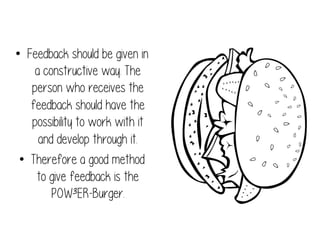
•  Feedback should be given in
a constructive way. The
person who receives the
feedback should have the
possibility to work with it
and develop through it. 
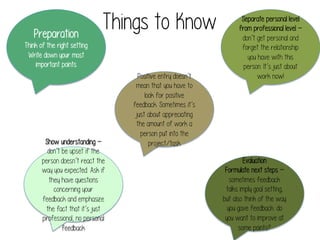
•  Therefore a good method
to give feedback is the
POW³ER-Burger.
Preparation 

Things to Know

Think of the right setting
Write down your most
important points

Show understanding –
don’t be upset if the
person doesn’t react the
way you expected. Ask if
they have questions
concerning your
feedback and emphasize
the fact that it’s just
professional, no personal
feedback

Positive entry doesn’t
mean that you have to
look for positive
feedback. Sometimes it’s
just about appreciating
the amount of work a
person put into the
project/task

Separate personal level
from professional level –
don’t get personal and
forget the relationship
you have with this
person. It’s just about
work now!

Evaluation 
Formulate next steps –
sometimes feedback
talks imply goal setting,
but also think of the way
you gave feedback: do
you want to improve at
some points?
DONTs
• 
• 
• 
• 

Give feedback to an individual openly
Forget the positive actions of each individual
Assume a situation or welfare of an individual
Don’t impose your activity standards or commitment on
others
•  Allow the personal to be the work
•  Ensure that sensitive issues are dealt with privately
•  Be blind to things that could negatively affect your team
Team Meetings
How best would you run a team meeting?
BE	
  
• 
• 
• 
• 
• 

Organized- room allocations, meeting objectives and activities
Create objectives
Be ontime (respecting the commitments of others)
Allow for clarifications of duties, task and roles
Make sure that members leave with confidence in their
roles and contributions
•  As productive and efficient as is possible
Delegation and Ownership
entrust (a task or responsibility) to another
person, typically one who is less senior than
oneself:
‘she must delegate duties so as to free
herself for more important tasks’
the power delegated to him must never be
misused
with object and infinitive send or authorize
(someone) to do something as a
representative:
Edward was delegated to meet new arrivals
What we discussed.
It is a positive activity if done well. People like ownership over
as task, this way they are accountable to the completion of it
and they feel like they have complete responsibility over it. It
should not be an excuse to free yourself time because all
activity should still be monitored but it allows for the growth
and development of your members. It also means that you take
a managerial role as opposed to one where all activity and
results are dependent on you. Effective delegation means that
all activity is led by an individual and you can ensure the
efficiency of activity.
Team Management...

ü 	


MAXIS2013: TL track - Team Management

  • 1.
  • 2.
    ? Team management refersto techniques, processes and tools for organizing and coordination a group of individual working towards a common goal
  • 3.
    MAXIMISE            
  • 4.
  • 5.
    Considering needs & feelings of others Taking responsibility forown mistakes Being humble about own strengths & not saying thoughtless things Being aware of how your words and actions affect others
  • 6.
  • 7.
    Conflict Resolution A conflictis a clash of interests of at least two persons or groups, which at least particularly are contradictory to each other
  • 8.
    •  Identify theinvolved persons •  Identify the reasons for the conflict by talking to everyone involved individually •  Organize and moderate a meeting with all involved persons •  Set “rules” to make sure that the same conflict will not come up again in the future
  • 9.
    DONTS •  •  •  •  •  •  •  •  Take sides Step intoo late Allow ill feelings to fester Allow scenarios to repeat Address in the presence of those not involved Single out individuals Allow physical contact Give more time to one than another
  • 10.
    Feedback Talks information aboutreactions to a product, a person's performance of a task, etc. which is used as a basis for improvement.
  • 11.
    Known to Others Knownto Self 1.  2.  3.  4.  OPEN BLIND HIDDEN UNKNOWN ^ ^ Open/Free area: what is known by the person about him/herself and is also know by others Blind area: what is unknown by the person about him/herself but which others know Hidden area: what the person knows about him/herself that others do not know Unknown area: what is unknown by the person about him/herself and is also unknown by others
  • 12.
    Open Area •  •  Theopen area increases as new information is shared: •  Reducing the blind area by asking for and receiving feedback Expanding on the hidden area by disclosing information or feelings and as others ask questions •  The unknown area can be reduced in different ways: •  by others' observation (increasing the blind area); •  by self-discovery (which increases the hidden area), •  by mutual enlightenment - via group experiences and discussion - which increases the open area as the unknown area reduces
  • 13.
    Unknown •  Ÿ Information,feelings, latent abilities, aptitudes, experiences that are unknown by the person and unknown to others •  Ÿ Can be prompted through self-discovery or observation by others, or through collective and mutual discovery •  Ÿ Uncovering « hidden talents » which are unknown skills and aptitudes, is different from developping the « hidden area », not as sensitive as unknown feelings •  Ÿ Discovery through sensitive communications, active listening and experience, will reduce the unknown area, transferring in part to the blind, hidden areas, depending on who knows what, or better still if known by the person and others, to the open free area •  Ÿ The unknown area could also include repressed or subconscious feelings rooted in formative events and traumatic past experiences, which can stay unknown for a lifetime
  • 14.
    •  Reduce theblind spot •  Learn things about yourself by receiving feedback. •  And give others the feedback they need to develop themselves
  • 15.
    •  Feedback shouldbe given in a constructive way. The person who receives the feedback should have the possibility to work with it and develop through it.  •  Therefore a good method to give feedback is the POW³ER-Burger.
  • 16.
    Preparation  Things to Know Thinkof the right setting Write down your most important points Show understanding – don’t be upset if the person doesn’t react the way you expected. Ask if they have questions concerning your feedback and emphasize the fact that it’s just professional, no personal feedback Positive entry doesn’t mean that you have to look for positive feedback. Sometimes it’s just about appreciating the amount of work a person put into the project/task Separate personal level from professional level – don’t get personal and forget the relationship you have with this person. It’s just about work now! Evaluation  Formulate next steps – sometimes feedback talks imply goal setting, but also think of the way you gave feedback: do you want to improve at some points?
  • 17.
    DONTs •  •  •  •  Give feedback toan individual openly Forget the positive actions of each individual Assume a situation or welfare of an individual Don’t impose your activity standards or commitment on others •  Allow the personal to be the work •  Ensure that sensitive issues are dealt with privately •  Be blind to things that could negatively affect your team
  • 18.
  • 19.
    How best wouldyou run a team meeting?
  • 20.
    BE   •  •  •  •  •  Organized- roomallocations, meeting objectives and activities Create objectives Be ontime (respecting the commitments of others) Allow for clarifications of duties, task and roles Make sure that members leave with confidence in their roles and contributions •  As productive and efficient as is possible
  • 21.
    Delegation and Ownership entrust(a task or responsibility) to another person, typically one who is less senior than oneself: ‘she must delegate duties so as to free herself for more important tasks’ the power delegated to him must never be misused with object and infinitive send or authorize (someone) to do something as a representative: Edward was delegated to meet new arrivals
  • 22.
    What we discussed. Itis a positive activity if done well. People like ownership over as task, this way they are accountable to the completion of it and they feel like they have complete responsibility over it. It should not be an excuse to free yourself time because all activity should still be monitored but it allows for the growth and development of your members. It also means that you take a managerial role as opposed to one where all activity and results are dependent on you. Effective delegation means that all activity is led by an individual and you can ensure the efficiency of activity.
  • 23.