MAXILLARY
SINUS
MAXILLARY SINUS
GUIDED BY-
DR. SIMA ODEDRA
PREPARED BY-
DR. HARITA D. PAGHADAL
PG PART I
ORAL AND MAXILLOFACIAL PATHOLOGY
AND MICROBIOLOGY
GDCHA
Outline
Introduction
Functions of the paranasal sinuses
Development and anatomy of maxillary sinus
Blood , Nerve supply& Lymphatic drainage of maxillary sinus
Histology of sinuses
Diagnostic evaluation of sinus disease
Associated pathologies
Other Clinical conditions
Paranasal sinus are air containing bony spaces which
is lined by respiratory mucosa and communicate
with the nasal airways.
They develop from cranial and facial bones.
There are 4 pairs of paranasal sinuses(bilaterally).
I. Maxillary
II. Frontal
III. Ethmoidal
IV. Sphenoidal
Introduction
Functions of paranasal sinuses
1. Warming of inspired air.
2. Humidification of dry air.
3. Lightening of skull weight.
4. Resonance of voice.
5. Filters debris.
6. Accessory olfactory organ.
7. Protects skull from mechanical shock.
8. Production of bactericidal lysozyme
Maxillary sinus: development
• Maxillary sinus is the pneumatic space that is lodged inside the body
of maxilla and that communicates with the environment by way of the
middle meatus and nasal vestibule.”
• Also known as “Antrum of Highmore”
• Anatomy of the maxillary sinus was 1st described by Highmore in1651
• Maxillary sinus is first of the PNS to develop
• It starts as a shallow groove on the medial surface of maxilla
during the 4th month of intrauterine life.(Koch1930)
• Expansion occurs more rapidly until all the permanent teeth
have erupted. (Bailey 1998, Sadler 1995)
• It reaches to maximum size around 18years of age. (Bailey
1998, Sadler 1995)
AGE CHANGES
Pyramidal shaped cavity with in the body of
maxilla.
Boundaries:
Apex- zygomatic process of maxilla.
Base- nasal surface of maxilla.
Roof-orbital surface of maxilla.
Floor- alveolar process of maxilla.
Anterior wall- related to infra-orbital plexus of
nerves and vessels and origin of muscles of
upper lip.
Posterior wall - pierced by post. Superior alveolar
nerve and vessels.
Anterior Wall Of Maxillary sinus
• Formed by the facial surface of the maxilla.
• Extends from pyriform aperture anteriorly, to ZM suture &
Inferior orbital rim superiorly to alveolar process inferiorly.
• Convexity towards sinus
• Thinnest in canine fossa
Imp structures
• Infraorbital foramen
• ASA, MSA nerves
• Canine fossa
Posterior wall of maxillary sinus
• Formed by sphenomaxillary wall.
• A thin plate of bone separate the antral cavity from the infratemporal
fossa. Made of zygomatic and greater wing of sphenoid bone.
• Thick laterally, thin medially.
Imp. structures
• PSA nerve
• Maxillary artery
• Pterygopalatine ganglion
• Nerve of pterygoid canal
Floor Of Maxillary Sinus
• Its mainly curved than flat in structure.
• Formed by junction of anterior sinus wall and lateral nasal wall
• Lies 1-1.2 cm below nasal floor
• Close relationship between sinus and teeth facilitate spread of
pathology.
Roof Of Maxillary Sinus
• Formed by floor of the orbit and is transverse by the infraorbital nerves. It is flat
and slopes slightly anteriorly and laterally.
Imp. structures
• Infraorbital canal
• Infraorbital foramen
• Infraorbital nerve and vessels.
Medial wall of maxillary sinus
• Formed by lateral nasal wall
• Below- inferior , nasal conchae
• Behind- palatine bone
• Above- uncinate process of ethmoid ,lacrimal bone
• Contains double layer of mucous membrane(pars membranacea)
Imp structures
• Sinus ostium
• Hiatus semilunaris
• Ethmoidal bulla
• Uncinate process
• Infundibulum
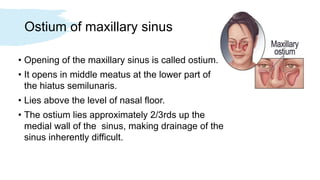
Ostium of maxillary sinus
• Opening of the maxillary sinus is called ostium.
• It opens in middle meatus at the lower part of
the hiatus semilunaris.
• Lies above the level of nasal floor.
• The ostium lies approximately 2/3rds up the
medial wall of the sinus, making drainage of the
sinus inherently difficult.
Maxillary sinus : Blood supply
• Branch of third part of maxillary artery (pterygopalatine part)
• Posterior superior alveolar artery
• Infra-orbital artery
• Greater palatine artery.
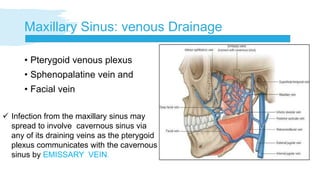
Maxillary Sinus: venous Drainage
• Pterygoid venous plexus
• Sphenopalatine vein and
• Facial vein
 Infection from the maxillary sinus may
spread to involve cavernous sinus via
any of its draining veins as the pterygoid
plexus communicates with the cavernous
sinus by EMISSARY VEIN.
Maxillary Sinus : Nerve Supply
• Maxillary division of the trigeminal
nerve,
• i.e. the posterior, middle and anterior
superior alveolar nerves, the infraorbital
nerve and the anterior palatine nerve
Maxillary sinus: lymphatic drainage
• Submandibular lymph nodes
• Deep cervical lymph node
• Retro pharyngeal lymph nodes
MAXILLARY SINUS :HISTOLOGY
• Maxillary sinus is lined by three
layers: epithelial layer, basal
lamina and sub epithelial layer
with periosteum.
• Epithelium is pseudo stratified,
columnar and ciliated.
• As cilia beats, the mucous on
epithelial surface moves from
sinus interior towards nasal
cavity.
Diagnostic Evaluation Of Sinus Diseases
• Detailed medical & dental history.
• Clinical examination.
Inspection
Palpation
Percussion
Transillumination
• Radiographs
• CT scan, MRI, Ultrasound
• Endoscopy.
INSPECTION :
Middle third of the face should be inspected for the presence
of asymmetry, deformity, swelling, erythema , ecchymosis or
hematoma
EXTRAORAL PALPATION :
Include palpation of the facial wall of the sinus above the
premolar where the bone is thinnest.
INTRAORAL EXAMINATION
Examination should be performed for tenderness, or
paresthesia of upper molar and premolar region.
TRANSILLUMINATION TEST:
It is performed in a darkened room by inserting an electrically
safe light into the mouth ( with the lip closed). Good
transilluminate indicates presence of air in the sinus while the
failure of transillumination indicates presence of pus, fluid
, solid lesion or mucosal thickening.
palpation
Transillumination test
Radiograph
Intra-oral
Periapical
Occlusal
Lateral occlusal
Extra-oral
Panoramic
Waters view
Submentovertex
PA view ORTHOPANTOMOGRAM
submentovertex
PA SKULL
WATER’S VIEW
CT Scan and MRI
CT SCAN
MRI SKULL
Ultrasound
Introduced by LANDMAN in 1986
Non-invasive
Safe
Quick
Ultrasound waves are generated by
probe.
Ultrasound images of maxillary sinus
Allows direct visualization in inaccessible areas,such as
maxillary moral roots that are behind distobuccal root of
maxillary 1st molar.
Endoscopy
Developmental anomalies & pathologic conditions of
maxillary sinus
Developmental
anomalies
• Agenesis/Aplasia
• hypoplasia
• Supernumerary
sinus
Agenesis:
absent of maxillary sinus
Hypoplasia:
Cleft palate, high palate, septal deformity mandibular
dysostosis, malformation of external nose
Supernumerary sinus
two completely separated sinus on same side
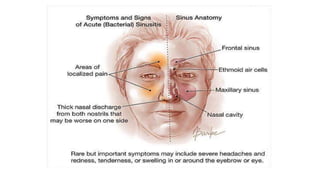
Maxillary sinusitis
When the inflammation develops in the sinus either due to
infection or allergy it is termed as sinusitis.
Most common disease involving the maxillary sinus.
Maxillary sinusitis can be divided into-
1. Acute - <3weeks.
2. Subacute- 3weeks to 3months.
3. Chronic/Recurrent ->3months.
Etiology
1. Infectious causes
a) Bacterial
b) Viral
c) Fungal 2. Non infectious causes
a) Allergic
b) Non allergic
c) Pharmocological
d) Irritants 3. Disruption of mucociliary
drainage
a) Surgery
c) Trauma
Clinical features (acute)
Can occur at any age.
Pt. complains of pain, pressure and heaviness at the affected
side.
Headache is the most common.
Facial erythema, swelling, fever.
Drainage of foul smelling mucopurulent material into the
nasal cavity and nasopharynx.
Pain is exacerbated on bending position.
Dull pain may be present on premolar and molar region.
Clinical features
(chronic)
Repeated attacks.
Pain and tenderness.
Foul unilateral discharge.
Cacosmia i.e. Fetid odor with bad taste in
mouth.
TREATMENT-
• Nasal decongestant
E.g. Ephedrine sulphate, phenylephrine, xylometazoline
• Antibiotics
Amoxicillin- 500mg TDS 10-15days
Augmentin – 625 mg BD 7 days
If patient fails to respond to the initial T/t within 72hrs, culture & sensitivity test
should be carriedout.
• Mucolytic agents:
Benzoin compound
Camphor
Methanol in boiling water
• Analgesic
Odontogenic cystic lesions
of maxillary sinus
ODONTOGENIC NON-ODONTOGENIC
DENTIGEROUS CYST MUCOUS RETENSION CYST
(ANTRAL RETENSION CYST)
RADICULAR CYST
KERATOCYST
 Also known as follicular cyst
 2nd most common cyst
 it usually appear on the impacted maxillary 3rd molar
DENTIGEROUS CYST
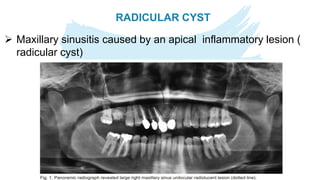
 Maxillary sinusitis caused by an apical inflammatory lesion (
radicular cyst)
RADICULAR CYST
Odontogenic keratocyst
 Odontogenic keratocyst is an
aggressive cystic lesion and a
common type of tooth derived cyst
due to presence of odontogenic
epithelial remnants in different
regions of jaw.
 In majority of cases, it is located in
mandibular posterior region. But it
can also be found in the maxilla
especially in the canine region.
Mucous retention cyst (antral retention cyst)
 seen asadome-shaped lesion on the floor of thesinus.
 Associated with sinusitis.
 Result from obstruction of mucous glands.
 It is usually asymptomatic but may sometimes cause some pain and
tenderness in the teeth and face over the sinus.
 In some cases the cyst disappears spontaneously due to rupture as a
result of abrupt pressure changes from sneezing or "blowing"of the
nose.
 Later on, the cyst may reappear after a few days.
MUCOUS RETENSTION
CYST
Associated benign tumors
Osteoma in the floor of the maxillary
sinus.
Polyps : Thickened and folded
mucosa in chronic sinusitis
Ameloblastoma
Associated malignant
tumors
 The location of nasal cavity and PNS makes
them extremely close to vitalorgans.
 Sino-nasal malignancies are rare but
common in African & Asia than America.
 Among the Sino nasal tumors, 60%-70%
are maxillary sinus tumors.
 Other malignant tumors :
 Malignant melanoma.
 Lymphoma
 Salivary type neoplasm
 Sarcomas
 Metastatic tumours
 Commonest type of malignancy involving the maxillary sinus is
squamous cell carcinoma about 80%. The second commonest tumor
involving the maxillary sinus is adenoid cystic carcinoma about 10%.
Other clinical conditions associated
with maxillary sinus
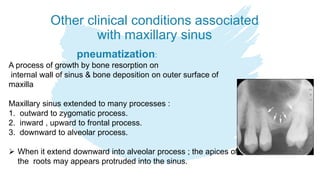
pneumatization:
A process of growth by bone resorption on
internal wall of sinus & bone deposition on outer surface of
maxilla
Maxillary sinus extended to many processes :
1. outward to zygomatic process.
2. inward , upward to frontal process.
3. downward to alveolar process.
 When it extend downward into alveolar process ; the apices of
the roots may appears protruded into the sinus.
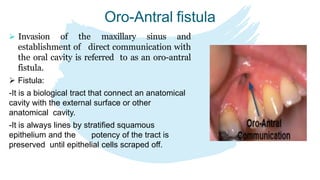
Oro-Antral fistula
 Invasion of the maxillary sinus and
establishment of direct communication with
the oral cavity is referred to as an oro-antral
fistula.
 Fistula:
-It is a biological tract that connect an anatomical
cavity with the external surface or other
anatomical cavity.
-It is always lines by stratified squamous
epithelium and the potency of the tract is
preserved until epithelial cells scraped off.
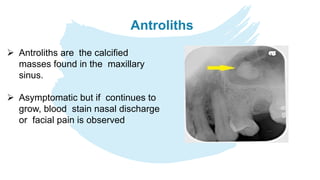
Antroliths
 Antroliths are the calcified
masses found in the maxillary
sinus.
 Asymptomatic but if continues to
grow, blood stain nasal discharge
or facial pain is observed
Conclusion
Anatomy physiology and histology of maxillary sinus is important because close
anatomic relation of the frontal sinus, anterior ethmoidal sinus and
the maxillary teeth, allowing for easy spread of infection.
Age changes , extractions leads to pneumatization and other clinical conditions
like oro-antral communication
The ostium lies approximately 2/3rds up the medial wall of the sinus, making
drainage of the sinus inherently difficult but making spread of infection easier
Infection from the maxillary sinus may spread to involve cavernous sinus via any
of its draining veins as the pterygoid plexus communicates with the cavernous
sinus by EMISSARY VEIN.
Most of the pathology associated with maxillary sinus either gives signs and
symptoms of sinusitis or and accidental findings
Maxillary sinus

Maxillary sinus

  • 1.
  • 2.
    MAXILLARY SINUS GUIDED BY- DR.SIMA ODEDRA PREPARED BY- DR. HARITA D. PAGHADAL PG PART I ORAL AND MAXILLOFACIAL PATHOLOGY AND MICROBIOLOGY GDCHA
  • 3.
    Outline Introduction Functions of theparanasal sinuses Development and anatomy of maxillary sinus Blood , Nerve supply& Lymphatic drainage of maxillary sinus Histology of sinuses Diagnostic evaluation of sinus disease Associated pathologies Other Clinical conditions
  • 4.
    Paranasal sinus areair containing bony spaces which is lined by respiratory mucosa and communicate with the nasal airways. They develop from cranial and facial bones. There are 4 pairs of paranasal sinuses(bilaterally). I. Maxillary II. Frontal III. Ethmoidal IV. Sphenoidal Introduction
  • 6.
    Functions of paranasalsinuses 1. Warming of inspired air. 2. Humidification of dry air. 3. Lightening of skull weight. 4. Resonance of voice. 5. Filters debris. 6. Accessory olfactory organ. 7. Protects skull from mechanical shock. 8. Production of bactericidal lysozyme
  • 7.
    Maxillary sinus: development •Maxillary sinus is the pneumatic space that is lodged inside the body of maxilla and that communicates with the environment by way of the middle meatus and nasal vestibule.” • Also known as “Antrum of Highmore” • Anatomy of the maxillary sinus was 1st described by Highmore in1651
  • 8.
    • Maxillary sinusis first of the PNS to develop • It starts as a shallow groove on the medial surface of maxilla during the 4th month of intrauterine life.(Koch1930) • Expansion occurs more rapidly until all the permanent teeth have erupted. (Bailey 1998, Sadler 1995) • It reaches to maximum size around 18years of age. (Bailey 1998, Sadler 1995)
  • 10.
  • 12.
    Pyramidal shaped cavitywith in the body of maxilla. Boundaries: Apex- zygomatic process of maxilla. Base- nasal surface of maxilla. Roof-orbital surface of maxilla. Floor- alveolar process of maxilla. Anterior wall- related to infra-orbital plexus of nerves and vessels and origin of muscles of upper lip. Posterior wall - pierced by post. Superior alveolar nerve and vessels.
  • 13.
    Anterior Wall OfMaxillary sinus • Formed by the facial surface of the maxilla. • Extends from pyriform aperture anteriorly, to ZM suture & Inferior orbital rim superiorly to alveolar process inferiorly. • Convexity towards sinus • Thinnest in canine fossa Imp structures • Infraorbital foramen • ASA, MSA nerves • Canine fossa
  • 14.
    Posterior wall ofmaxillary sinus • Formed by sphenomaxillary wall. • A thin plate of bone separate the antral cavity from the infratemporal fossa. Made of zygomatic and greater wing of sphenoid bone. • Thick laterally, thin medially. Imp. structures • PSA nerve • Maxillary artery • Pterygopalatine ganglion • Nerve of pterygoid canal
  • 15.
    Floor Of MaxillarySinus • Its mainly curved than flat in structure. • Formed by junction of anterior sinus wall and lateral nasal wall • Lies 1-1.2 cm below nasal floor • Close relationship between sinus and teeth facilitate spread of pathology.
  • 16.
    Roof Of MaxillarySinus • Formed by floor of the orbit and is transverse by the infraorbital nerves. It is flat and slopes slightly anteriorly and laterally. Imp. structures • Infraorbital canal • Infraorbital foramen • Infraorbital nerve and vessels.
  • 17.
    Medial wall ofmaxillary sinus • Formed by lateral nasal wall • Below- inferior , nasal conchae • Behind- palatine bone • Above- uncinate process of ethmoid ,lacrimal bone • Contains double layer of mucous membrane(pars membranacea) Imp structures • Sinus ostium • Hiatus semilunaris • Ethmoidal bulla • Uncinate process • Infundibulum
  • 18.
    Ostium of maxillarysinus • Opening of the maxillary sinus is called ostium. • It opens in middle meatus at the lower part of the hiatus semilunaris. • Lies above the level of nasal floor. • The ostium lies approximately 2/3rds up the medial wall of the sinus, making drainage of the sinus inherently difficult.
  • 19.
    Maxillary sinus :Blood supply • Branch of third part of maxillary artery (pterygopalatine part) • Posterior superior alveolar artery • Infra-orbital artery • Greater palatine artery.
  • 20.
    Maxillary Sinus: venousDrainage • Pterygoid venous plexus • Sphenopalatine vein and • Facial vein  Infection from the maxillary sinus may spread to involve cavernous sinus via any of its draining veins as the pterygoid plexus communicates with the cavernous sinus by EMISSARY VEIN.
  • 21.
    Maxillary Sinus :Nerve Supply • Maxillary division of the trigeminal nerve, • i.e. the posterior, middle and anterior superior alveolar nerves, the infraorbital nerve and the anterior palatine nerve
  • 22.
    Maxillary sinus: lymphaticdrainage • Submandibular lymph nodes • Deep cervical lymph node • Retro pharyngeal lymph nodes
  • 23.
  • 24.
    • Maxillary sinusis lined by three layers: epithelial layer, basal lamina and sub epithelial layer with periosteum. • Epithelium is pseudo stratified, columnar and ciliated. • As cilia beats, the mucous on epithelial surface moves from sinus interior towards nasal cavity.
  • 25.
    Diagnostic Evaluation OfSinus Diseases • Detailed medical & dental history. • Clinical examination. Inspection Palpation Percussion Transillumination • Radiographs • CT scan, MRI, Ultrasound • Endoscopy.
  • 26.
    INSPECTION : Middle thirdof the face should be inspected for the presence of asymmetry, deformity, swelling, erythema , ecchymosis or hematoma EXTRAORAL PALPATION : Include palpation of the facial wall of the sinus above the premolar where the bone is thinnest.
  • 27.
    INTRAORAL EXAMINATION Examination shouldbe performed for tenderness, or paresthesia of upper molar and premolar region. TRANSILLUMINATION TEST: It is performed in a darkened room by inserting an electrically safe light into the mouth ( with the lip closed). Good transilluminate indicates presence of air in the sinus while the failure of transillumination indicates presence of pus, fluid , solid lesion or mucosal thickening.
  • 28.
  • 29.
  • 30.
  • 31.
  • 32.
    CT Scan andMRI CT SCAN
  • 33.
  • 34.
    Ultrasound Introduced by LANDMANin 1986 Non-invasive Safe Quick Ultrasound waves are generated by probe.
  • 35.
    Ultrasound images ofmaxillary sinus
  • 36.
    Allows direct visualizationin inaccessible areas,such as maxillary moral roots that are behind distobuccal root of maxillary 1st molar. Endoscopy
  • 37.
    Developmental anomalies &pathologic conditions of maxillary sinus Developmental anomalies • Agenesis/Aplasia • hypoplasia • Supernumerary sinus
  • 40.
    Agenesis: absent of maxillarysinus Hypoplasia: Cleft palate, high palate, septal deformity mandibular dysostosis, malformation of external nose Supernumerary sinus two completely separated sinus on same side
  • 41.
    Maxillary sinusitis When theinflammation develops in the sinus either due to infection or allergy it is termed as sinusitis. Most common disease involving the maxillary sinus. Maxillary sinusitis can be divided into- 1. Acute - <3weeks. 2. Subacute- 3weeks to 3months. 3. Chronic/Recurrent ->3months.
  • 42.
    Etiology 1. Infectious causes a)Bacterial b) Viral c) Fungal 2. Non infectious causes a) Allergic b) Non allergic c) Pharmocological d) Irritants 3. Disruption of mucociliary drainage a) Surgery c) Trauma
  • 43.
    Clinical features (acute) Canoccur at any age. Pt. complains of pain, pressure and heaviness at the affected side. Headache is the most common. Facial erythema, swelling, fever. Drainage of foul smelling mucopurulent material into the nasal cavity and nasopharynx. Pain is exacerbated on bending position. Dull pain may be present on premolar and molar region.
  • 45.
    Clinical features (chronic) Repeated attacks. Painand tenderness. Foul unilateral discharge. Cacosmia i.e. Fetid odor with bad taste in mouth.
  • 46.
    TREATMENT- • Nasal decongestant E.g.Ephedrine sulphate, phenylephrine, xylometazoline • Antibiotics Amoxicillin- 500mg TDS 10-15days Augmentin – 625 mg BD 7 days If patient fails to respond to the initial T/t within 72hrs, culture & sensitivity test should be carriedout. • Mucolytic agents: Benzoin compound Camphor Methanol in boiling water • Analgesic
  • 47.
    Odontogenic cystic lesions ofmaxillary sinus ODONTOGENIC NON-ODONTOGENIC DENTIGEROUS CYST MUCOUS RETENSION CYST (ANTRAL RETENSION CYST) RADICULAR CYST KERATOCYST
  • 48.
     Also knownas follicular cyst  2nd most common cyst  it usually appear on the impacted maxillary 3rd molar DENTIGEROUS CYST
  • 49.
     Maxillary sinusitiscaused by an apical inflammatory lesion ( radicular cyst) RADICULAR CYST
  • 50.
    Odontogenic keratocyst  Odontogenickeratocyst is an aggressive cystic lesion and a common type of tooth derived cyst due to presence of odontogenic epithelial remnants in different regions of jaw.  In majority of cases, it is located in mandibular posterior region. But it can also be found in the maxilla especially in the canine region.
  • 51.
    Mucous retention cyst(antral retention cyst)  seen asadome-shaped lesion on the floor of thesinus.  Associated with sinusitis.  Result from obstruction of mucous glands.  It is usually asymptomatic but may sometimes cause some pain and tenderness in the teeth and face over the sinus.  In some cases the cyst disappears spontaneously due to rupture as a result of abrupt pressure changes from sneezing or "blowing"of the nose.  Later on, the cyst may reappear after a few days.
  • 52.
  • 53.
    Associated benign tumors Osteomain the floor of the maxillary sinus. Polyps : Thickened and folded mucosa in chronic sinusitis Ameloblastoma
  • 54.
    Associated malignant tumors  Thelocation of nasal cavity and PNS makes them extremely close to vitalorgans.  Sino-nasal malignancies are rare but common in African & Asia than America.  Among the Sino nasal tumors, 60%-70% are maxillary sinus tumors.
  • 55.
     Other malignanttumors :  Malignant melanoma.  Lymphoma  Salivary type neoplasm  Sarcomas  Metastatic tumours  Commonest type of malignancy involving the maxillary sinus is squamous cell carcinoma about 80%. The second commonest tumor involving the maxillary sinus is adenoid cystic carcinoma about 10%.
  • 56.
    Other clinical conditionsassociated with maxillary sinus pneumatization: A process of growth by bone resorption on internal wall of sinus & bone deposition on outer surface of maxilla Maxillary sinus extended to many processes : 1. outward to zygomatic process. 2. inward , upward to frontal process. 3. downward to alveolar process.  When it extend downward into alveolar process ; the apices of the roots may appears protruded into the sinus.
  • 57.
    Oro-Antral fistula  Invasionof the maxillary sinus and establishment of direct communication with the oral cavity is referred to as an oro-antral fistula.  Fistula: -It is a biological tract that connect an anatomical cavity with the external surface or other anatomical cavity. -It is always lines by stratified squamous epithelium and the potency of the tract is preserved until epithelial cells scraped off.
  • 58.
    Antroliths  Antroliths arethe calcified masses found in the maxillary sinus.  Asymptomatic but if continues to grow, blood stain nasal discharge or facial pain is observed
  • 59.
    Conclusion Anatomy physiology andhistology of maxillary sinus is important because close anatomic relation of the frontal sinus, anterior ethmoidal sinus and the maxillary teeth, allowing for easy spread of infection. Age changes , extractions leads to pneumatization and other clinical conditions like oro-antral communication The ostium lies approximately 2/3rds up the medial wall of the sinus, making drainage of the sinus inherently difficult but making spread of infection easier Infection from the maxillary sinus may spread to involve cavernous sinus via any of its draining veins as the pterygoid plexus communicates with the cavernous sinus by EMISSARY VEIN. Most of the pathology associated with maxillary sinus either gives signs and symptoms of sinusitis or and accidental findings