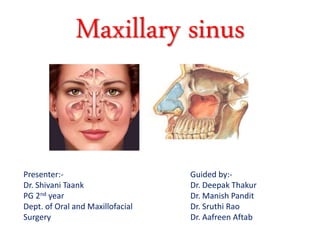
Maxillary sinus
Presenter:-
Dr. Shivani Taank
PG 2nd year
Dept. of Oral and Maxillofacial
Surgery
Guided by:-
Dr. Deepak Thakur
Dr. Manish Pandit
Dr. Sruthi Rao
Dr. Aafreen Aftab
CONTENT
• INTRODUCTION
• EMBROYOLOGY
• DVELOPMENT AND AGE CHANGES
• ANATOMY
• DRAINAGE OF MAXILLARY SINUS
• APPLIED ASPECT
• OHNGREN’S LINE
• DISEASES OF SINUS
• MAXILLARY SINUSITIS
• FUNGAL SINUSITIS
• SILENT SINUS SYNDROME
• OROANTRAL COMMUNICATION
• CALDWELL-LUC OPERATION
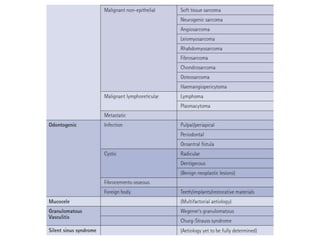
• FESS
• BIBLIOGRAPHY
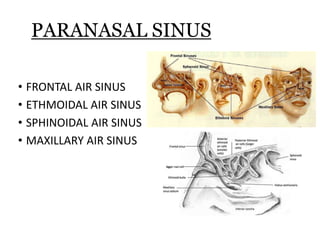
PARANASAL SINUS
• FRONTAL AIR SINUS
• ETHMOIDAL AIR SINUS
• SPHINOIDAL AIR SINUS
• MAXILLARY AIR SINUS
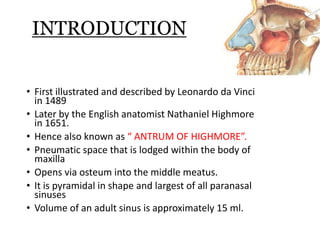
INTRODUCTION
• First illustrated and described by Leonardo da Vinci
in 1489
• Later by the English anatomist Nathaniel Highmore
in 1651.
• Hence also known as “ ANTRUM OF HIGHMORE”.
• Pneumatic space that is lodged within the body of
maxilla
• Opens via osteum into the middle meatus.
• It is pyramidal in shape and largest of all paranasal
sinuses
• Volume of an adult sinus is approximately 15 ml.
EMBROYOLOGY
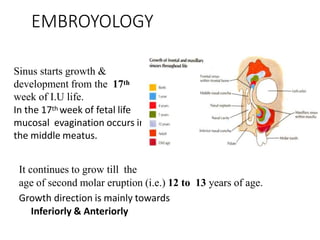
Sinus starts growth &
development from the 17th
week of I.U life.
In the 17th week of fetal life
mucosal evagination occurs in
the middle meatus.
It continues to grow till the
age of second molar eruption (i.e.) 12 to 13 years of age.
Growth direction is mainly towards
Inferiorly & Anteriorly
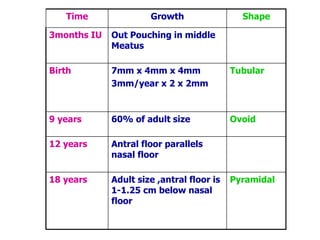
Time Growth Shape
3months IU Out Pouching in middle
Meatus
Birth 7mm x 4mm x 4mm
3mm/year x 2 x 2mm
Tubular
9 years 60% of adult size Ovoid
12 years Antral floor parallels
nasal floor
18 years Adult size ,antral floor is
1-1.25 cm below nasal
floor
Pyramidal
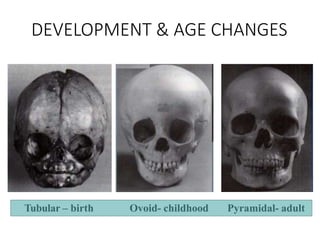
DEVELOPMENT & AGE CHANGES
Tubular – birth Ovoid- childhood Pyramidal- adult
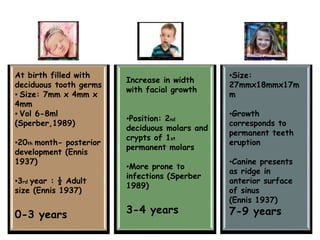
At birth filled with
deciduous tooth germs
• Size: 7mm x 4mm x
4mm
• Vol 6-8ml
(Sperber,1989)
•20th month- posterior
development (Ennis
1937)
•3rd year : ½ Adult
size (Ennis 1937)
0-3 years
Increase in width
with facial growth
•Position: 2nd
deciduous molars and
crypts of 1st
permanent molars
•More prone to
infections (Sperber
1989)
3-4 years
•Size:
27mmx18mmx17m
m
•Growth
corresponds to
permanent teeth
eruption
•Canine presents
as ridge in
anterior surface
of sinus
(Ennis 1937)
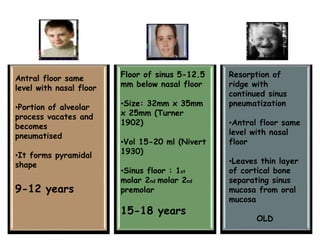
7-9 years
Antral floor same
level with nasal floor
•Portion of alveolar
process vacates and
becomes
pneumatised
•It forms pyramidal
shape
9-12 years
Floor of sinus 5-12.5
mm below nasal floor
•Size: 32mm x 35mm
x 25mm (Turner
1902)
•Vol 15-20 ml (Nivert
1930)
•Sinus floor : 1st
molar 2nd molar 2nd
premolar
15-18 years
Resorption of
ridge with
continued sinus
pneumatization
•Antral floor same
level with nasal
floor
•Leaves thin layer
of cortical bone
separating sinus
mucosa from oral
mucosa
OLD
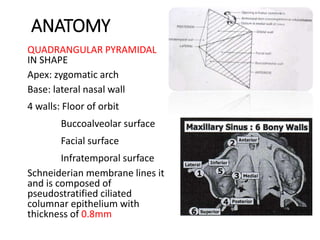
ANATOMY
QUADRANGULAR PYRAMIDAL
IN SHAPE
Apex: zygomatic arch
Base: lateral nasal wall
4 walls: Floor of orbit
Buccoalveolar surface
Facial surface
Infratemporal surface
Schneiderian membrane lines it
and is composed of
pseudostratified ciliated
columnar epithelium with
thickness of 0.8mm
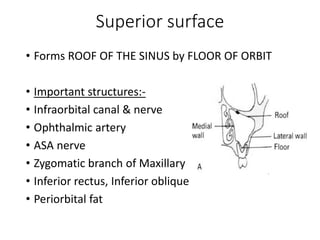
Superior surface
• Forms ROOF OF THE SINUS by FLOOR OF ORBIT
• Important structures:-
• Infraorbital canal & nerve
• Ophthalmic artery
• ASA nerve
• Zygomatic branch of Maxillary nerve
• Inferior rectus, Inferior oblique
• Periorbital fat
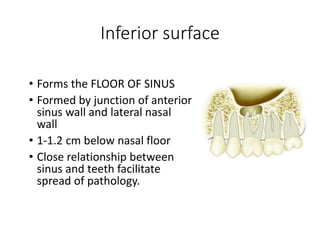
Inferior surface
• Forms the FLOOR OF SINUS
• Formed by junction of anterior
sinus wall and lateral nasal
wall
• 1-1.2 cm below nasal floor
• Close relationship between
sinus and teeth facilitate
spread of pathology.
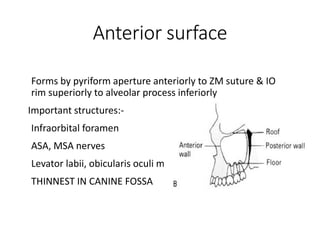
Anterior surface
Forms by pyriform aperture anteriorly to ZM suture & IO
rim superiorly to alveolar process inferiorly
Important structures:-
Infraorbital foramen
ASA, MSA nerves
Levator labii, obicularis oculi muscles
THINNEST IN CANINE FOSSA
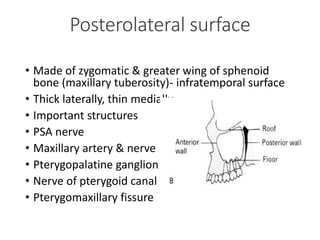
• Made of zygomatic & greater wing of sphenoid
bone (maxillary tuberosity)- infratemporal surface
• Thick laterally, thin medially
• Important structures
• PSA nerve
• Maxillary artery & nerve
• Pterygopalatine ganglion
• Nerve of pterygoid canal
• Pterygomaxillary fissure
Posterolateral surface
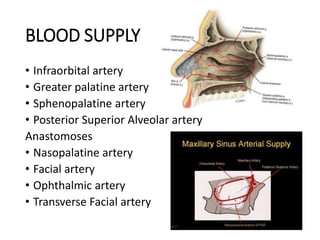
BLOOD SUPPLY
• Infraorbital artery
• Greater palatine artery
• Sphenopalatine artery
• Posterior Superior Alveolar artery
Anastomoses
• Nasopalatine artery
• Facial artery
• Ophthalmic artery
• Transverse Facial artery
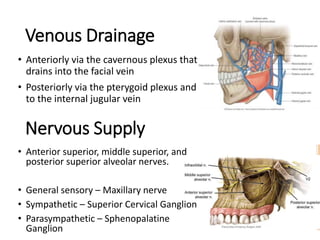
Venous Drainage
• Anteriorly via the cavernous plexus that
drains into the facial vein
• Posteriorly via the pterygoid plexus and
to the internal jugular vein
Nervous Supply
• Anterior superior, middle superior, and
posterior superior alveolar nerves.
• General sensory – Maxillary nerve
• Sympathetic – Superior Cervical Ganglion
• Parasympathetic – Sphenopalatine
Ganglion
Lymphatic Drainage
• Converge with those of lateral nasal wall
Lymphatic plexus near Eustachian tube
Submandibular nodes
Retropharyngeal nodes
Upper deep cervical nodes
Jugular lymphatic trunk
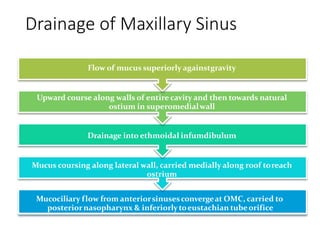
Drainage of Maxillary Sinus
Flow of mucus superiorly againstgravity
Upward course along walls of entire cavity and then towards natural
ostium in superomedialwall
Drainage into ethmoidal infumdibulum
Mucus coursing along lateral wall, carried medially along roof toreach
ostrium
Mucociliary flow from anteriorsinusesconvergeat OMC, carried to
posteriornasopharynx & inferiorlytoeustachian tubeorifice
By Donald etal & Antunesetal
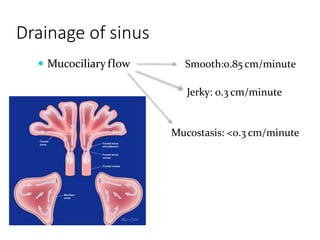
Drainage of sinus
 Mucociliary flow Smooth:0.85 cm/minute
Jerky: 0.3 cm/minute
Mucostasis: <0.3 cm/minute
APPLIED ASPECT OF MAXILLARY
SINUS
• Floor of sinus: Close relation to root apices
Facilitates spread of infection from teeth
[Endo – antral syndrome, Selden (1974)]
Oroantral Fistula formation.
•Superior wall: vulnerable to trauma, Erosion by
tumor
•Posterolateral wall: borders Pterygopalatine fossa,
Infratemporal fossa
• Tumors associated with maxillary sinus:
Thin walls of sinus eroded by tumours - swelling on
cheek, palate, buccal mucosa.
•Sinus wall thin in canine fossa:- Diagnostic aspiration
Caldwell-Luc
•Oro-antral communication: Clearance 1-1.2 cm in
adults, more in children – hence, less chance OAF
• Infections of sinus:- may spread to involve
cavernous sinus via any of its draining veins as
pterygoid plexus communicates with cavernous
sinus by EMISSARY VEIN
•Antral puncture - middle meatus in children, inferior
meatus in adults.
•Inner surface is rough by bony septa
Retrieval of root fragment
Implant placement, sinus augmentation
Interferes with sinus drainage
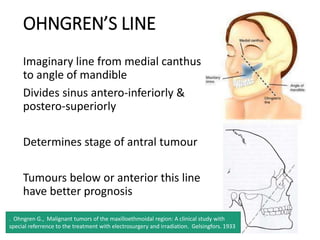
OHNGREN’S LINE
Imaginary line from medial canthus
to angle of mandible
Divides sinus antero-inferiorly &
postero-superiorly
Determines stage of antral tumour
Tumours below or anterior this line
have better prognosis
. Ohngren G., Malignant tumors of the maxilloethmoidal region: A clinical study with
special referrence to the treatment with electrosurgery and irradiation. Gelsingfors. 1933
• Ohngren’s line may still have important value as a
prognostic factor in patients who are to be treated with
open surgery.
• With the modern capability for endoscopic removal
followed by adjuvant radiation therapy and good
outcomes becoming more popular. Ohngren’s Line,
described in 1933, does not necessarily predict outcomes
for tumors treated using endoscopic approaches that
allow better visualization and access to the skull base.
• Ohngren’s line may no longer be a prognostic factor for
maxillary sinus tumors or sinonasal malignancy,
Turner, Meghan & Geltzeiler, Mathew & Hebert, Andrea & Fernandez-Miranda, Juan
& Gardner, Paul & Wang, Eric & Snyderman, Carl. (2018). Ohngren's Line: A Relic in
the Modern Era.
DISEASES OF MAXILLARY SINUS
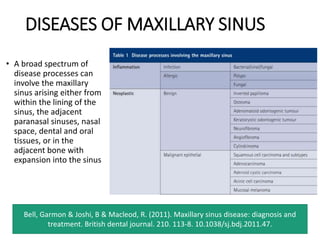
• A broad spectrum of
disease processes can
involve the maxillary
sinus arising either from
within the lining of the
sinus, the adjacent
paranasal sinuses, nasal
space, dental and oral
tissues, or in the
adjacent bone with
expansion into the sinus
Bell, Garmon & Joshi, B & Macleod, R. (2011). Maxillary sinus disease: diagnosis and
treatment. British dental journal. 210. 113-8. 10.1038/sj.bdj.2011.47.
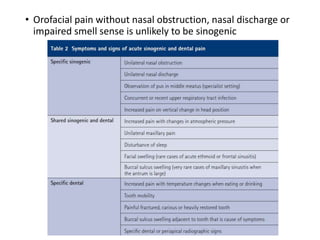
• Orofacial pain without nasal obstruction, nasal discharge or
impaired smell sense is unlikely to be sinogenic
DEVELOPMENTAL DEFECTS
• Crouzon syndrome
Early synostosis of sutures - hypoplasia of maxilla & sinus
High arched palate
• Treacher Collins syndrome
Grossly & symmetrically underdeveloped maxillary
sinuses & malar bones
• Binder syndrome
Hypoplasia of middle third of face
Small maxillary length
Maxillary sinus hypoplasia
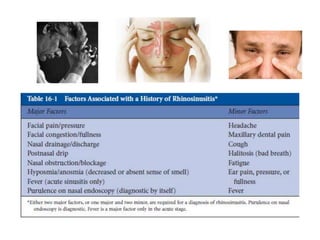
MAXILLARY SINUSITIS
• European Academy of Allergology and Clinical Immunology
defines acute rhinosinusitis as, “Inflammation of the nose
and the paranasal sinuses characterized by two or more of
the following symptoms: blockage/congestion; discharge
(anterior or postnasal drip); facial pain/pressure; reduction
or loss of smell, lasting less than 12 weeks.
• The definition of chronic rhinosinusitis is nasal congestion
or blockage lasting more than 12 weeks and accompanied
by one of the following three sets of symptoms: facial pain
or pressure; discoloured nasal discharge or postnasal drip;
or reduction or loss of smell
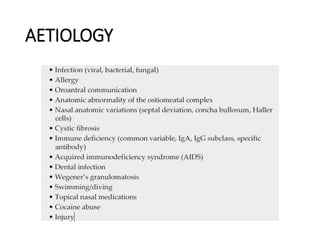
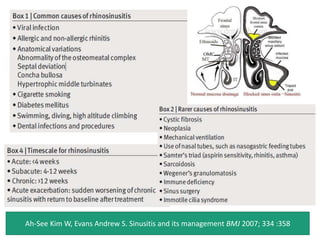
AETIOLOGY
Ah-See Kim W, Evans Andrew S. Sinusitis and its management BMJ 2007; 334 :358
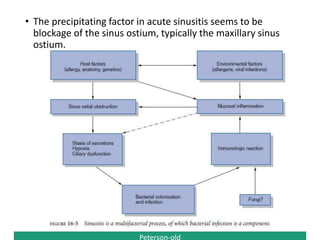
Peterson-old
• The precipitating factor in acute sinusitis seems to be
blockage of the sinus ostium, typically the maxillary sinus
ostium.
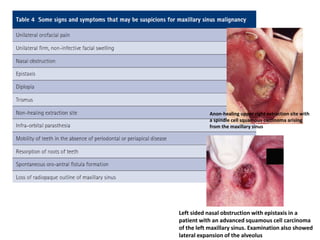
Anon-healing upper right extraction site with
a spindle cell squamous carcinoma arising
from the maxillary sinus
Left sided nasal obstruction with epistaxis in a
patient with an advanced squamous cell carcinoma
of the left maxillary sinus. Examination also showed
lateral expansion of the alveolus
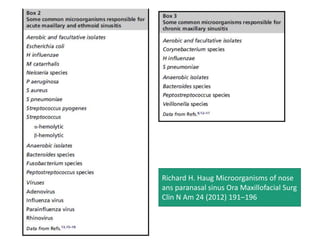
Richard H. Haug Microorganisms of nose
ans paranasal sinus Ora Maxillofacial Surg
Clin N Am 24 (2012) 191–196
DIAGNOSIS OF SINUSITIS
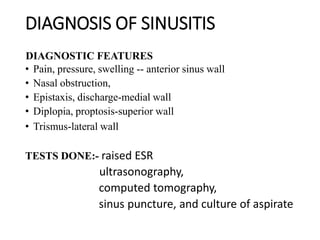
DIAGNOSTIC FEATURES
• Pain, pressure, swelling -- anterior sinus wall
• Nasal obstruction,
• Epistaxis, discharge-medial wall
• Diplopia, proptosis-superior wall
• Trismus-lateral wall
TESTS DONE:- raised ESR
ultrasonography,
computed tomography,
sinus puncture, and culture of aspirate
RHINOSCOPY
NASAL AND SINUS ENDOSCOPY
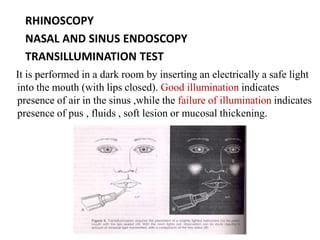
TRANSILLUMINATION TEST
It is performed in a dark room by inserting an electrically a safe light
into the mouth (with lips closed). Good illumination indicates
presence of air in the sinus ,while the failure of illumination indicates
presence of pus , fluids , soft lesion or mucosal thickening.
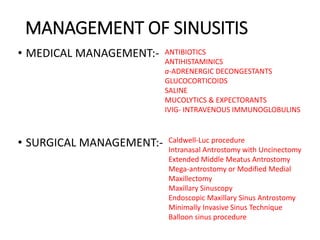
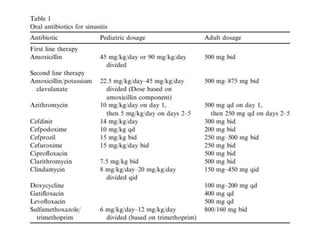
MANAGEMENT OF SINUSITIS
• MEDICAL MANAGEMENT:-
• SURGICAL MANAGEMENT:-
ANTIBIOTICS
ANTIHISTAMINICS
a-ADRENERGIC DECONGESTANTS
GLUCOCORTICOIDS
SALINE
MUCOLYTICS & EXPECTORANTS
IVIG- INTRAVENOUS IMMUNOGLOBULINS
Caldwell-Luc procedure
Intranasal Antrostomy with Uncinectomy
Extended Middle Meatus Antrostomy
Mega-antrostomy or Modified Medial
Maxillectomy
Maxillary Sinuscopy
Endoscopic Maxillary Sinus Antrostomy
Minimally Invasive Sinus Technique
Balloon sinus procedure
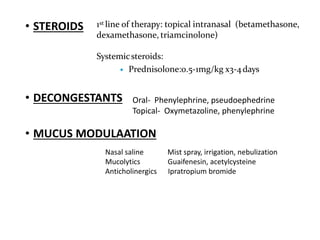
• STEROIDS
• DECONGESTANTS
• MUCUS MODULAATION
1st line of therapy: topical intranasal (betamethasone,
dexamethasone, triamcinolone)
Systemicsteroids:
 Prednisolone:0.5-1mg/kg x3-4days
Oral- Phenylephrine, pseudoephedrine
Topical- Oxymetazoline, phenylephrine
Nasal saline Mist spray, irrigation, nebulization
Mucolytics Guaifenesin, acetylcysteine
Anticholinergics Ipratropium bromide
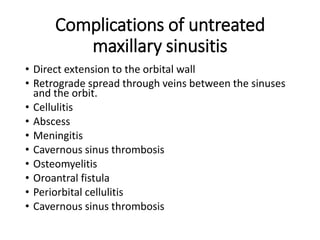
Complications of untreated
maxillary sinusitis
• Direct extension to the orbital wall
• Retrograde spread through veins between the sinuses
and the orbit.
• Cellulitis
• Abscess
• Meningitis
• Cavernous sinus thrombosis
• Osteomyelitis
• Oroantral fistula
• Periorbital cellulitis
• Cavernous sinus thrombosis
FUNGAL SINUSITIS
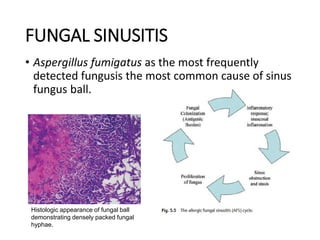
• Aspergillus fumigatus as the most frequently
detected fungusis the most common cause of sinus
fungus ball.
Histologic appearance of fungal ball
demonstrating densely packed fungal
hyphae.
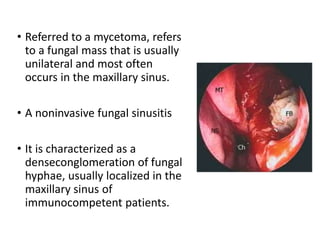
• Referred to a mycetoma, refers
to a fungal mass that is usually
unilateral and most often
occurs in the maxillary sinus.
• A noninvasive fungal sinusitis
• It is characterized as a
denseconglomeration of fungal
hyphae, usually localized in the
maxillary sinus of
immunocompetent patients.
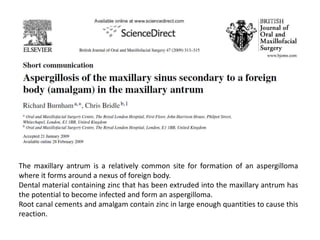
The maxillary antrum is a relatively common site for formation of an aspergilloma
where it forms around a nexus of foreign body.
Dental material containing zinc that has been extruded into the maxillary antrum has
the potential to become infected and form an aspergilloma.
Root canal cements and amalgam contain zinc in large enough quantities to cause this
reaction.
MANAGEMENT OF FUNGUS BALL
1) Removal of fungus ball.
2) Treating dental cause
3) Ensuring sufficient ventilation of sinus.
SURGICAL MANAGEMENT:
1) Fess- gold standard
2) Caldwell-luc
3) Bone lid method
IATROGENIC DISEASE
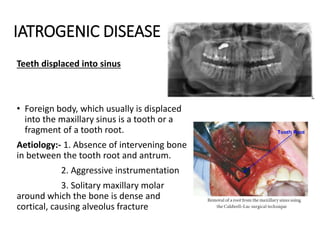
Teeth displaced into sinus
• Foreign body, which usually is displaced
into the maxillary sinus is a tooth or a
fragment of a tooth root.
Aetiology:- 1. Absence of intervening bone
in between the tooth root and antrum.
2. Aggressive instrumentation
3. Solitary maxillary molar
around which the bone is dense and
cortical, causing alveolus fracture
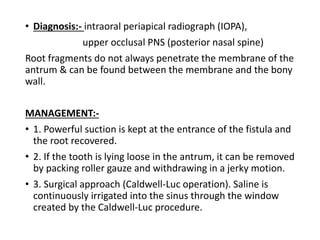
• Diagnosis:- intraoral periapical radiograph (IOPA),
upper occlusal PNS (posterior nasal spine)
Root fragments do not always penetrate the membrane of the
antrum & can be found between the membrane and the bony
wall.
MANAGEMENT:-
• 1. Powerful suction is kept at the entrance of the fistula and
the root recovered.
• 2. If the tooth is lying loose in the antrum, it can be removed
by packing roller gauze and withdrawing in a jerky motion.
• 3. Surgical approach (Caldwell-Luc operation). Saline is
continuously irrigated into the sinus through the window
created by the Caldwell-Luc procedure.
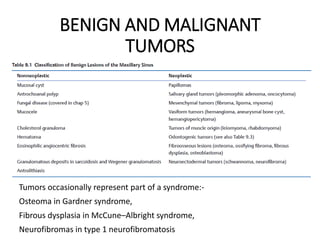
BENIGN AND MALIGNANT
TUMORS
Tumors occasionally represent part of a syndrome:-
Osteoma in Gardner syndrome,
Fibrous dysplasia in McCune–Albright syndrome,
Neurofibromas in type 1 neurofibromatosis
MAXILLARY SINUS CANCER
STAGING
• STAGE 0- carcinoma insitu.
Found in the innermost lining of the maxillary sinus
only
• STAGE 1- Cancer is found in the mucous
membranes of the maxillary sinus
• STAGE 2- spread to bone around the maxillary
sinus, including the roof of the mouth and the
nose, but not to bones at the back of the maxillary
sinus or the base of the skull.
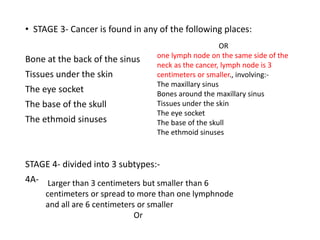
• STAGE 3- Cancer is found in any of the following places:
Bone at the back of the sinus
Tissues under the skin
The eye socket
The base of the skull
The ethmoid sinuses
STAGE 4- divided into 3 subtypes:-
4A-
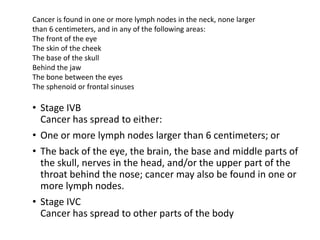
OR
one lymph node on the same side of the
neck as the cancer, lymph node is 3
centimeters or smaller., involving:-
The maxillary sinus
Bones around the maxillary sinus
Tissues under the skin
The eye socket
The base of the skull
The ethmoid sinuses
Larger than 3 centimeters but smaller than 6
centimeters or spread to more than one lymphnode
and all are 6 centimeters or smaller
Or
• Stage IVB
Cancer has spread to either:
• One or more lymph nodes larger than 6 centimeters; or
• The back of the eye, the brain, the base and middle parts of
the skull, nerves in the head, and/or the upper part of the
throat behind the nose; cancer may also be found in one or
more lymph nodes.
• Stage IVC
Cancer has spread to other parts of the body
Cancer is found in one or more lymph nodes in the neck, none larger
than 6 centimeters, and in any of the following areas:
The front of the eye
The skin of the cheek
The base of the skull
Behind the jaw
The bone between the eyes
The sphenoid or frontal sinuses
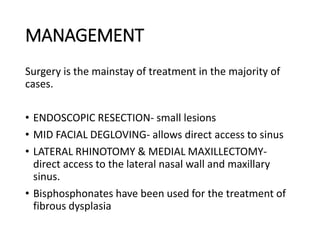
MANAGEMENT
Surgery is the mainstay of treatment in the majority of
cases.
• ENDOSCOPIC RESECTION- small lesions
• MID FACIAL DEGLOVING- allows direct access to sinus
• LATERAL RHINOTOMY & MEDIAL MAXILLECTOMY-
direct access to the lateral nasal wall and maxillary
sinus.
• Bisphosphonates have been used for the treatment of
fibrous dysplasia
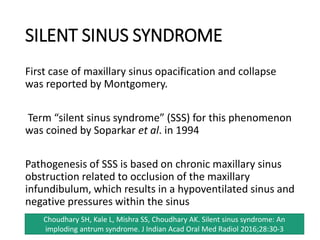
SILENT SINUS SYNDROME
First case of maxillary sinus opacification and collapse
was reported by Montgomery.
Term “silent sinus syndrome” (SSS) for this phenomenon
was coined by Soparkar et al. in 1994
Pathogenesis of SSS is based on chronic maxillary sinus
obstruction related to occlusion of the maxillary
infundibulum, which results in a hypoventilated sinus and
negative pressures within the sinus
Choudhary SH, Kale L, Mishra SS, Choudhary AK. Silent sinus syndrome: An
imploding antrum syndrome. J Indian Acad Oral Med Radiol 2016;28:30-3
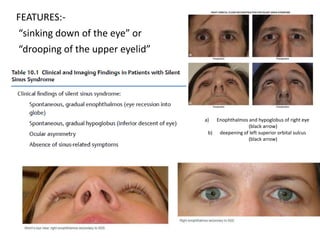
FEATURES:-
“sinking down of the eye” or
“drooping of the upper eyelid”
a) Enophthalmos and hypoglobus of right eye
(black arrow)
b) deepening of left superior orbital sulcus
(black arrow)
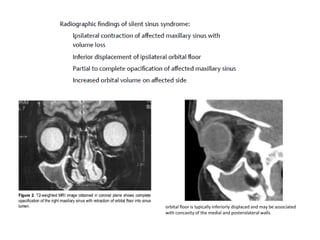
orbital floor is typically inferiorly displaced and may be associated
with concavity of the medial and posterolateral walls
MANAGEMENT
Treatment for SSS is mostly surgical with otolaryngological
intervention.
1) surgical treatment was done by performing a Caldwell–
Luc procedure and transconjunctival repair of the orbital
floor.
2) Blackwell et al. in 1993 endoscopic maxillary antrostomy
in conjunction with a transconjunctival orbital floor repair,
having a greater success rate.
OROANTRAL
COMMUNICATION
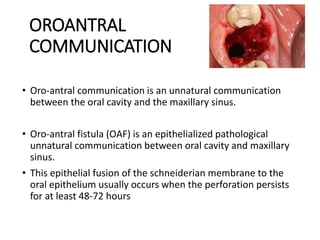
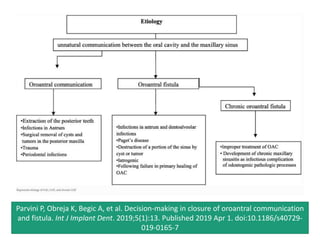
• Oro-antral communication is an unnatural communication
between the oral cavity and the maxillary sinus.
• Oro-antral fistula (OAF) is an epithelialized pathological
unnatural communication between oral cavity and maxillary
sinus.
• This epithelial fusion of the schneiderian membrane to the
oral epithelium usually occurs when the perforation persists
for at least 48-72 hours
• OAF can be further classified as:- alveolo-sinusal
palatal-sinusal
vestibulo-sinusal.
• Szabo found out that 7-8 days is the average time during
which an oro-antral perforation epithelialize and become a
chronic fistulous tract
• Harrison demonstrated that the bone lamella between the
maxillary posterior teeth and the maxillary sinus is
occasionally 0.5mm.
• Thus, the first premolars accounted for 5.3% of OACs
Borgonovo AE, Berardinelli FV, Favale M, Maiorana C. Surgical Options in Oro-antral Fistula Treatment. Open
Dent J 2012;6:94-8.
Haanaes HR, Pederson KN. Treatment of oroantral communication. Int J Oral Surg 1974;3:124-32.
Harrison DF. Oro-antral fistula. Br J Clin Pract. 1961;15:169–74.
Parvini P, Obreja K, Begic A, et al. Decision-making in closure of oroantral communication
and fistula. Int J Implant Dent. 2019;5(1):13. Published 2019 Apr 1. doi:10.1186/s40729-
019-0165-7
5E: FRESH OROANTRAL COMMUNICATION
• Escape of fluids: From mouth to nose
• Epistaxis (Unilateral): due to blood in sinus escaping
through ostium into nostril
• Escape of air: From mouth into nose, on sucking, inhaling
or puffing cheeks
• Enhanced column of air: Causes alteration in vocal
resonance
• Excruciating pain: In and around the region of affected
sinus
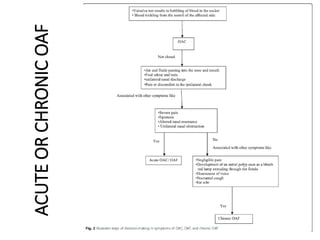
Chronic cases
• Halitosis/ pus discharge
• Asymptomatic
• Intraoral polyp
ACUTEORCHRONICOAF
CLINICAL SYMPTOMS & DIAGNOSIS
• Nasal regurgitation of
liquid,
• Altered nasal resonance,
• Difficulty in sucking
through straw,
• Unilateral nasal discharge,
• Bad taste in the mouth and
whistling sound while
speaking.
• Pain may be present at
malar region.
LATER STAGES:-
• Formation of antral
polyp is visible through
the defect intra-orally.
• Large fistula is easily
seen on inspection.
• Air bubbles, blood or
mucoid secretion
around the orifice
PROCEDURES PERFORMED
1) Intraoral examination:-
The large OAC is easily seen on the investigation. At a
later stage, the antral polyp is seen through the defect.
2) Valsalva test:-
The patient is instructed to try to exhale through blocked
nasal airway. However, a negative test does not exclude
the possibility of antral perforation. It is worth noting
that the detection of small perforations is not always
possible.
3) Cheek-blowing test:-
The patient is asked to blow air into the cheeks against a
closed mouth. This test is considered a risk of antral
complications due to the spread of microorganisms from
the oral cavity into the maxillary sinus.
4)-Exploration of the perforation with probing:-
Attempt of probing the fistula is likely to result in
sinusitis or widening of the fistula due to pushing of
foreign
5) The escape of air through the nostril can be tested
by placing a cotton wisp near the orifice.
6) A mouth mirror placed at oro-antral fistula causes
fogging of the mirror.
Parvini P, Obreja K, Begic A, et al. Decision-making in closure of oroantral
communication and fistula. Int J Implant Dent. 2019;5(1):13. Published 2019 Apr
1. doi:10.1186/s40729-019-0165-7
Khandelwal P, Hajira N. Management of Oro-antral Communication and Fistula:
Various Surgical Options. World J Plast Surg. 2017 Jan;6(1):3-8. PMID: 28289607;
PMCID: PMC5339603.
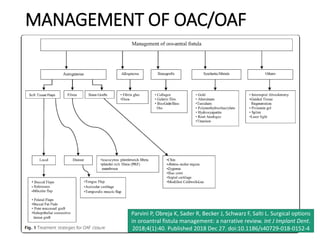
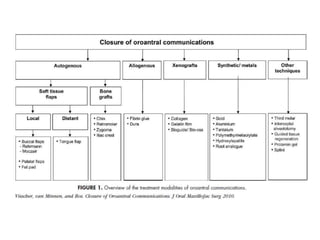
MANAGEMENT OF OAC/OAF
Parvini P, Obreja K, Sader R, Becker J, Schwarz F, Salti L. Surgical options
in oroantral fistula management: a narrative review. Int J Implant Dent.
2018;4(1):40. Published 2018 Dec 27. doi:10.1186/s40729-018-0152-4
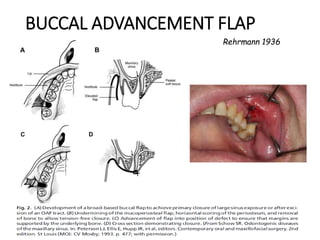
BUCCAL ADVANCEMENT FLAP
Rehrmann 1936
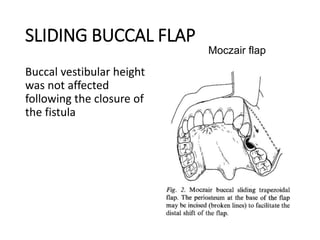
SLIDING BUCCAL FLAP
Buccal vestibular height
was not affected
following the closure of
the fistula
Moczair flap
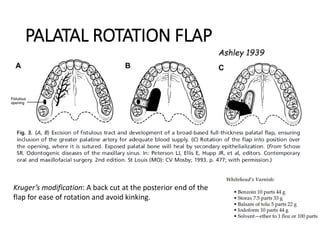
PALATAL ROTATION FLAP
Ashley 1939
Kruger’s modification: A back cut at the posterior end of the
flap for ease of rotation and avoid kinking.
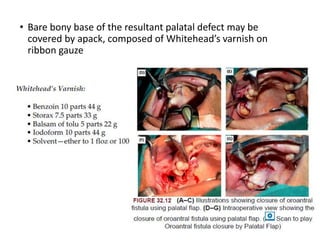
• Bare bony base of the resultant palatal defect may be
covered by apack, composed of Whitehead’s varnish on
ribbon gauze
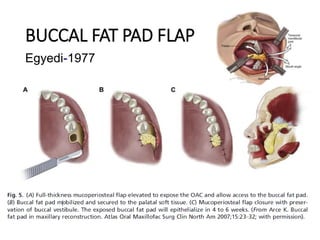
BUCCAL FAT PAD FLAP
Egyedi-1977
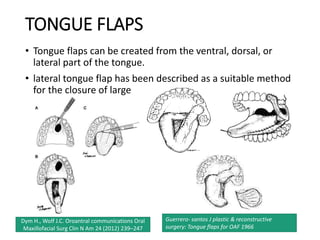
TONGUE FLAPS
• Tongue flaps can be created from the ventral, dorsal, or
lateral part of the tongue.
• lateral tongue flap has been described as a suitable method
for the closure of large
Dym H., Wolf J.C. Oroantral communications Oral
Maxillofacial Surg Clin N Am 24 (2012) 239–247
Guerrero- santos J plastic & reconstructive
surgery: Tongue flaps for OAF 1966
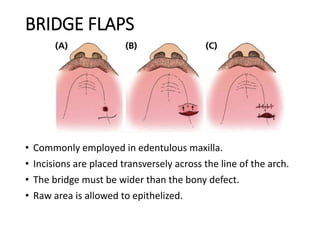
BRIDGE FLAPS
• Commonly employed in edentulous maxilla.
• Incisions are placed transversely across the line of the arch.
• The bridge must be wider than the bony defect.
• Raw area is allowed to epithelized.
Bone Press fit closure of OAF
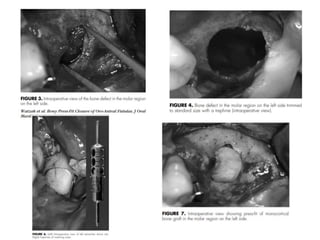
• The basic principle of the surgical procedure lies in press-
fitting monocortical block grafts into the bone defect to
ensure primary stability.
Watzak G, Tepper G, Zechner W, Monov G, Busenlechner D, Watzek G. Bony press-fit closure of oro-antral fistulas:
a technique for pre-sinus lift repair and secondary closure. J Oral Maxillofac Surg. 2005;63(9):1288‐1294.
Indications
•If OAF > 10 mm
•OAF with planned sinus floor elevation
•OAF along neighboring root surface extending into maxillary sinus
•Chronic OAF with multiple unsuccessful attempts of closure
Bone graft
•Iliac crest, chin, retromolar area, zygoma, lateral wall of sinus
•Autografts better option than allograft
AUTOGRAFTS FOR CLOSING OAFS
Procedure is indicated in closure of defects larger than 10 mm
or in the case of failure of conservative methods.
• Autografts harvested from:- extraction socket,
retromolar area,
zygomatic process,
chin
auricular & septal cartilage
Distant sites like the iliac crest
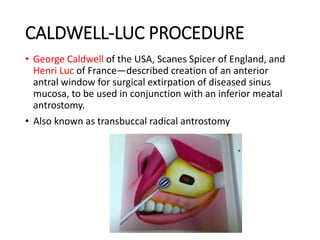
CALDWELL-LUC PROCEDURE
• George Caldwell of the USA, Scanes Spicer of England, and
Henri Luc of France—described creation of an anterior
antral window for surgical extirpation of diseased sinus
mucosa, to be used in conjunction with an inferior meatal
antrostomy.
• Also known as transbuccal radical antrostomy
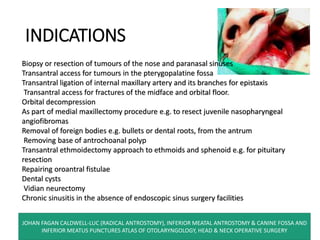
INDICATIONS
Biopsy or resection of tumours of the nose and paranasal sinuses
Transantral access for tumours in the pterygopalatine fossa
Transantral ligation of internal maxillary artery and its branches for epistaxis
Transantral access for fractures of the midface and orbital floor.
Orbital decompression
As part of medial maxillectomy procedure e.g. to resect juvenile nasopharyngeal
angiofibromas
Removal of foreign bodies e.g. bullets or dental roots, from the antrum
Removing base of antrochoanal polyp
Transantral ethmoidectomy approach to ethmoids and sphenoid e.g. for pituitary
resection
Repairing oroantral fistulae
Dental cysts
Vidian neurectomy
Chronic sinusitis in the absence of endoscopic sinus surgery facilities
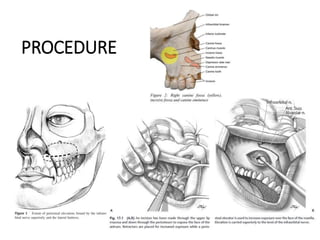
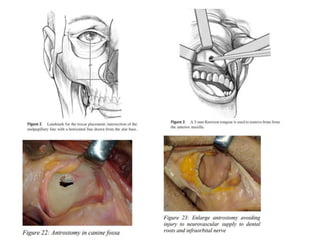
JOHAN FAGAN CALDWELL-LUC (RADICAL ANTROSTOMY), INFERIOR MEATAL ANTROSTOMY & CANINE FOSSA AND
INFERIOR MEATUS PUNCTURES ATLAS OF OTOLARYNGOLOGY, HEAD & NECK OPERATIVE SURGERY
PROCEDURE
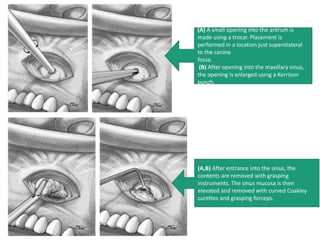
(A,B) After entrance into the sinus, the
contents are removed with grasping
instruments. The sinus mucosa is then
elevated and removed with curved Coakley
curettes and grasping forceps.
(A) A small opening into the antrum is
made using a trocar. Placement is
performed in a location just superolateral
to the canine
fossa.
(B) After opening into the maxillary sinus,
the opening is enlarged using a Kerrison
punch.
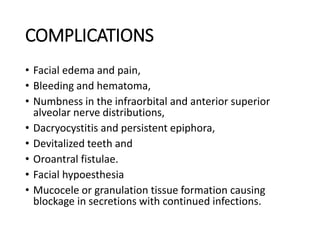
COMPLICATIONS
• Facial edema and pain,
• Bleeding and hematoma,
• Numbness in the infraorbital and anterior superior
alveolar nerve distributions,
• Dacryocystitis and persistent epiphora,
• Devitalized teeth and
• Oroantral fistulae.
• Facial hypoesthesia
• Mucocele or granulation tissue formation causing
blockage in secretions with continued infections.
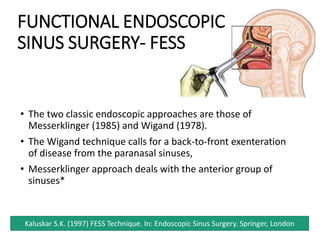
• The two classic endoscopic approaches are those of
Messerklinger (1985) and Wigand (1978).
• The Wigand technique calls for a back-to-front exenteration
of disease from the paranasal sinuses,
• Messerklinger approach deals with the anterior group of
sinuses*
Kaluskar S.K. (1997) FESS Technique. In: Endoscopic Sinus Surgery. Springer, London
FUNCTIONAL ENDOSCOPIC
SINUS SURGERY- FESS
• IT aim at re-establishing normal drainage channels, thereby
reversing the diseased mucosa to normalcy.
• Surgical objectives:-
1. Restoration of nasal patency, without excessive exposure.
2. Improved delivery of medications and washes.
3. Improved exposure to olfactory stimuli.
4. Clearance of inflammatory foci (opacified cells and sinuses).
5. Maintenance and restoration of natural mucociliary
pathways
Barnes, Martyn & Surda, Pavol & Douglas, Richard & Shao, Angus. (2016). Functional
Endoscopic Sinus Surgery (FESS) - Part 1. ENT and Audiology News. 25. 104.
INDICATIONS FOR FESS
1) Chronic rhinosinusitis unresponsive to medical treatment.
2) Recurrent acute sinusitis
3) Sinunasal polyposis
4) Mucocele
5) Non-invasion fungal ball
6) Invasive fungal rhinosinusitis
7) Csf rhinorrohoea & anterior meningoencephalocele
8) Sinonasal tumor
9) Sever exopthamos
10) Nasolacrimal duct obstruction
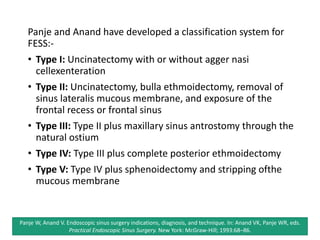
Panje and Anand have developed a classification system for
FESS:-
• Type I: Uncinatectomy with or without agger nasi
cellexenteration
• Type II: Uncinatectomy, bulla ethmoidectomy, removal of
sinus lateralis mucous membrane, and exposure of the
frontal recess or frontal sinus
• Type III: Type II plus maxillary sinus antrostomy through the
natural ostium
• Type IV: Type III plus complete posterior ethmoidectomy
• Type V: Type IV plus sphenoidectomy and stripping ofthe
mucous membrane
Panje W, Anand V. Endoscopic sinus surgery indications, diagnosis, and technique. In: Anand VK, Panje WR, eds.
Practical Endoscopic Sinus Surgery. New York: McGraw-Hill; 1993:68–86.
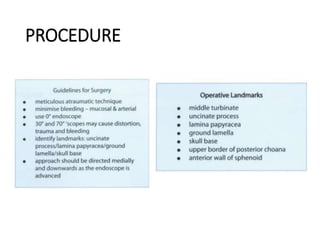
PROCEDURE
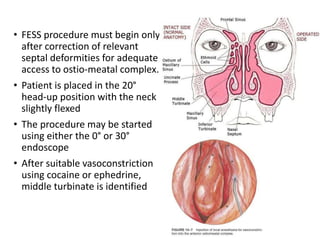
• FESS procedure must begin only
after correction of relevant
septal deformities for adequate
access to ostio-meatal complex.
• Patient is placed in the 20°
head-up position with the neck
slightly flexed
• The procedure may be started
using either the 0° or 30°
endoscope
• After suitable vasoconstriction
using cocaine or ephedrine,
middle turbinate is identified
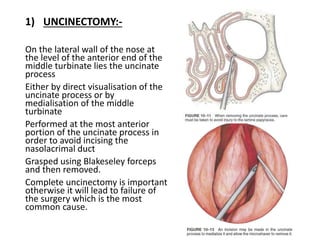
1) UNCINECTOMY:-
On the lateral wall of the nose at
the level of the anterior end of the
middle turbinate lies the uncinate
process
Either by direct visualisation of the
uncinate process or by
medialisation of the middle
turbinate
Performed at the most anterior
portion of the uncinate process in
order to avoid incising the
nasolacrimal duct
Grasped using Blakeseley forceps
and then removed.
Complete uncinectomy is important
otherwise it will lead to failure of
the surgery which is the most
common cause.
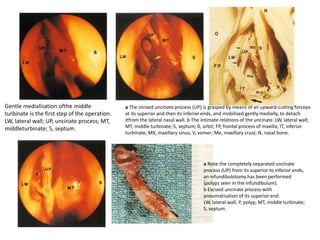
Gentle medialisation ofthe middle
turbinate is the first step of the operation.
LW, lateral wall; UP, uncinate process; MT,
middleturbinate; 5, septum.
a The incised uncinate process (UP) is grasped by means of an upward-cutting forceps
at its superior and then its inferior ends, and mobilised gently medially, to detach
itfrom the lateral nasal wall. b The intimate relations of the uncinate. LW, lateral wall;
MT, middle turbinate; S, septum; 0, orbit; FP, frontal process of maxilla; IT, inferior
turbinate; MX, maxillary sinus; V, vomer; Me, maxillary crust; N, nasal bone.
a Note the completely separated uncinate
process (UP) from its superior to inferior ends,
an infundibulotomy has been performed
(polyps seen in the infundibulum).
b Excised uncinate process with
pneumatisation of its superior end.
LW, lateral wall; P, polyp; MT, middle turbinate;
S, septum.
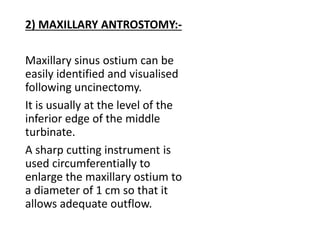
2) MAXILLARY ANTROSTOMY:-
Maxillary sinus ostium can be
easily identified and visualised
following uncinectomy.
It is usually at the level of the
inferior edge of the middle
turbinate.
A sharp cutting instrument is
used circumferentially to
enlarge the maxillary ostium to
a diameter of 1 cm so that it
allows adequate outflow.
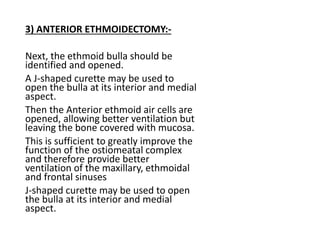
3) ANTERIOR ETHMOIDECTOMY:-
Next, the ethmoid bulla should be
identified and opened.
A J-shaped curette may be used to
open the bulla at its interior and medial
aspect.
Then the Anterior ethmoid air cells are
opened, allowing better ventilation but
leaving the bone covered with mucosa.
This is sufficient to greatly improve the
function of the ostiomeatal complex
and therefore provide better
ventilation of the maxillary, ethmoidal
and frontal sinuses
J-shaped curette may be used to open
the bulla at its interior and medial
aspect.
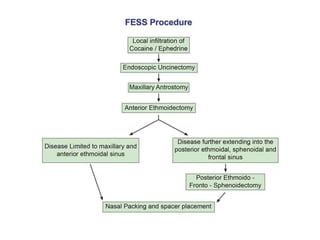
• If the sinus disease is limited to the anterior ethmoid cells
and the maxillary sinus, the procedure may end with simple
anterior ethmoidectomy and maxillary antrostomy.
• If radiographic interpretation shows disease spread to the
posterior ethmoidal and sphenoidal cells, then dissection
should further continue with posterior ethmoido
frontosphenoidectomy.
• Once the procedure is complete and haemostasis is
achieved, an antibiotic gauze pack is placed into the nostril.
COMPLICATIONS
MINOR COMPLICATIONS
periorbital emphysema,
epistaxis,
postoperative nasal
synechiae, and
odontalgia.
Massive hemorrhage
Orbital ecchymosis
Dental hyperesthesia
MAJOR COMPLICATIONS
CSF Rhinorrhea
Meningitis
Intracranial injury
Orbital trauma with
diplopia and vision loss
Injury to internal carotid
artery
Extended uses of FESS
• Endoscopic dacryocystorhinostomy
• Endoscopic orbital decompression
BIBLIOGRAPHY
• Iwanaga, Joe & Wilson, Charlotte & Lachkar, Stefan & Tomaszewski, Krzysztof &
Walocha, Jerzy & Tubbs, R.. (2019). Clinical anatomy of the maxillary sinus:
Application to sinus floor augmentation. Anatomy & Cell Biology. 52. 17.
10.5115/acb.2019.52.1.17.
• . Ohngren G., Malignant tumors of the maxilloethmoidal region: A clinical study
with special referrence to the treatment with electrosurgery and irradiation.
Gelsingfors. 1933
• Turner, Meghan & Geltzeiler, Mathew & Hebert, Andrea & Fernandez-Miranda,
Juan & Gardner, Paul & Wang, Eric & Snyderman, Carl. (2018). Ohngren's Line: A
Relic in the Modern Era.
• Bell, Garmon & Joshi, B & Macleod, R. (2011). Maxillary sinus disease: diagnosis
and treatment. British dental journal. 210. 113-8. 10.1038/sj.bdj.2011.47.
• Ah-See Kim W, Evans Andrew S. Sinusitis and its management BMJ 2007; 334 :358
• Richard H. Haug Microorganisms of nose ans paranasal sinus Ora Maxillofacial Surg
Clin N Am 24 (2012) 191–196
• Kim, E., & Duncavage, J. (2010). Caldwell-Luc procedure. Operative Techniques in
Otolaryngology-Head and Neck Surgery, 21(3), 163–165.
• Richard H. Haug Microorganisms of nose ans paranasal sinus Ora
Maxillofacial Surg Clin N Am 24 (2012) 191–196
• Burnham, R., & Bridle, C. (2009). Aspergillosis of the maxillary sinus
secondary to a foreign body (amalgam) in the maxillary antrum. British
Journal of Oral and Maxillofacial Surgery, 47(4), 313–
315. doi:10.1016/j.bjoms.2009.01.015
• Choudhary SH, Kale L, Mishra SS, Choudhary AK. Silent sinus syndrome:
An imploding antrum syndrome. J Indian Acad Oral Med Radiol
2016;28:30-3
• Borgonovo AE, Berardinelli FV, Favale M, Maiorana C. Surgical Options in
Oro-antral Fistula Treatment. Open Dent J 2012;6:94-8.
• Haanaes HR, Pederson KN. Treatment of oroantral communication. Int J
Oral Surg 1974;3:124-32.
• Harrison DF. Oro-antral fistula. Br J Clin Pract. 1961;15:169–74.
• Parvini P, Obreja K, Begic A, et al. Decision-making in closure of
oroantral communication and fistula. Int J Implant Dent. 2019;5(1):13.
Published 2019 Apr 1. doi:10.1186/s40729-019-0165-7
• Kaluskar S.K. (1997) FESS Technique. In: Endoscopic Sinus Surgery.
Springer, London
• Parvini P, Obreja K, Begic A, et al. Decision-making in closure of
oroantral communication and fistula. Int J Implant Dent. 2019;5(1):13.
Published 2019 Apr 1. doi:10.1186/s40729-019-0165-7
• Khandelwal P, Hajira N. Management of Oro-antral Communication and
Fistula: Various Surgical Options. World J Plast Surg. 2017 Jan;6(1):3-8.
PMID: 28289607; PMCID: PMC5339603.
• Dym H., Wolf J.C. Oroantral communications Oral Maxillofacial Surg Clin
N Am 24 (2012) 239–247
• Guerrero- santos J plastic & reconstructive surgery: Tongue flaps for OAF
1966
• Watzak G, Tepper G, Zechner W, Monov G, Busenlechner D, Watzek G.
Bony press-fit closure of oro-antral fistulas: a technique for pre-sinus lift
repair and secondary closure. J Oral Maxillofac Surg.
2005;63(9):1288‐1294.
• JOHAN FAGAN CALDWELL-LUC (RADICAL ANTROSTOMY), INFERIOR
MEATAL ANTROSTOMY & CANINE FOSSA AND INFERIOR MEATUS
PUNCTURES ATLAS OF OTOLARYNGOLOGY, HEAD & NECK OPERATIVE
SURGERY
• Barnes, Martyn & Surda, Pavol & Douglas, Richard & Shao,
Angus. (2016). Functional Endoscopic Sinus Surgery (FESS) -
Part 1. ENT and Audiology News. 25. 104.
• Panje W, Anand V. Endoscopic sinus surgery indications,
diagnosis, and technique. In: Anand VK, Panje WR, eds.
Practical Endoscopic Sinus Surgery. New York: McGraw-Hill;
1993:68–86.
• Roy casaino Endoscopic sinus surgery dissection manual- A
stepwise anatomically based approach to endoscopic sinus
surgery.
• Textbook of oral and maxillofacial surgery. SM Balaji
• James A. Duncavage & Samuel S.Becker The Maxillary Sinus
Medical & Surgical Management.
• Peterson’s Principles of oral and maxillofacial surgery ed.2
 Maxillary sinus by Dr. Shivani Taank

Maxillary sinus by Dr. Shivani Taank

  • 1.
    Maxillary sinus Presenter:- Dr. ShivaniTaank PG 2nd year Dept. of Oral and Maxillofacial Surgery Guided by:- Dr. Deepak Thakur Dr. Manish Pandit Dr. Sruthi Rao Dr. Aafreen Aftab
  • 2.
    CONTENT • INTRODUCTION • EMBROYOLOGY •DVELOPMENT AND AGE CHANGES • ANATOMY • DRAINAGE OF MAXILLARY SINUS • APPLIED ASPECT • OHNGREN’S LINE • DISEASES OF SINUS • MAXILLARY SINUSITIS • FUNGAL SINUSITIS • SILENT SINUS SYNDROME • OROANTRAL COMMUNICATION • CALDWELL-LUC OPERATION • FESS • BIBLIOGRAPHY
  • 3.
    PARANASAL SINUS • FRONTALAIR SINUS • ETHMOIDAL AIR SINUS • SPHINOIDAL AIR SINUS • MAXILLARY AIR SINUS
  • 4.
    INTRODUCTION • First illustratedand described by Leonardo da Vinci in 1489 • Later by the English anatomist Nathaniel Highmore in 1651. • Hence also known as “ ANTRUM OF HIGHMORE”. • Pneumatic space that is lodged within the body of maxilla • Opens via osteum into the middle meatus. • It is pyramidal in shape and largest of all paranasal sinuses • Volume of an adult sinus is approximately 15 ml.
  • 5.
    EMBROYOLOGY Sinus starts growth& development from the 17th week of I.U life. In the 17th week of fetal life mucosal evagination occurs in the middle meatus. It continues to grow till the age of second molar eruption (i.e.) 12 to 13 years of age. Growth direction is mainly towards Inferiorly & Anteriorly
  • 6.
    Time Growth Shape 3monthsIU Out Pouching in middle Meatus Birth 7mm x 4mm x 4mm 3mm/year x 2 x 2mm Tubular 9 years 60% of adult size Ovoid 12 years Antral floor parallels nasal floor 18 years Adult size ,antral floor is 1-1.25 cm below nasal floor Pyramidal
  • 7.
    DEVELOPMENT & AGECHANGES Tubular – birth Ovoid- childhood Pyramidal- adult
  • 8.
    At birth filledwith deciduous tooth germs • Size: 7mm x 4mm x 4mm • Vol 6-8ml (Sperber,1989) •20th month- posterior development (Ennis 1937) •3rd year : ½ Adult size (Ennis 1937) 0-3 years Increase in width with facial growth •Position: 2nd deciduous molars and crypts of 1st permanent molars •More prone to infections (Sperber 1989) 3-4 years •Size: 27mmx18mmx17m m •Growth corresponds to permanent teeth eruption •Canine presents as ridge in anterior surface of sinus (Ennis 1937) 7-9 years
  • 9.
    Antral floor same levelwith nasal floor •Portion of alveolar process vacates and becomes pneumatised •It forms pyramidal shape 9-12 years Floor of sinus 5-12.5 mm below nasal floor •Size: 32mm x 35mm x 25mm (Turner 1902) •Vol 15-20 ml (Nivert 1930) •Sinus floor : 1st molar 2nd molar 2nd premolar 15-18 years Resorption of ridge with continued sinus pneumatization •Antral floor same level with nasal floor •Leaves thin layer of cortical bone separating sinus mucosa from oral mucosa OLD
  • 10.
    ANATOMY QUADRANGULAR PYRAMIDAL IN SHAPE Apex:zygomatic arch Base: lateral nasal wall 4 walls: Floor of orbit Buccoalveolar surface Facial surface Infratemporal surface Schneiderian membrane lines it and is composed of pseudostratified ciliated columnar epithelium with thickness of 0.8mm
  • 11.
    Superior surface • FormsROOF OF THE SINUS by FLOOR OF ORBIT • Important structures:- • Infraorbital canal & nerve • Ophthalmic artery • ASA nerve • Zygomatic branch of Maxillary nerve • Inferior rectus, Inferior oblique • Periorbital fat
  • 12.
    Inferior surface • Formsthe FLOOR OF SINUS • Formed by junction of anterior sinus wall and lateral nasal wall • 1-1.2 cm below nasal floor • Close relationship between sinus and teeth facilitate spread of pathology.
  • 13.
    Anterior surface Forms bypyriform aperture anteriorly to ZM suture & IO rim superiorly to alveolar process inferiorly Important structures:- Infraorbital foramen ASA, MSA nerves Levator labii, obicularis oculi muscles THINNEST IN CANINE FOSSA
  • 14.
    • Made ofzygomatic & greater wing of sphenoid bone (maxillary tuberosity)- infratemporal surface • Thick laterally, thin medially • Important structures • PSA nerve • Maxillary artery & nerve • Pterygopalatine ganglion • Nerve of pterygoid canal • Pterygomaxillary fissure Posterolateral surface
  • 15.
    BLOOD SUPPLY • Infraorbitalartery • Greater palatine artery • Sphenopalatine artery • Posterior Superior Alveolar artery Anastomoses • Nasopalatine artery • Facial artery • Ophthalmic artery • Transverse Facial artery
  • 16.
    Venous Drainage • Anteriorlyvia the cavernous plexus that drains into the facial vein • Posteriorly via the pterygoid plexus and to the internal jugular vein Nervous Supply • Anterior superior, middle superior, and posterior superior alveolar nerves. • General sensory – Maxillary nerve • Sympathetic – Superior Cervical Ganglion • Parasympathetic – Sphenopalatine Ganglion
  • 17.
    Lymphatic Drainage • Convergewith those of lateral nasal wall Lymphatic plexus near Eustachian tube Submandibular nodes Retropharyngeal nodes Upper deep cervical nodes Jugular lymphatic trunk
  • 18.
    Drainage of MaxillarySinus Flow of mucus superiorly againstgravity Upward course along walls of entire cavity and then towards natural ostium in superomedialwall Drainage into ethmoidal infumdibulum Mucus coursing along lateral wall, carried medially along roof toreach ostrium Mucociliary flow from anteriorsinusesconvergeat OMC, carried to posteriornasopharynx & inferiorlytoeustachian tubeorifice By Donald etal & Antunesetal
  • 19.
    Drainage of sinus Mucociliary flow Smooth:0.85 cm/minute Jerky: 0.3 cm/minute Mucostasis: <0.3 cm/minute
  • 20.
    APPLIED ASPECT OFMAXILLARY SINUS • Floor of sinus: Close relation to root apices Facilitates spread of infection from teeth [Endo – antral syndrome, Selden (1974)] Oroantral Fistula formation. •Superior wall: vulnerable to trauma, Erosion by tumor •Posterolateral wall: borders Pterygopalatine fossa, Infratemporal fossa
  • 21.
    • Tumors associatedwith maxillary sinus: Thin walls of sinus eroded by tumours - swelling on cheek, palate, buccal mucosa. •Sinus wall thin in canine fossa:- Diagnostic aspiration Caldwell-Luc •Oro-antral communication: Clearance 1-1.2 cm in adults, more in children – hence, less chance OAF
  • 22.
    • Infections ofsinus:- may spread to involve cavernous sinus via any of its draining veins as pterygoid plexus communicates with cavernous sinus by EMISSARY VEIN •Antral puncture - middle meatus in children, inferior meatus in adults. •Inner surface is rough by bony septa Retrieval of root fragment Implant placement, sinus augmentation Interferes with sinus drainage
  • 23.
    OHNGREN’S LINE Imaginary linefrom medial canthus to angle of mandible Divides sinus antero-inferiorly & postero-superiorly Determines stage of antral tumour Tumours below or anterior this line have better prognosis . Ohngren G., Malignant tumors of the maxilloethmoidal region: A clinical study with special referrence to the treatment with electrosurgery and irradiation. Gelsingfors. 1933
  • 24.
    • Ohngren’s linemay still have important value as a prognostic factor in patients who are to be treated with open surgery. • With the modern capability for endoscopic removal followed by adjuvant radiation therapy and good outcomes becoming more popular. Ohngren’s Line, described in 1933, does not necessarily predict outcomes for tumors treated using endoscopic approaches that allow better visualization and access to the skull base. • Ohngren’s line may no longer be a prognostic factor for maxillary sinus tumors or sinonasal malignancy, Turner, Meghan & Geltzeiler, Mathew & Hebert, Andrea & Fernandez-Miranda, Juan & Gardner, Paul & Wang, Eric & Snyderman, Carl. (2018). Ohngren's Line: A Relic in the Modern Era.
  • 25.
    DISEASES OF MAXILLARYSINUS • A broad spectrum of disease processes can involve the maxillary sinus arising either from within the lining of the sinus, the adjacent paranasal sinuses, nasal space, dental and oral tissues, or in the adjacent bone with expansion into the sinus Bell, Garmon & Joshi, B & Macleod, R. (2011). Maxillary sinus disease: diagnosis and treatment. British dental journal. 210. 113-8. 10.1038/sj.bdj.2011.47.
  • 27.
    • Orofacial painwithout nasal obstruction, nasal discharge or impaired smell sense is unlikely to be sinogenic
  • 28.
    DEVELOPMENTAL DEFECTS • Crouzonsyndrome Early synostosis of sutures - hypoplasia of maxilla & sinus High arched palate • Treacher Collins syndrome Grossly & symmetrically underdeveloped maxillary sinuses & malar bones • Binder syndrome Hypoplasia of middle third of face Small maxillary length Maxillary sinus hypoplasia
  • 29.
    MAXILLARY SINUSITIS • EuropeanAcademy of Allergology and Clinical Immunology defines acute rhinosinusitis as, “Inflammation of the nose and the paranasal sinuses characterized by two or more of the following symptoms: blockage/congestion; discharge (anterior or postnasal drip); facial pain/pressure; reduction or loss of smell, lasting less than 12 weeks. • The definition of chronic rhinosinusitis is nasal congestion or blockage lasting more than 12 weeks and accompanied by one of the following three sets of symptoms: facial pain or pressure; discoloured nasal discharge or postnasal drip; or reduction or loss of smell
  • 30.
  • 31.
    Ah-See Kim W,Evans Andrew S. Sinusitis and its management BMJ 2007; 334 :358
  • 32.
    Peterson-old • The precipitatingfactor in acute sinusitis seems to be blockage of the sinus ostium, typically the maxillary sinus ostium.
  • 34.
    Anon-healing upper rightextraction site with a spindle cell squamous carcinoma arising from the maxillary sinus Left sided nasal obstruction with epistaxis in a patient with an advanced squamous cell carcinoma of the left maxillary sinus. Examination also showed lateral expansion of the alveolus
  • 35.
    Richard H. HaugMicroorganisms of nose ans paranasal sinus Ora Maxillofacial Surg Clin N Am 24 (2012) 191–196
  • 36.
    DIAGNOSIS OF SINUSITIS DIAGNOSTICFEATURES • Pain, pressure, swelling -- anterior sinus wall • Nasal obstruction, • Epistaxis, discharge-medial wall • Diplopia, proptosis-superior wall • Trismus-lateral wall TESTS DONE:- raised ESR ultrasonography, computed tomography, sinus puncture, and culture of aspirate
  • 37.
    RHINOSCOPY NASAL AND SINUSENDOSCOPY TRANSILLUMINATION TEST It is performed in a dark room by inserting an electrically a safe light into the mouth (with lips closed). Good illumination indicates presence of air in the sinus ,while the failure of illumination indicates presence of pus , fluids , soft lesion or mucosal thickening.
  • 38.
    MANAGEMENT OF SINUSITIS •MEDICAL MANAGEMENT:- • SURGICAL MANAGEMENT:- ANTIBIOTICS ANTIHISTAMINICS a-ADRENERGIC DECONGESTANTS GLUCOCORTICOIDS SALINE MUCOLYTICS & EXPECTORANTS IVIG- INTRAVENOUS IMMUNOGLOBULINS Caldwell-Luc procedure Intranasal Antrostomy with Uncinectomy Extended Middle Meatus Antrostomy Mega-antrostomy or Modified Medial Maxillectomy Maxillary Sinuscopy Endoscopic Maxillary Sinus Antrostomy Minimally Invasive Sinus Technique Balloon sinus procedure
  • 40.
    • STEROIDS • DECONGESTANTS •MUCUS MODULAATION 1st line of therapy: topical intranasal (betamethasone, dexamethasone, triamcinolone) Systemicsteroids:  Prednisolone:0.5-1mg/kg x3-4days Oral- Phenylephrine, pseudoephedrine Topical- Oxymetazoline, phenylephrine Nasal saline Mist spray, irrigation, nebulization Mucolytics Guaifenesin, acetylcysteine Anticholinergics Ipratropium bromide
  • 41.
    Complications of untreated maxillarysinusitis • Direct extension to the orbital wall • Retrograde spread through veins between the sinuses and the orbit. • Cellulitis • Abscess • Meningitis • Cavernous sinus thrombosis • Osteomyelitis • Oroantral fistula • Periorbital cellulitis • Cavernous sinus thrombosis
  • 42.
    FUNGAL SINUSITIS • Aspergillusfumigatus as the most frequently detected fungusis the most common cause of sinus fungus ball. Histologic appearance of fungal ball demonstrating densely packed fungal hyphae.
  • 43.
    • Referred toa mycetoma, refers to a fungal mass that is usually unilateral and most often occurs in the maxillary sinus. • A noninvasive fungal sinusitis • It is characterized as a denseconglomeration of fungal hyphae, usually localized in the maxillary sinus of immunocompetent patients.
  • 44.
    The maxillary antrumis a relatively common site for formation of an aspergilloma where it forms around a nexus of foreign body. Dental material containing zinc that has been extruded into the maxillary antrum has the potential to become infected and form an aspergilloma. Root canal cements and amalgam contain zinc in large enough quantities to cause this reaction.
  • 45.
    MANAGEMENT OF FUNGUSBALL 1) Removal of fungus ball. 2) Treating dental cause 3) Ensuring sufficient ventilation of sinus. SURGICAL MANAGEMENT: 1) Fess- gold standard 2) Caldwell-luc 3) Bone lid method
  • 46.
    IATROGENIC DISEASE Teeth displacedinto sinus • Foreign body, which usually is displaced into the maxillary sinus is a tooth or a fragment of a tooth root. Aetiology:- 1. Absence of intervening bone in between the tooth root and antrum. 2. Aggressive instrumentation 3. Solitary maxillary molar around which the bone is dense and cortical, causing alveolus fracture
  • 47.
    • Diagnosis:- intraoralperiapical radiograph (IOPA), upper occlusal PNS (posterior nasal spine) Root fragments do not always penetrate the membrane of the antrum & can be found between the membrane and the bony wall. MANAGEMENT:- • 1. Powerful suction is kept at the entrance of the fistula and the root recovered. • 2. If the tooth is lying loose in the antrum, it can be removed by packing roller gauze and withdrawing in a jerky motion. • 3. Surgical approach (Caldwell-Luc operation). Saline is continuously irrigated into the sinus through the window created by the Caldwell-Luc procedure.
  • 48.
    BENIGN AND MALIGNANT TUMORS Tumorsoccasionally represent part of a syndrome:- Osteoma in Gardner syndrome, Fibrous dysplasia in McCune–Albright syndrome, Neurofibromas in type 1 neurofibromatosis
  • 49.
    MAXILLARY SINUS CANCER STAGING •STAGE 0- carcinoma insitu. Found in the innermost lining of the maxillary sinus only • STAGE 1- Cancer is found in the mucous membranes of the maxillary sinus • STAGE 2- spread to bone around the maxillary sinus, including the roof of the mouth and the nose, but not to bones at the back of the maxillary sinus or the base of the skull.
  • 50.
    • STAGE 3-Cancer is found in any of the following places: Bone at the back of the sinus Tissues under the skin The eye socket The base of the skull The ethmoid sinuses STAGE 4- divided into 3 subtypes:- 4A- OR one lymph node on the same side of the neck as the cancer, lymph node is 3 centimeters or smaller., involving:- The maxillary sinus Bones around the maxillary sinus Tissues under the skin The eye socket The base of the skull The ethmoid sinuses Larger than 3 centimeters but smaller than 6 centimeters or spread to more than one lymphnode and all are 6 centimeters or smaller Or
  • 51.
    • Stage IVB Cancerhas spread to either: • One or more lymph nodes larger than 6 centimeters; or • The back of the eye, the brain, the base and middle parts of the skull, nerves in the head, and/or the upper part of the throat behind the nose; cancer may also be found in one or more lymph nodes. • Stage IVC Cancer has spread to other parts of the body Cancer is found in one or more lymph nodes in the neck, none larger than 6 centimeters, and in any of the following areas: The front of the eye The skin of the cheek The base of the skull Behind the jaw The bone between the eyes The sphenoid or frontal sinuses
  • 52.
    MANAGEMENT Surgery is themainstay of treatment in the majority of cases. • ENDOSCOPIC RESECTION- small lesions • MID FACIAL DEGLOVING- allows direct access to sinus • LATERAL RHINOTOMY & MEDIAL MAXILLECTOMY- direct access to the lateral nasal wall and maxillary sinus. • Bisphosphonates have been used for the treatment of fibrous dysplasia
  • 53.
    SILENT SINUS SYNDROME Firstcase of maxillary sinus opacification and collapse was reported by Montgomery. Term “silent sinus syndrome” (SSS) for this phenomenon was coined by Soparkar et al. in 1994 Pathogenesis of SSS is based on chronic maxillary sinus obstruction related to occlusion of the maxillary infundibulum, which results in a hypoventilated sinus and negative pressures within the sinus Choudhary SH, Kale L, Mishra SS, Choudhary AK. Silent sinus syndrome: An imploding antrum syndrome. J Indian Acad Oral Med Radiol 2016;28:30-3
  • 54.
    FEATURES:- “sinking down ofthe eye” or “drooping of the upper eyelid” a) Enophthalmos and hypoglobus of right eye (black arrow) b) deepening of left superior orbital sulcus (black arrow)
  • 55.
    orbital floor istypically inferiorly displaced and may be associated with concavity of the medial and posterolateral walls
  • 56.
    MANAGEMENT Treatment for SSSis mostly surgical with otolaryngological intervention. 1) surgical treatment was done by performing a Caldwell– Luc procedure and transconjunctival repair of the orbital floor. 2) Blackwell et al. in 1993 endoscopic maxillary antrostomy in conjunction with a transconjunctival orbital floor repair, having a greater success rate.
  • 57.
    OROANTRAL COMMUNICATION • Oro-antral communicationis an unnatural communication between the oral cavity and the maxillary sinus. • Oro-antral fistula (OAF) is an epithelialized pathological unnatural communication between oral cavity and maxillary sinus. • This epithelial fusion of the schneiderian membrane to the oral epithelium usually occurs when the perforation persists for at least 48-72 hours
  • 58.
    • OAF canbe further classified as:- alveolo-sinusal palatal-sinusal vestibulo-sinusal. • Szabo found out that 7-8 days is the average time during which an oro-antral perforation epithelialize and become a chronic fistulous tract • Harrison demonstrated that the bone lamella between the maxillary posterior teeth and the maxillary sinus is occasionally 0.5mm. • Thus, the first premolars accounted for 5.3% of OACs Borgonovo AE, Berardinelli FV, Favale M, Maiorana C. Surgical Options in Oro-antral Fistula Treatment. Open Dent J 2012;6:94-8. Haanaes HR, Pederson KN. Treatment of oroantral communication. Int J Oral Surg 1974;3:124-32. Harrison DF. Oro-antral fistula. Br J Clin Pract. 1961;15:169–74.
  • 59.
    Parvini P, ObrejaK, Begic A, et al. Decision-making in closure of oroantral communication and fistula. Int J Implant Dent. 2019;5(1):13. Published 2019 Apr 1. doi:10.1186/s40729- 019-0165-7
  • 60.
    5E: FRESH OROANTRALCOMMUNICATION • Escape of fluids: From mouth to nose • Epistaxis (Unilateral): due to blood in sinus escaping through ostium into nostril • Escape of air: From mouth into nose, on sucking, inhaling or puffing cheeks • Enhanced column of air: Causes alteration in vocal resonance • Excruciating pain: In and around the region of affected sinus Chronic cases • Halitosis/ pus discharge • Asymptomatic • Intraoral polyp
  • 61.
  • 62.
    CLINICAL SYMPTOMS &DIAGNOSIS • Nasal regurgitation of liquid, • Altered nasal resonance, • Difficulty in sucking through straw, • Unilateral nasal discharge, • Bad taste in the mouth and whistling sound while speaking. • Pain may be present at malar region. LATER STAGES:- • Formation of antral polyp is visible through the defect intra-orally. • Large fistula is easily seen on inspection. • Air bubbles, blood or mucoid secretion around the orifice
  • 63.
    PROCEDURES PERFORMED 1) Intraoralexamination:- The large OAC is easily seen on the investigation. At a later stage, the antral polyp is seen through the defect. 2) Valsalva test:- The patient is instructed to try to exhale through blocked nasal airway. However, a negative test does not exclude the possibility of antral perforation. It is worth noting that the detection of small perforations is not always possible. 3) Cheek-blowing test:- The patient is asked to blow air into the cheeks against a closed mouth. This test is considered a risk of antral complications due to the spread of microorganisms from the oral cavity into the maxillary sinus.
  • 64.
    4)-Exploration of theperforation with probing:- Attempt of probing the fistula is likely to result in sinusitis or widening of the fistula due to pushing of foreign 5) The escape of air through the nostril can be tested by placing a cotton wisp near the orifice. 6) A mouth mirror placed at oro-antral fistula causes fogging of the mirror. Parvini P, Obreja K, Begic A, et al. Decision-making in closure of oroantral communication and fistula. Int J Implant Dent. 2019;5(1):13. Published 2019 Apr 1. doi:10.1186/s40729-019-0165-7 Khandelwal P, Hajira N. Management of Oro-antral Communication and Fistula: Various Surgical Options. World J Plast Surg. 2017 Jan;6(1):3-8. PMID: 28289607; PMCID: PMC5339603.
  • 65.
    MANAGEMENT OF OAC/OAF ParviniP, Obreja K, Sader R, Becker J, Schwarz F, Salti L. Surgical options in oroantral fistula management: a narrative review. Int J Implant Dent. 2018;4(1):40. Published 2018 Dec 27. doi:10.1186/s40729-018-0152-4
  • 67.
  • 68.
    SLIDING BUCCAL FLAP Buccalvestibular height was not affected following the closure of the fistula Moczair flap
  • 69.
    PALATAL ROTATION FLAP Ashley1939 Kruger’s modification: A back cut at the posterior end of the flap for ease of rotation and avoid kinking.
  • 70.
    • Bare bonybase of the resultant palatal defect may be covered by apack, composed of Whitehead’s varnish on ribbon gauze
  • 71.
    BUCCAL FAT PADFLAP Egyedi-1977
  • 72.
    TONGUE FLAPS • Tongueflaps can be created from the ventral, dorsal, or lateral part of the tongue. • lateral tongue flap has been described as a suitable method for the closure of large Dym H., Wolf J.C. Oroantral communications Oral Maxillofacial Surg Clin N Am 24 (2012) 239–247 Guerrero- santos J plastic & reconstructive surgery: Tongue flaps for OAF 1966
  • 73.
    BRIDGE FLAPS • Commonlyemployed in edentulous maxilla. • Incisions are placed transversely across the line of the arch. • The bridge must be wider than the bony defect. • Raw area is allowed to epithelized.
  • 74.
    Bone Press fitclosure of OAF • The basic principle of the surgical procedure lies in press- fitting monocortical block grafts into the bone defect to ensure primary stability. Watzak G, Tepper G, Zechner W, Monov G, Busenlechner D, Watzek G. Bony press-fit closure of oro-antral fistulas: a technique for pre-sinus lift repair and secondary closure. J Oral Maxillofac Surg. 2005;63(9):1288‐1294. Indications •If OAF > 10 mm •OAF with planned sinus floor elevation •OAF along neighboring root surface extending into maxillary sinus •Chronic OAF with multiple unsuccessful attempts of closure Bone graft •Iliac crest, chin, retromolar area, zygoma, lateral wall of sinus •Autografts better option than allograft
  • 76.
    AUTOGRAFTS FOR CLOSINGOAFS Procedure is indicated in closure of defects larger than 10 mm or in the case of failure of conservative methods. • Autografts harvested from:- extraction socket, retromolar area, zygomatic process, chin auricular & septal cartilage Distant sites like the iliac crest
  • 77.
    CALDWELL-LUC PROCEDURE • GeorgeCaldwell of the USA, Scanes Spicer of England, and Henri Luc of France—described creation of an anterior antral window for surgical extirpation of diseased sinus mucosa, to be used in conjunction with an inferior meatal antrostomy. • Also known as transbuccal radical antrostomy
  • 78.
    INDICATIONS Biopsy or resectionof tumours of the nose and paranasal sinuses Transantral access for tumours in the pterygopalatine fossa Transantral ligation of internal maxillary artery and its branches for epistaxis Transantral access for fractures of the midface and orbital floor. Orbital decompression As part of medial maxillectomy procedure e.g. to resect juvenile nasopharyngeal angiofibromas Removal of foreign bodies e.g. bullets or dental roots, from the antrum Removing base of antrochoanal polyp Transantral ethmoidectomy approach to ethmoids and sphenoid e.g. for pituitary resection Repairing oroantral fistulae Dental cysts Vidian neurectomy Chronic sinusitis in the absence of endoscopic sinus surgery facilities JOHAN FAGAN CALDWELL-LUC (RADICAL ANTROSTOMY), INFERIOR MEATAL ANTROSTOMY & CANINE FOSSA AND INFERIOR MEATUS PUNCTURES ATLAS OF OTOLARYNGOLOGY, HEAD & NECK OPERATIVE SURGERY
  • 79.
  • 81.
    (A,B) After entranceinto the sinus, the contents are removed with grasping instruments. The sinus mucosa is then elevated and removed with curved Coakley curettes and grasping forceps. (A) A small opening into the antrum is made using a trocar. Placement is performed in a location just superolateral to the canine fossa. (B) After opening into the maxillary sinus, the opening is enlarged using a Kerrison punch.
  • 82.
    COMPLICATIONS • Facial edemaand pain, • Bleeding and hematoma, • Numbness in the infraorbital and anterior superior alveolar nerve distributions, • Dacryocystitis and persistent epiphora, • Devitalized teeth and • Oroantral fistulae. • Facial hypoesthesia • Mucocele or granulation tissue formation causing blockage in secretions with continued infections.
  • 85.
    • The twoclassic endoscopic approaches are those of Messerklinger (1985) and Wigand (1978). • The Wigand technique calls for a back-to-front exenteration of disease from the paranasal sinuses, • Messerklinger approach deals with the anterior group of sinuses* Kaluskar S.K. (1997) FESS Technique. In: Endoscopic Sinus Surgery. Springer, London FUNCTIONAL ENDOSCOPIC SINUS SURGERY- FESS
  • 86.
    • IT aimat re-establishing normal drainage channels, thereby reversing the diseased mucosa to normalcy. • Surgical objectives:- 1. Restoration of nasal patency, without excessive exposure. 2. Improved delivery of medications and washes. 3. Improved exposure to olfactory stimuli. 4. Clearance of inflammatory foci (opacified cells and sinuses). 5. Maintenance and restoration of natural mucociliary pathways Barnes, Martyn & Surda, Pavol & Douglas, Richard & Shao, Angus. (2016). Functional Endoscopic Sinus Surgery (FESS) - Part 1. ENT and Audiology News. 25. 104.
  • 87.
    INDICATIONS FOR FESS 1)Chronic rhinosinusitis unresponsive to medical treatment. 2) Recurrent acute sinusitis 3) Sinunasal polyposis 4) Mucocele 5) Non-invasion fungal ball 6) Invasive fungal rhinosinusitis 7) Csf rhinorrohoea & anterior meningoencephalocele 8) Sinonasal tumor 9) Sever exopthamos 10) Nasolacrimal duct obstruction
  • 88.
    Panje and Anandhave developed a classification system for FESS:- • Type I: Uncinatectomy with or without agger nasi cellexenteration • Type II: Uncinatectomy, bulla ethmoidectomy, removal of sinus lateralis mucous membrane, and exposure of the frontal recess or frontal sinus • Type III: Type II plus maxillary sinus antrostomy through the natural ostium • Type IV: Type III plus complete posterior ethmoidectomy • Type V: Type IV plus sphenoidectomy and stripping ofthe mucous membrane Panje W, Anand V. Endoscopic sinus surgery indications, diagnosis, and technique. In: Anand VK, Panje WR, eds. Practical Endoscopic Sinus Surgery. New York: McGraw-Hill; 1993:68–86.
  • 89.
  • 90.
    • FESS proceduremust begin only after correction of relevant septal deformities for adequate access to ostio-meatal complex. • Patient is placed in the 20° head-up position with the neck slightly flexed • The procedure may be started using either the 0° or 30° endoscope • After suitable vasoconstriction using cocaine or ephedrine, middle turbinate is identified
  • 92.
    1) UNCINECTOMY:- On thelateral wall of the nose at the level of the anterior end of the middle turbinate lies the uncinate process Either by direct visualisation of the uncinate process or by medialisation of the middle turbinate Performed at the most anterior portion of the uncinate process in order to avoid incising the nasolacrimal duct Grasped using Blakeseley forceps and then removed. Complete uncinectomy is important otherwise it will lead to failure of the surgery which is the most common cause.
  • 93.
    Gentle medialisation ofthemiddle turbinate is the first step of the operation. LW, lateral wall; UP, uncinate process; MT, middleturbinate; 5, septum. a The incised uncinate process (UP) is grasped by means of an upward-cutting forceps at its superior and then its inferior ends, and mobilised gently medially, to detach itfrom the lateral nasal wall. b The intimate relations of the uncinate. LW, lateral wall; MT, middle turbinate; S, septum; 0, orbit; FP, frontal process of maxilla; IT, inferior turbinate; MX, maxillary sinus; V, vomer; Me, maxillary crust; N, nasal bone. a Note the completely separated uncinate process (UP) from its superior to inferior ends, an infundibulotomy has been performed (polyps seen in the infundibulum). b Excised uncinate process with pneumatisation of its superior end. LW, lateral wall; P, polyp; MT, middle turbinate; S, septum.
  • 94.
    2) MAXILLARY ANTROSTOMY:- Maxillarysinus ostium can be easily identified and visualised following uncinectomy. It is usually at the level of the inferior edge of the middle turbinate. A sharp cutting instrument is used circumferentially to enlarge the maxillary ostium to a diameter of 1 cm so that it allows adequate outflow.
  • 95.
    3) ANTERIOR ETHMOIDECTOMY:- Next,the ethmoid bulla should be identified and opened. A J-shaped curette may be used to open the bulla at its interior and medial aspect. Then the Anterior ethmoid air cells are opened, allowing better ventilation but leaving the bone covered with mucosa. This is sufficient to greatly improve the function of the ostiomeatal complex and therefore provide better ventilation of the maxillary, ethmoidal and frontal sinuses J-shaped curette may be used to open the bulla at its interior and medial aspect.
  • 96.
    • If thesinus disease is limited to the anterior ethmoid cells and the maxillary sinus, the procedure may end with simple anterior ethmoidectomy and maxillary antrostomy. • If radiographic interpretation shows disease spread to the posterior ethmoidal and sphenoidal cells, then dissection should further continue with posterior ethmoido frontosphenoidectomy. • Once the procedure is complete and haemostasis is achieved, an antibiotic gauze pack is placed into the nostril.
  • 97.
    COMPLICATIONS MINOR COMPLICATIONS periorbital emphysema, epistaxis, postoperativenasal synechiae, and odontalgia. Massive hemorrhage Orbital ecchymosis Dental hyperesthesia MAJOR COMPLICATIONS CSF Rhinorrhea Meningitis Intracranial injury Orbital trauma with diplopia and vision loss Injury to internal carotid artery Extended uses of FESS • Endoscopic dacryocystorhinostomy • Endoscopic orbital decompression
  • 98.
    BIBLIOGRAPHY • Iwanaga, Joe& Wilson, Charlotte & Lachkar, Stefan & Tomaszewski, Krzysztof & Walocha, Jerzy & Tubbs, R.. (2019). Clinical anatomy of the maxillary sinus: Application to sinus floor augmentation. Anatomy & Cell Biology. 52. 17. 10.5115/acb.2019.52.1.17. • . Ohngren G., Malignant tumors of the maxilloethmoidal region: A clinical study with special referrence to the treatment with electrosurgery and irradiation. Gelsingfors. 1933 • Turner, Meghan & Geltzeiler, Mathew & Hebert, Andrea & Fernandez-Miranda, Juan & Gardner, Paul & Wang, Eric & Snyderman, Carl. (2018). Ohngren's Line: A Relic in the Modern Era. • Bell, Garmon & Joshi, B & Macleod, R. (2011). Maxillary sinus disease: diagnosis and treatment. British dental journal. 210. 113-8. 10.1038/sj.bdj.2011.47. • Ah-See Kim W, Evans Andrew S. Sinusitis and its management BMJ 2007; 334 :358 • Richard H. Haug Microorganisms of nose ans paranasal sinus Ora Maxillofacial Surg Clin N Am 24 (2012) 191–196 • Kim, E., & Duncavage, J. (2010). Caldwell-Luc procedure. Operative Techniques in Otolaryngology-Head and Neck Surgery, 21(3), 163–165.
  • 99.
    • Richard H.Haug Microorganisms of nose ans paranasal sinus Ora Maxillofacial Surg Clin N Am 24 (2012) 191–196 • Burnham, R., & Bridle, C. (2009). Aspergillosis of the maxillary sinus secondary to a foreign body (amalgam) in the maxillary antrum. British Journal of Oral and Maxillofacial Surgery, 47(4), 313– 315. doi:10.1016/j.bjoms.2009.01.015 • Choudhary SH, Kale L, Mishra SS, Choudhary AK. Silent sinus syndrome: An imploding antrum syndrome. J Indian Acad Oral Med Radiol 2016;28:30-3 • Borgonovo AE, Berardinelli FV, Favale M, Maiorana C. Surgical Options in Oro-antral Fistula Treatment. Open Dent J 2012;6:94-8. • Haanaes HR, Pederson KN. Treatment of oroantral communication. Int J Oral Surg 1974;3:124-32. • Harrison DF. Oro-antral fistula. Br J Clin Pract. 1961;15:169–74. • Parvini P, Obreja K, Begic A, et al. Decision-making in closure of oroantral communication and fistula. Int J Implant Dent. 2019;5(1):13. Published 2019 Apr 1. doi:10.1186/s40729-019-0165-7 • Kaluskar S.K. (1997) FESS Technique. In: Endoscopic Sinus Surgery. Springer, London
  • 100.
    • Parvini P,Obreja K, Begic A, et al. Decision-making in closure of oroantral communication and fistula. Int J Implant Dent. 2019;5(1):13. Published 2019 Apr 1. doi:10.1186/s40729-019-0165-7 • Khandelwal P, Hajira N. Management of Oro-antral Communication and Fistula: Various Surgical Options. World J Plast Surg. 2017 Jan;6(1):3-8. PMID: 28289607; PMCID: PMC5339603. • Dym H., Wolf J.C. Oroantral communications Oral Maxillofacial Surg Clin N Am 24 (2012) 239–247 • Guerrero- santos J plastic & reconstructive surgery: Tongue flaps for OAF 1966 • Watzak G, Tepper G, Zechner W, Monov G, Busenlechner D, Watzek G. Bony press-fit closure of oro-antral fistulas: a technique for pre-sinus lift repair and secondary closure. J Oral Maxillofac Surg. 2005;63(9):1288‐1294. • JOHAN FAGAN CALDWELL-LUC (RADICAL ANTROSTOMY), INFERIOR MEATAL ANTROSTOMY & CANINE FOSSA AND INFERIOR MEATUS PUNCTURES ATLAS OF OTOLARYNGOLOGY, HEAD & NECK OPERATIVE SURGERY
  • 101.
    • Barnes, Martyn& Surda, Pavol & Douglas, Richard & Shao, Angus. (2016). Functional Endoscopic Sinus Surgery (FESS) - Part 1. ENT and Audiology News. 25. 104. • Panje W, Anand V. Endoscopic sinus surgery indications, diagnosis, and technique. In: Anand VK, Panje WR, eds. Practical Endoscopic Sinus Surgery. New York: McGraw-Hill; 1993:68–86. • Roy casaino Endoscopic sinus surgery dissection manual- A stepwise anatomically based approach to endoscopic sinus surgery. • Textbook of oral and maxillofacial surgery. SM Balaji • James A. Duncavage & Samuel S.Becker The Maxillary Sinus Medical & Surgical Management. • Peterson’s Principles of oral and maxillofacial surgery ed.2

Editor's Notes

  • #86 unless there is definite evidence of posterior group disease in which case a complete fronto-ethmoido-sphenoidotomy and frontal sinusotomy could be performed