
MAXILLARY ANESTHESIAMAXILLARY ANESTHESIA
Basic Injection TechniqueBasic Injection Technique
Check flow of local anestheticCheck flow of local anesthetic
Position the patientPosition the patient
Prepare the tissuePrepare the tissue
Communicate with the patientCommunicate with the patient
Establish hand restEstablish hand rest
Basic Injection TechniqueBasic Injection Technique
Make the tissue tautMake the tissue taut
Keep the syringe out of patient sightKeep the syringe out of patient sight
Bevel the needle toward the boneBevel the needle toward the bone
Insert the needleInsert the needle
Deposit while advancing the needleDeposit while advancing the needle
Basic Injection TechniqueBasic Injection Technique
AspirateAspirate
Slowly injectSlowly inject
Communicate with the patientCommunicate with the patient
Withdraw the needleWithdraw the needle
Cap the needleCap the needle
Watch the patientWatch the patient
Record the injection in the patient chartRecord the injection in the patient chart
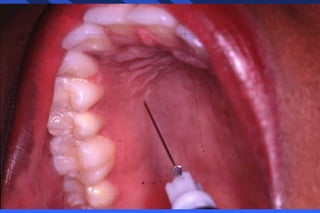
Infiltration - PalateInfiltration - Palate
NervesNerves
Terminal branches - Greater Palatine nerveTerminal branches - Greater Palatine nerve
Nasopalatine nerveNasopalatine nerve
AreaArea
Palatal soft tissue in area of injectionPalatal soft tissue in area of injection
Infiltration - PalateInfiltration - Palate
IndicationsIndications
Limited areaLimited area
HemostasisHemostasis
ContraindicationsContraindications
More than 2 teethMore than 2 teeth
Inflammation/infection at siteInflammation/infection at site
Infiltration - PalateInfiltration - Palate
AdvantagesAdvantages
HemostasisHemostasis
Minimal area affectedMinimal area affected
DisadvantagesDisadvantages
Potentially traumaticPotentially traumatic
Infiltration - PalateInfiltration - Palate
TechniqueTechnique
Apply topical, pressureApply topical, pressure
Insert into gingiva in center of areaInsert into gingiva in center of area
- 5-10 mm from gingival margin- 5-10 mm from gingival margin
Aspirate (positive results are rare)Aspirate (positive results are rare)
Inject 0.2-.3 ml, slowlyInject 0.2-.3 ml, slowly
Signs and SymptomsSigns and Symptoms
Numbness, blanching of palatal soft tissueNumbness, blanching of palatal soft tissue
No pain during dental therapyNo pain during dental therapy
Failures of AnesthesiaFailures of Anesthesia
Quite rareQuite rare
Failure of hemostasisFailure of hemostasis
InflammationInflammation
Lack of vasoconstrictorLack of vasoconstrictor
ComplicationsComplications
Necrosis of soft tissueNecrosis of soft tissue
(due to excess vasoconstriction)(due to excess vasoconstriction)

Maxillary anesthesia 1

  • 1.
  • 2.
    Basic Injection TechniqueBasicInjection Technique Check flow of local anestheticCheck flow of local anesthetic Position the patientPosition the patient Prepare the tissuePrepare the tissue Communicate with the patientCommunicate with the patient Establish hand restEstablish hand rest
  • 3.
    Basic Injection TechniqueBasicInjection Technique Make the tissue tautMake the tissue taut Keep the syringe out of patient sightKeep the syringe out of patient sight Bevel the needle toward the boneBevel the needle toward the bone Insert the needleInsert the needle Deposit while advancing the needleDeposit while advancing the needle
  • 4.
    Basic Injection TechniqueBasicInjection Technique AspirateAspirate Slowly injectSlowly inject Communicate with the patientCommunicate with the patient Withdraw the needleWithdraw the needle Cap the needleCap the needle Watch the patientWatch the patient Record the injection in the patient chartRecord the injection in the patient chart
  • 5.
    Infiltration - PalateInfiltration- Palate NervesNerves Terminal branches - Greater Palatine nerveTerminal branches - Greater Palatine nerve Nasopalatine nerveNasopalatine nerve AreaArea Palatal soft tissue in area of injectionPalatal soft tissue in area of injection
  • 6.
    Infiltration - PalateInfiltration- Palate IndicationsIndications Limited areaLimited area HemostasisHemostasis ContraindicationsContraindications More than 2 teethMore than 2 teeth Inflammation/infection at siteInflammation/infection at site
  • 7.
    Infiltration - PalateInfiltration- Palate AdvantagesAdvantages HemostasisHemostasis Minimal area affectedMinimal area affected DisadvantagesDisadvantages Potentially traumaticPotentially traumatic
  • 8.
    Infiltration - PalateInfiltration- Palate TechniqueTechnique Apply topical, pressureApply topical, pressure Insert into gingiva in center of areaInsert into gingiva in center of area - 5-10 mm from gingival margin- 5-10 mm from gingival margin Aspirate (positive results are rare)Aspirate (positive results are rare) Inject 0.2-.3 ml, slowlyInject 0.2-.3 ml, slowly
  • 10.
    Signs and SymptomsSignsand Symptoms Numbness, blanching of palatal soft tissueNumbness, blanching of palatal soft tissue No pain during dental therapyNo pain during dental therapy
  • 11.
    Failures of AnesthesiaFailuresof Anesthesia Quite rareQuite rare Failure of hemostasisFailure of hemostasis InflammationInflammation Lack of vasoconstrictorLack of vasoconstrictor
  • 12.
    ComplicationsComplications Necrosis of softtissueNecrosis of soft tissue (due to excess vasoconstriction)(due to excess vasoconstriction)