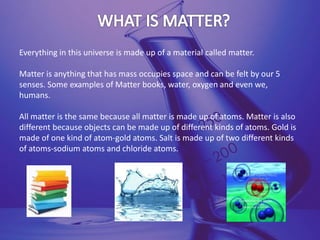
Everything in this universe is made up of a material called matter.
Matter is anything that has mass occupies space and can be felt by our 5
senses. Some examples of Matter books, water, oxygen and even we,
humans.
All matter is the same because all matter is made up of atoms. Matter is also
different because objects can be made up of different kinds of atoms. Gold is
made of one kind of atom-gold atoms. Salt is made up of two different kinds
of atoms-sodium atoms and chloride atoms.
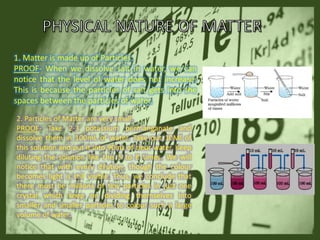
1. Matter is made up of Particles.
PROOF- When we dissolve salt in water, we can
notice that the level of water does not increase.
This is because the particles of salt gets into the
spaces between the particles of water.
2. Particles of Matter are very small.
PROOF- Take 2-3 potassium permanganate and
dissolve them in 100mL of water. Take out 10Ml of
this solution and put it into 90mL of clear water. Keep
diluting the solution like this 5 to 8 times. We will
notice that with every dilution, though the colour
becomes light is still visible. Thus, we conclude that
there must be millions of tiny particles in just one
crystal which keep on dividing themselves into
smaller and smaller particles to colour such a large
volume of water.
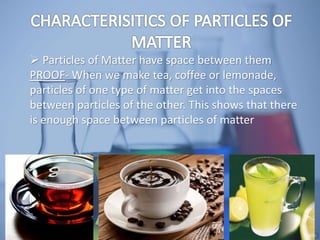
 Particles of Matter have space between them
PROOF- When we make tea, coffee or lemonade,
particles of one type of matter get into the spaces
between particles of the other. This shows that there
is enough space between particles of matter
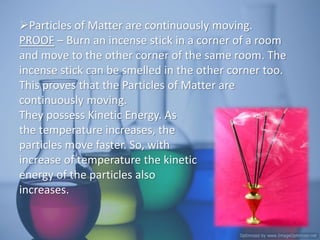
Particles of Matter are continuously moving.
PROOF – Burn an incense stick in a corner of a room
and move to the other corner of the same room. The
incense stick can be smelled in the other corner too.
This proves that the Particles of Matter are
continuously moving.
They possess Kinetic Energy. As
the temperature increases, the
particles move faster. So, with
increase of temperature the kinetic
energy of the particles also
increases.
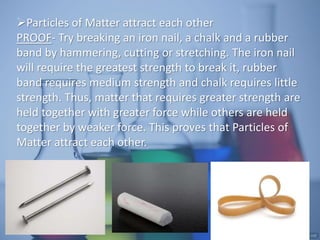
Particles of Matter attract each other
PROOF- Try breaking an iron nail, a chalk and a rubber
band by hammering, cutting or stretching. The iron nail
will require the greatest strength to break it, rubber
band requires medium strength and chalk requires little
strength. Thus, matter that requires greater strength are
held together with greater force while others are held
together by weaker force. This proves that Particles of
Matter attract each other.
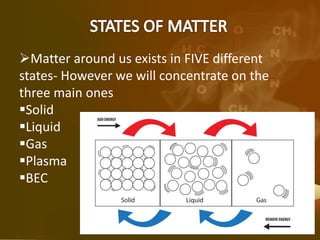
Matter around us exists in FIVE different
states- However we will concentrate on the
three main ones
Solid
Liquid
Gas
Plasma
BEC
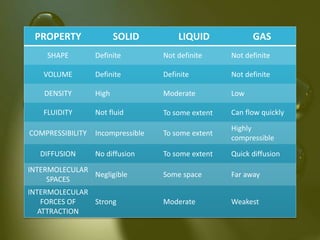
PROPERTY SOLID LIQUID GAS
SHAPE Definite Not definite Not definite
VOLUME Definite Definite Not definite
DENSITY High Moderate Low
FLUIDITY Not fluid To some extent Can flow quickly
COMPRESSIBILITY Incompressible To some extent
Highly
compressible
DIFFUSION No diffusion To some extent Quick diffusion
INTERMOLECULAR
SPACES
Negligible Some space Far away
INTERMOLECULAR
FORCES OF
ATTRACTION
Strong Moderate Weakest
GAS
LIQUIDSOLID
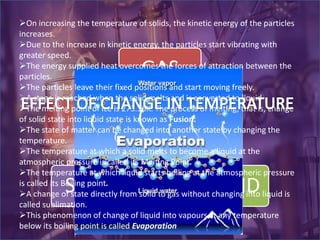
On increasing the temperature of solids, the kinetic energy of the particles
increases.
Due to the increase in kinetic energy, the particles start vibrating with
greater speed.
The energy supplied heat overcomes the forces of attraction between the
particles.
The particles leave their fixed positions and start moving freely.
A stage is reached when the solid melts and is converted to liquid
The melting point of ice is 273.16K. The process of melting, that is, change
of solid state into liquid state is known as Fusion.
The state of matter can be changed into another state by changing the
temperature.
The temperature at which a solid melts to become a liquid at the
atmospheric pressure is called its Melting Point.
The temperature at which liquid starts boiling at the atmospheric pressure
is called its Boiling point.
A change of state directly from solid to gas without changing into liquid is
called sublimation.
This phenomenon of change of liquid into vapours at any temperature
below its boiling point is called Evaporation
FORMATTING
SHREYAN DAS
RISEN V MATTHEW
CONTENT
RHYTHM KAUSHAL
SAKSHAM CHOPRA
RIYA KHATRI
EDITTING AND OMMISSION
RIYA KHATRI
SHAARON MARK
PICTURES
RAHUL BISHT
SIDDHANT KATYAL

Matter Around Us

  • 2.
    Everything in thisuniverse is made up of a material called matter. Matter is anything that has mass occupies space and can be felt by our 5 senses. Some examples of Matter books, water, oxygen and even we, humans. All matter is the same because all matter is made up of atoms. Matter is also different because objects can be made up of different kinds of atoms. Gold is made of one kind of atom-gold atoms. Salt is made up of two different kinds of atoms-sodium atoms and chloride atoms.
  • 3.
    1. Matter ismade up of Particles. PROOF- When we dissolve salt in water, we can notice that the level of water does not increase. This is because the particles of salt gets into the spaces between the particles of water. 2. Particles of Matter are very small. PROOF- Take 2-3 potassium permanganate and dissolve them in 100mL of water. Take out 10Ml of this solution and put it into 90mL of clear water. Keep diluting the solution like this 5 to 8 times. We will notice that with every dilution, though the colour becomes light is still visible. Thus, we conclude that there must be millions of tiny particles in just one crystal which keep on dividing themselves into smaller and smaller particles to colour such a large volume of water.
  • 4.
     Particles ofMatter have space between them PROOF- When we make tea, coffee or lemonade, particles of one type of matter get into the spaces between particles of the other. This shows that there is enough space between particles of matter
  • 5.
    Particles of Matterare continuously moving. PROOF – Burn an incense stick in a corner of a room and move to the other corner of the same room. The incense stick can be smelled in the other corner too. This proves that the Particles of Matter are continuously moving. They possess Kinetic Energy. As the temperature increases, the particles move faster. So, with increase of temperature the kinetic energy of the particles also increases.
  • 6.
    Particles of Matterattract each other PROOF- Try breaking an iron nail, a chalk and a rubber band by hammering, cutting or stretching. The iron nail will require the greatest strength to break it, rubber band requires medium strength and chalk requires little strength. Thus, matter that requires greater strength are held together with greater force while others are held together by weaker force. This proves that Particles of Matter attract each other.
  • 7.
    Matter around usexists in FIVE different states- However we will concentrate on the three main ones Solid Liquid Gas Plasma BEC
  • 8.
    PROPERTY SOLID LIQUIDGAS SHAPE Definite Not definite Not definite VOLUME Definite Definite Not definite DENSITY High Moderate Low FLUIDITY Not fluid To some extent Can flow quickly COMPRESSIBILITY Incompressible To some extent Highly compressible DIFFUSION No diffusion To some extent Quick diffusion INTERMOLECULAR SPACES Negligible Some space Far away INTERMOLECULAR FORCES OF ATTRACTION Strong Moderate Weakest
  • 9.
    GAS LIQUIDSOLID On increasing thetemperature of solids, the kinetic energy of the particles increases. Due to the increase in kinetic energy, the particles start vibrating with greater speed. The energy supplied heat overcomes the forces of attraction between the particles. The particles leave their fixed positions and start moving freely. A stage is reached when the solid melts and is converted to liquid The melting point of ice is 273.16K. The process of melting, that is, change of solid state into liquid state is known as Fusion. The state of matter can be changed into another state by changing the temperature. The temperature at which a solid melts to become a liquid at the atmospheric pressure is called its Melting Point. The temperature at which liquid starts boiling at the atmospheric pressure is called its Boiling point. A change of state directly from solid to gas without changing into liquid is called sublimation. This phenomenon of change of liquid into vapours at any temperature below its boiling point is called Evaporation
  • 11.
    FORMATTING SHREYAN DAS RISEN VMATTHEW CONTENT RHYTHM KAUSHAL SAKSHAM CHOPRA RIYA KHATRI EDITTING AND OMMISSION RIYA KHATRI SHAARON MARK PICTURES RAHUL BISHT SIDDHANT KATYAL

Editor's Notes

  • #3 Still the scientists’ thinking remains the same about the pancha tatva.