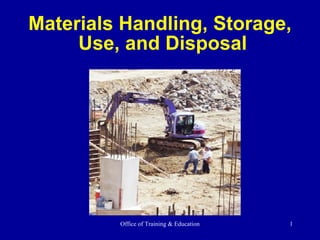
Materials Handling, Storage,  Use, and Disposal
Overview -- Handling and  Storing Materials  Involves diverse operations: Manual material handling Carrying bags or materials Unpacking materials Material handling via machine Forklift Crane Rigging  Stacking or storing   drums, barrels, kegs, lumber,  loose bricks   or other materials
Injuries Lifting objects is a major cause of back injuries in the work place Improper storing and handling of material and equipment can cause struck by and crushed by injuries
Hazards Improper manual lifting or  carrying loads that are too  large or heavy Being struck by materials or being caught in pinch points  Crushed by machines, falling materials or improperly stored materials Incorrectly cutting ties or  securing devices
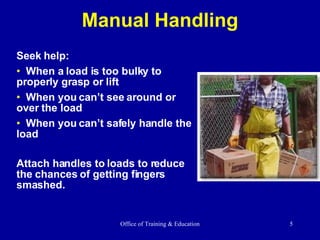
Manual Handling Seek help: When a load is too bulky to properly grasp or lift  When you can’t see around or over the load When you can’t safely handle the load Attach handles to loads to reduce the chances of getting fingers smashed.
Safe Lifting Break load into parts Get help with heavy or bulky items Lift with legs, keep back straight, do not twist Use handling aids - such as steps, trestles, shoulder pads, handles, and wheels Avoid lifting above shoulder level
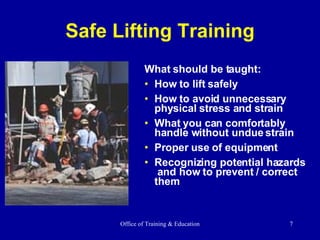
Safe Lifting Training What should be taught: How to lift safely How to avoid unnecessary physical stress and strain What you can comfortably handle without undue strain Proper use of equipment Recognizing potential hazards  and how to prevent / correct them
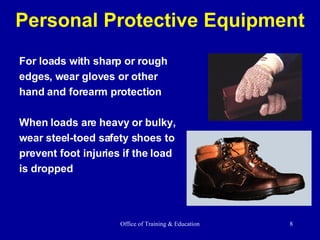
Personal Protective Equipment For loads with sharp or rough  edges, wear gloves or other hand and forearm protection  When loads are heavy or bulky,  wear steel-toed safety shoes to prevent foot injuries if the load is dropped
Materials Handling Equipment Employees must be trained in the proper use and limitations of the equipment they operate  This includes knowing how to effectively use equipment such as forklifts, cranes,  and slings
Forklifts Center the load on the forks and as close to the mast as possible to minimize the potential for the truck tipping or load falling  Overloading a lift truck makes it hard to control and could make it tip over Place the load at the lowest position for traveling Don’t place extra weight on the rear of a counterbalanced forklift to allow an overload
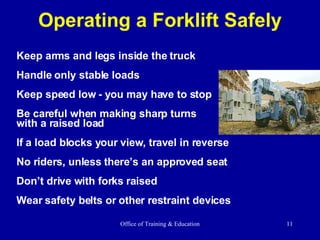
Operating a Forklift Safely Keep arms and legs inside the truck Handle only stable loads Keep speed low - you may have to stop Be careful when making sharp turns with a raised load If a load blocks your view, travel in reverse No riders, unless there’s an approved seat Don’t drive with forks raised Wear safety belts or other restraint devices
Powered Industrial Truck Training Truck-related topics Workplace-related topics Standard requirements Trainees must be supervised by a competent person and not endanger others Formal instruction Practical training Evaluation of performance
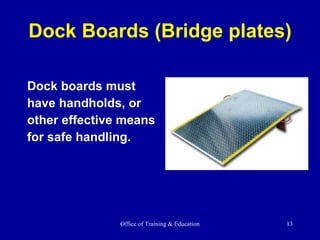
Dock Boards (Bridge plates) Dock boards must  have handholds, or other effective means for safe handling.
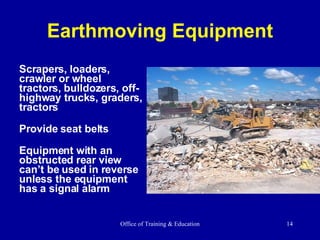
Earthmoving Equipment Scrapers, loaders, crawler or wheel tractors, bulldozers, off-highway trucks, graders, tractors Provide seat belts Equipment with an obstructed rear view can’t be used in reverse unless the equipment has a signal alarm
Cranes Check the load chart in the cab Frequently inspect Never lift people Check overhead power lines Ensure area of travel is clear
Rigging Equipment Slings Types of slings covered are those made from alloy steel chain, wire rope, metal mesh, natural or synthetic fiber rope, and synthetic web. Chain Wire rope Metal mesh Synthetic
Sling Inspection Inspect slings: Each day before use Where service conditions  warrant Remove them from service if damaged or defective
Remove From Service Immediately remove damaged or  defective slings from service
Adapts to shape of the load Can damage by sudden shocks Best choice for hoisting very hot materials Must have an affixed tag stating size, grade, rated capacity, and sling manufacturer Alloy Steel Chains
Markings  Alloy Steel Chain It must be marked with grade or manufacturer's mark
Hooks, rings, oblong links, or other attachments, when used with alloy steel chains, must have a rated capacity at least equal to that of the chain Alloy Steel Chain Attachments Rated Capacity
Job or shop hooks and links, or makeshift fasteners, formed from bolts, rods, etc., or other such attachments, can’t be used Unsuitable Alloy Steel Chain Attachments Right Wrong
Chain Wear When a chain shows excessive wear, or is cracked or pitted, remove it from service Non-alloy repair links can not be used
Wire Rope Slings Used to hoist materials Selection considerations:   strength ability to bend without cracking ability to withstand abrasive wear ability to withstand abuse Wire rope Strand Center Wire Core
Wire Rope Slings Eye Splices Eye splices made in any wire rope  must have at least three full tucks
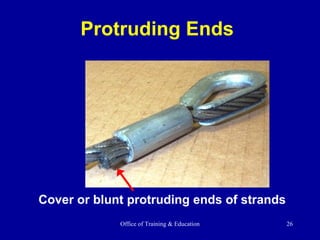
Cover or blunt protruding ends of strands Protruding Ends
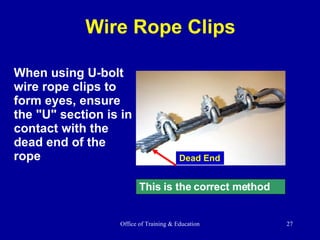
Wire Rope Clips When using U-bolt wire rope clips to form eyes, ensure the "U" section is in contact with the dead end of the rope This is the correct method Dead End
Lubrication Regularly lubricate ropes and chains
Wire Rope Slings  Remove From Service If these happen, remove the wire rope sling from service Crushing Kinking Bird Caging
Mark or code to show: Name or trademark of manufacturer Rated capacities for the type of hitch Type of material Synthetic Web Sling Markings
Fittings must be: At least as strong as that of the sling Free of sharp edges that could damage the webbing Synthetic Web Slings Fittings
Stitching is the only method allowed to attach end fittings to webbing, or to form eyes Synthetic Web Sling Stitching Stitching
Remove from service if any of these are present: Acid or caustic burns Melting or charring of any part  Snags, punctures, tears or cuts Broken or worn stitches Distortion of fittings Synthetic Web Slings - Remove from Service Heat Damage
Storing Materials Secure materials stored in tiers by stacking, racking, blocking, or interlocking to prevent  them from falling Post safe load limits of floors Keep aisles and passageways clear
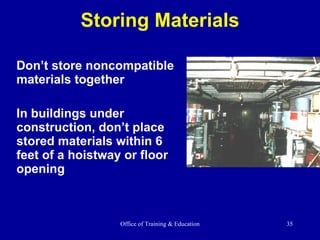
Storing Materials Don’t store noncompatible materials together In buildings under construction, don’t place stored materials within 6 feet of a hoistway or floor opening
Employees who work on stored materials in silos, hoppers, or tanks, must be equipped with lifelines and  harnesses Fall Protection
Stack bricks in a manner that will keep them from falling Do not stack them more than 7 feet high Taper back a loose brick stack after it is 4 feet high Brick Storage
Lumber Remove nails before stacking Stack on sills Stack lumber so that it is stable and self supporting
Housekeeping Keep storage areas free from accumulated materials that cause tripping, fires, or explosions, or that may contribute to harboring rats and pests
Disposal of Waste Materials Use an enclosed chute when you drop material more than 20 feet outside of a building If you drop debris through holes in the floor without  chutes, enclose the drop area with barricades
Disposal of Scrap and Flammable Materials Remove all scrap lumber, waste material, and rubbish from the immediate work area as work progresses Keep all solvent waste, oily rags, and flammable liquids in fire resistant covered containers until removed from worksite
Disposal of Demolition Materials   Removal of materials through floor openings Openings must be less than 25 percent of the whole floor Floors weakened or  made unsafe by demolition must be shored so they can safely carry the demolition load
Summary Manually handling materials When lifting objects, lift with your legs, keep your back straight, do not twist, and use handling aids  Using cranes, forklifts, and slings to move materials Watch for potential struck by and crushed by dangers For slings, check their load capacity, inspect them, and remove them from service when they display signs of stress or wear Also - Keep work areas free from debris and materials Store materials safely to avoid struck by/crushed by hazards

Matl Handling C

  • 1.
    Materials Handling, Storage, Use, and Disposal
  • 2.
    Overview -- Handlingand Storing Materials Involves diverse operations: Manual material handling Carrying bags or materials Unpacking materials Material handling via machine Forklift Crane Rigging Stacking or storing drums, barrels, kegs, lumber, loose bricks or other materials
  • 3.
    Injuries Lifting objectsis a major cause of back injuries in the work place Improper storing and handling of material and equipment can cause struck by and crushed by injuries
  • 4.
    Hazards Improper manuallifting or carrying loads that are too large or heavy Being struck by materials or being caught in pinch points Crushed by machines, falling materials or improperly stored materials Incorrectly cutting ties or securing devices
  • 5.
    Manual Handling Seekhelp: When a load is too bulky to properly grasp or lift When you can’t see around or over the load When you can’t safely handle the load Attach handles to loads to reduce the chances of getting fingers smashed.
  • 6.
    Safe Lifting Breakload into parts Get help with heavy or bulky items Lift with legs, keep back straight, do not twist Use handling aids - such as steps, trestles, shoulder pads, handles, and wheels Avoid lifting above shoulder level
  • 7.
    Safe Lifting TrainingWhat should be taught: How to lift safely How to avoid unnecessary physical stress and strain What you can comfortably handle without undue strain Proper use of equipment Recognizing potential hazards and how to prevent / correct them
  • 8.
    Personal Protective EquipmentFor loads with sharp or rough edges, wear gloves or other hand and forearm protection When loads are heavy or bulky, wear steel-toed safety shoes to prevent foot injuries if the load is dropped
  • 9.
    Materials Handling EquipmentEmployees must be trained in the proper use and limitations of the equipment they operate This includes knowing how to effectively use equipment such as forklifts, cranes, and slings
  • 10.
    Forklifts Center theload on the forks and as close to the mast as possible to minimize the potential for the truck tipping or load falling Overloading a lift truck makes it hard to control and could make it tip over Place the load at the lowest position for traveling Don’t place extra weight on the rear of a counterbalanced forklift to allow an overload
  • 11.
    Operating a ForkliftSafely Keep arms and legs inside the truck Handle only stable loads Keep speed low - you may have to stop Be careful when making sharp turns with a raised load If a load blocks your view, travel in reverse No riders, unless there’s an approved seat Don’t drive with forks raised Wear safety belts or other restraint devices
  • 12.
    Powered Industrial TruckTraining Truck-related topics Workplace-related topics Standard requirements Trainees must be supervised by a competent person and not endanger others Formal instruction Practical training Evaluation of performance
  • 13.
    Dock Boards (Bridgeplates) Dock boards must have handholds, or other effective means for safe handling.
  • 14.
    Earthmoving Equipment Scrapers,loaders, crawler or wheel tractors, bulldozers, off-highway trucks, graders, tractors Provide seat belts Equipment with an obstructed rear view can’t be used in reverse unless the equipment has a signal alarm
  • 15.
    Cranes Check theload chart in the cab Frequently inspect Never lift people Check overhead power lines Ensure area of travel is clear
  • 16.
    Rigging Equipment SlingsTypes of slings covered are those made from alloy steel chain, wire rope, metal mesh, natural or synthetic fiber rope, and synthetic web. Chain Wire rope Metal mesh Synthetic
  • 17.
    Sling Inspection Inspectslings: Each day before use Where service conditions warrant Remove them from service if damaged or defective
  • 18.
    Remove From ServiceImmediately remove damaged or defective slings from service
  • 19.
    Adapts to shapeof the load Can damage by sudden shocks Best choice for hoisting very hot materials Must have an affixed tag stating size, grade, rated capacity, and sling manufacturer Alloy Steel Chains
  • 20.
    Markings AlloySteel Chain It must be marked with grade or manufacturer's mark
  • 21.
    Hooks, rings, oblonglinks, or other attachments, when used with alloy steel chains, must have a rated capacity at least equal to that of the chain Alloy Steel Chain Attachments Rated Capacity
  • 22.
    Job or shophooks and links, or makeshift fasteners, formed from bolts, rods, etc., or other such attachments, can’t be used Unsuitable Alloy Steel Chain Attachments Right Wrong
  • 23.
    Chain Wear Whena chain shows excessive wear, or is cracked or pitted, remove it from service Non-alloy repair links can not be used
  • 24.
    Wire Rope SlingsUsed to hoist materials Selection considerations: strength ability to bend without cracking ability to withstand abrasive wear ability to withstand abuse Wire rope Strand Center Wire Core
  • 25.
    Wire Rope SlingsEye Splices Eye splices made in any wire rope must have at least three full tucks
  • 26.
    Cover or bluntprotruding ends of strands Protruding Ends
  • 27.
    Wire Rope ClipsWhen using U-bolt wire rope clips to form eyes, ensure the "U" section is in contact with the dead end of the rope This is the correct method Dead End
  • 28.
  • 29.
    Wire Rope Slings Remove From Service If these happen, remove the wire rope sling from service Crushing Kinking Bird Caging
  • 30.
    Mark or codeto show: Name or trademark of manufacturer Rated capacities for the type of hitch Type of material Synthetic Web Sling Markings
  • 31.
    Fittings must be:At least as strong as that of the sling Free of sharp edges that could damage the webbing Synthetic Web Slings Fittings
  • 32.
    Stitching is theonly method allowed to attach end fittings to webbing, or to form eyes Synthetic Web Sling Stitching Stitching
  • 33.
    Remove from serviceif any of these are present: Acid or caustic burns Melting or charring of any part Snags, punctures, tears or cuts Broken or worn stitches Distortion of fittings Synthetic Web Slings - Remove from Service Heat Damage
  • 34.
    Storing Materials Securematerials stored in tiers by stacking, racking, blocking, or interlocking to prevent them from falling Post safe load limits of floors Keep aisles and passageways clear
  • 35.
    Storing Materials Don’tstore noncompatible materials together In buildings under construction, don’t place stored materials within 6 feet of a hoistway or floor opening
  • 36.
    Employees who workon stored materials in silos, hoppers, or tanks, must be equipped with lifelines and harnesses Fall Protection
  • 37.
    Stack bricks ina manner that will keep them from falling Do not stack them more than 7 feet high Taper back a loose brick stack after it is 4 feet high Brick Storage
  • 38.
    Lumber Remove nailsbefore stacking Stack on sills Stack lumber so that it is stable and self supporting
  • 39.
    Housekeeping Keep storageareas free from accumulated materials that cause tripping, fires, or explosions, or that may contribute to harboring rats and pests
  • 40.
    Disposal of WasteMaterials Use an enclosed chute when you drop material more than 20 feet outside of a building If you drop debris through holes in the floor without chutes, enclose the drop area with barricades
  • 41.
    Disposal of Scrapand Flammable Materials Remove all scrap lumber, waste material, and rubbish from the immediate work area as work progresses Keep all solvent waste, oily rags, and flammable liquids in fire resistant covered containers until removed from worksite
  • 42.
    Disposal of DemolitionMaterials Removal of materials through floor openings Openings must be less than 25 percent of the whole floor Floors weakened or made unsafe by demolition must be shored so they can safely carry the demolition load
  • 43.
    Summary Manually handlingmaterials When lifting objects, lift with your legs, keep your back straight, do not twist, and use handling aids Using cranes, forklifts, and slings to move materials Watch for potential struck by and crushed by dangers For slings, check their load capacity, inspect them, and remove them from service when they display signs of stress or wear Also - Keep work areas free from debris and materials Store materials safely to avoid struck by/crushed by hazards

Editor's Notes

  • #2 1926 Subpart H ‑ Materials Handling, Storage, Use, and Disposal This presentation is designed to assist trainers conducting OSHA 10-hour Construction Industry outreach training for workers. Since workers are the target audience, this presentation emphasizes hazard identification, avoidance, and control – not standards. No attempt has been made to treat the topic exhaustively. It is essential that trainers tailor their presentations to the needs and understanding of their audience. This presentation is not a substitute for any of the provisions of the Occupational Safety and Health Act of 1970 or for any standards issued by the U.S. Department of Labor. Mention of trade names, commercial products, or organizations does not imply endorsement by the U.S. Department of Labor.