The Man Who
Knew ∞
Srinivasa
Ramanujan
“
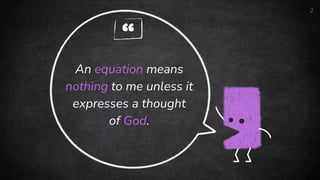
An equation means
nothing to me unless it
expresses a thought
of God.
2
1.
Ramanujan’s
Life STory
Let’s take a look at his life
4
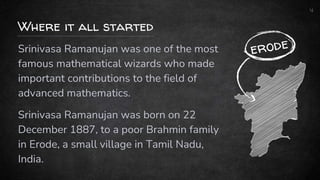
Srinivasa Ramanujan was one of the most
famous mathematical wizards who made
important contributions to the field of
advanced mathematics.
Srinivasa Ramanujan was born on 22
December 1887, to a poor Brahmin family
in Erode, a small village in Tamil Nadu,
India.
Where it all started
His crazy love for maths
5
He loved mathematics more than any other
subject and even more than people (except
for his wife).
In his middle school classes, he
mathematically calculated the approximate
length of the equator. He also very clearly
knew the values of the square root of two
and the value of pi!
6
At the age of 16, he got a scholarship for his first
year at the Government College in his hometown.
He later found a job as an accounts clerk in the
office of Madras Port Trust.
Then, he got in touch with V. Ramaswamy Aiyer,
the founder of the Indian Mathematical Society.
With his help, Ramanujan got his paper on
Bernoulli numbers published in the ‘Journal of the
Indian Mathematical Society’ in 1911.
Education and Work
The major turning point
7
In 1913, he casually wrote to the well-known
Cambridge mathematician, G. H. Hardy, and told
him about his work. Hardy was mighty impressed
with Ramanujan’s works and assisted him in
getting a grant from Trinity College, Cambridge.
Ramanujan moved abroad and started to work in
collaboration with Hardy. In 1916, he graduated
from Cambridge with a Bachelor of Science in
Research.
The end of a genius’s life
In 1920, he came
back to India and
died at the age of
32.
While working with
Hardy, Ramanujan
suffered from
Tuberculosis. Even
then he remained
engrossed in his
research and study
8
2.
Ramanujan’s
Contributions
Let’s look at his contributions toward maths
10
Despite having almost no formal training in
Mathematics, Ramanujan’s knowledge of the
subject matter was astounding. Without the
knowledge of the modern developments in
the subject, he had made some important
contributions to the field of mathematical
analysis, number theory, game theory, infinite
series, and continued fractions.
3.
Ramanujan’s
Achievements
Let’s take a look at his achievements
December 22
Is celebrated as the National Mathematics Day
in India
12
In his honour
The Man Who Knew
Infinity
were made to remember and
celebrate his life.
13
A biography (in 1991) and
a movie (in 2015) titled
4.
Hardy Ramanujan
number
Let’s take a look at this not so ordinary number
15
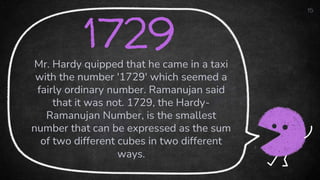
1729
Mr. Hardy quipped that he came in a taxi
with the number '1729' which seemed a
fairly ordinary number. Ramanujan said
that it was not. 1729, the Hardy-
Ramanujan Number, is the smallest
number that can be expressed as the sum
of two different cubes in two different
ways.
16
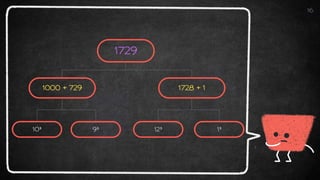
1729
1728 + 1
1000 + 729
10³ 9³ 12³ 1³
17
thanks!
- Vanshav Bhalla [X-A]

Maths day or Srinivasa Ramanujan PPT

  • 1.
    The Man Who Knew∞ Srinivasa Ramanujan
  • 2.
    “ An equation means nothingto me unless it expresses a thought of God. 2
  • 3.
  • 4.
    4 Srinivasa Ramanujan wasone of the most famous mathematical wizards who made important contributions to the field of advanced mathematics. Srinivasa Ramanujan was born on 22 December 1887, to a poor Brahmin family in Erode, a small village in Tamil Nadu, India. Where it all started
  • 5.
    His crazy lovefor maths 5 He loved mathematics more than any other subject and even more than people (except for his wife). In his middle school classes, he mathematically calculated the approximate length of the equator. He also very clearly knew the values of the square root of two and the value of pi!
  • 6.
    6 At the ageof 16, he got a scholarship for his first year at the Government College in his hometown. He later found a job as an accounts clerk in the office of Madras Port Trust. Then, he got in touch with V. Ramaswamy Aiyer, the founder of the Indian Mathematical Society. With his help, Ramanujan got his paper on Bernoulli numbers published in the ‘Journal of the Indian Mathematical Society’ in 1911. Education and Work
  • 7.
    The major turningpoint 7 In 1913, he casually wrote to the well-known Cambridge mathematician, G. H. Hardy, and told him about his work. Hardy was mighty impressed with Ramanujan’s works and assisted him in getting a grant from Trinity College, Cambridge. Ramanujan moved abroad and started to work in collaboration with Hardy. In 1916, he graduated from Cambridge with a Bachelor of Science in Research.
  • 8.
    The end ofa genius’s life In 1920, he came back to India and died at the age of 32. While working with Hardy, Ramanujan suffered from Tuberculosis. Even then he remained engrossed in his research and study 8
  • 9.
    2. Ramanujan’s Contributions Let’s look athis contributions toward maths
  • 10.
    10 Despite having almostno formal training in Mathematics, Ramanujan’s knowledge of the subject matter was astounding. Without the knowledge of the modern developments in the subject, he had made some important contributions to the field of mathematical analysis, number theory, game theory, infinite series, and continued fractions.
  • 11.
  • 12.
    December 22 Is celebratedas the National Mathematics Day in India 12 In his honour
  • 13.
    The Man WhoKnew Infinity were made to remember and celebrate his life. 13 A biography (in 1991) and a movie (in 2015) titled
  • 14.
    4. Hardy Ramanujan number Let’s takea look at this not so ordinary number
  • 15.
    15 1729 Mr. Hardy quippedthat he came in a taxi with the number '1729' which seemed a fairly ordinary number. Ramanujan said that it was not. 1729, the Hardy- Ramanujan Number, is the smallest number that can be expressed as the sum of two different cubes in two different ways.
  • 16.
    16 1729 1728 + 1 1000+ 729 10³ 9³ 12³ 1³
  • 17.