SRINIVASA
IYENGAR
RAMANUJAN
The Man Who Knew Infinity – How Indian
Genius Ramanujan Rose From Zero to Wow the
Math World
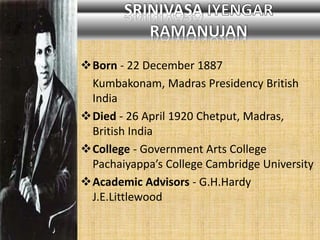
Born - 22 December 1887
Kumbakonam, Madras Presidency British
India
Died - 26 April 1920 Chetput, Madras,
British India
College - Government Arts College
Pachaiyappa’s College Cambridge University
Academic Advisors - G.H.Hardy
J.E.Littlewood
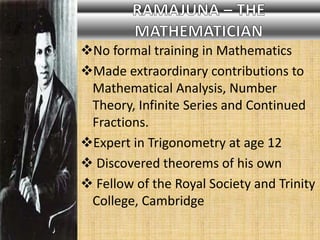
No formal training in Mathematics
Made extraordinary contributions to
Mathematical Analysis, Number
Theory, Infinite Series and Continued
Fractions.
Expert in Trigonometry at age 12
 Discovered theorems of his own
 Fellow of the Royal Society and Trinity
College, Cambridge
Born in Erode to K. Srinivasa Iyengar and
Komalatmmal
Lived in Sarangapani Street in Kumbakonam
Went school first on 1.10.1892.
Had to switch primary school 3 times due to
unfavourable circumstances.
Completed Math exam in half the allotted
time.
A synopsis of Elementary Results in Pure and
Applied Mathematics. Book acknowledged in
awakening the genius of Ramanujan.
Left college without a degree and pursued
research in Mathematics.
Married to a 9 year old bride Janaki
Ammal on 14 July 1909.
Searched for job
Tutored college students
Met V. Ramaswamy Aiyer, founder of
Indian Mathematical Society
“I was struck by the extraordinary
mathematical results contained in it [the
notebooks]. I had no mind to smother his
genius by an appointment in the lowest
rungs of the revenue department”
Introduced to R. Ramachandra Rao,
secretary of the Indian Mathematical
Society
Impressed by Ramanujan but doubted
his integrity.
Continued Mathematical Research with
Rao’s financial help
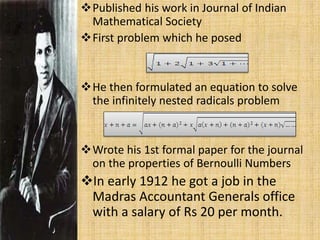
Published his work in Journal of Indian
Mathematical Society
First problem which he posed
He then formulated an equation to solve
the infinitely nested radicals problem
Wrote his 1st formal paper for the journal
on the properties of Bernoulli Numbers
In early 1912 he got a job in the
Madras Accountant Generals office
with a salary of Rs 20 per month.
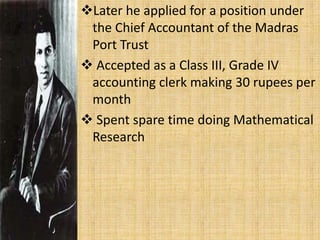
Later he applied for a position under
the Chief Accountant of the Madras
Port Trust
 Accepted as a Class III, Grade IV
accounting clerk making 30 rupees per
month
 Spent spare time doing Mathematical
Research
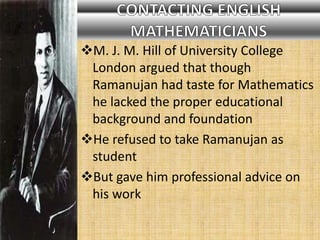
M. J. M. Hill of University College
London argued that though
Ramanujan had taste for Mathematics
he lacked the proper educational
background and foundation
He refused to take Ramanujan as
student
But gave him professional advice on
his work
G.H. Hardy was an academician at
Cambridge University
He was a prominent English mathematician,
known for his achievements in number
theory and mathematical analysis.
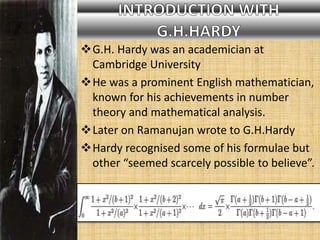
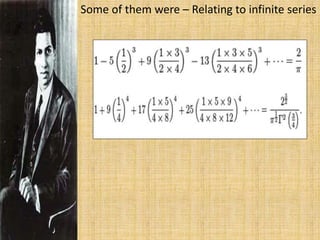
Later on Ramanujan wrote to G.H.Hardy
Hardy recognised some of his formulae but
other “seemed scarcely possible to believe”.
Some of them were – Relating to infinite series
Ramanujan boarded the S.S.Nevasa on 17
March 1914 and arrived in London on 14th
April
Ramanujan began working with Hardy and
Littlewood
Hardy received 120 theorems from him in 1st
2 letters but there were many more results in
his notebook
After working with Ramanujan Littlewood
commented, "I can believe that he's at least a
Jacobi”
Hardy said he "can compare him only with
[Leonhard] Euler or Jacobi”
Ramanujan spent nearly 5 years in Cambridge
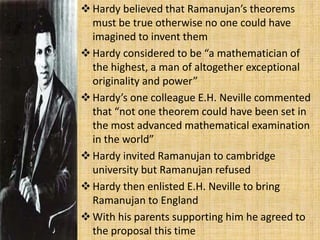
Hardy believed that Ramanujan’s theorems
must be true otherwise no one could have
imagined to invent them
Hardy considered to be “a mathematician of
the highest, a man of altogether exceptional
originality and power”
Hardy’s one colleague E.H. Neville commented
that “not one theorem could have been set in
the most advanced mathematical examination
in the world”
Hardy invited Ramanujan to cambridge
university but Ramanujan refused
Hardy then enlisted E.H. Neville to bring
Ramanujan to England
With his parents supporting him he agreed to
the proposal this time
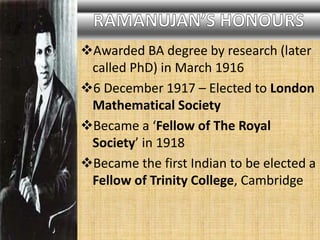
Awarded BA degree by research (later
called PhD) in March 1916
6 December 1917 – Elected to London
Mathematical Society
Became a ‘Fellow of The Royal
Society’ in 1918
Became the first Indian to be elected a
Fellow of Trinity College, Cambridge
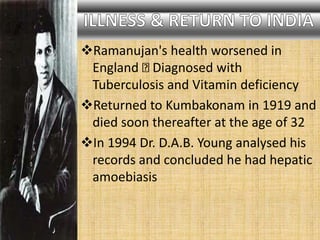
Ramanujan's health worsened in
England Diagnosed with
Tuberculosis and Vitamin deficiency
Returned to Kumbakonam in 1919 and
died soon thereafter at the age of 32
In 1994 Dr. D.A.B. Young analysed his
records and concluded he had hepatic
amoebiasis
A person with a somewhat shy and
quiet disposition
A dignified man with pleasant
manners
Ramanujan credited his success to his
family Goddess, Namagiri of Namakkal
He claimed to receive visions of scrolls
of complex mathematical content
unfolding before his eyes
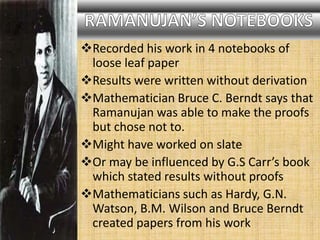
Recorded his work in 4 notebooks of
loose leaf paper
Results were written without derivation
Mathematician Bruce C. Berndt says that
Ramanujan was able to make the proofs
but chose not to.
Might have worked on slate
Or may be influenced by G.S Carr’s book
which stated results without proofs
Mathematicians such as Hardy, G.N.
Watson, B.M. Wilson and Bruce Berndt
created papers from his work
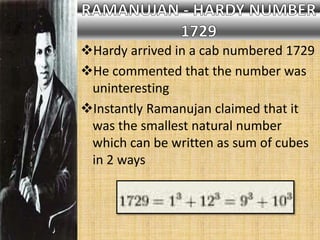
Hardy arrived in a cab numbered 1729
He commented that the number was
uninteresting
Instantly Ramanujan claimed that it
was the smallest natural number
which can be written as sum of cubes
in 2 ways
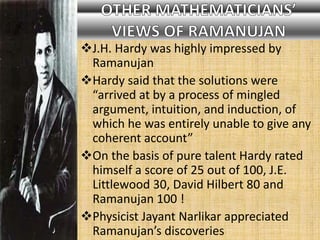
J.H. Hardy was highly impressed by
Ramanujan
Hardy said that the solutions were
“arrived at by a process of mingled
argument, intuition, and induction, of
which he was entirely unable to give any
coherent account”
On the basis of pure talent Hardy rated
himself a score of 25 out of 100, J.E.
Littlewood 30, David Hilbert 80 and
Ramanujan 100 !
Physicist Jayant Narlikar appreciated
Ramanujan’s discoveries
Tamil Nadu celebrates 22 December
as ‘State IT Day’
Stamp released by the Govt. in 1962
22nd December celebrated as
Ramanujan Day in Govt Arts College,
Kumbakonam
National Symposium On Mathematical
Methods and Applications (NSMMA)
SASTRA Ramanujan Prize
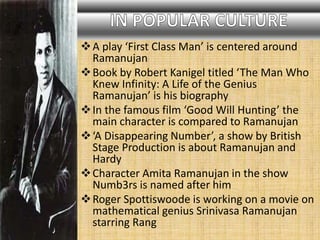
A play ‘First Class Man’ is centered around
Ramanujan
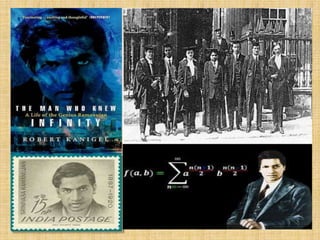
Book by Robert Kanigel titled ‘The Man Who
Knew Infinity: A Life of the Genius
Ramanujan’ is his biography
In the famous film ‘Good Will Hunting’ the
main character is compared to Ramanujan
‘A Disappearing Number’, a show by British
Stage Production is about Ramanujan and
Hardy
Character Amita Ramanujan in the show
Numb3rs is named after him
Roger Spottiswoode is working on a movie on
mathematical genius Srinivasa Ramanujan
starring Rang
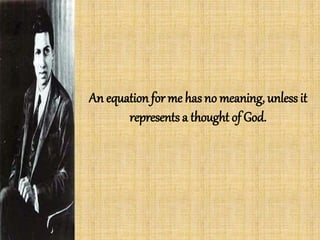
An equation for me has no meaning, unless it
represents a thought of God.
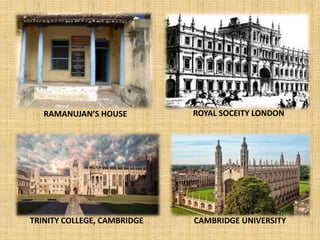
ROYAL SOCEITY LONDON
CAMBRIDGE UNIVERSITYTRINITY COLLEGE, CAMBRIDGE
RAMANUJAN’S HOUSE
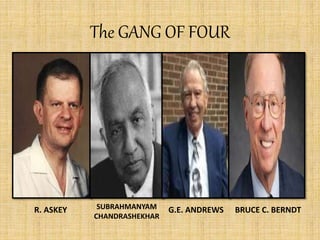
The GANG OF FOUR
R. ASKEY SUBRAHMANYAM
CHANDRASHEKHAR
G.E. ANDREWS BRUCE C. BERNDT
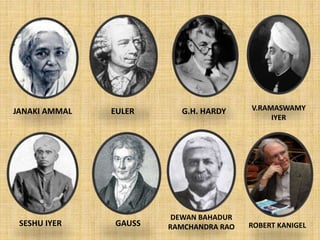
DEWAN BAHADUR
RAMCHANDRA RAO
EULER G.H. HARDY V.RAMASWAMY
IYER
SESHU IYER GAUSS ROBERT KANIGEL
JANAKI AMMAL
Ramanujan: The Man Who Knew Infinity

Ramanujan: The Man Who Knew Infinity

  • 1.
    SRINIVASA IYENGAR RAMANUJAN The Man WhoKnew Infinity – How Indian Genius Ramanujan Rose From Zero to Wow the Math World
  • 2.
    Born - 22December 1887 Kumbakonam, Madras Presidency British India Died - 26 April 1920 Chetput, Madras, British India College - Government Arts College Pachaiyappa’s College Cambridge University Academic Advisors - G.H.Hardy J.E.Littlewood
  • 3.
    No formal trainingin Mathematics Made extraordinary contributions to Mathematical Analysis, Number Theory, Infinite Series and Continued Fractions. Expert in Trigonometry at age 12  Discovered theorems of his own  Fellow of the Royal Society and Trinity College, Cambridge
  • 4.
    Born in Erodeto K. Srinivasa Iyengar and Komalatmmal Lived in Sarangapani Street in Kumbakonam Went school first on 1.10.1892. Had to switch primary school 3 times due to unfavourable circumstances. Completed Math exam in half the allotted time. A synopsis of Elementary Results in Pure and Applied Mathematics. Book acknowledged in awakening the genius of Ramanujan. Left college without a degree and pursued research in Mathematics.
  • 5.
    Married to a9 year old bride Janaki Ammal on 14 July 1909. Searched for job Tutored college students
  • 6.
    Met V. RamaswamyAiyer, founder of Indian Mathematical Society “I was struck by the extraordinary mathematical results contained in it [the notebooks]. I had no mind to smother his genius by an appointment in the lowest rungs of the revenue department” Introduced to R. Ramachandra Rao, secretary of the Indian Mathematical Society Impressed by Ramanujan but doubted his integrity. Continued Mathematical Research with Rao’s financial help
  • 7.
    Published his workin Journal of Indian Mathematical Society First problem which he posed He then formulated an equation to solve the infinitely nested radicals problem Wrote his 1st formal paper for the journal on the properties of Bernoulli Numbers In early 1912 he got a job in the Madras Accountant Generals office with a salary of Rs 20 per month.
  • 8.
    Later he appliedfor a position under the Chief Accountant of the Madras Port Trust  Accepted as a Class III, Grade IV accounting clerk making 30 rupees per month  Spent spare time doing Mathematical Research
  • 9.
    M. J. M.Hill of University College London argued that though Ramanujan had taste for Mathematics he lacked the proper educational background and foundation He refused to take Ramanujan as student But gave him professional advice on his work
  • 10.
    G.H. Hardy wasan academician at Cambridge University He was a prominent English mathematician, known for his achievements in number theory and mathematical analysis. Later on Ramanujan wrote to G.H.Hardy Hardy recognised some of his formulae but other “seemed scarcely possible to believe”.
  • 11.
    Some of themwere – Relating to infinite series
  • 12.
    Ramanujan boarded theS.S.Nevasa on 17 March 1914 and arrived in London on 14th April Ramanujan began working with Hardy and Littlewood Hardy received 120 theorems from him in 1st 2 letters but there were many more results in his notebook After working with Ramanujan Littlewood commented, "I can believe that he's at least a Jacobi” Hardy said he "can compare him only with [Leonhard] Euler or Jacobi” Ramanujan spent nearly 5 years in Cambridge
  • 13.
    Hardy believed thatRamanujan’s theorems must be true otherwise no one could have imagined to invent them Hardy considered to be “a mathematician of the highest, a man of altogether exceptional originality and power” Hardy’s one colleague E.H. Neville commented that “not one theorem could have been set in the most advanced mathematical examination in the world” Hardy invited Ramanujan to cambridge university but Ramanujan refused Hardy then enlisted E.H. Neville to bring Ramanujan to England With his parents supporting him he agreed to the proposal this time
  • 14.
    Awarded BA degreeby research (later called PhD) in March 1916 6 December 1917 – Elected to London Mathematical Society Became a ‘Fellow of The Royal Society’ in 1918 Became the first Indian to be elected a Fellow of Trinity College, Cambridge
  • 15.
    Ramanujan's health worsenedin England Diagnosed with Tuberculosis and Vitamin deficiency Returned to Kumbakonam in 1919 and died soon thereafter at the age of 32 In 1994 Dr. D.A.B. Young analysed his records and concluded he had hepatic amoebiasis
  • 17.
    A person witha somewhat shy and quiet disposition A dignified man with pleasant manners Ramanujan credited his success to his family Goddess, Namagiri of Namakkal He claimed to receive visions of scrolls of complex mathematical content unfolding before his eyes
  • 18.
    Recorded his workin 4 notebooks of loose leaf paper Results were written without derivation Mathematician Bruce C. Berndt says that Ramanujan was able to make the proofs but chose not to. Might have worked on slate Or may be influenced by G.S Carr’s book which stated results without proofs Mathematicians such as Hardy, G.N. Watson, B.M. Wilson and Bruce Berndt created papers from his work
  • 19.
    Hardy arrived ina cab numbered 1729 He commented that the number was uninteresting Instantly Ramanujan claimed that it was the smallest natural number which can be written as sum of cubes in 2 ways
  • 20.
    J.H. Hardy washighly impressed by Ramanujan Hardy said that the solutions were “arrived at by a process of mingled argument, intuition, and induction, of which he was entirely unable to give any coherent account” On the basis of pure talent Hardy rated himself a score of 25 out of 100, J.E. Littlewood 30, David Hilbert 80 and Ramanujan 100 ! Physicist Jayant Narlikar appreciated Ramanujan’s discoveries
  • 21.
    Tamil Nadu celebrates22 December as ‘State IT Day’ Stamp released by the Govt. in 1962 22nd December celebrated as Ramanujan Day in Govt Arts College, Kumbakonam National Symposium On Mathematical Methods and Applications (NSMMA) SASTRA Ramanujan Prize
  • 22.
    A play ‘FirstClass Man’ is centered around Ramanujan Book by Robert Kanigel titled ‘The Man Who Knew Infinity: A Life of the Genius Ramanujan’ is his biography In the famous film ‘Good Will Hunting’ the main character is compared to Ramanujan ‘A Disappearing Number’, a show by British Stage Production is about Ramanujan and Hardy Character Amita Ramanujan in the show Numb3rs is named after him Roger Spottiswoode is working on a movie on mathematical genius Srinivasa Ramanujan starring Rang
  • 23.
    An equation forme has no meaning, unless it represents a thought of God.
  • 24.
    ROYAL SOCEITY LONDON CAMBRIDGEUNIVERSITYTRINITY COLLEGE, CAMBRIDGE RAMANUJAN’S HOUSE
  • 26.
    The GANG OFFOUR R. ASKEY SUBRAHMANYAM CHANDRASHEKHAR G.E. ANDREWS BRUCE C. BERNDT
  • 27.
    DEWAN BAHADUR RAMCHANDRA RAO EULERG.H. HARDY V.RAMASWAMY IYER SESHU IYER GAUSS ROBERT KANIGEL JANAKI AMMAL