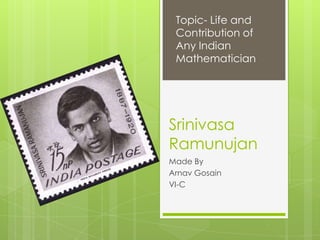
Srinivasa Ramanujan was an Indian mathematician who made extraordinary contributions to mathematical analysis, number theory, infinite series and continued fractions. Although he had almost no formal training, his natural talent for mathematics was recognized as being on par with legendary mathematicians such as Gauss, Euler, and Newton. During his short life, Ramanujan independently compiled nearly 3900 mathematical results, many of which have been proven correct and inspired further research. He made significant original discoveries such as the Ramanujan prime and theta function. India now celebrates Ramanujan's birthday as National Mathematics Day in recognition of his remarkable contributions.
![Life and Contribution
Born in Erode, Madras Presidency, to a poor
Brahmin family, Ramanujan first encountered
formal mathematics at age 10. He demonstrated
a natural ability, and was given books on
advanced trigonometry written by S. L.
Loney.[2] He mastered them by age 12, and even
discovered theorems of his own, including
independently re-discovering Euler's identity. He
demonstrated unusual mathematical skills at
school, winning accolades and awards. By
17, Ramanujan conducted his own mathematical
research on Bernoulli numbers and the Euler–
Mascheroni constant.](https://image.slidesharecdn.com/homeworkppt-120215063109-phpapp01/85/Srinivasa-Ramunujan-3-320.jpg)
![ He received a scholarship to study at
Government College in Kumbakonam, but
lost it when he failed his non-mathematical
coursework. He joined another college to
pursue independent mathematical
research, working as a clerk in the
Accountant-General's office at the Madras
Port Trust Office to support himself.[3] In 1912–
1913, he sent samples of his theorems to three
academics at the University of Cambridge.
Only Hardy recognised the brilliance of his
work, subsequently inviting Ramanujan to visit
and work with him at Cambridge. He
became a Fellow of the Royal Society and a
Fellow of Trinity College, Cambridge, dying of
illness, malnutrition and possibly liver infection
in 1920 at the age of 32.](https://image.slidesharecdn.com/homeworkppt-120215063109-phpapp01/85/Srinivasa-Ramunujan-4-320.jpg)
![ During his short lifetime, Ramanujan
independently compiled nearly 3900 results
(mostly identities andequations).[4] Although a
small number of these results were actually
false and some were already known, most of
his claims have now been proven
correct.[5] He stated results that were both
original and highly unconventional, such as
the Ramanujan prime and the Ramanujan
theta function, and these have inspired a vast
amount of further research.[6] However, the
mathematical mainstream has been rather
slow in absorbing some of his major
discoveries. The Ramanujan Journal, an
international publication, was launched to
publish work in all areas of mathematics
influenced by his work.[7]](https://image.slidesharecdn.com/homeworkppt-120215063109-phpapp01/85/Srinivasa-Ramunujan-5-320.jpg)
![ Inrecognition of his contribution to
mathematics, the Government of India
declared in Dec 2011 to celebrate
Ramajuan's birthday as the 'National
Mathematics Day' every year on 22
December and declared 2012 as the
'National Mathematical Year'.[8]](https://image.slidesharecdn.com/homeworkppt-120215063109-phpapp01/85/Srinivasa-Ramunujan-6-320.jpg)



![INDIAN MATHEMATICIAN [Recovered].pptx ppt](https://cdn.slidesharecdn.com/ss_thumbnails/indianmathematicianrecovered-250706105519-169192d2-thumbnail.jpg?width=640&height=640&fit=bounds)


