Srinivasa Aiyangar Ramanujan
PPT by
M PADMA LALITHA SHARADA
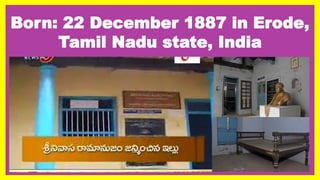
Born: 22 December 1887 in Erode,
Tamil Nadu state, India
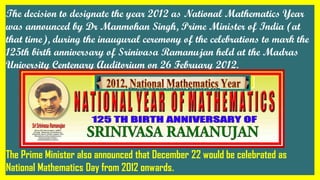
The decision to designate the year 2012 as National Mathematics Year
was announced by Dr Manmohan Singh, Prime Minister of India (at
that time), during the inaugural ceremony of the celebrations to mark the
125th birth anniversary of Srinivasa Ramanujan held at the Madras
University Centenary Auditorium on 26 February 2012.
The Prime Minister also announced that December 22 would be celebrated as
National Mathematics Day from 2012 onwards.
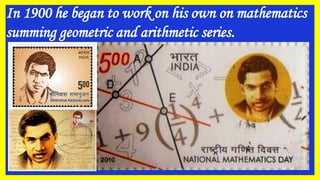
In 1900 he began to work on his own on mathematics
summing geometric and arithmetic series.
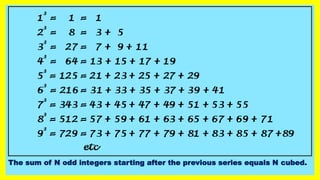
The sum of N odd integers starting after the previous series equals N cubed.
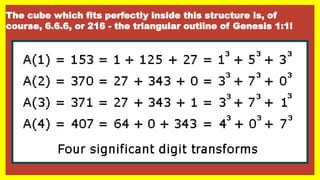
The cube which fits perfectly inside this structure is, of
course, 6.6.6, or 216 - the triangular outline of Genesis 1:1!
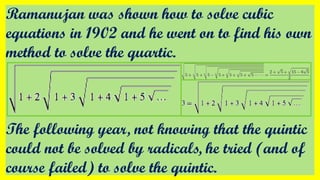
Ramanujan was shown how to solve cubic
equations in 1902 and he went on to find his own
method to solve the quartic.
The following year, not knowing that the quintic
could not be solved by radicals, he tried (and of
course failed) to solve the quintic.
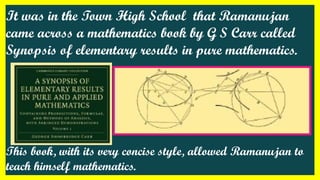
It was in the Town High School that Ramanujan
came across a mathematics book by G S Carr called
Synopsis of elementary results in pure mathematics.
This book, with its very concise style, allowed Ramanujan to
teach himself mathematics.
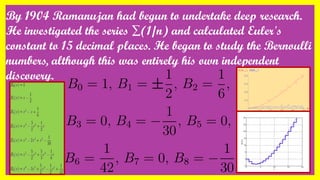
By 1904 Ramanujan had begun to undertake deep research.
He investigated the series ∑(1/n) and calculated Euler's
constant to 15 decimal places. He began to study the Bernoulli
numbers, although this was entirely his own independent
discovery.
He married on 14 July 1909 when his mother arranged
for him to marry a ten year old girl S Janaki Ammal.
Janaki Ammal
His Mother
With his wife Janaki
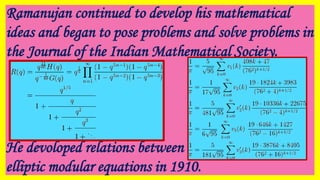
Ramanujan continued to develop his mathematical
ideas and began to pose problems and solve problems in
the Journal of the Indian Mathematical Society.
He devoloped relations between
elliptic modular equations in 1910.
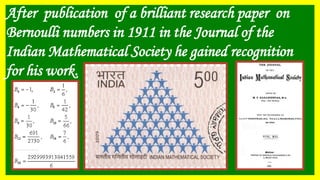
After publication of a brilliant research paper on
Bernoulli numbers in 1911 in the Journal of the
Indian Mathematical Society he gained recognition
for his work.
Indeed the University of Madras did give Ramanujan a
scholarship in May 1913 for two years and, in 1914, Hardy
brought Ramanujan to Trinity College, Cambridge, to begin
an extraordinary collaboration.
with friends at
Trinity College
Trinity College, Cambridge
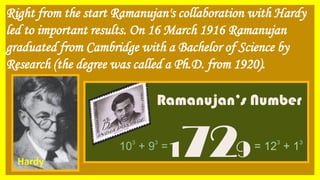
Right from the start Ramanujan's collaboration with Hardy
led to important results. On 16 March 1916 Ramanujan
graduated from Cambridge with a Bachelor of Science by
Research (the degree was called a Ph.D. from 1920).
Hardy
Ramanujan's dissertation was on Highly composite numbers
and consisted of seven of his papers published in England.
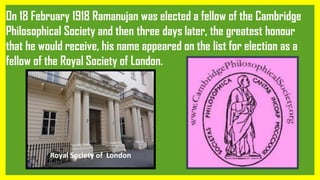
On 18 February 1918 Ramanujan was elected a fellow of the Cambridge
Philosophical Society and then three days later, the greatest honour
that he would receive, his name appeared on the list for election as a
fellow of the Royal Society of London.
Royal Society of London
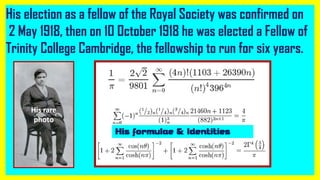
His election as a fellow of the Royal Society was confirmed on
2 May 1918, then on 10 October 1918 he was elected a Fellow of
Trinity College Cambridge, the fellowship to run for six years.
His rare
photo
His formulae & Identities
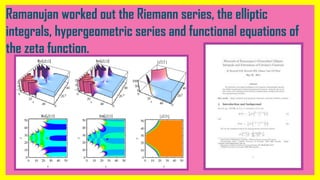
Ramanujan worked out the Riemann series, the elliptic
integrals, hypergeometric series and functional equations of
the zeta function.
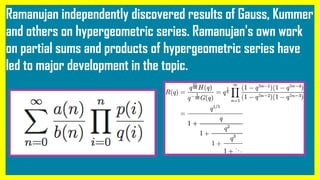
Ramanujan independently discovered results of Gauss, Kummer
and others on hypergeometric series. Ramanujan's own work
on partial sums and products of hypergeometric series have
led to major development in the topic.
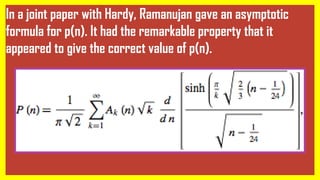
In a joint paper with Hardy, Ramanujan gave an asymptotic
formula for p(n). It had the remarkable property that it
appeared to give the correct value of p(n).
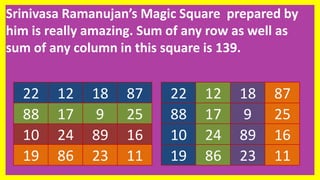
Srinivasa Ramanujan’s Magic Square prepared by
him is really amazing. Sum of any row as well as
sum of any column in this square is 139.
22 12 18 87
88 17 9 25
10 24 89 16
19 86 23 11
22 12 18 87
88 17 9 25
10 24 89 16
19 86 23 11
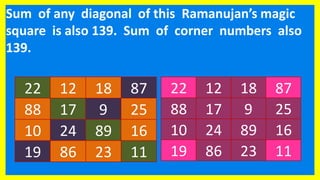
Sum of any diagonal of this Ramanujan’s magic
square is also 139. Sum of corner numbers also
139.
22 12 18 87
88 17 9 25
10 24 89 16
19 86 23 11
22 12 18 87
88 17 9 25
10 24 89 16
19 86 23 11
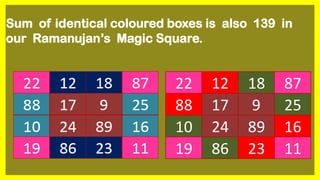
Sum of identical coloured boxes is also 139 in
our Ramanujan’s Magic Square.
22 12 18 87
88 17 9 25
10 24 89 16
19 86 23 11
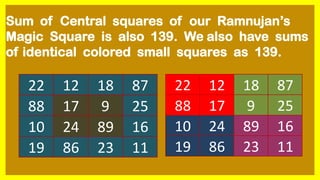
Sum of Central squares of our Ramnujan’s
Magic Square is also 139. We also have sums
of identical colored small squares as 139.
22 12 18 87
88 17 9 25
10 24 89 16
19 86 23 11
22 12 18 87
88 17 9 25
10 24 89 16
19 86 23 11
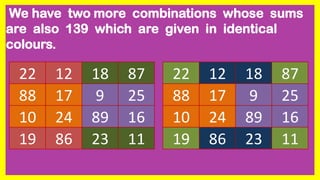
We have two more combinations whose sums
are also 139 which are given in identical
colours.
22 12 18 87
88 17 9 25
10 24 89 16
19 86 23 11
22 12 18 87
88 17 9 25
10 24 89 16
19 86 23 11
This magic square is based on our great Indian
Mathematician Srinivasa Ramanujan’s Date of
Birth 22.12. 1987. PROUD TO BE AN an INDIAN.
A TRIBUTE to great Mathematician SRINIVASA
RAMANUJAN
THANK YOU ONE & ALL - Sharada

Srinivasa Ramanujan Date Of Birth 22.12.1887

  • 1.
    Srinivasa Aiyangar Ramanujan PPTby M PADMA LALITHA SHARADA
  • 2.
    Born: 22 December1887 in Erode, Tamil Nadu state, India
  • 3.
    The decision todesignate the year 2012 as National Mathematics Year was announced by Dr Manmohan Singh, Prime Minister of India (at that time), during the inaugural ceremony of the celebrations to mark the 125th birth anniversary of Srinivasa Ramanujan held at the Madras University Centenary Auditorium on 26 February 2012. The Prime Minister also announced that December 22 would be celebrated as National Mathematics Day from 2012 onwards.
  • 4.
    In 1900 hebegan to work on his own on mathematics summing geometric and arithmetic series.
  • 5.
    The sum ofN odd integers starting after the previous series equals N cubed.
  • 6.
    The cube whichfits perfectly inside this structure is, of course, 6.6.6, or 216 - the triangular outline of Genesis 1:1!
  • 7.
    Ramanujan was shownhow to solve cubic equations in 1902 and he went on to find his own method to solve the quartic. The following year, not knowing that the quintic could not be solved by radicals, he tried (and of course failed) to solve the quintic.
  • 8.
    It was inthe Town High School that Ramanujan came across a mathematics book by G S Carr called Synopsis of elementary results in pure mathematics. This book, with its very concise style, allowed Ramanujan to teach himself mathematics.
  • 9.
    By 1904 Ramanujanhad begun to undertake deep research. He investigated the series ∑(1/n) and calculated Euler's constant to 15 decimal places. He began to study the Bernoulli numbers, although this was entirely his own independent discovery.
  • 10.
    He married on14 July 1909 when his mother arranged for him to marry a ten year old girl S Janaki Ammal. Janaki Ammal His Mother With his wife Janaki
  • 11.
    Ramanujan continued todevelop his mathematical ideas and began to pose problems and solve problems in the Journal of the Indian Mathematical Society. He devoloped relations between elliptic modular equations in 1910.
  • 12.
    After publication ofa brilliant research paper on Bernoulli numbers in 1911 in the Journal of the Indian Mathematical Society he gained recognition for his work.
  • 13.
    Indeed the Universityof Madras did give Ramanujan a scholarship in May 1913 for two years and, in 1914, Hardy brought Ramanujan to Trinity College, Cambridge, to begin an extraordinary collaboration. with friends at Trinity College Trinity College, Cambridge
  • 14.
    Right from thestart Ramanujan's collaboration with Hardy led to important results. On 16 March 1916 Ramanujan graduated from Cambridge with a Bachelor of Science by Research (the degree was called a Ph.D. from 1920). Hardy
  • 15.
    Ramanujan's dissertation wason Highly composite numbers and consisted of seven of his papers published in England.
  • 16.
    On 18 February1918 Ramanujan was elected a fellow of the Cambridge Philosophical Society and then three days later, the greatest honour that he would receive, his name appeared on the list for election as a fellow of the Royal Society of London. Royal Society of London
  • 17.
    His election asa fellow of the Royal Society was confirmed on 2 May 1918, then on 10 October 1918 he was elected a Fellow of Trinity College Cambridge, the fellowship to run for six years. His rare photo His formulae & Identities
  • 18.
    Ramanujan worked outthe Riemann series, the elliptic integrals, hypergeometric series and functional equations of the zeta function.
  • 19.
    Ramanujan independently discoveredresults of Gauss, Kummer and others on hypergeometric series. Ramanujan's own work on partial sums and products of hypergeometric series have led to major development in the topic.
  • 20.
    In a jointpaper with Hardy, Ramanujan gave an asymptotic formula for p(n). It had the remarkable property that it appeared to give the correct value of p(n).
  • 21.
    Srinivasa Ramanujan’s MagicSquare prepared by him is really amazing. Sum of any row as well as sum of any column in this square is 139. 22 12 18 87 88 17 9 25 10 24 89 16 19 86 23 11 22 12 18 87 88 17 9 25 10 24 89 16 19 86 23 11
  • 22.
    Sum of anydiagonal of this Ramanujan’s magic square is also 139. Sum of corner numbers also 139. 22 12 18 87 88 17 9 25 10 24 89 16 19 86 23 11 22 12 18 87 88 17 9 25 10 24 89 16 19 86 23 11
  • 23.
    Sum of identicalcoloured boxes is also 139 in our Ramanujan’s Magic Square. 22 12 18 87 88 17 9 25 10 24 89 16 19 86 23 11
  • 24.
    Sum of Centralsquares of our Ramnujan’s Magic Square is also 139. We also have sums of identical colored small squares as 139. 22 12 18 87 88 17 9 25 10 24 89 16 19 86 23 11 22 12 18 87 88 17 9 25 10 24 89 16 19 86 23 11
  • 25.
    We have twomore combinations whose sums are also 139 which are given in identical colours. 22 12 18 87 88 17 9 25 10 24 89 16 19 86 23 11 22 12 18 87 88 17 9 25 10 24 89 16 19 86 23 11
  • 26.
    This magic squareis based on our great Indian Mathematician Srinivasa Ramanujan’s Date of Birth 22.12. 1987. PROUD TO BE AN an INDIAN.
  • 27.
    A TRIBUTE togreat Mathematician SRINIVASA RAMANUJAN THANK YOU ONE & ALL - Sharada