Wylde Green Primary
School
Maths Workshop
Aims
Explain how we teach calculation across the
Early Years (EY) and Key Stage 1 (KS1).
Illustrate progression and development of
skills used in each year group.
Explore resources and strategies used in the
classroom.

Share with you some ideas of how you can
help your child with their Numeracy at home.
Numeracy in Early Years
•

Maths or Problem Solving, Reasoning and
Numeracy, in the Early Years, builds an
important foundation for number work and
problem solving in Key Stage 1.
There are 2 aspects of mathematical
understanding in Early Years Foundation
Stage.

Numbers

Shape, space and measure.
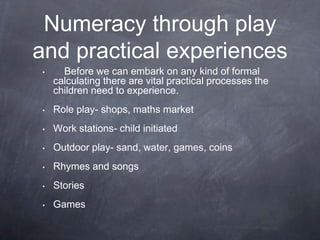
Numeracy through play
and practical experiences
•

Before we can embark on any kind of formal
calculating there are vital practical processes the
children need to experience.

•

Role play- shops, maths market

•

Work stations- child initiated

•

Outdoor play- sand, water, games, coins

•

Rhymes and songs

•

Stories

•

Games
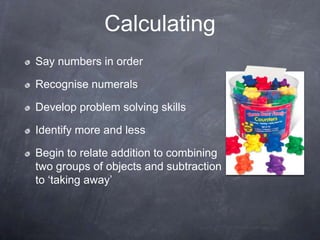
Calculating
Say numbers in order
Recognise numerals
Develop problem solving skills
Identify more and less
Begin to relate addition to combining
two groups of objects and subtraction
to ‘taking away’
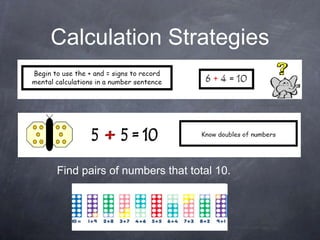
Calculation Strategies

Find pairs of numbers that total 10.
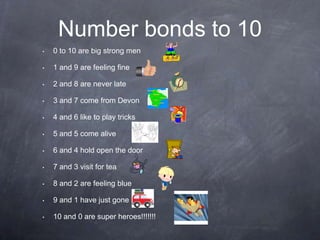
Number bonds to 10
•

0 to 10 are big strong men

•

1 and 9 are feeling fine

•

2 and 8 are never late

•

3 and 7 come from Devon

•

4 and 6 like to play tricks

•

5 and 5 come alive

•

6 and 4 hold open the door

•

7 and 3 visit for tea

•

8 and 2 are feeling blue

•

9 and 1 have just gone

•

10 and 0 are super heroes!!!!!!!
Problem Solving,
Reasoning and Numeracy
Use mathematical language – greater,
heavier, longer, smaller, under, beside

Identify patterns
Identify and describe shape

Recognise and name coins and learn to use
them in practical experiences
How is learning achieved
in Early Years?
Through structured play, adult led activities and child
initiated learning.

Using counting rhymes, stories and games.
We encourage the use of cubes, compare bears, fingers,
number fans, numicon and number lines up to 10 and 20.
We talk about 1 more/ 1 less, odd and even and multiples
of 2 and 10 up to 20
How YOU Can Help...
Do little and often.
Praise.
Play lots of games.
Remember that maths should be FUN!

Maths reception presentation 1

  • 1.
  • 2.
    Aims Explain how weteach calculation across the Early Years (EY) and Key Stage 1 (KS1). Illustrate progression and development of skills used in each year group. Explore resources and strategies used in the classroom. Share with you some ideas of how you can help your child with their Numeracy at home.
  • 3.
    Numeracy in EarlyYears • Maths or Problem Solving, Reasoning and Numeracy, in the Early Years, builds an important foundation for number work and problem solving in Key Stage 1.
  • 4.
    There are 2aspects of mathematical understanding in Early Years Foundation Stage. Numbers Shape, space and measure.
  • 5.
    Numeracy through play andpractical experiences • Before we can embark on any kind of formal calculating there are vital practical processes the children need to experience. • Role play- shops, maths market • Work stations- child initiated • Outdoor play- sand, water, games, coins • Rhymes and songs • Stories • Games
  • 6.
    Calculating Say numbers inorder Recognise numerals Develop problem solving skills Identify more and less Begin to relate addition to combining two groups of objects and subtraction to ‘taking away’
  • 7.
    Calculation Strategies Find pairsof numbers that total 10.
  • 8.
    Number bonds to10 • 0 to 10 are big strong men • 1 and 9 are feeling fine • 2 and 8 are never late • 3 and 7 come from Devon • 4 and 6 like to play tricks • 5 and 5 come alive • 6 and 4 hold open the door • 7 and 3 visit for tea • 8 and 2 are feeling blue • 9 and 1 have just gone • 10 and 0 are super heroes!!!!!!!
  • 9.
    Problem Solving, Reasoning andNumeracy Use mathematical language – greater, heavier, longer, smaller, under, beside Identify patterns Identify and describe shape Recognise and name coins and learn to use them in practical experiences
  • 10.
    How is learningachieved in Early Years? Through structured play, adult led activities and child initiated learning. Using counting rhymes, stories and games. We encourage the use of cubes, compare bears, fingers, number fans, numicon and number lines up to 10 and 20. We talk about 1 more/ 1 less, odd and even and multiples of 2 and 10 up to 20
  • 11.
    How YOU CanHelp... Do little and often. Praise. Play lots of games. Remember that maths should be FUN!