INTRODUCTION 
The concepts of measurement and evaluation are 
used in everyday school situations, for decisions 
are continually made by both school personnel 
and students. The terms measurement and 
evaluation are sometimes used interchangeably; 
some scholars, however, make a distinction 
among them.
DEFINITIONS OF MEASUREMENT 
• As a result of a test, a measure is obtained. An 
observation, a rating scale or any other device that 
allows us to obtain information in a quantitative form is 
a measurement. Measurement may be defined as 
follows: 
• Measurement is an act or a process that involves the 
assignment of a numerical index to whatever is being 
assessed. Beyond its general definition, refers to the 
set of procedures and the principles for how to use the 
procedures in educational tests and assessments. 
Some of the basic principles of measurement in 
educational evaluations would be raw scores, 
percentile ranks, derived scores, standard scores, etc.
Continuation on Measurement 
• Measurement is thus concerned with 
quantification. Language proficiency, like many 
other constructs and characteristics of persons in 
social sciences, needs to be quantified before any 
judgments can be made about it. This process of 
quantifying is called operationalization in 
research by which we mean assigning numbers 
according to observable operations and explicit 
procedures or rules to measure a construct 
(Bachman 1990) (Ary et al. 1996)
Types of Measurement: 
Generally, there are three types of 
measurement: 
(i) Direct; (ii) Indirect; and Relative. 
• To find the length and breadth of a table involves direct 
measurement and this is always accurate if the tool is 
valid. To know the quantity of heat contained by a 
substance involves indirect measurement for we have 
to first find out the temperature of the substance with 
the help of a thermometer and then we can calculate 
the heat contained by the substance. To measure the 
intelligence of a boy involves relative measurement, for 
the score obtained by the boy in an intelligence test is 
compared with norms. It is obvious that psychological 
and educational measurements are relative.
Definitions of Evaluation 
Procedures used to determine whether the 
subject (i.e. student) meets a preset criteria, 
such as qualifying for special education 
services. This uses assessment (remember 
that an assessment may be a test) to make a 
determination of qualification in accordance 
with a predetermined criteria.
Continuation on Evaluations 
• It is a decision making process which assists to make grade 
and ranking. 
According to Barrow and Mc Gee 
• It is the process of education that involves collection of 
data from the products which can be used for comparison 
with preconceived criteria to make judgment. 
• 
• 1) Evaluation is an act or a process that allows one to 
make a judgment about the desirability or value of a 
measure. 
• 2) Evaluation is a process of delineating, obtaining and 
providing useful information for judging decision 
alternatives
Distinct between Evaluation and 
Measurement 
• Measurement helps in evaluation but is not the 
same as evaluation. Let us consider one example 
to clarify this difference. Manish and Bharat study 
in the same class. In the first test, they obtain 40 
and 60 marks respectively in Mathematics. In the 
second test, both of them obtain 75 marks. Now, 
in the second test the measurement (test scores) 
of their achievement in Mathematics is the same, 
yet the evaluation will differ, when the teacher 
says that the rate of progress of Manish is 
comparatively better than that of Bharat.
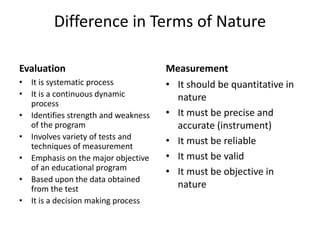
Difference in Terms of Nature 
Evaluation 
• It is systematic process 
• It is a continuous dynamic 
process 
• Identifies strength and weakness 
of the program 
• Involves variety of tests and 
techniques of measurement 
• Emphasis on the major objective 
of an educational program 
• Based upon the data obtained 
from the test 
• It is a decision making process 
Measurement 
• It should be quantitative in 
nature 
• It must be precise and 
accurate (instrument) 
• It must be reliable 
• It must be valid 
• It must be objective in 
nature
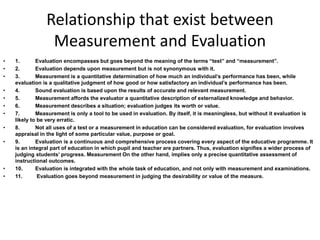
Relationship that exist between 
Measurement and Evaluation 
• 1. Evaluation encompasses but goes beyond the meaning of the terms “test” and “measurement”. 
• 2. Evaluation depends upon measurement but is not synonymous with it. 
• 3. Measurement is a quantitative determination of how much an individual’s performance has been, while 
evaluation is a qualitative judgment of how good or how satisfactory an individual’s performance has been. 
• 4. Sound evaluation is based upon the results of accurate and relevant measurement. 
• 5. Measurement affords the evaluator a quantitative description of externalized knowledge and behavior. 
• 6. Measurement describes a situation; evaluation judges its worth or value. 
• 7. Measurement is only a tool to be used in evaluation. By itself, it is meaningless, but without it evaluation is 
likely to be very erratic. 
• 8. Not all uses of a test or a measurement in education can be considered evaluation, for evaluation involves 
appraisal in the light of some particular value, purpose or goal. 
• 9. Evaluation is a continuous and comprehensive process covering every aspect of the educative programme. It 
is an integral part of education in which pupil and teacher are partners. Thus, evaluation signifies a wider process of 
judging students’ progress. Measurement On the other hand, implies only a precise quantitative assessment of 
instructional outcomes. 
• 10. Evaluation is integrated with the whole task of education, and not only with measurement and examinations. 
• 11. Evaluation goes beyond measurement in judging the desirability or value of the measure.
Scope of Evaluation Related to Student 
• To determine the objectives 
• To select a particular team 
• Classification of the students 
• To select appropriate learning situation 
• To motivate the students 
• To develop ability and skill of the students 
• To find out the rate of improvement or 
progress 
• To predict future performance 
• For grading purpose 
• To diagnose the learning problem
Scope of Evaluation Related Teacher 
• To determine the effectiveness of teaching 
(teaching methods) 
• To adjust the content of course (in relation to 
determine the no. of subject and content of the 
syllabi) 
• Development of norms which may involve in 
evaluation 
• To conduct intensive research 
• To predict the performance and 
• To develop new programs in the field of physical 
education and sports
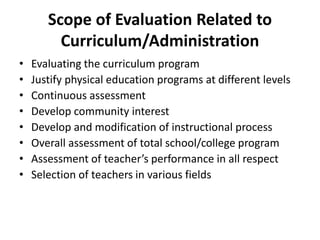
Scope of Evaluation Related to 
Curriculum/Administration 
• Evaluating the curriculum program 
• Justify physical education programs at different levels 
• Continuous assessment 
• Develop community interest 
• Develop and modification of instructional process 
• Overall assessment of total school/college program 
• Assessment of teacher’s performance in all respect 
• Selection of teachers in various fields
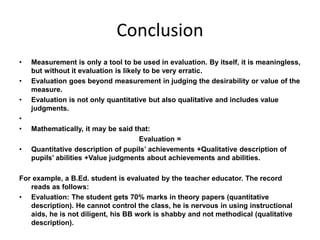
Conclusion 
• Measurement is only a tool to be used in evaluation. By itself, it is meaningless, 
but without it evaluation is likely to be very erratic. 
• Evaluation goes beyond measurement in judging the desirability or value of the 
measure. 
• Evaluation is not only quantitative but also qualitative and includes value 
judgments. 
• 
• Mathematically, it may be said that: 
Evaluation = 
• Quantitative description of pupils’ achievements +Qualitative description of 
pupils’ abilities +Value judgments about achievements and abilities. 
For example, a B.Ed. student is evaluated by the teacher educator. The record 
reads as follows: 
• Evaluation: The student gets 70% marks in theory papers (quantitative 
description). He cannot control the class, he is nervous in using instructional 
aids, he is not diligent, his BB work is shabby and not methodical (qualitative 
description).

Maths method ii presentation

  • 1.
    INTRODUCTION The conceptsof measurement and evaluation are used in everyday school situations, for decisions are continually made by both school personnel and students. The terms measurement and evaluation are sometimes used interchangeably; some scholars, however, make a distinction among them.
  • 2.
    DEFINITIONS OF MEASUREMENT • As a result of a test, a measure is obtained. An observation, a rating scale or any other device that allows us to obtain information in a quantitative form is a measurement. Measurement may be defined as follows: • Measurement is an act or a process that involves the assignment of a numerical index to whatever is being assessed. Beyond its general definition, refers to the set of procedures and the principles for how to use the procedures in educational tests and assessments. Some of the basic principles of measurement in educational evaluations would be raw scores, percentile ranks, derived scores, standard scores, etc.
  • 3.
    Continuation on Measurement • Measurement is thus concerned with quantification. Language proficiency, like many other constructs and characteristics of persons in social sciences, needs to be quantified before any judgments can be made about it. This process of quantifying is called operationalization in research by which we mean assigning numbers according to observable operations and explicit procedures or rules to measure a construct (Bachman 1990) (Ary et al. 1996)
  • 4.
    Types of Measurement: Generally, there are three types of measurement: (i) Direct; (ii) Indirect; and Relative. • To find the length and breadth of a table involves direct measurement and this is always accurate if the tool is valid. To know the quantity of heat contained by a substance involves indirect measurement for we have to first find out the temperature of the substance with the help of a thermometer and then we can calculate the heat contained by the substance. To measure the intelligence of a boy involves relative measurement, for the score obtained by the boy in an intelligence test is compared with norms. It is obvious that psychological and educational measurements are relative.
  • 5.
    Definitions of Evaluation Procedures used to determine whether the subject (i.e. student) meets a preset criteria, such as qualifying for special education services. This uses assessment (remember that an assessment may be a test) to make a determination of qualification in accordance with a predetermined criteria.
  • 6.
    Continuation on Evaluations • It is a decision making process which assists to make grade and ranking. According to Barrow and Mc Gee • It is the process of education that involves collection of data from the products which can be used for comparison with preconceived criteria to make judgment. • • 1) Evaluation is an act or a process that allows one to make a judgment about the desirability or value of a measure. • 2) Evaluation is a process of delineating, obtaining and providing useful information for judging decision alternatives
  • 7.
    Distinct between Evaluationand Measurement • Measurement helps in evaluation but is not the same as evaluation. Let us consider one example to clarify this difference. Manish and Bharat study in the same class. In the first test, they obtain 40 and 60 marks respectively in Mathematics. In the second test, both of them obtain 75 marks. Now, in the second test the measurement (test scores) of their achievement in Mathematics is the same, yet the evaluation will differ, when the teacher says that the rate of progress of Manish is comparatively better than that of Bharat.
  • 8.
    Difference in Termsof Nature Evaluation • It is systematic process • It is a continuous dynamic process • Identifies strength and weakness of the program • Involves variety of tests and techniques of measurement • Emphasis on the major objective of an educational program • Based upon the data obtained from the test • It is a decision making process Measurement • It should be quantitative in nature • It must be precise and accurate (instrument) • It must be reliable • It must be valid • It must be objective in nature
  • 9.
    Relationship that existbetween Measurement and Evaluation • 1. Evaluation encompasses but goes beyond the meaning of the terms “test” and “measurement”. • 2. Evaluation depends upon measurement but is not synonymous with it. • 3. Measurement is a quantitative determination of how much an individual’s performance has been, while evaluation is a qualitative judgment of how good or how satisfactory an individual’s performance has been. • 4. Sound evaluation is based upon the results of accurate and relevant measurement. • 5. Measurement affords the evaluator a quantitative description of externalized knowledge and behavior. • 6. Measurement describes a situation; evaluation judges its worth or value. • 7. Measurement is only a tool to be used in evaluation. By itself, it is meaningless, but without it evaluation is likely to be very erratic. • 8. Not all uses of a test or a measurement in education can be considered evaluation, for evaluation involves appraisal in the light of some particular value, purpose or goal. • 9. Evaluation is a continuous and comprehensive process covering every aspect of the educative programme. It is an integral part of education in which pupil and teacher are partners. Thus, evaluation signifies a wider process of judging students’ progress. Measurement On the other hand, implies only a precise quantitative assessment of instructional outcomes. • 10. Evaluation is integrated with the whole task of education, and not only with measurement and examinations. • 11. Evaluation goes beyond measurement in judging the desirability or value of the measure.
  • 10.
    Scope of EvaluationRelated to Student • To determine the objectives • To select a particular team • Classification of the students • To select appropriate learning situation • To motivate the students • To develop ability and skill of the students • To find out the rate of improvement or progress • To predict future performance • For grading purpose • To diagnose the learning problem
  • 11.
    Scope of EvaluationRelated Teacher • To determine the effectiveness of teaching (teaching methods) • To adjust the content of course (in relation to determine the no. of subject and content of the syllabi) • Development of norms which may involve in evaluation • To conduct intensive research • To predict the performance and • To develop new programs in the field of physical education and sports
  • 12.
    Scope of EvaluationRelated to Curriculum/Administration • Evaluating the curriculum program • Justify physical education programs at different levels • Continuous assessment • Develop community interest • Develop and modification of instructional process • Overall assessment of total school/college program • Assessment of teacher’s performance in all respect • Selection of teachers in various fields
  • 13.
    Conclusion • Measurementis only a tool to be used in evaluation. By itself, it is meaningless, but without it evaluation is likely to be very erratic. • Evaluation goes beyond measurement in judging the desirability or value of the measure. • Evaluation is not only quantitative but also qualitative and includes value judgments. • • Mathematically, it may be said that: Evaluation = • Quantitative description of pupils’ achievements +Qualitative description of pupils’ abilities +Value judgments about achievements and abilities. For example, a B.Ed. student is evaluated by the teacher educator. The record reads as follows: • Evaluation: The student gets 70% marks in theory papers (quantitative description). He cannot control the class, he is nervous in using instructional aids, he is not diligent, his BB work is shabby and not methodical (qualitative description).