A PROJECT PROPOSAL ON
Direct And Residual Effect Of Dietry Brewer's Dried
Grain (BDG) On Performance Nutrients Retention And
Feed Intestinal Transit Time In Broilers
Name : Adeniyi Abraham Olamilekan
Maric No: 14/10ac089
Department of Animal Production
Faculty of Agriculture
University of Ilorin
INTRODUCTION
At current high cost of regular feed,the current attempt is to
replace part of the regular feed with cheap but high fibre
ingredient. Examples include, rice husk, wheat offal,
palmkernel cake (PKC), maize milling waste (MMW) and one
of those being used is brewer's dried grain (BDG) which
contains protein, energy and fibre. However, fibre is known to
have negative effects on digestion and subsequent
performance because birds do not have the innate enzymes
to digest fibres.
STATEMENT OF THE PROBLEM
One of the known effect of high dietary fibre is to reduce
feed intestinal transit time (FITT), thereby reducing nutrient
retention while increasing feed/gain ratio.
The effects of fibre on feed intestinal transit time (FITT)
are known to vary with different fibre sources.
However, there is no specific information on the direct and
residual effects of dietary levels of brewer's dried grain (BDG)
on the feed intestinal transit time (FITT) and it's correlation
with nutrient retention and performance.
 Investigate the residual effect
of dietary Brewer's dried grain
fed from 0-3 weeks on
subsequent performance,
nutrient retention, feed
intestinal transit time and
economics of broilers fed a
standard diet from 4-6 weeks
of age.
 Investigate the correlation
between feed intestinal transit
time and nutrient retention
performance indices and
economics of broiler fed
various levels of Brewer's dried
grain (BDG).
OBJECTIVE OF THE STUDY
The general objective is to
investigate the direct and residual
effects of dietary brewer's dried
grain on performance, nutrient
retention, feed intestinal transit
time and economic production.
Specific objectives of the study
were to :
 Investigate the direct effect of
dietary levels of Brewer's dried
grain on performance, nutrient
retention, feed intestinal transit
time in broilers of 0-3 weeks of
age.
JUSTIFICATION OF THE STUDY
Results of this study will give information on the direct
and residual effects of dietary levels of Brewer's dried
grain (BDG) on feed intestinal transit time (FITT) and
it's correction on nutrient retention, performance and
economics of broiler production.
MATERIALS AND METHODS
The experiment will be carried out in the Poultry
Unit of Teaching and Research Farms University of
Ilorin, Ilorin, Kwara state of Nigeria.
A total number of ninety-six (96) day old chicks
(mixed sex) of a commercial strain will be used for
this trial.Birds will be fed a control diet or diets in
which Brewer's dried grain will be added at 5, 10 or
15% at the expense of maize in the control diet
from 0-3 weeks of age in a completely randomized
design as shown in Table 1.
Thus there will be four (4) treatments each with
three (3) replicates of eight (8) chicks. At three (3)
weeks of age, all the birds irrespective of their
treatment during the first three (3) weeks, will be fed
the control diet to six (6) weeks of age.
At three (3) and six (6) weeks of age, a nutrient
retention trial and estimation of feed intestinal
transit time will be carried out. 0.3% Ferric oxide will
be added to the experimental diets. Weighed
quantities of the diets will be supplied and excreta
samples will be collected over a 72 hour period using
the total collection method.
The time interval between the introduction of the
colored diets and the appearance of the colored
excreta will be determined using a stopwatch.
Feed and excreta samples (FITT) will be analyzed
for protein, fat and crude fibre using the methods
of AOAC (2005).
 Data collected will be subjected to analysis of
variance (ANOVA) using the model for completely
randomized design. The significant difference
between means will be separated using the
Duncan multiple range test (DRMT), (Duncan,1955).

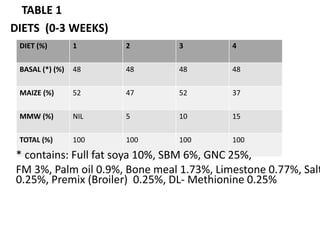
TABLE 1
DIETS (0-3 WEEKS)
DIET (%) 1 2 3 4
BASAL (*) (%) 48 48 48 48
MAIZE (%) 52 47 52 37
MMW (%) NIL 5 10 15
TOTAL (%) 100 100 100 100
* contains: Full fat soya 10%, SBM 6%, GNC 25%,
FM 3%, Palm oil 0.9%, Bone meal 1.73%, Limestone 0.77%, Salt
0.25%, Premix (Broiler) 0.25%, DL- Methionine 0.25%
THANK YOU FOR LISTENING

Abraham power point

  • 1.
    A PROJECT PROPOSALON Direct And Residual Effect Of Dietry Brewer's Dried Grain (BDG) On Performance Nutrients Retention And Feed Intestinal Transit Time In Broilers Name : Adeniyi Abraham Olamilekan Maric No: 14/10ac089 Department of Animal Production Faculty of Agriculture University of Ilorin
  • 2.
    INTRODUCTION At current highcost of regular feed,the current attempt is to replace part of the regular feed with cheap but high fibre ingredient. Examples include, rice husk, wheat offal, palmkernel cake (PKC), maize milling waste (MMW) and one of those being used is brewer's dried grain (BDG) which contains protein, energy and fibre. However, fibre is known to have negative effects on digestion and subsequent performance because birds do not have the innate enzymes to digest fibres.
  • 3.
    STATEMENT OF THEPROBLEM One of the known effect of high dietary fibre is to reduce feed intestinal transit time (FITT), thereby reducing nutrient retention while increasing feed/gain ratio. The effects of fibre on feed intestinal transit time (FITT) are known to vary with different fibre sources. However, there is no specific information on the direct and residual effects of dietary levels of brewer's dried grain (BDG) on the feed intestinal transit time (FITT) and it's correlation with nutrient retention and performance.
  • 4.
     Investigate theresidual effect of dietary Brewer's dried grain fed from 0-3 weeks on subsequent performance, nutrient retention, feed intestinal transit time and economics of broilers fed a standard diet from 4-6 weeks of age.  Investigate the correlation between feed intestinal transit time and nutrient retention performance indices and economics of broiler fed various levels of Brewer's dried grain (BDG). OBJECTIVE OF THE STUDY The general objective is to investigate the direct and residual effects of dietary brewer's dried grain on performance, nutrient retention, feed intestinal transit time and economic production. Specific objectives of the study were to :  Investigate the direct effect of dietary levels of Brewer's dried grain on performance, nutrient retention, feed intestinal transit time in broilers of 0-3 weeks of age.
  • 5.
    JUSTIFICATION OF THESTUDY Results of this study will give information on the direct and residual effects of dietary levels of Brewer's dried grain (BDG) on feed intestinal transit time (FITT) and it's correction on nutrient retention, performance and economics of broiler production.
  • 6.
    MATERIALS AND METHODS Theexperiment will be carried out in the Poultry Unit of Teaching and Research Farms University of Ilorin, Ilorin, Kwara state of Nigeria. A total number of ninety-six (96) day old chicks (mixed sex) of a commercial strain will be used for this trial.Birds will be fed a control diet or diets in which Brewer's dried grain will be added at 5, 10 or 15% at the expense of maize in the control diet from 0-3 weeks of age in a completely randomized design as shown in Table 1.
  • 7.
    Thus there willbe four (4) treatments each with three (3) replicates of eight (8) chicks. At three (3) weeks of age, all the birds irrespective of their treatment during the first three (3) weeks, will be fed the control diet to six (6) weeks of age. At three (3) and six (6) weeks of age, a nutrient retention trial and estimation of feed intestinal transit time will be carried out. 0.3% Ferric oxide will be added to the experimental diets. Weighed quantities of the diets will be supplied and excreta samples will be collected over a 72 hour period using the total collection method.
  • 8.
    The time intervalbetween the introduction of the colored diets and the appearance of the colored excreta will be determined using a stopwatch. Feed and excreta samples (FITT) will be analyzed for protein, fat and crude fibre using the methods of AOAC (2005).  Data collected will be subjected to analysis of variance (ANOVA) using the model for completely randomized design. The significant difference between means will be separated using the Duncan multiple range test (DRMT), (Duncan,1955). 
  • 9.
    TABLE 1 DIETS (0-3WEEKS) DIET (%) 1 2 3 4 BASAL (*) (%) 48 48 48 48 MAIZE (%) 52 47 52 37 MMW (%) NIL 5 10 15 TOTAL (%) 100 100 100 100 * contains: Full fat soya 10%, SBM 6%, GNC 25%, FM 3%, Palm oil 0.9%, Bone meal 1.73%, Limestone 0.77%, Salt 0.25%, Premix (Broiler) 0.25%, DL- Methionine 0.25%
  • 10.
    THANK YOU FORLISTENING