Math-Bridge:
Technology-Enhanced Learning
on the European Scale
Dr. Sergey Sosnovsky
Project info
2
• Supported by the eContentplus program (budget ~ 3.5
mil.)
• Duration: from 01.05.09 to 31.01.12
• Partners: 9 universities + 2 companies from 7 EU
countries
Motivation1
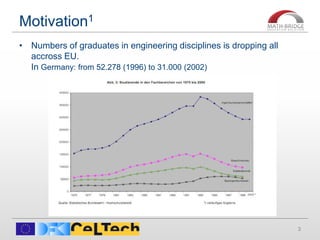
• Numbers of graduates in engineering disciplines is dropping all
accross EU.
In Germany: from 52.278 (1996) to 31.000 (2002)
3
Motivation2
• Drop-out rates of students in engineering and science
programs across the EU vary from 15-40%
• Lack of mathematics competencies is identified as one
of the major reasons
• Existing remedial courses suffer from several problems:
– unilingual content
– little interactivity
– not interoperable, not standard compliant
– not for all colleges and universities
• Bridge the gap between schools and higher education in
Europe by developing the pan-European repository of
remedial content + adaptive platform for accessing it
4
Project objectives
• Enhance existing European content collections
• Implement them in interoperable format
• Provide multi-lingual and multi-cultural access
(English, German, Spanish, Finnish, French, Dutch,
Hungarian)
• Customize adaptive e-Learning system ActiveMath
(developed at CeLTech) into the Math-Bridge platform
• Integrate Math-Bridge with existing assessment tools
and LMS
• Evaluate Math-Bridge platform
• Form the user community and disseminate project
results
5
Project Results
Content & Knowledge Base
• Largest in EU Collection of Math Bridging Content
– Sliced into Individual Learning Objects (>10 000)
– Sharable Formats (XML, RDF, OWL)
– Multilingual/Multicultural (7 languages)
– Annotated with Metadata (OMDoc, LOM, Dublic Core)
– Interactive Learning Experience (>5 000 exercises)
• Math-Bridge Ontology
– 600 concepts formalizing remedial mathematics
• Notation Census
– Full set of mathematical notations for 7 Languages for
all concepts of the Math-Bridge Ontology
6
Project Results
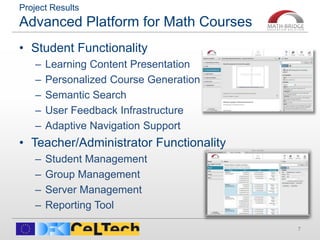
Advanced Platform for Math Courses
• Student Functionality
– Learning Content Presentation
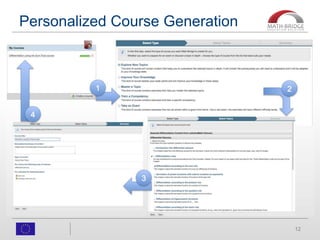
– Personalized Course Generation
– Semantic Search
– User Feedback Infrastructure
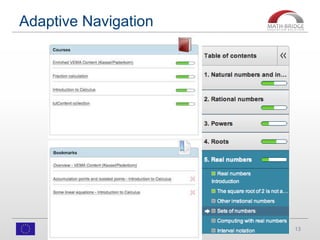
– Adaptive Navigation Support
• Teacher/Administrator Functionality
– Student Management
– Group Management
– Server Management
– Reporting Tool
7
Project Results
Large-Scale Evaluation of Math-Bridge
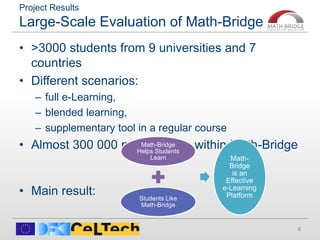
• >3000 students from 9 universities and 7
countries
• Different scenarios:
– full e-Learning,
– blended learning,
– supplementary tool in a regular course
• Almost 300 000 page access within Math-Bridge
• Main result:
8
Math-Bridge
Helps Students
Learn
Students Like
Math-Bridge
Math-
Bridge
is an
Effective
e-Learning
Platform
Project Results
Community and Exploitation
• Math-Bridge Community:
– 11 full-time partners
– > 40 associated partners
• Math-Bridge is regularly used for teaching bridging
courses in several EU universities (last count: 9
universities from 6 countries)
• Follow-up projects:
– Kompetenzbrücken (European Regional Development Fund)
– MetaMath (Tempus IV)
– MathGeAr (Tempus IV)
9
www.math-bridge.org
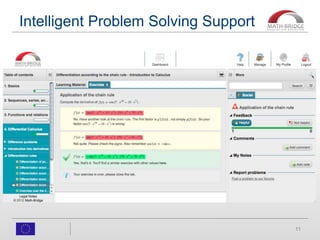
Intelligent Problem Solving Support
11
Personalized Course Generation
12
Adaptive Navigation
13

Math-Bridge Platform

  • 1.
    Math-Bridge: Technology-Enhanced Learning on theEuropean Scale Dr. Sergey Sosnovsky
  • 2.
    Project info 2 • Supportedby the eContentplus program (budget ~ 3.5 mil.) • Duration: from 01.05.09 to 31.01.12 • Partners: 9 universities + 2 companies from 7 EU countries
  • 3.
    Motivation1 • Numbers ofgraduates in engineering disciplines is dropping all accross EU. In Germany: from 52.278 (1996) to 31.000 (2002) 3
  • 4.
    Motivation2 • Drop-out ratesof students in engineering and science programs across the EU vary from 15-40% • Lack of mathematics competencies is identified as one of the major reasons • Existing remedial courses suffer from several problems: – unilingual content – little interactivity – not interoperable, not standard compliant – not for all colleges and universities • Bridge the gap between schools and higher education in Europe by developing the pan-European repository of remedial content + adaptive platform for accessing it 4
  • 5.
    Project objectives • Enhanceexisting European content collections • Implement them in interoperable format • Provide multi-lingual and multi-cultural access (English, German, Spanish, Finnish, French, Dutch, Hungarian) • Customize adaptive e-Learning system ActiveMath (developed at CeLTech) into the Math-Bridge platform • Integrate Math-Bridge with existing assessment tools and LMS • Evaluate Math-Bridge platform • Form the user community and disseminate project results 5
  • 6.
    Project Results Content &Knowledge Base • Largest in EU Collection of Math Bridging Content – Sliced into Individual Learning Objects (>10 000) – Sharable Formats (XML, RDF, OWL) – Multilingual/Multicultural (7 languages) – Annotated with Metadata (OMDoc, LOM, Dublic Core) – Interactive Learning Experience (>5 000 exercises) • Math-Bridge Ontology – 600 concepts formalizing remedial mathematics • Notation Census – Full set of mathematical notations for 7 Languages for all concepts of the Math-Bridge Ontology 6
  • 7.
    Project Results Advanced Platformfor Math Courses • Student Functionality – Learning Content Presentation – Personalized Course Generation – Semantic Search – User Feedback Infrastructure – Adaptive Navigation Support • Teacher/Administrator Functionality – Student Management – Group Management – Server Management – Reporting Tool 7
  • 8.
    Project Results Large-Scale Evaluationof Math-Bridge • >3000 students from 9 universities and 7 countries • Different scenarios: – full e-Learning, – blended learning, – supplementary tool in a regular course • Almost 300 000 page access within Math-Bridge • Main result: 8 Math-Bridge Helps Students Learn Students Like Math-Bridge Math- Bridge is an Effective e-Learning Platform
  • 9.
    Project Results Community andExploitation • Math-Bridge Community: – 11 full-time partners – > 40 associated partners • Math-Bridge is regularly used for teaching bridging courses in several EU universities (last count: 9 universities from 6 countries) • Follow-up projects: – Kompetenzbrücken (European Regional Development Fund) – MetaMath (Tempus IV) – MathGeAr (Tempus IV) 9
  • 10.
  • 11.
  • 12.
  • 13.