Charles Fadel
Mathematics for the 21st Century
Geneva May 2018
Charles@CurriculumRedesign.org
© Center for Curriculum Redesign
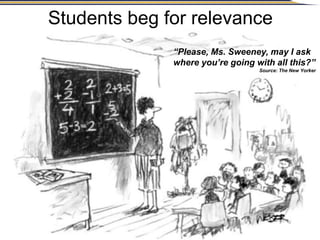
Students beg for relevance
“Please, Ms. Sweeney, may I ask
where you’re going with all this?”
Source: The New Yorker
© Center for Curriculum Redesign
Why Maths?
• Foundation of economic growth via Science, Technology,
Engineering; at the basis of innovation
• Foundation for understanding the world and citizenry
“Gullible citizens are a demagogue’s dream… almost every
political issue has a quantitative aspect”
John Allen Paulos, Mathematician
© Center for Curriculum Redesign
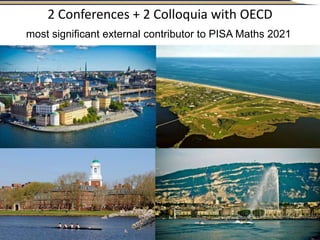
2 Conferences + 2 Colloquia with OECD
most significant external contributor to PISA Maths 2021
© Center for Curriculum Redesign
Many thanks to
© Center for Curriculum Redesign
Report to
download
© Center for Curriculum Redesign
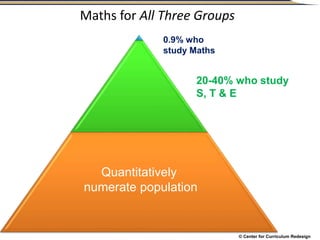
Maths for All Three Groups
Quantitatively
numerate population
20-40% who study
S, T & E
0.9% who
study Maths
© Center for Curriculum Redesign
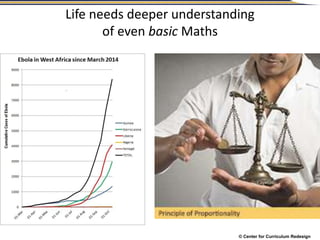
Life needs deeper understanding
of even basic Maths
© Center for Curriculum Redesign
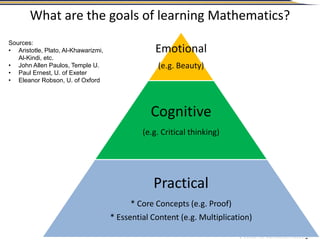
What are the goals of learning Mathematics?
Emotional
(e.g. Beauty)
Cognitive
(e.g. Critical thinking)
Practical
* Core Concepts (e.g. Proof)
* Essential Content (e.g. Multiplication)
Sources:
• Aristotle, Plato, Al-Khawarizmi,
Al-Kindi, etc.
• John Allen Paulos, Temple U.
• Paul Ernest, U. of Exeter
• Eleanor Robson, U. of Oxford
© Center for Curriculum Redesign
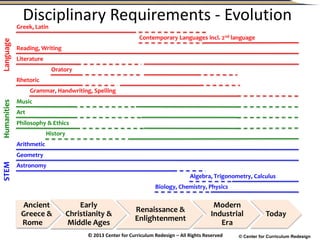
Disciplinary Requirements - Evolution
History
Music
Art
Philosophy & Ethics
Humanities
Arithmetic
Geometry
Astronomy
Biology, Chemistry, Physics
Algebra, Trigonometry, Calculus
STEM
Reading, Writing
Literature
Oratory
Rhetoric
Grammar, Handwriting, Spelling
Greek, Latin
Contemporary Languages incl. 2nd language
Language
Ancient
Greece &
Rome
Early
Christianity &
Middle Ages
Renaissance &
Enlightenment
Modern
Industrial
Era
Today
© 2013 Center for Curriculum Redesign – All Rights Reserved
© Center for Curriculum Redesign
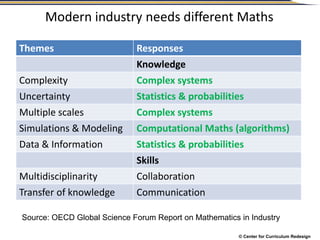
Modern industry needs different Maths
Themes Responses
Knowledge
Complexity Complex systems
Uncertainty Statistics & probabilities
Multiple scales Complex systems
Simulations & Modeling Computational Maths (algorithms)
Data & Information Statistics & probabilities
Skills
Multidisciplinarity Collaboration
Transfer of knowledge Communication
Source: OECD Global Science Forum Report on Mathematics in Industry
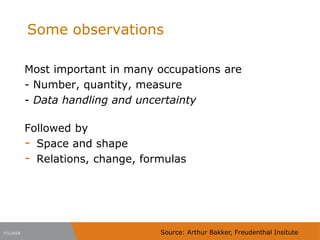
Some observations
Most important in many occupations are
- Number, quantity, measure
- Data handling and uncertainty
Followed by
- Space and shape
- Relations, change, formulas
7/1/2018 Source: Arthur Bakker, Freudenthal Insitute
© Center for Curriculum Redesign
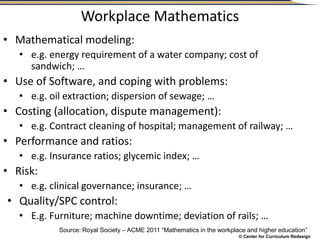
Workplace Mathematics
• Mathematical modeling:
• e.g. energy requirement of a water company; cost of
sandwich; …
• Use of Software, and coping with problems:
• e.g. oil extraction; dispersion of sewage; …
• Costing (allocation, dispute management):
• e.g. Contract cleaning of hospital; management of railway; …
• Performance and ratios:
• e.g. Insurance ratios; glycemic index; …
• Risk:
• e.g. clinical governance; insurance; …
• Quality/SPC control:
• E.g. Furniture; machine downtime; deviation of rails; …
Source: Royal Society – ACME 2011 “Mathematics in the workplace and higher education”
© Center for Curriculum Redesign
© Charles Fadel
Occupation (below) Algebra Applied Maths Calculus
Discrete
Mathematics Foundations Geometry
Numbers &
Operations
Statistics &
Probability
Topology &
Recreational
Taxonomy & Ontology: Wolfram Research →
Matrices,
Operations,
Vectors etc
Complex
systems,
Control, Game
theory, etc
Analysis,
Transforms,
Polynomials, etc
Automata, Graphs,
Computational
maths etc
Sets, Logic etc
Curves, Dimensions,
Transformations,
Trigonometry, etc
Arithmetic
operations,
Fractions,
Sequences, etc
Distributions,
Analysis,
Estimation, etc
Knots, Figures,
Folding, Spaces,
etc
Agriculture X X X
Architecture X X X X X
Astronomy/Cosmology X X X X X X X X
Biology, Botany, Zoology X X X X
Biotechnology, Genetics X X X X X X X X
Business X X X
Cinematography/Photography X X X
Civil engineering X X X X X X X X
Communication X X X
Computer science X X X X X X X X X
Craftsmanship X X X
Dance X X X
Design X X X
Drawing X X X
Economics & Finance X X X X X X X
Education X X X X X X
Electrical engineering X X X X X X X
Environmental science X X X X X X X
Ethics X
Geography/Geology X X X X X X X X
Health X X
History/Archeology X X X X X
Journalism X X X X
Languages/Linguistics X X X X X
Law X X X
Materials Science/Nanotechnology X X X X X X X X
Mechanical engineering, Robotics X X X X X X X X
Medicine/Pharmacy/Veterinary X X X
Music X X X
Painting X X
Philosophy X X X X
Physics X X X X X X X X X
Poetry/Prose X
Psychology/Sociology/Anthropology X X X X X
Sculpture X X X
Sewing/Knitting/Tapestry X X X
Spirituality/Religions X
Theater/Acting X X
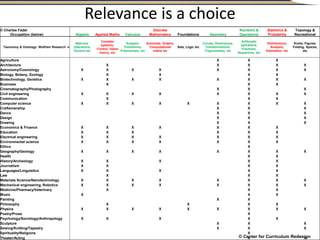
Relevance is a choice
© Center for Curriculum Redesign
Change is Hard
From NSF report:
• “more emphasis on estimation, mental maths…
• “less emphasis on paper/pencil execution…”
• “content in… algebra, geometry, pre-calculus and
trigonometry need to be… streamlined to make
room for important new topics.”
• “discrete Mathematics, statistics/probabilities and
computer science must be introduced”.
Date of report: 1982 (!)
© Center for Curriculum Redesign
Why did we add Trigonometry in the 1800’s?
a) Because it is pure
b) Because the times required more land surveyors and
woodworkers
c) Because it was a predictor of college success
A: b) of course !
© Center for Curriculum Redesign
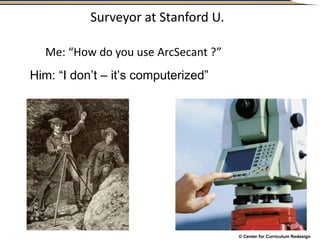
Surveyor at Stanford U.
Me: “How do you use ArcSecant ?”
Him: “I don’t – it’s computerized”
© Center for Curriculum Redesign
Wisdom from a Mathematician
“Numbers and probability provide the basis for statistics,
which, together with Logic, constitute the foundation of
the Scientific Method”
John Allen Paulos
Author, “A mathematician reads the newspaper”
© Center for Curriculum Redesign
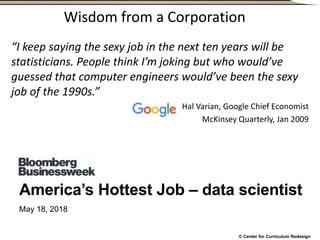
Wisdom from a Corporation
“I keep saying the sexy job in the next ten years will be
statisticians. People think I’m joking but who would’ve
guessed that computer engineers would’ve been the sexy
job of the 1990s.”
Hal Varian, Google Chief Economist
McKinsey Quarterly, Jan 2009
America’s Hottest Job – data scientist
May 18, 2018
© Center for Curriculum Redesign
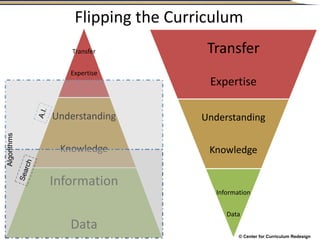
Flipping the Curriculum
Transfer
Expertise
Understanding
Knowledge
Information
Data
Transfer
Expertise
Understanding
Knowledge
Information
Data
Algorithms
© Center for Curriculum Redesign
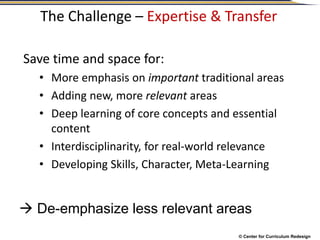
The Challenge – Expertise & Transfer
Save time and space for:
• More emphasis on important traditional areas
• Adding new, more relevant areas
• Deep learning of core concepts and essential
content
• Interdisciplinarity, for real-world relevance
• Developing Skills, Character, Meta-Learning
 De-emphasize less relevant areas
© Center for Curriculum Redesign
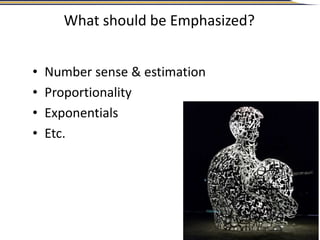
What should be Emphasized?
• Number sense & estimation
• Proportionality
• Exponentials
• Etc.
© Center for Curriculum Redesign
What should be added ?
Branches/topics:
• Recreational Maths
• Statistics & probabilities
• Discrete Maths
• Applied Maths
Tools/Methods:
 Logic and argumentation
 Progression from concrete to abstract
 Use of computer-based computation
 Linkages to the real-world
© Center for Curriculum Redesign
What should be emphasized or added ? (3)
Core Concepts/Processes:
• Variable, rate, dimension, etc.
• Proving, representing, modelling etc.
Other Dimensions of Education:
 Skills: Critical Thinking
 Character: Resilience
 Meta-Learning: Metacognition; Growth Mindset
© Center for Curriculum Redesign
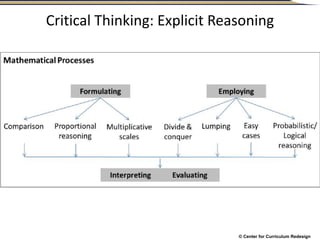
Critical Thinking: Explicit Reasoning
© Center for Curriculum Redesign
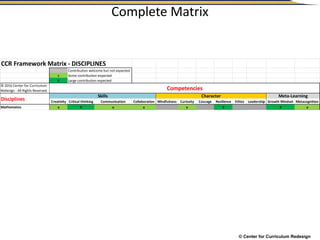
Complete Matrix
CCR Framework Matrix - DISCIPLINES
Contribution welcome but not expected
x Some contribution expected
X Large contribution expected
© 2016 Center for Curriculum
Redesign - All Rights Reserved
Creativity Critical thinking Communication Collaboration Mindfulness Curiosity Courage Resilience Ethics Leadership Growth Mindset Metacognition
Mathematics x X x x x X X x
Competencies
Meta-Learning
Disciplines
Skills Character
© Center for Curriculum Redesign
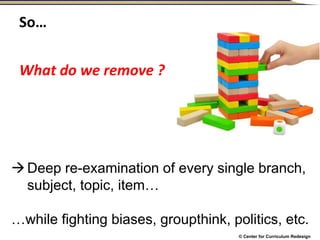
So…
Deep re-examination of every single branch,
subject, topic, item…
…while fighting biases, groupthink, politics, etc.
What do we remove ?
© Center for Curriculum Redesign
What should be de-emphasized ?
Branches/topics to carefully curate:
 Algebra
 Calculus
 Geometry/Trigonometry
Tools/Methods:
By-hand algebraic computation
© Center for Curriculum Redesign
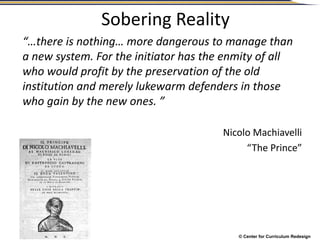
Sobering Reality
“…there is nothing… more dangerous to manage than
a new system. For the initiator has the enmity of all
who would profit by the preservation of the old
institution and merely lukewarm defenders in those
who gain by the new ones. ”
Nicolo Machiavelli
“The Prince”
© Center for Curriculum Redesign
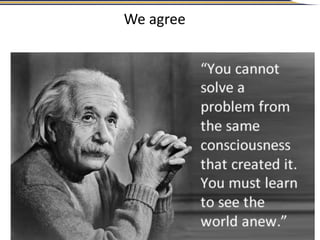
We agree
© Center for Curriculum Redesign
www.curriculumredesign.org
Twitter: @CurrRedesign
#4DEdu
“What should students learn for the 21st century?”
Thank You !

Mathematics for the 21st Century

  • 1.
    Charles Fadel Mathematics forthe 21st Century Geneva May 2018 Charles@CurriculumRedesign.org
  • 2.
    © Center forCurriculum Redesign Students beg for relevance “Please, Ms. Sweeney, may I ask where you’re going with all this?” Source: The New Yorker
  • 3.
    © Center forCurriculum Redesign Why Maths? • Foundation of economic growth via Science, Technology, Engineering; at the basis of innovation • Foundation for understanding the world and citizenry “Gullible citizens are a demagogue’s dream… almost every political issue has a quantitative aspect” John Allen Paulos, Mathematician
  • 4.
    © Center forCurriculum Redesign
  • 5.
    © Center forCurriculum Redesign 2 Conferences + 2 Colloquia with OECD most significant external contributor to PISA Maths 2021
  • 6.
    © Center forCurriculum Redesign Many thanks to
  • 7.
    © Center forCurriculum Redesign Report to download
  • 8.
    © Center forCurriculum Redesign Maths for All Three Groups Quantitatively numerate population 20-40% who study S, T & E 0.9% who study Maths
  • 9.
    © Center forCurriculum Redesign Life needs deeper understanding of even basic Maths
  • 10.
    © Center forCurriculum Redesign What are the goals of learning Mathematics? Emotional (e.g. Beauty) Cognitive (e.g. Critical thinking) Practical * Core Concepts (e.g. Proof) * Essential Content (e.g. Multiplication) Sources: • Aristotle, Plato, Al-Khawarizmi, Al-Kindi, etc. • John Allen Paulos, Temple U. • Paul Ernest, U. of Exeter • Eleanor Robson, U. of Oxford
  • 11.
    © Center forCurriculum Redesign Disciplinary Requirements - Evolution History Music Art Philosophy & Ethics Humanities Arithmetic Geometry Astronomy Biology, Chemistry, Physics Algebra, Trigonometry, Calculus STEM Reading, Writing Literature Oratory Rhetoric Grammar, Handwriting, Spelling Greek, Latin Contemporary Languages incl. 2nd language Language Ancient Greece & Rome Early Christianity & Middle Ages Renaissance & Enlightenment Modern Industrial Era Today © 2013 Center for Curriculum Redesign – All Rights Reserved
  • 12.
    © Center forCurriculum Redesign Modern industry needs different Maths Themes Responses Knowledge Complexity Complex systems Uncertainty Statistics & probabilities Multiple scales Complex systems Simulations & Modeling Computational Maths (algorithms) Data & Information Statistics & probabilities Skills Multidisciplinarity Collaboration Transfer of knowledge Communication Source: OECD Global Science Forum Report on Mathematics in Industry
  • 13.
    Some observations Most importantin many occupations are - Number, quantity, measure - Data handling and uncertainty Followed by - Space and shape - Relations, change, formulas 7/1/2018 Source: Arthur Bakker, Freudenthal Insitute
  • 14.
    © Center forCurriculum Redesign Workplace Mathematics • Mathematical modeling: • e.g. energy requirement of a water company; cost of sandwich; … • Use of Software, and coping with problems: • e.g. oil extraction; dispersion of sewage; … • Costing (allocation, dispute management): • e.g. Contract cleaning of hospital; management of railway; … • Performance and ratios: • e.g. Insurance ratios; glycemic index; … • Risk: • e.g. clinical governance; insurance; … • Quality/SPC control: • E.g. Furniture; machine downtime; deviation of rails; … Source: Royal Society – ACME 2011 “Mathematics in the workplace and higher education”
  • 15.
    © Center forCurriculum Redesign © Charles Fadel Occupation (below) Algebra Applied Maths Calculus Discrete Mathematics Foundations Geometry Numbers & Operations Statistics & Probability Topology & Recreational Taxonomy & Ontology: Wolfram Research → Matrices, Operations, Vectors etc Complex systems, Control, Game theory, etc Analysis, Transforms, Polynomials, etc Automata, Graphs, Computational maths etc Sets, Logic etc Curves, Dimensions, Transformations, Trigonometry, etc Arithmetic operations, Fractions, Sequences, etc Distributions, Analysis, Estimation, etc Knots, Figures, Folding, Spaces, etc Agriculture X X X Architecture X X X X X Astronomy/Cosmology X X X X X X X X Biology, Botany, Zoology X X X X Biotechnology, Genetics X X X X X X X X Business X X X Cinematography/Photography X X X Civil engineering X X X X X X X X Communication X X X Computer science X X X X X X X X X Craftsmanship X X X Dance X X X Design X X X Drawing X X X Economics & Finance X X X X X X X Education X X X X X X Electrical engineering X X X X X X X Environmental science X X X X X X X Ethics X Geography/Geology X X X X X X X X Health X X History/Archeology X X X X X Journalism X X X X Languages/Linguistics X X X X X Law X X X Materials Science/Nanotechnology X X X X X X X X Mechanical engineering, Robotics X X X X X X X X Medicine/Pharmacy/Veterinary X X X Music X X X Painting X X Philosophy X X X X Physics X X X X X X X X X Poetry/Prose X Psychology/Sociology/Anthropology X X X X X Sculpture X X X Sewing/Knitting/Tapestry X X X Spirituality/Religions X Theater/Acting X X Relevance is a choice
  • 16.
    © Center forCurriculum Redesign Change is Hard From NSF report: • “more emphasis on estimation, mental maths… • “less emphasis on paper/pencil execution…” • “content in… algebra, geometry, pre-calculus and trigonometry need to be… streamlined to make room for important new topics.” • “discrete Mathematics, statistics/probabilities and computer science must be introduced”. Date of report: 1982 (!)
  • 17.
    © Center forCurriculum Redesign Why did we add Trigonometry in the 1800’s? a) Because it is pure b) Because the times required more land surveyors and woodworkers c) Because it was a predictor of college success A: b) of course !
  • 18.
    © Center forCurriculum Redesign Surveyor at Stanford U. Me: “How do you use ArcSecant ?” Him: “I don’t – it’s computerized”
  • 19.
    © Center forCurriculum Redesign Wisdom from a Mathematician “Numbers and probability provide the basis for statistics, which, together with Logic, constitute the foundation of the Scientific Method” John Allen Paulos Author, “A mathematician reads the newspaper”
  • 20.
    © Center forCurriculum Redesign Wisdom from a Corporation “I keep saying the sexy job in the next ten years will be statisticians. People think I’m joking but who would’ve guessed that computer engineers would’ve been the sexy job of the 1990s.” Hal Varian, Google Chief Economist McKinsey Quarterly, Jan 2009 America’s Hottest Job – data scientist May 18, 2018
  • 21.
    © Center forCurriculum Redesign Flipping the Curriculum Transfer Expertise Understanding Knowledge Information Data Transfer Expertise Understanding Knowledge Information Data Algorithms
  • 22.
    © Center forCurriculum Redesign The Challenge – Expertise & Transfer Save time and space for: • More emphasis on important traditional areas • Adding new, more relevant areas • Deep learning of core concepts and essential content • Interdisciplinarity, for real-world relevance • Developing Skills, Character, Meta-Learning  De-emphasize less relevant areas
  • 23.
    © Center forCurriculum Redesign What should be Emphasized? • Number sense & estimation • Proportionality • Exponentials • Etc.
  • 24.
    © Center forCurriculum Redesign What should be added ? Branches/topics: • Recreational Maths • Statistics & probabilities • Discrete Maths • Applied Maths Tools/Methods:  Logic and argumentation  Progression from concrete to abstract  Use of computer-based computation  Linkages to the real-world
  • 25.
    © Center forCurriculum Redesign What should be emphasized or added ? (3) Core Concepts/Processes: • Variable, rate, dimension, etc. • Proving, representing, modelling etc. Other Dimensions of Education:  Skills: Critical Thinking  Character: Resilience  Meta-Learning: Metacognition; Growth Mindset
  • 26.
    © Center forCurriculum Redesign Critical Thinking: Explicit Reasoning
  • 27.
    © Center forCurriculum Redesign Complete Matrix CCR Framework Matrix - DISCIPLINES Contribution welcome but not expected x Some contribution expected X Large contribution expected © 2016 Center for Curriculum Redesign - All Rights Reserved Creativity Critical thinking Communication Collaboration Mindfulness Curiosity Courage Resilience Ethics Leadership Growth Mindset Metacognition Mathematics x X x x x X X x Competencies Meta-Learning Disciplines Skills Character
  • 28.
    © Center forCurriculum Redesign So… Deep re-examination of every single branch, subject, topic, item… …while fighting biases, groupthink, politics, etc. What do we remove ?
  • 29.
    © Center forCurriculum Redesign What should be de-emphasized ? Branches/topics to carefully curate:  Algebra  Calculus  Geometry/Trigonometry Tools/Methods: By-hand algebraic computation
  • 30.
    © Center forCurriculum Redesign Sobering Reality “…there is nothing… more dangerous to manage than a new system. For the initiator has the enmity of all who would profit by the preservation of the old institution and merely lukewarm defenders in those who gain by the new ones. ” Nicolo Machiavelli “The Prince”
  • 31.
    © Center forCurriculum Redesign We agree
  • 32.
    © Center forCurriculum Redesign www.curriculumredesign.org Twitter: @CurrRedesign #4DEdu “What should students learn for the 21st century?” Thank You !