Mathematics for Machine Learning
Multivariate Calculus
Formula sheet
Dr Samuel J. Cooper
Prof. David Dye
Dr A. Freddie Page
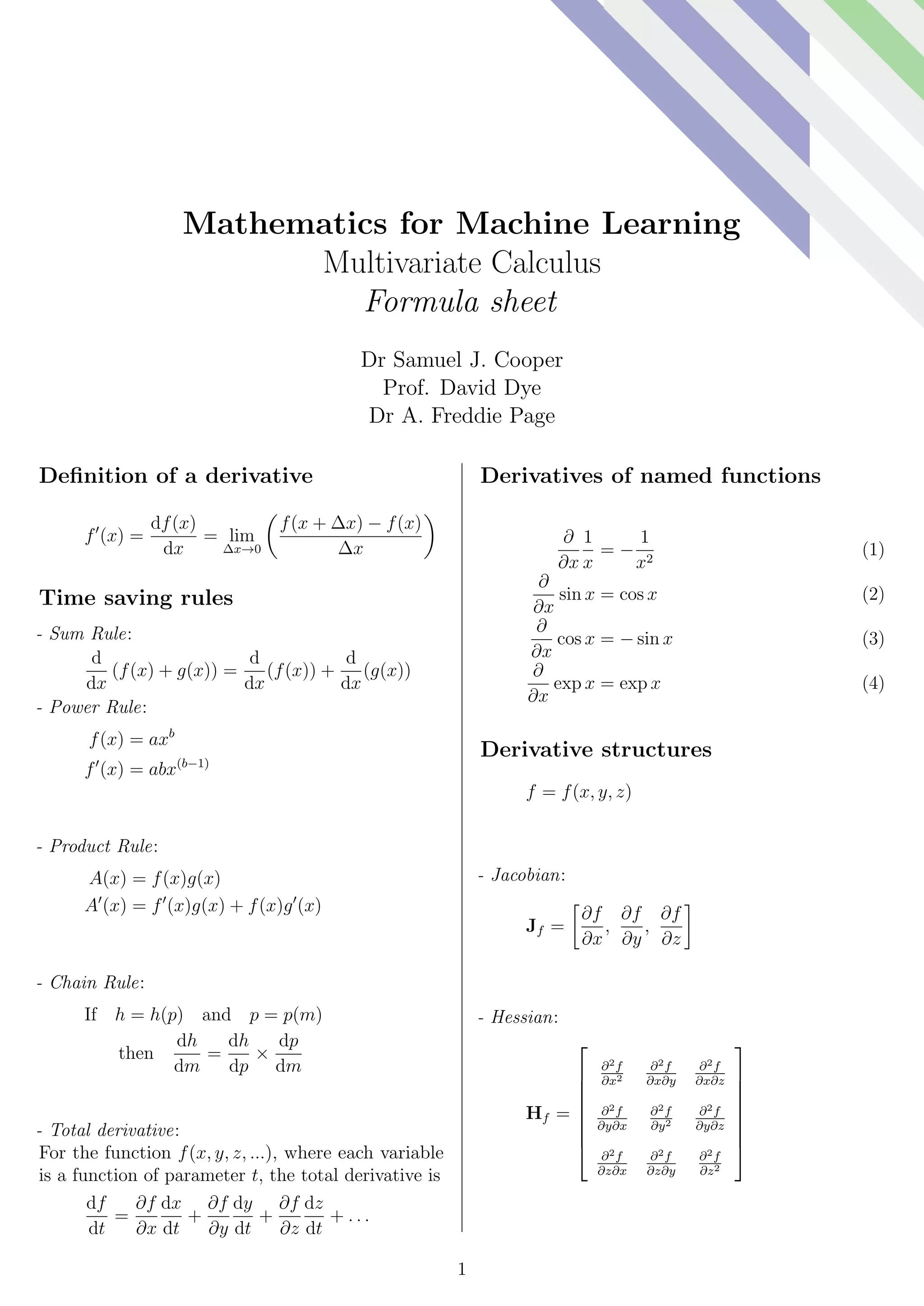
Definition of a derivative
f (x) =
df(x)
dx
= lim
∆x→0
f(x + ∆x) − f(x)
∆x
Time saving rules
- Sum Rule:
d
dx
(f(x) + g(x)) =
d
dx
(f(x)) +
d
dx
(g(x))
- Power Rule:
f(x) = axb
f (x) = abx(b−1)
- Product Rule:
A(x) = f(x)g(x)
A (x) = f (x)g(x) + f(x)g (x)
- Chain Rule:
If h = h(p) and p = p(m)
then
dh
dm
=
dh
dp
×
dp
dm
- Total derivative:
For the function f(x, y, z, ...), where each variable
is a function of parameter t, the total derivative is
df
dt
=
∂f
∂x
dx
dt
+
∂f
∂y
dy
dt
+
∂f
∂z
dz
dt
+ . . .
Derivatives of named functions
∂
∂x
1
x
= −
1
x2
(1)
∂
∂x
sin x = cos x (2)
∂
∂x
cos x = − sin x (3)
∂
∂x
exp x = exp x (4)
Derivative structures
f = f(x, y, z)
- Jacobian:
Jf =
∂f
∂x
,
∂f
∂y
,
∂f
∂z
- Hessian:
Hf =








∂2f
∂x2
∂2f
∂x∂y
∂2f
∂x∂z
∂2f
∂y∂x
∂2f
∂y2
∂2f
∂y∂z
∂2f
∂z∂x
∂2f
∂z∂y
∂2f
∂z2








1
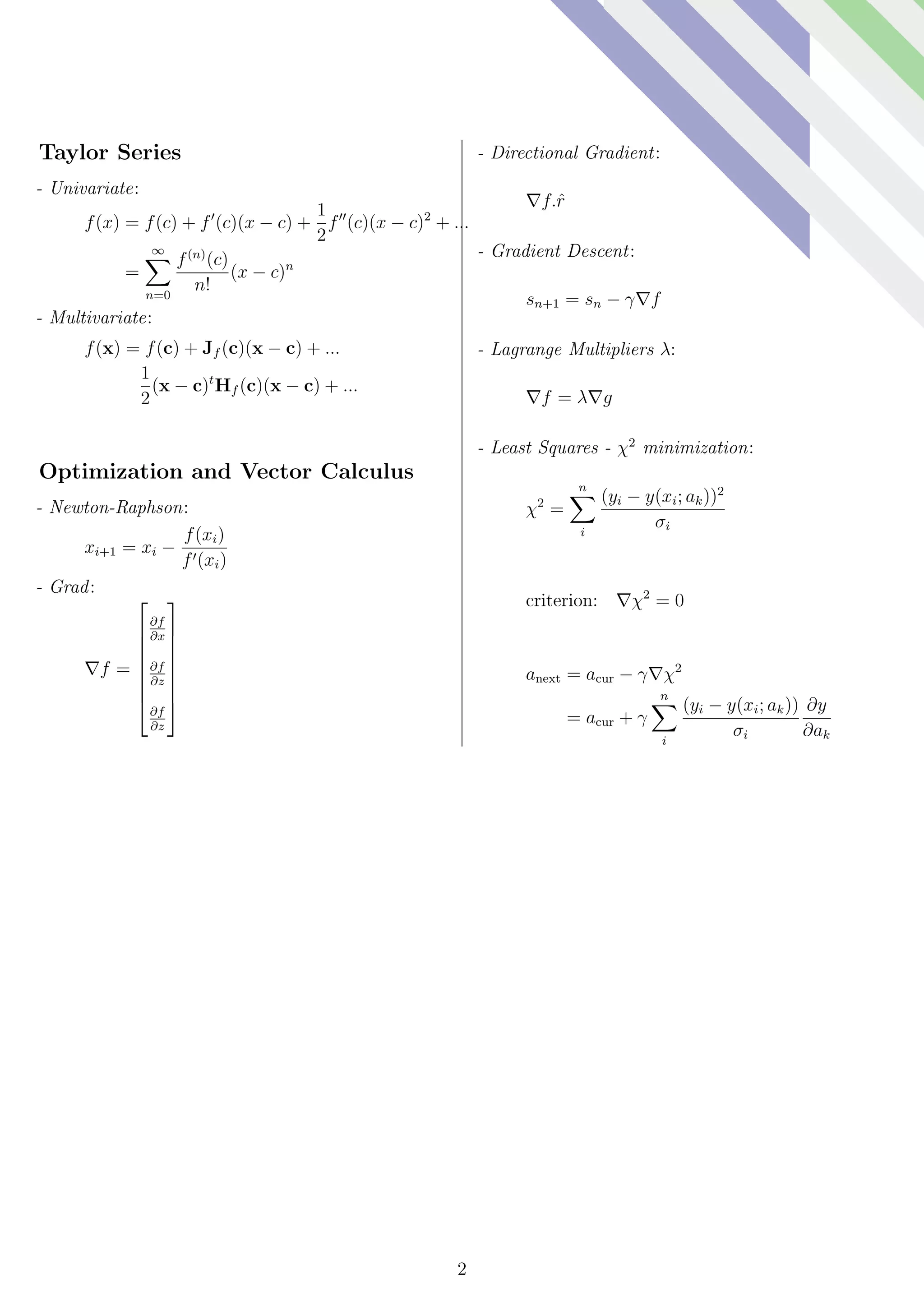
Taylor Series
- Univariate:
f(x) = f(c) + f (c)(x − c) +
1
2
f (c)(x − c)2
+ ...
=
∞
n=0
f(n)
(c)
n!
(x − c)n
- Multivariate:
f(x) = f(c) + Jf (c)(x − c) + ...
1
2
(x − c)t
Hf (c)(x − c) + ...
Optimization and Vector Calculus
- Newton-Raphson:
xi+1 = xi −
f(xi)
f (xi)
- Grad:
f =








∂f
∂x
∂f
∂z
∂f
∂z








- Directional Gradient:
f.ˆr
- Gradient Descent:
sn+1 = sn − γ f
- Lagrange Multipliers λ:
f = λ g
- Least Squares - χ2
minimization:
χ2
=
n
i
(yi − y(xi; ak))2
σi
criterion: χ2
= 0
anext = acur − γ χ2
= acur + γ
n
i
(yi − y(xi; ak))
σi
∂y
∂ak
2

Mathematics for machine learning calculus formulasheet

  • 1.
    Mathematics for MachineLearning Multivariate Calculus Formula sheet Dr Samuel J. Cooper Prof. David Dye Dr A. Freddie Page Definition of a derivative f (x) = df(x) dx = lim ∆x→0 f(x + ∆x) − f(x) ∆x Time saving rules - Sum Rule: d dx (f(x) + g(x)) = d dx (f(x)) + d dx (g(x)) - Power Rule: f(x) = axb f (x) = abx(b−1) - Product Rule: A(x) = f(x)g(x) A (x) = f (x)g(x) + f(x)g (x) - Chain Rule: If h = h(p) and p = p(m) then dh dm = dh dp × dp dm - Total derivative: For the function f(x, y, z, ...), where each variable is a function of parameter t, the total derivative is df dt = ∂f ∂x dx dt + ∂f ∂y dy dt + ∂f ∂z dz dt + . . . Derivatives of named functions ∂ ∂x 1 x = − 1 x2 (1) ∂ ∂x sin x = cos x (2) ∂ ∂x cos x = − sin x (3) ∂ ∂x exp x = exp x (4) Derivative structures f = f(x, y, z) - Jacobian: Jf = ∂f ∂x , ∂f ∂y , ∂f ∂z - Hessian: Hf =         ∂2f ∂x2 ∂2f ∂x∂y ∂2f ∂x∂z ∂2f ∂y∂x ∂2f ∂y2 ∂2f ∂y∂z ∂2f ∂z∂x ∂2f ∂z∂y ∂2f ∂z2         1
  • 2.
    Taylor Series - Univariate: f(x)= f(c) + f (c)(x − c) + 1 2 f (c)(x − c)2 + ... = ∞ n=0 f(n) (c) n! (x − c)n - Multivariate: f(x) = f(c) + Jf (c)(x − c) + ... 1 2 (x − c)t Hf (c)(x − c) + ... Optimization and Vector Calculus - Newton-Raphson: xi+1 = xi − f(xi) f (xi) - Grad: f =         ∂f ∂x ∂f ∂z ∂f ∂z         - Directional Gradient: f.ˆr - Gradient Descent: sn+1 = sn − γ f - Lagrange Multipliers λ: f = λ g - Least Squares - χ2 minimization: χ2 = n i (yi − y(xi; ak))2 σi criterion: χ2 = 0 anext = acur − γ χ2 = acur + γ n i (yi − y(xi; ak)) σi ∂y ∂ak 2