Field Theory and Lattices
-Dr.P.Geetha
Jacobson Theorem
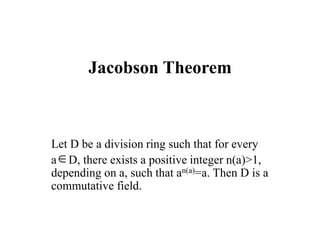
Let D be a division ring such that for every
a D, there exists a positive integer n(a)>1,
depending on a, such that an(a)=a. Then D is a
commutative field.

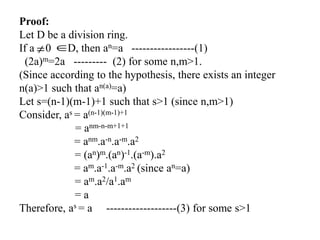
Proof:
Let D be a division ring.
If a 0 D, then an=a -----------------(1)
(2a)m=2a --------- (2) for some n,m>1.
(Since according to the hypothesis, there exists an integer
n(a)>1 such that an(a)=a)
Let s=(n-1)(m-1)+1 such that s>1 (since n,m>1)
Consider, as = a(n-1)(m-1)+1
= anm-n-m+1+1
= anm.a-n.a-m.a2
= (an)m.(an)-1.(a-m).a2
= am.a-1.a-m.a2 (since an=a)
= am.a2/a1.am
= a
Therefore, as = a -------------------(3) for some s>1
 
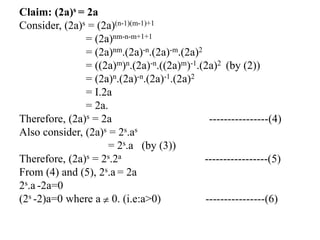
Claim: (2a)s = 2a
Consider, (2a)s = (2a)(n-1)(m-1)+1
= (2a)nm-n-m+1+1
= (2a)nm.(2a)-n.(2a)-m.(2a)2
= ((2a)m)n.(2a)-n.((2a)m)-1.(2a)2 (by (2))
= (2a)n.(2a)-n.(2a)-1.(2a)2
= I.2a
= 2a.
Therefore, (2a)s = 2a ----------------(4)
Also consider, (2a)s = 2s.as
= 2s.a (by (3))
Therefore, (2a)s = 2s.2a -----------------(5)
From (4) and (5), 2s.a = 2a
2s.a -2a=0
(2s -2)a=0 where a 0. (i.e:a>0) ----------------(6)
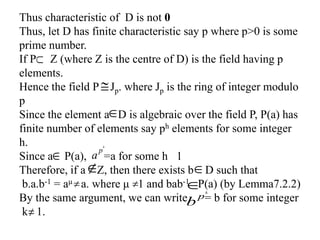
Thus characteristic of D is not 0
Thus, let D has finite characteristic say p where p>0 is some
prime number.
If P Z (where Z is the centre of D) is the field having p
elements.
Hence the field P Jp. where Jp is the ring of integer modulo
p
Since the element a D is algebraic over the field P, P(a) has
finite number of elements say ph elements for some integer
h.
Since a P(a), =a for some h 1
Therefore, if a Z, then there exists b D such that
b.a.b-1 = aμ a. where μ 1 and bab-1 P(a) (by Lemma7.2.2)
By the same argument, we can write = b for some integer
k 1.



 a
p
h

 
b
p
k

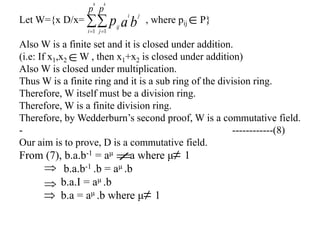
Let W={x D/x= , where pij P}
Also W is a finite set and it is closed under addition.
(i.e: If x1,x2 W , then x1+x2 is closed under addition)
Also W is closed under multiplication.
Thus W is a finite ring and it is a sub ring of the division ring.
Therefore, W itself must be a division ring.
Therefore, W is a finite division ring.
Therefore, by Wedderburn’s second proof, W is a commutative field.
- ------------(8)
Our aim is to prove, D is a commutative field.
From (7), b.a.b-1 = aμ a where μ 1
b.a.b-1 .b = aμ .b
b.a.I = aμ .b
b.a = aμ .b where μ 1
bap
ji
i j
ij
p p
h k
 1 1








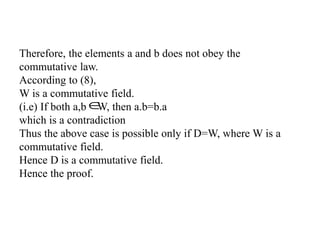
Therefore, the elements a and b does not obey the
commutative law.
According to (8),
W is a commutative field.
(i.e) If both a,b W, then a.b=b.a
which is a contradiction
Thus the above case is possible only if D=W, where W is a
commutative field.
Hence D is a commutative field.
Hence the proof.


Jacobson Theorem

  • 1.
    Field Theory andLattices -Dr.P.Geetha
  • 2.
    Jacobson Theorem Let Dbe a division ring such that for every a D, there exists a positive integer n(a)>1, depending on a, such that an(a)=a. Then D is a commutative field. 
  • 3.
    Proof: Let D bea division ring. If a 0 D, then an=a -----------------(1) (2a)m=2a --------- (2) for some n,m>1. (Since according to the hypothesis, there exists an integer n(a)>1 such that an(a)=a) Let s=(n-1)(m-1)+1 such that s>1 (since n,m>1) Consider, as = a(n-1)(m-1)+1 = anm-n-m+1+1 = anm.a-n.a-m.a2 = (an)m.(an)-1.(a-m).a2 = am.a-1.a-m.a2 (since an=a) = am.a2/a1.am = a Therefore, as = a -------------------(3) for some s>1  
  • 4.
    Claim: (2a)s =2a Consider, (2a)s = (2a)(n-1)(m-1)+1 = (2a)nm-n-m+1+1 = (2a)nm.(2a)-n.(2a)-m.(2a)2 = ((2a)m)n.(2a)-n.((2a)m)-1.(2a)2 (by (2)) = (2a)n.(2a)-n.(2a)-1.(2a)2 = I.2a = 2a. Therefore, (2a)s = 2a ----------------(4) Also consider, (2a)s = 2s.as = 2s.a (by (3)) Therefore, (2a)s = 2s.2a -----------------(5) From (4) and (5), 2s.a = 2a 2s.a -2a=0 (2s -2)a=0 where a 0. (i.e:a>0) ----------------(6)
  • 5.
    Thus characteristic ofD is not 0 Thus, let D has finite characteristic say p where p>0 is some prime number. If P Z (where Z is the centre of D) is the field having p elements. Hence the field P Jp. where Jp is the ring of integer modulo p Since the element a D is algebraic over the field P, P(a) has finite number of elements say ph elements for some integer h. Since a P(a), =a for some h 1 Therefore, if a Z, then there exists b D such that b.a.b-1 = aμ a. where μ 1 and bab-1 P(a) (by Lemma7.2.2) By the same argument, we can write = b for some integer k 1.     a p h    b p k 
  • 6.
    Let W={x D/x=, where pij P} Also W is a finite set and it is closed under addition. (i.e: If x1,x2 W , then x1+x2 is closed under addition) Also W is closed under multiplication. Thus W is a finite ring and it is a sub ring of the division ring. Therefore, W itself must be a division ring. Therefore, W is a finite division ring. Therefore, by Wedderburn’s second proof, W is a commutative field. - ------------(8) Our aim is to prove, D is a commutative field. From (7), b.a.b-1 = aμ a where μ 1 b.a.b-1 .b = aμ .b b.a.I = aμ .b b.a = aμ .b where μ 1 bap ji i j ij p p h k  1 1        
  • 7.
    Therefore, the elementsa and b does not obey the commutative law. According to (8), W is a commutative field. (i.e) If both a,b W, then a.b=b.a which is a contradiction Thus the above case is possible only if D=W, where W is a commutative field. Hence D is a commutative field. Hence the proof. 