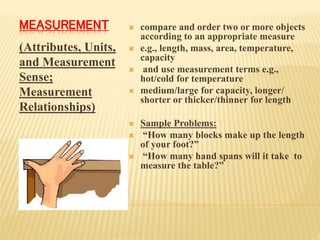
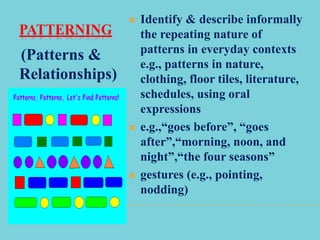
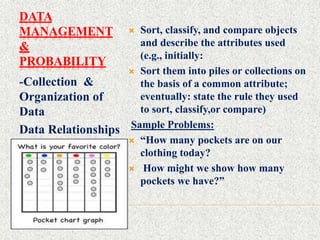
This document discusses the importance of early learning experiences and assessment strategies for young children. It states that early interactions directly impact brain development and lay the foundation for future learning. Effective assessment should be frequent, well-planned, and use observation as the primary strategy. When teaching mathematics, it is important to provide a balance of teacher-initiated and child-initiated activities to demonstrate concepts like number sense, measurement, geometry, patterning, and data management in a way that is relevant to children's lives.



![1] PROBLEM SOLVING:
2]Reasoning &
proving
Teachers can
provide models
for problem
solving
How did you decide
to…?”
“How did you know
what came next in the
pattern?”
“What do you think will
happen?
How can you show
me?”](https://image.slidesharecdn.com/akankshacurriculum-math-141003081006-phpapp02/85/Akanksha-curriculum-math-11-320.jpg)
![3]REFLECTING
To help the children deepen their understanding
e.g.,
“How many different ways did we … ?”
“How many more do you think we need
now?”
“You have a good start with this pattern. Is
there another way you could…”
“Would looking at Nancy’s pattern help?”
“What could you do to… ?”).](https://image.slidesharecdn.com/akankshacurriculum-math-141003081006-phpapp02/85/Akanksha-curriculum-math-12-320.jpg)
![4]CONNECTING
Teachers facilitate mathematical
thinking in various ways :
e.g.,
“How many people will be at
your lunch?
How many plates will you need?”
“How is your building big – is it
tall or is it wide?”;
We are going to make a class
book about all the places
where we use numbers.”](https://image.slidesharecdn.com/akankshacurriculum-math-141003081006-phpapp02/85/Akanksha-curriculum-math-13-320.jpg)
![5]REPRESENTING
Teachers can do that by providing
models, thinking aloud
e.g.,“I can’t draw this many people.
How else could we keep track of them?”,
and describing children’s
representations
e.g.,“You used 2 balls on this plate and 3
balls on that plate to make 5 balls.”).](https://image.slidesharecdn.com/akankshacurriculum-math-141003081006-phpapp02/85/Akanksha-curriculum-math-14-320.jpg)
![6] COMMUNICATING
Teachers provide models
for using mathematical
language
e.g.,“How did you know that this
plate has more apples?” “Can
you show me how you figured
that out?” “How can you prove
that?”](https://image.slidesharecdn.com/akankshacurriculum-math-141003081006-phpapp02/85/Akanksha-curriculum-math-15-320.jpg)