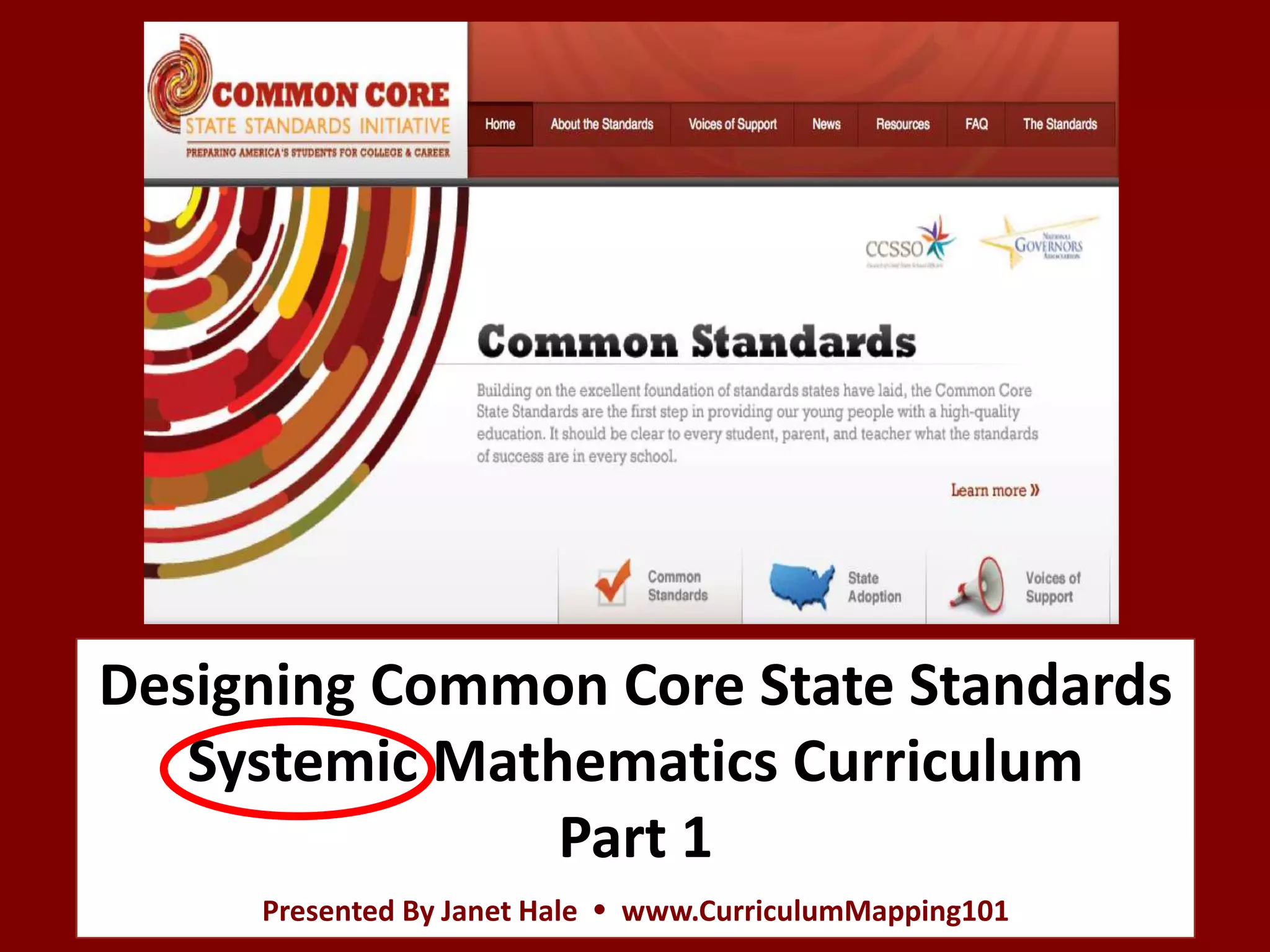

Designing Common Core State Standards
   Systemic Mathematics Curriculum
                Part 1
     Presented By Janet Hale  www.CurriculumMapping101
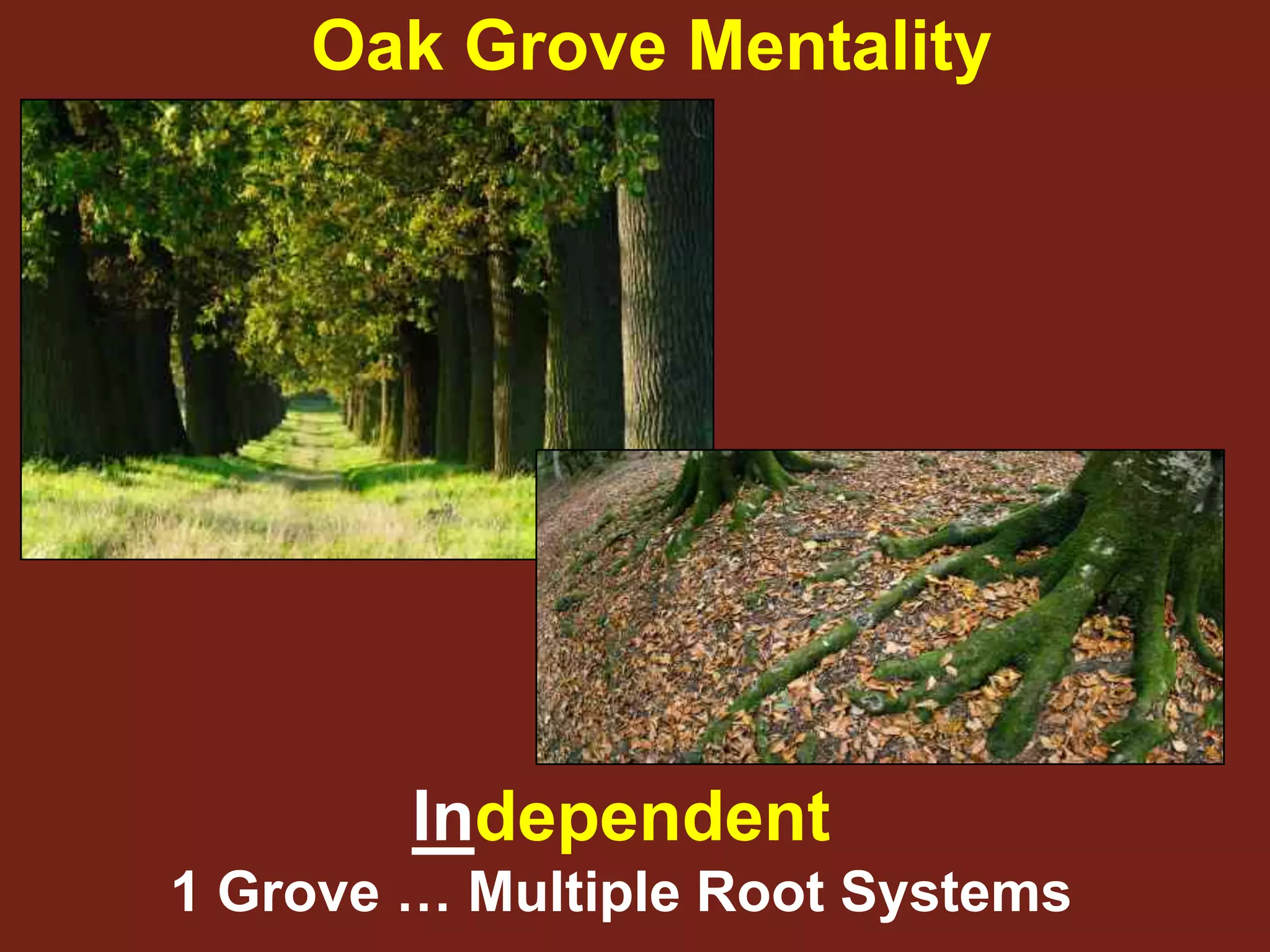
Oak Grove Mentality


        Independent
1 Grove … Multiple Root Systems
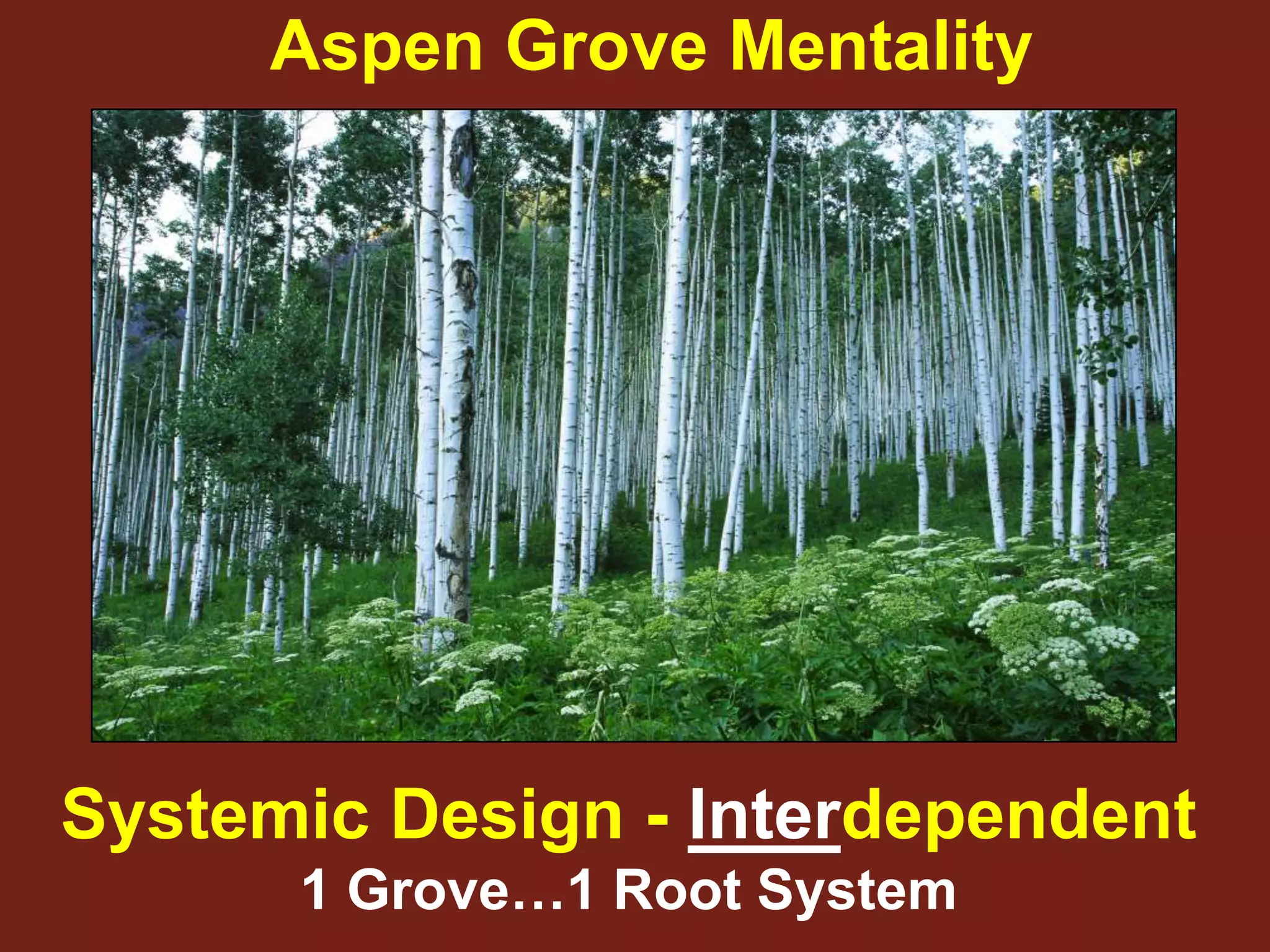
Aspen Grove Mentality


Systemic Design - Interdependent
      1 Grove…1 Root System
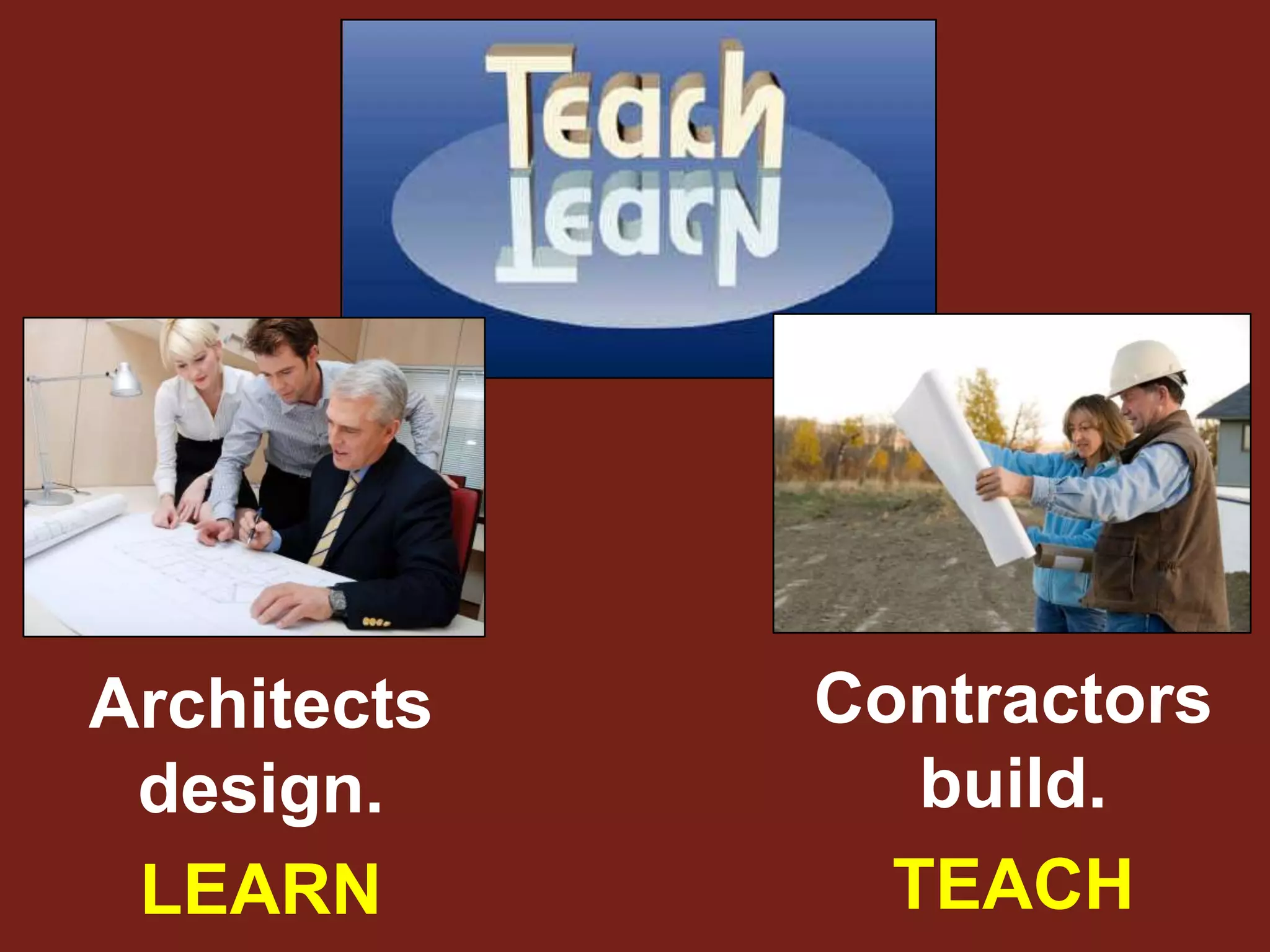
Architects   Contractors
 design.        build.
 LEARN         TEACH
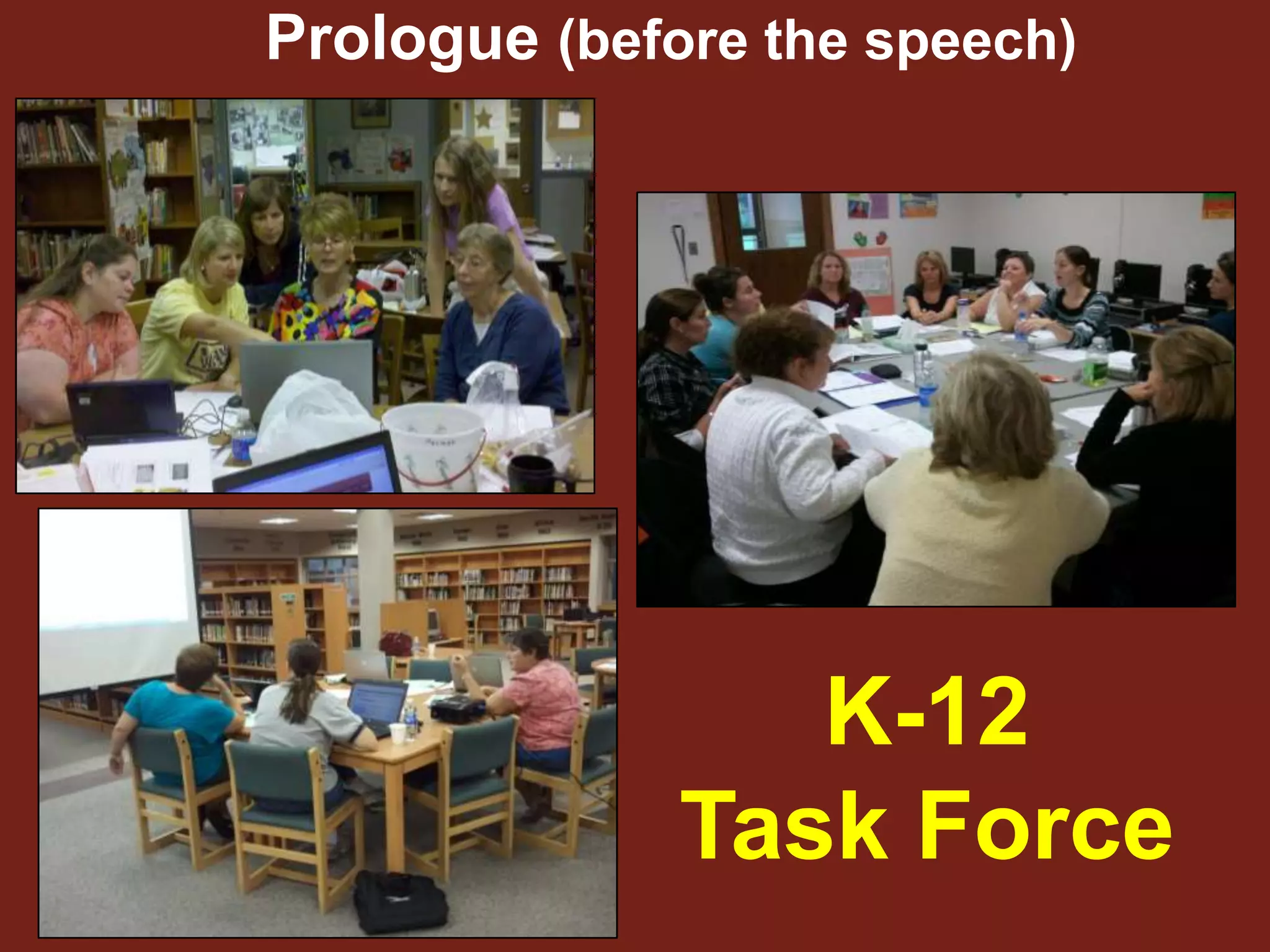
Prologue (before the speech)


                 K-12
              Task Force
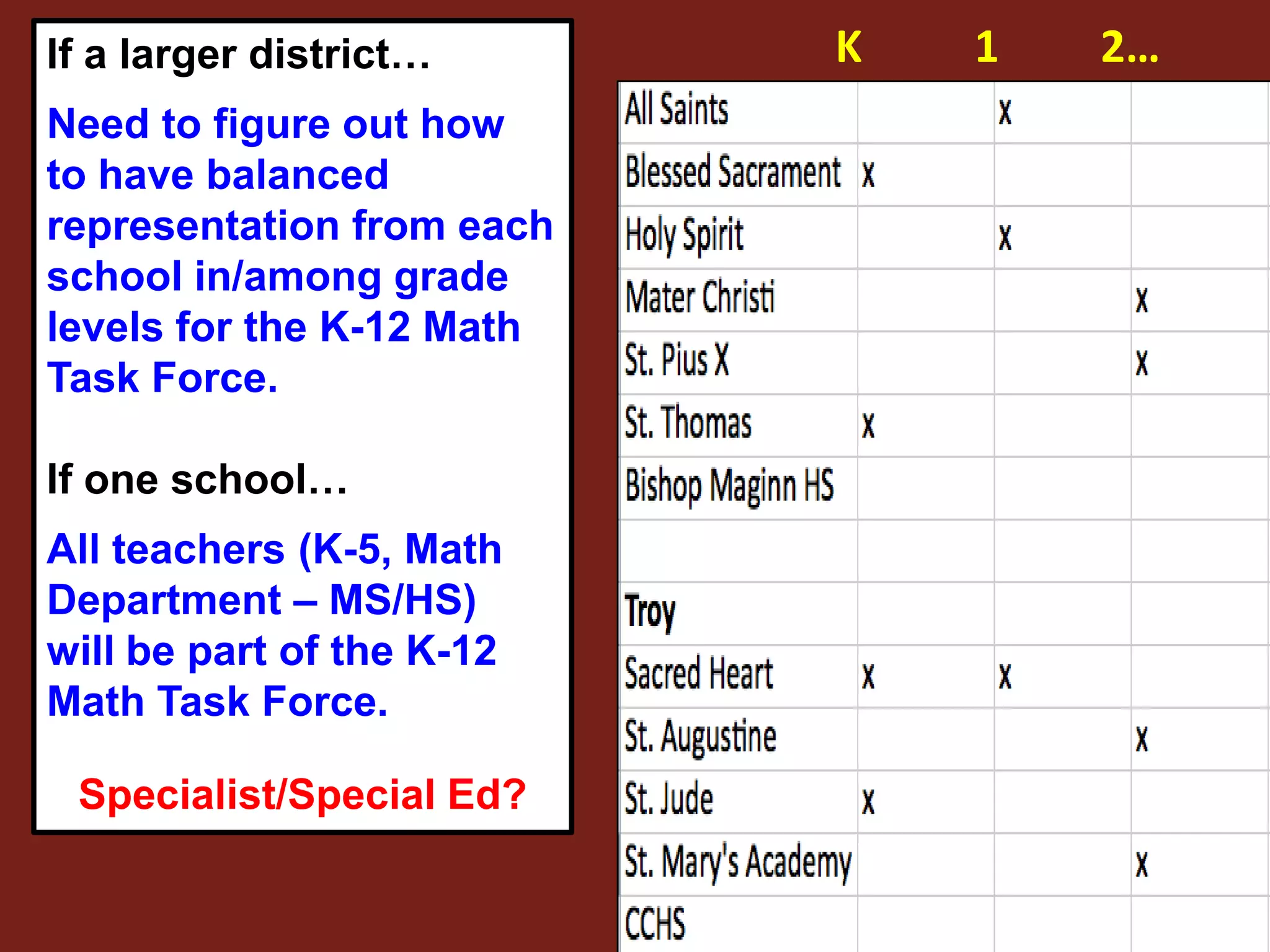
If a larger district…      K   1   2…
Need to figure out how
to have balanced
representation from each
school in/among grade
levels for the K-12 Math
Task Force.

If one school…
All teachers (K-5, Math
Department – MS/HS)
will be part of the K-12
Math Task Force.

 Specialist/Special Ed?
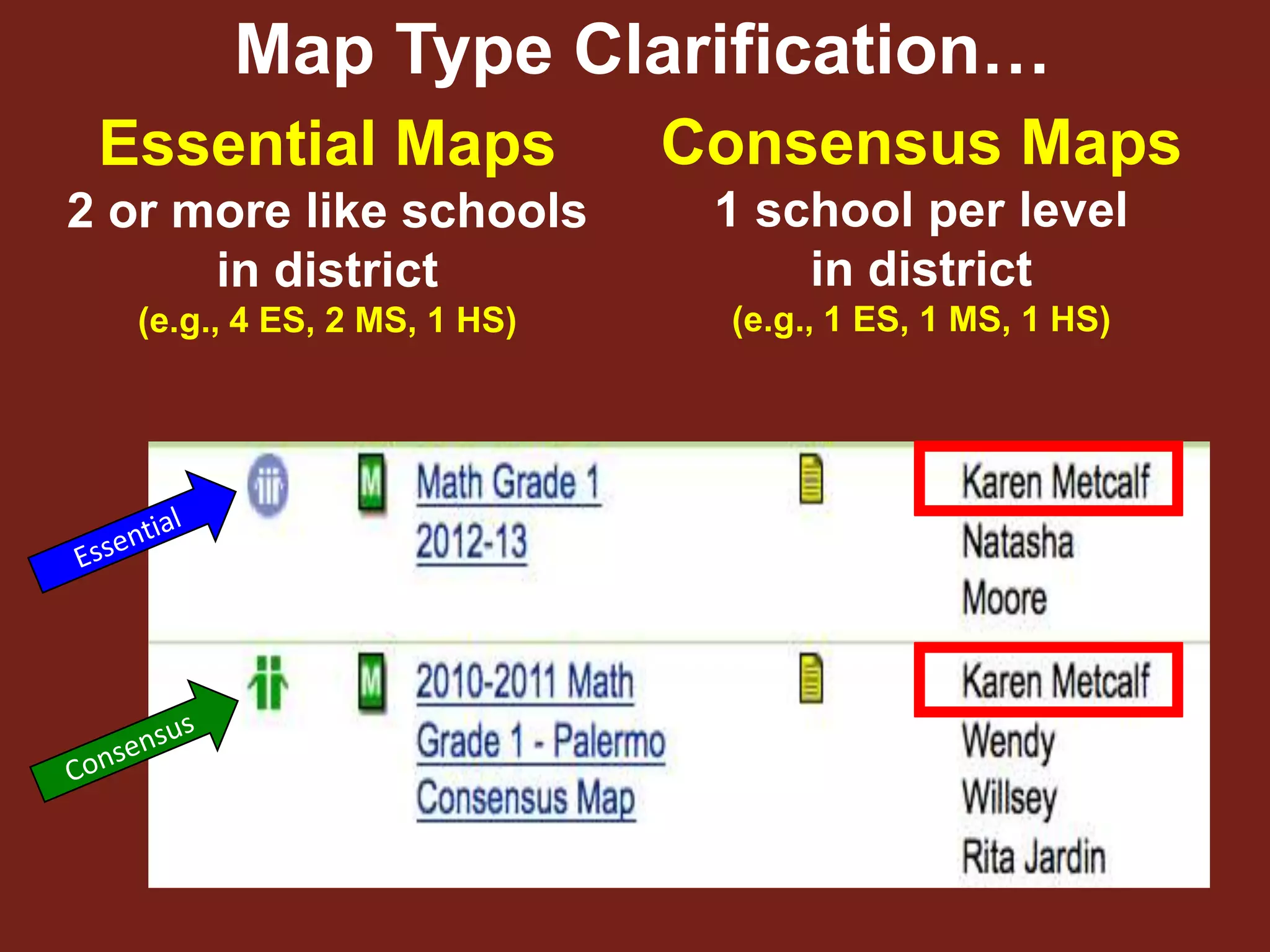
Map Type Clarification…
 Essential Maps              Consensus Maps
2 or more like schools        1 school per level
      in district                 in district
  (e.g., 4 ES, 2 MS, 1 HS)    (e.g., 1 ES, 1 MS, 1 HS)
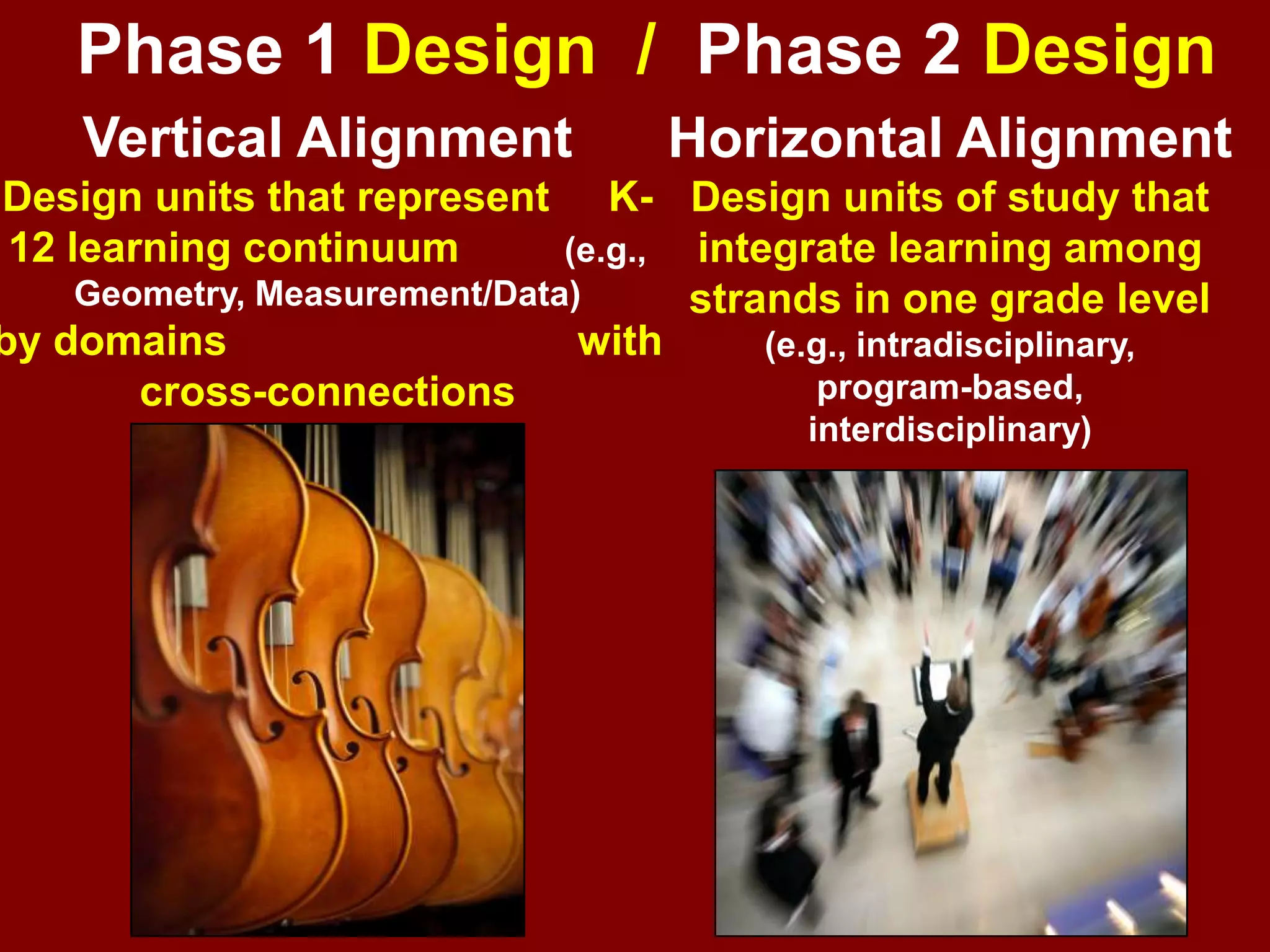
Phase 1 Design / Phase 2 Design
    Vertical Alignment               Horizontal Alignment
Design units that represent K- Design units of study that
 12 learning continuum         (e.g., integrate learning among
     Geometry, Measurement/Data)      strands in one grade level
by domains                      with      (e.g., intradisciplinary,
        cross-connections                    program-based,
                                            interdisciplinary)
Part 1: Laying a Solid Foundation

• Unit Names

• Enduring Understandings/
  Essential Questions

• Standards for Mathematical Practice

• Vocabulary
Designing
                          Phase 1
                        UNIT NAMES


  Quickly locating
      learning
by reading electronic
                            (Pre-K) K through 12
   “binder” spine.
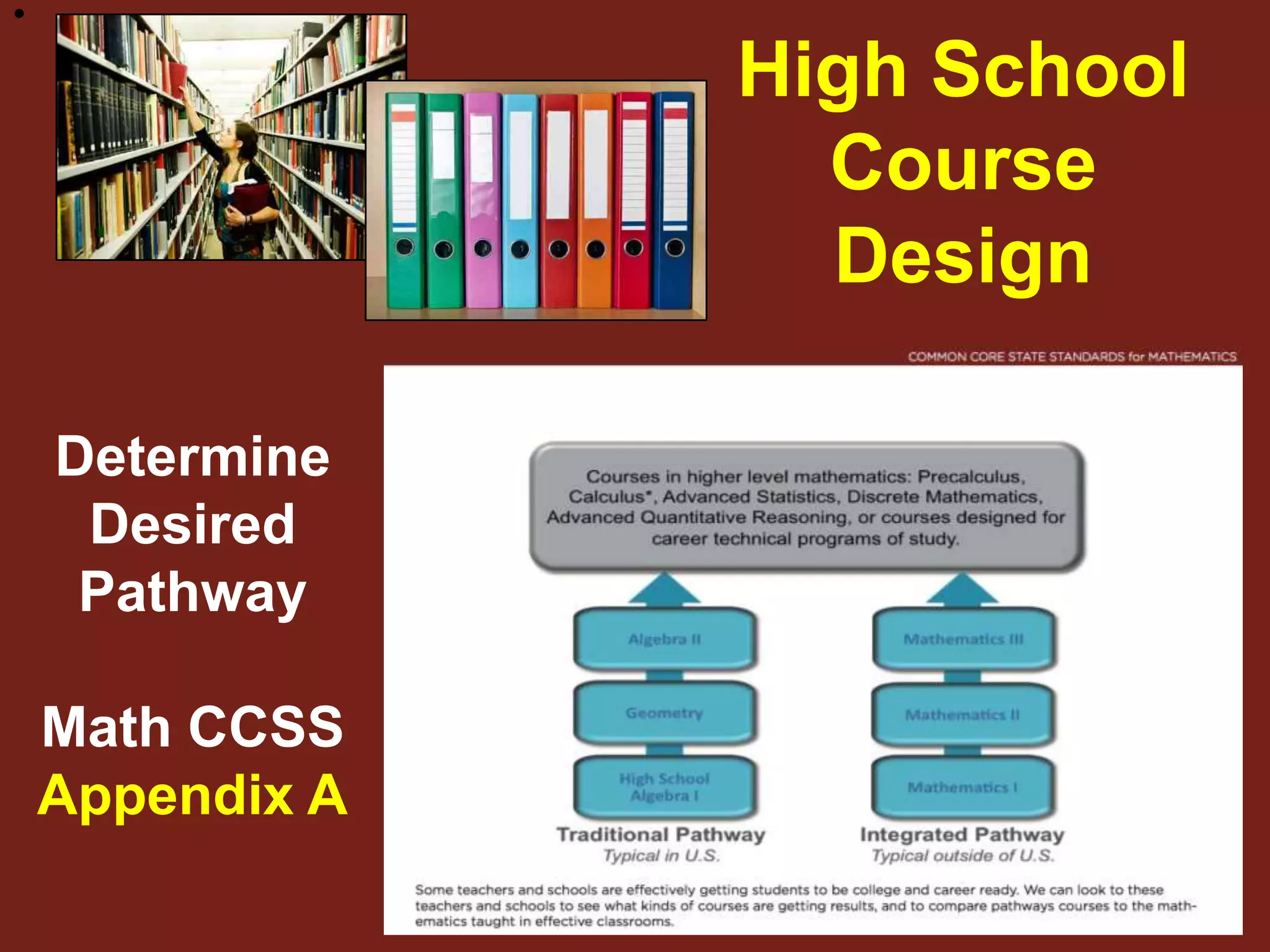
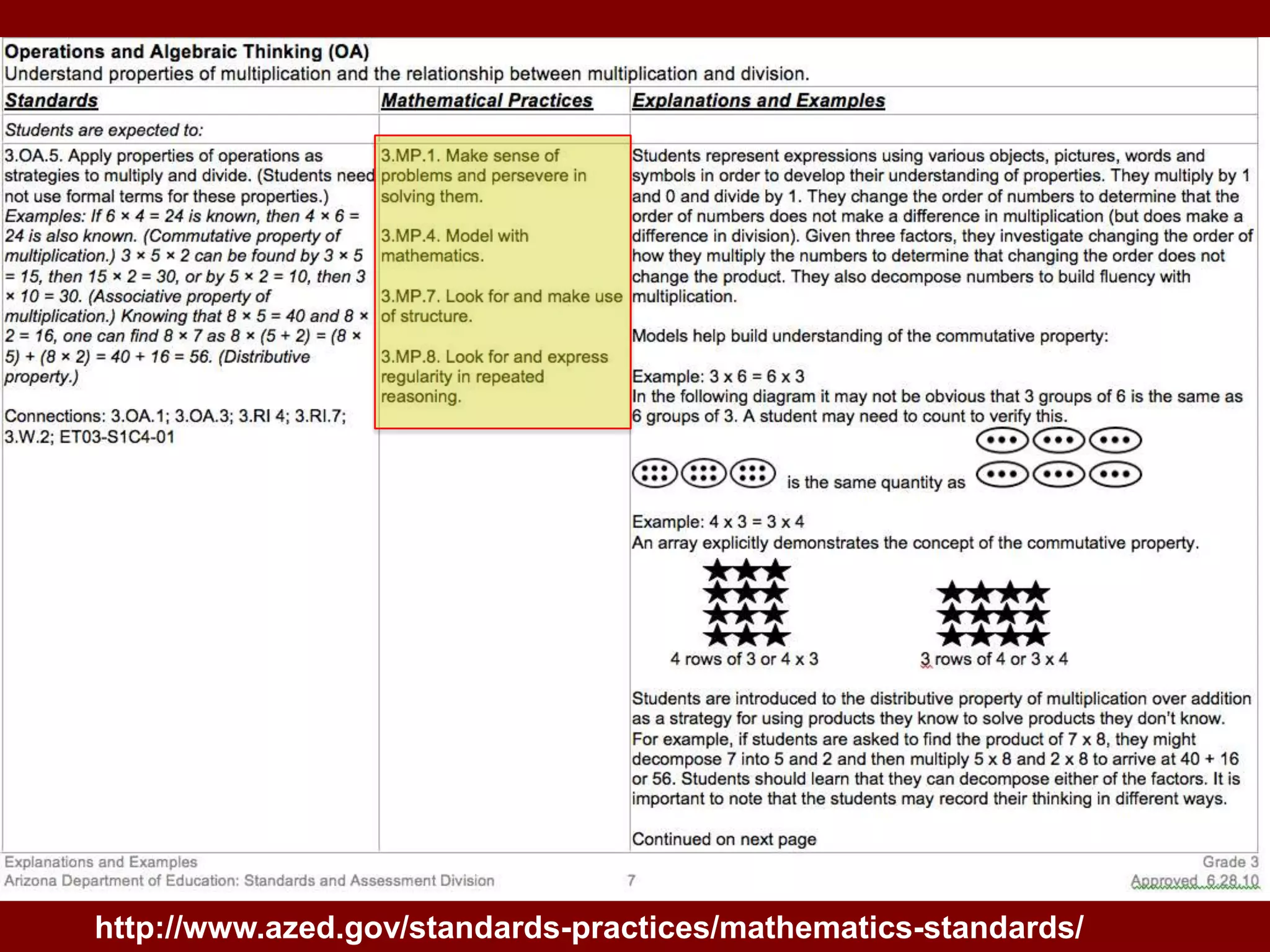
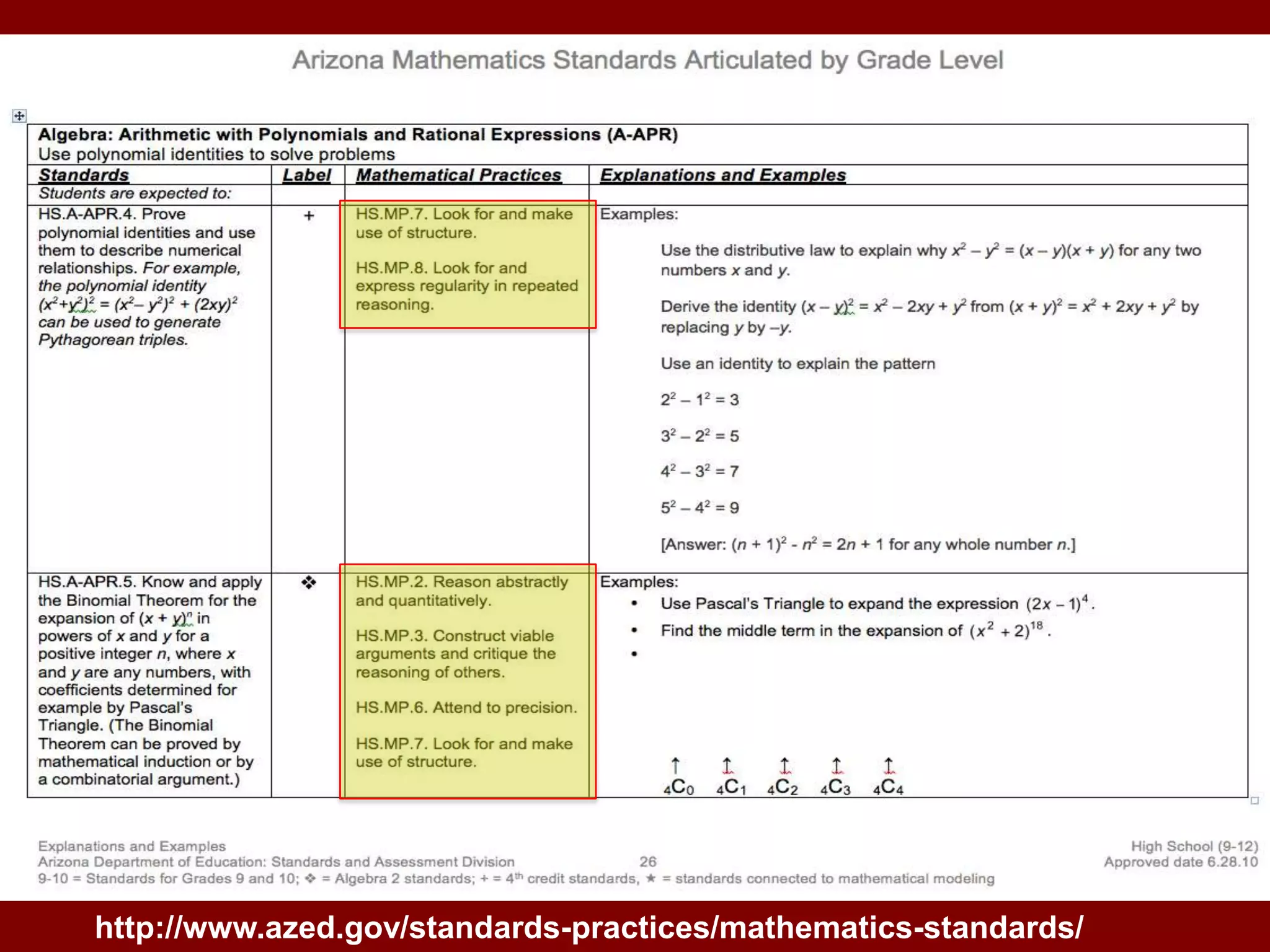
Arizona
                                                    http://www.azed.gov/standards-
                                                    practices/mathematics-standards/


                                         Ohio
http://education.ohio.gov/GD/Templates/Pages/ODE/
ODEDetail.aspxPage=3&TopicRelationID=1704&Con
tent=123507(Transitional Tools)


                 High School
                   Course
                   Design

    Determine
     Desired
     Pathway

    Math CCSS
    Appendix A

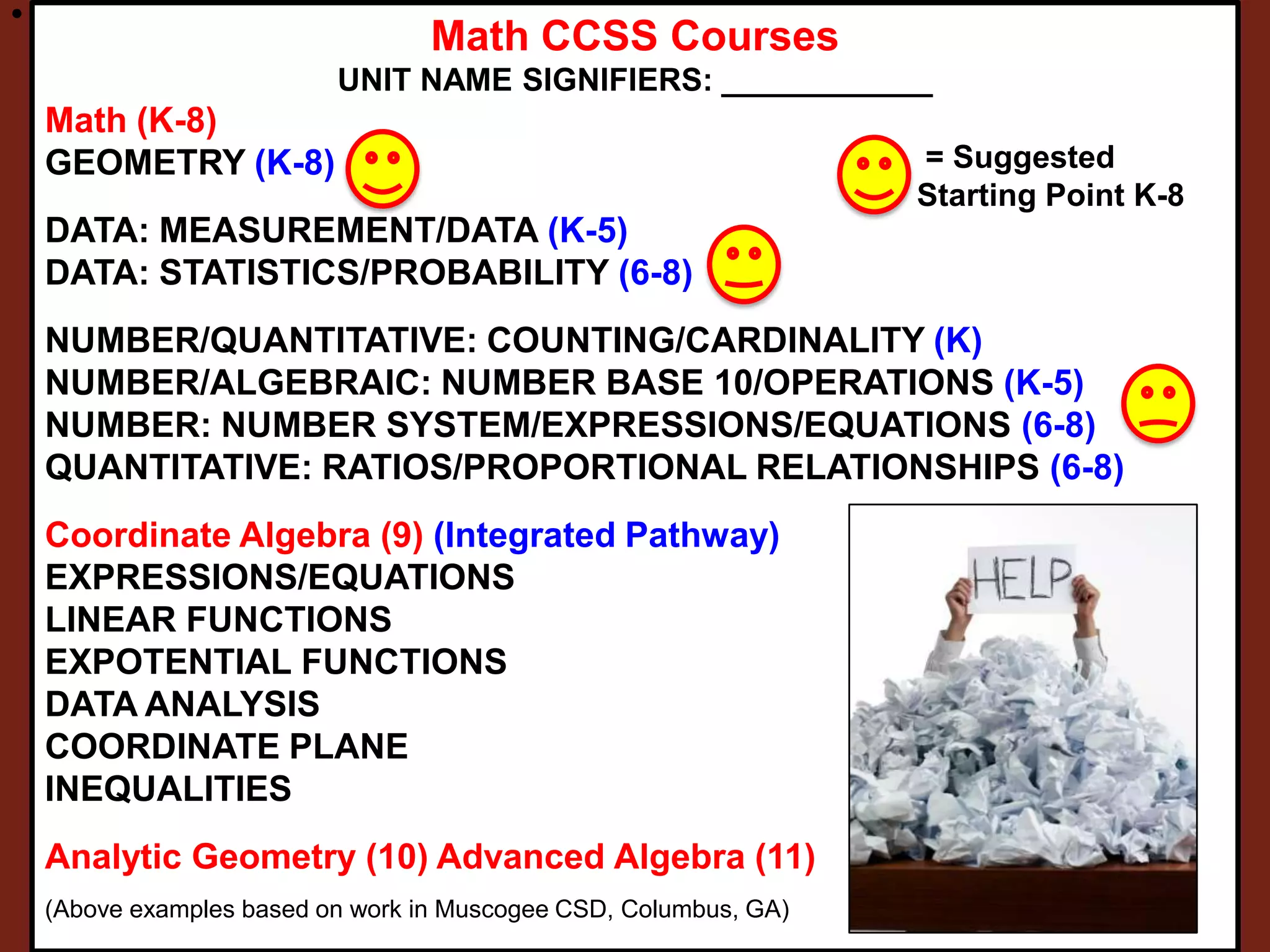
                                   Math CCSS Courses
                           UNIT NAME SIGNIFIERS: ____________
    Math (K-8)
    GEOMETRY (K-8)                                                 = Suggested
                                                                   Starting Point K-8
    DATA: MEASUREMENT/DATA (K-5)
    DATA: STATISTICS/PROBABILITY (6-8)
    NUMBER/QUANTITATIVE: COUNTING/CARDINALITY (K)
    NUMBER/ALGEBRAIC: NUMBER BASE 10/OPERATIONS (K-5)
    NUMBER: NUMBER SYSTEM/EXPRESSIONS/EQUATIONS (6-8)
    QUANTITATIVE: RATIOS/PROPORTIONAL RELATIONSHIPS (6-8)
    Coordinate Algebra (9) (Integrated Pathway)
    EXPRESSIONS/EQUATIONS
    LINEAR FUNCTIONS
    EXPOTENTIAL FUNCTIONS
    DATA ANALYSIS
    COORDINATE PLANE
    INEQUALITIES
    Analytic Geometry (10) Advanced Algebra (11)
    (Above examples based on work in Muscogee CSD, Columbus, GA)
Part 1: Laying a Solid Foundation

• Unit Names

• Enduring Understandings/
  Essential Questions

• Standards for Mathematical Practice

• Vocabulary
Enduring Understandings/
               Essential Questions
Choices…
1. Create vertically aligned CCSS-based
   EUs/EQs as part of Phase 1
2. Create vertically aligned CCSS-based
   EUs/EQs as part of Phase 2
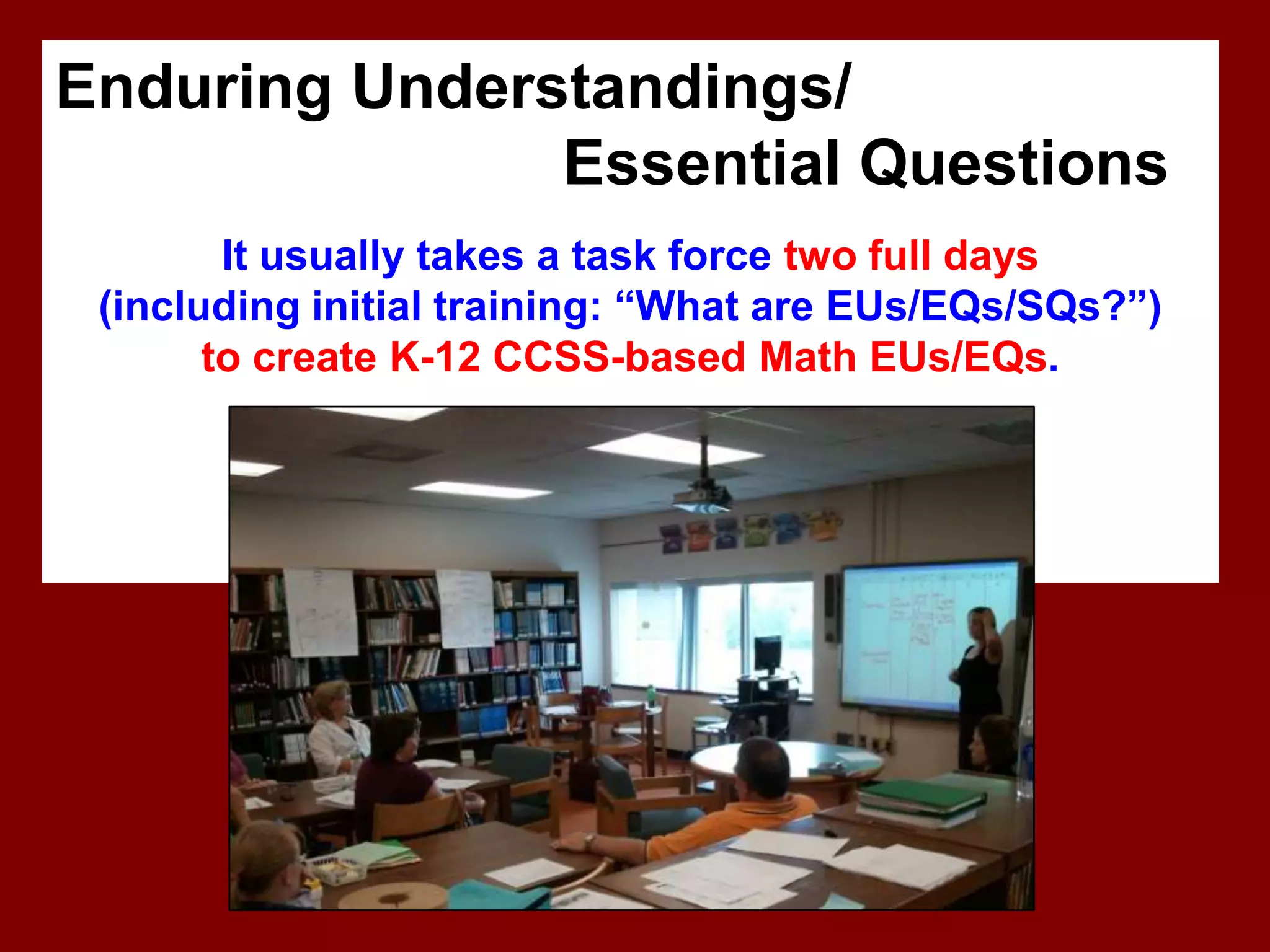
Enduring Understandings/
               Essential Questions
        It usually takes a task force two full days
 (including initial training: “What are EUs/EQs/SQs?”)
       to create K-12 CCSS-based Math EUs/EQs.
Exploring Enduring Understandings
       and Essential Questions
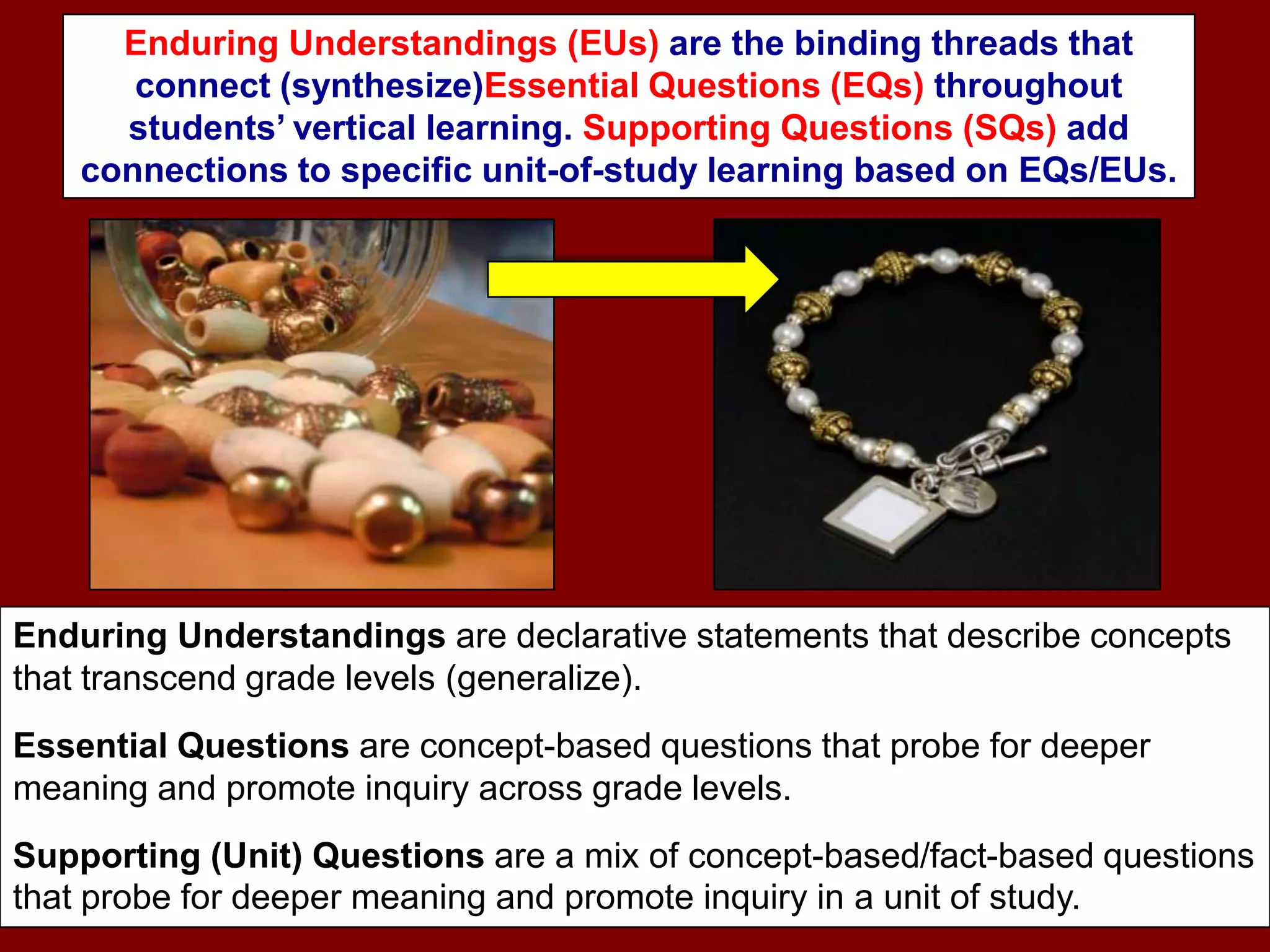
Enduring Understandings (EUs) are the binding threads that
       connect (synthesize)Essential Questions (EQs) throughout
      students’ vertical learning. Supporting Questions (SQs) add
    connections to specific unit-of-study learning based on EQs/EUs.


Enduring Understandings are declarative statements that describe concepts
that transcend grade levels (generalize).
Essential Questions are concept-based questions that probe for deeper
meaning and promote inquiry across grade levels.
Supporting (Unit) Questions are a mix of concept-based/fact-based questions
that probe for deeper meaning and promote inquiry in a unit of study.
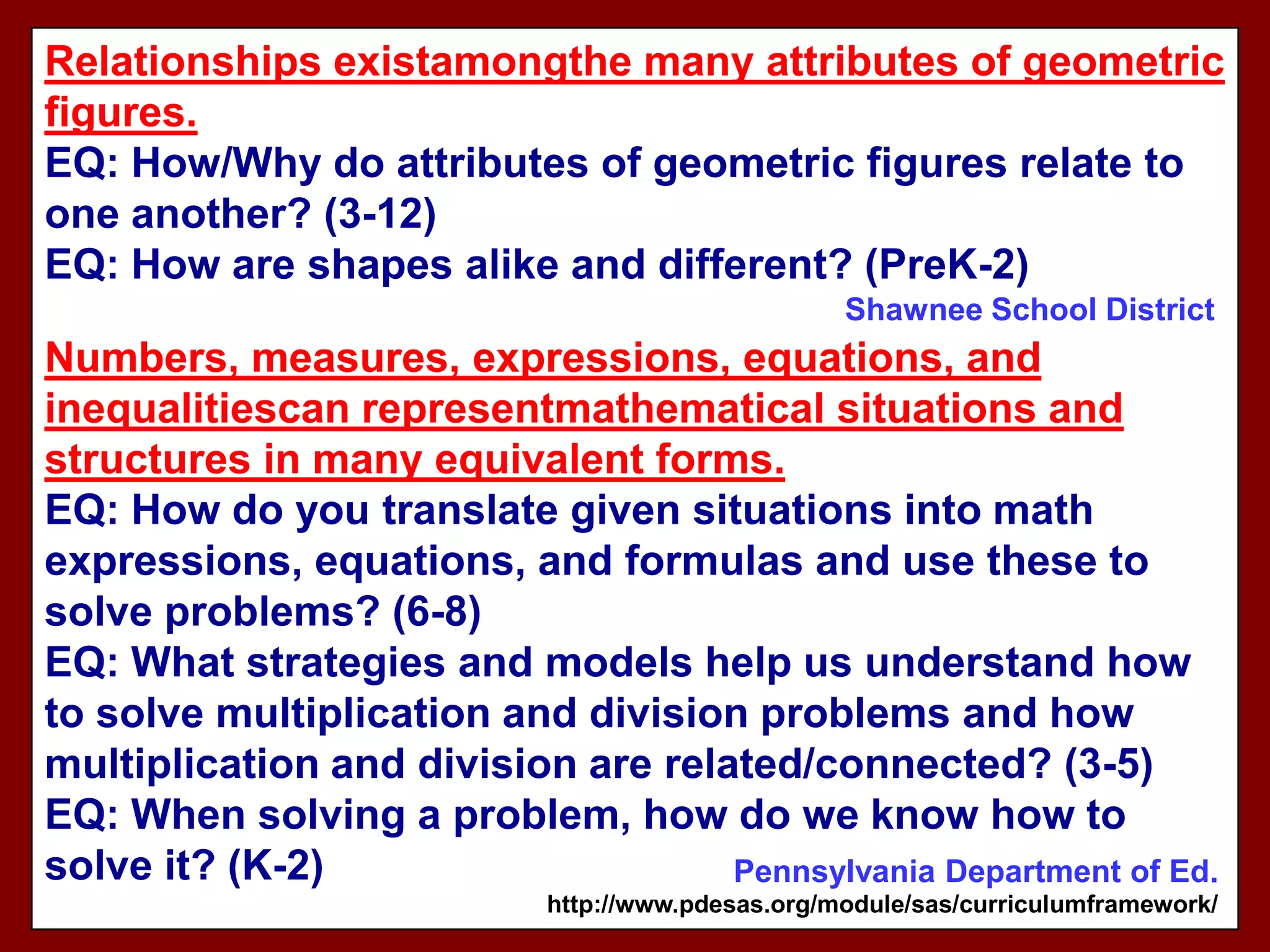
Relationships existamongthe many attributes of geometric
figures.
EQ: How/Why do attributes of geometric figures relate to
one another? (3-12)
EQ: How are shapes alike and different? (PreK-2)
                                                   Shawnee School District
Numbers, measures, expressions, equations, and
inequalitiescan representmathematical situations and
structures in many equivalent forms.
EQ: How do you translate given situations into math
expressions, equations, and formulas and use these to
solve problems? (6-8)
EQ: What strategies and models help us understand how
to solve multiplication and division problems and how
multiplication and division are related/connected? (3-5)
EQ: When solving a problem, how do we know how to
solve it? (K-2)                     Pennsylvania Department of Ed.
                            http://www.pdesas.org/module/sas/curriculumframework/

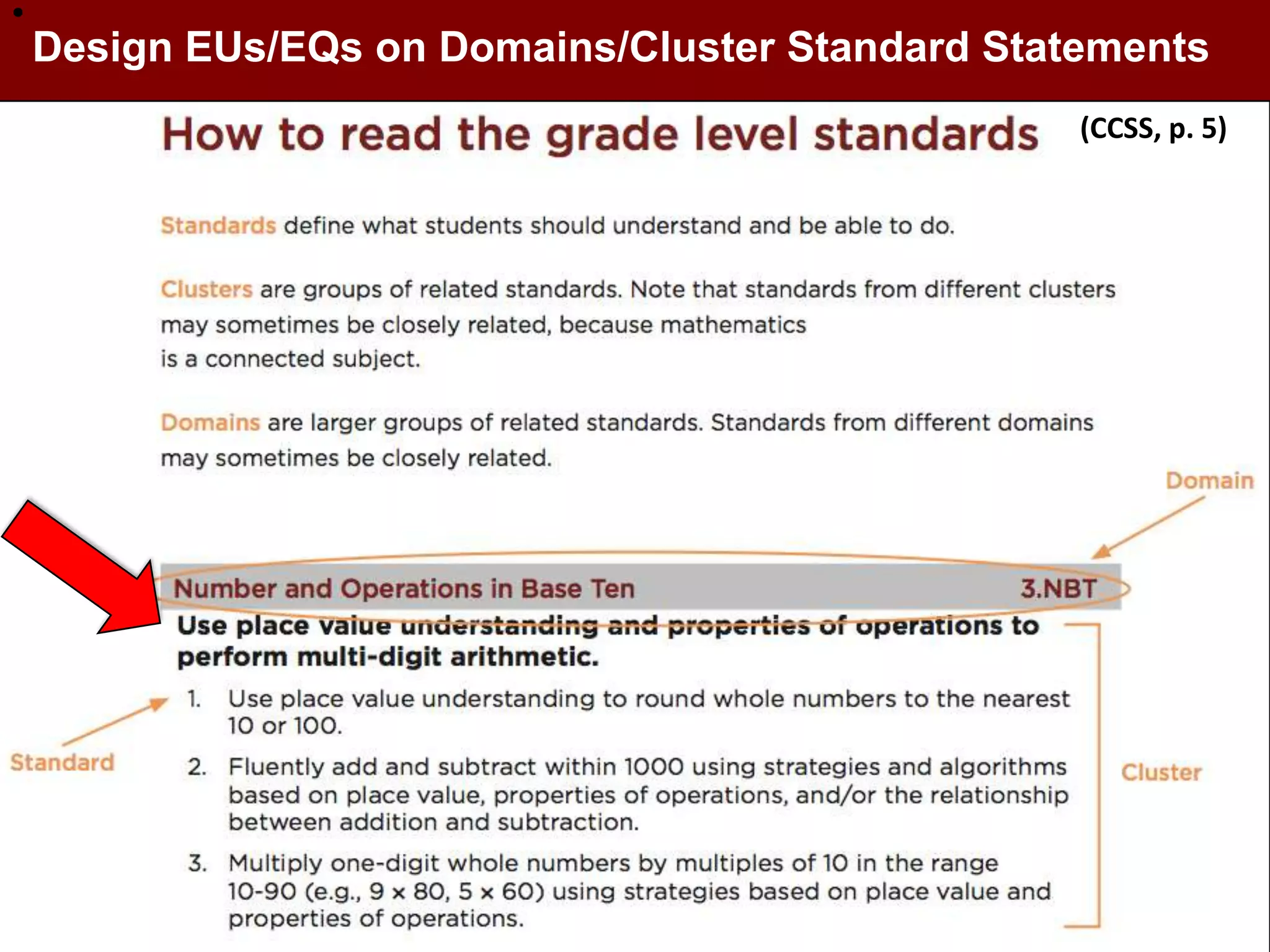
    Design EUs/EQs on Domains/Cluster Standard Statements
                                                   (CCSS, p. 5)
Part 1: Laying a Solid Foundation

• Unit Names

• Enduring Understandings/
  Essential Questions

• Standards for Mathematical Practice

• Vocabulary
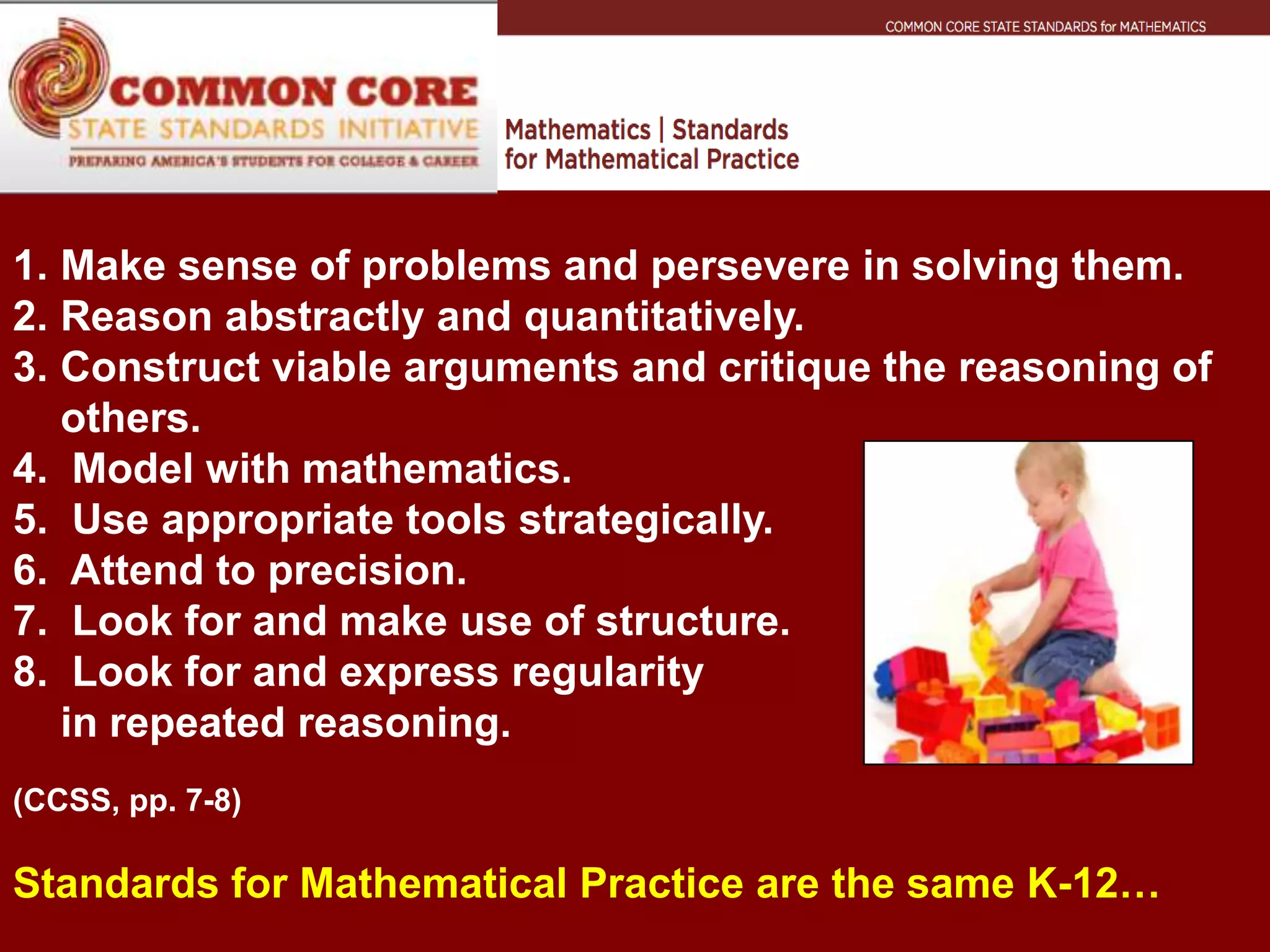
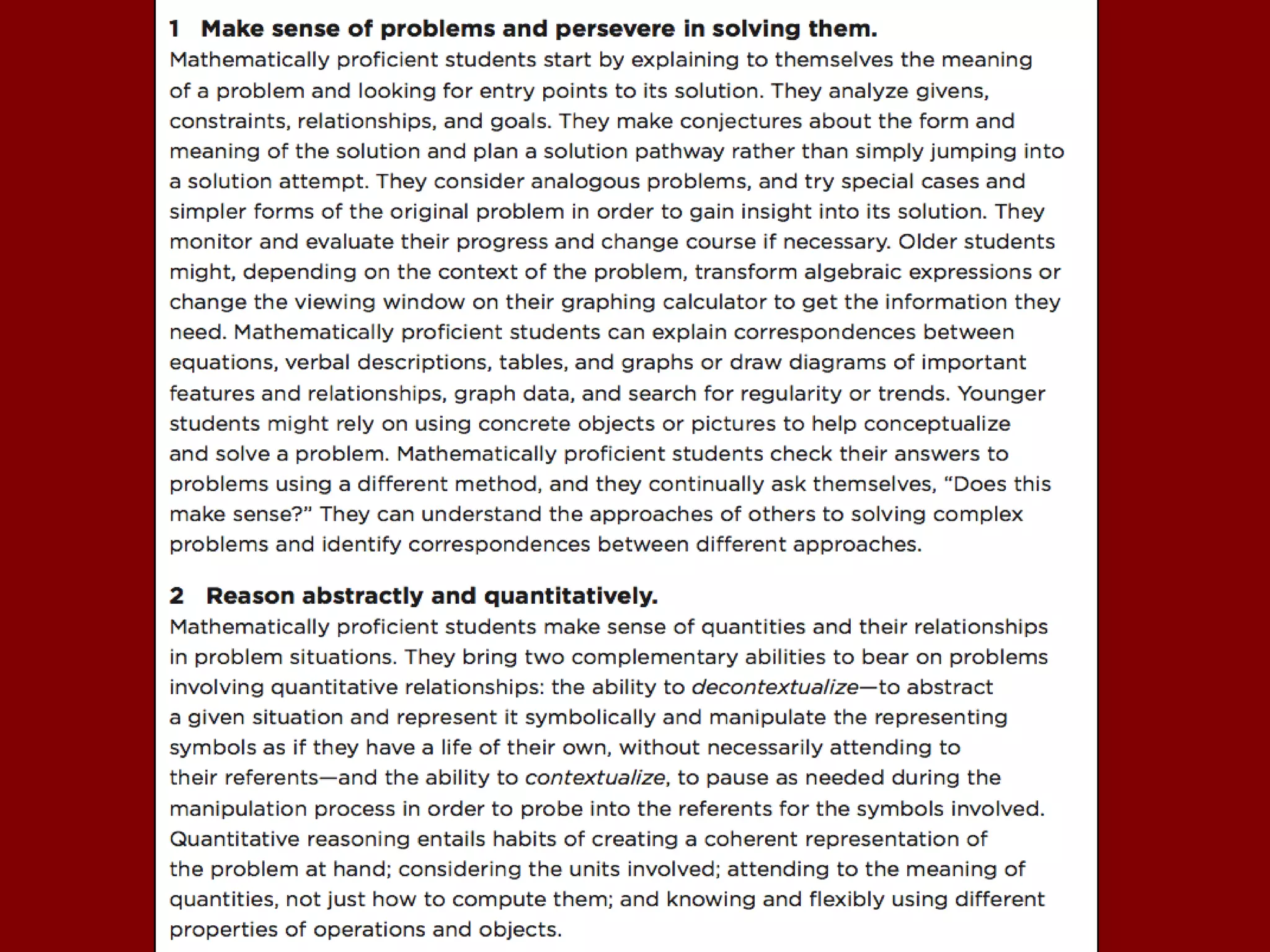
1. Make sense of problems and persevere in solving them.
2. Reason abstractly and quantitatively.
3. Construct viable arguments and critique the reasoning of
   others.
4. Model with mathematics.
5. Use appropriate tools strategically.
6. Attend to precision.
7. Look for and make use of structure.
8. Look for and express regularity
   in repeated reasoning.
(CCSS, pp. 7-8)

Standards for Mathematical Practice are the same K-12…
http://www.azed.gov/standards-practices/mathematics-standards/

    Standards for Mathematical Practice
    Choices…
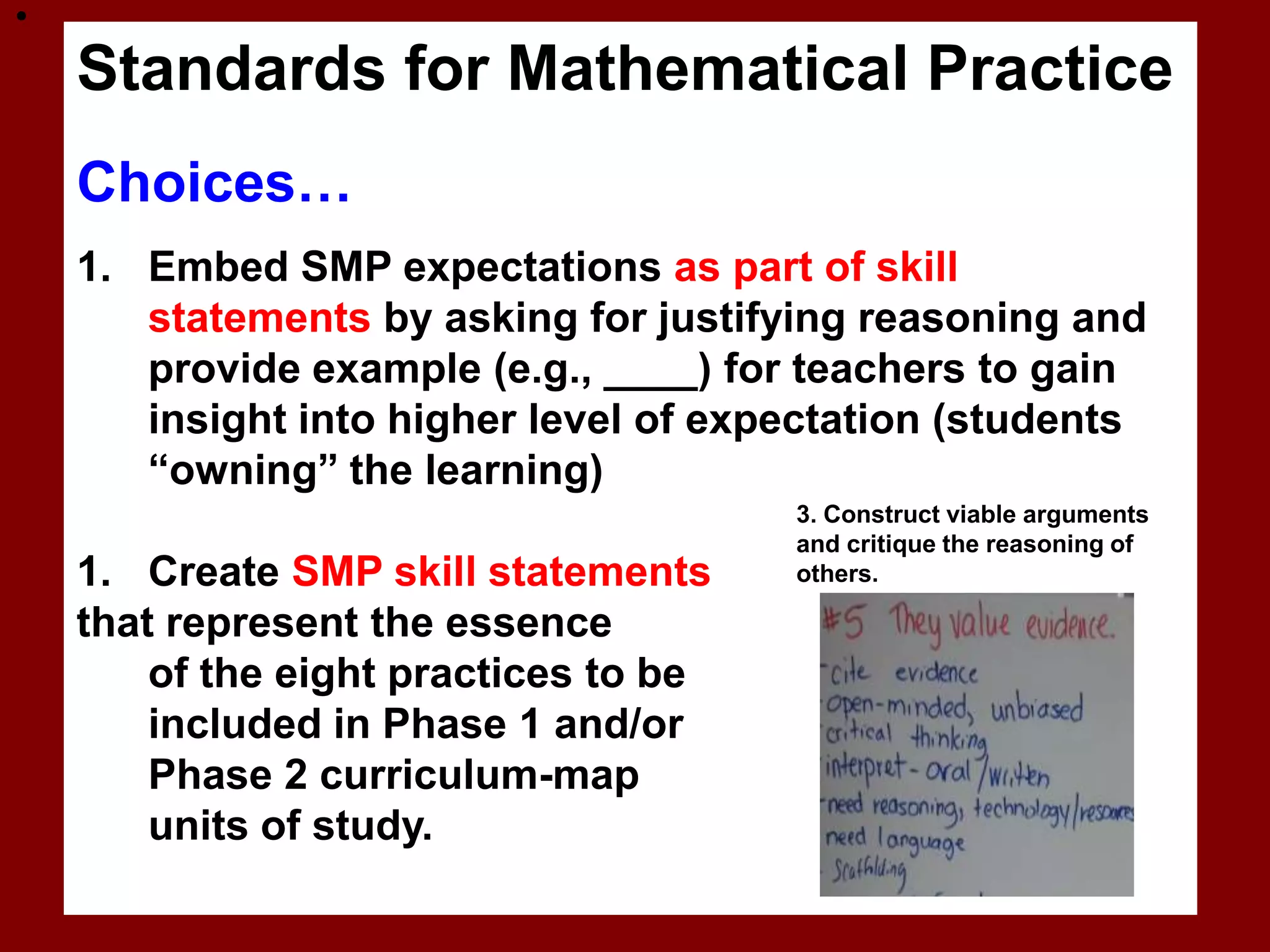
    1. Embed SMP expectations as part of skill
       statements by asking for justifying reasoning and
       provide example (e.g., ____) for teachers to gain
       insight into higher level of expectation (students
       “owning” the learning)
                                       3. Construct viable arguments
                                       and critique the reasoning of
    1. Create SMP skill statements     others.

    that represent the essence
        of the eight practices to be
        included in Phase 1 and/or
        Phase 2 curriculum-map
        units of study.
Part 1: Laying a Solid Foundation

• Unit Names

• Enduring Understandings/
  Essential Questions

• Standards for Mathematical Practice

• Vocabulary


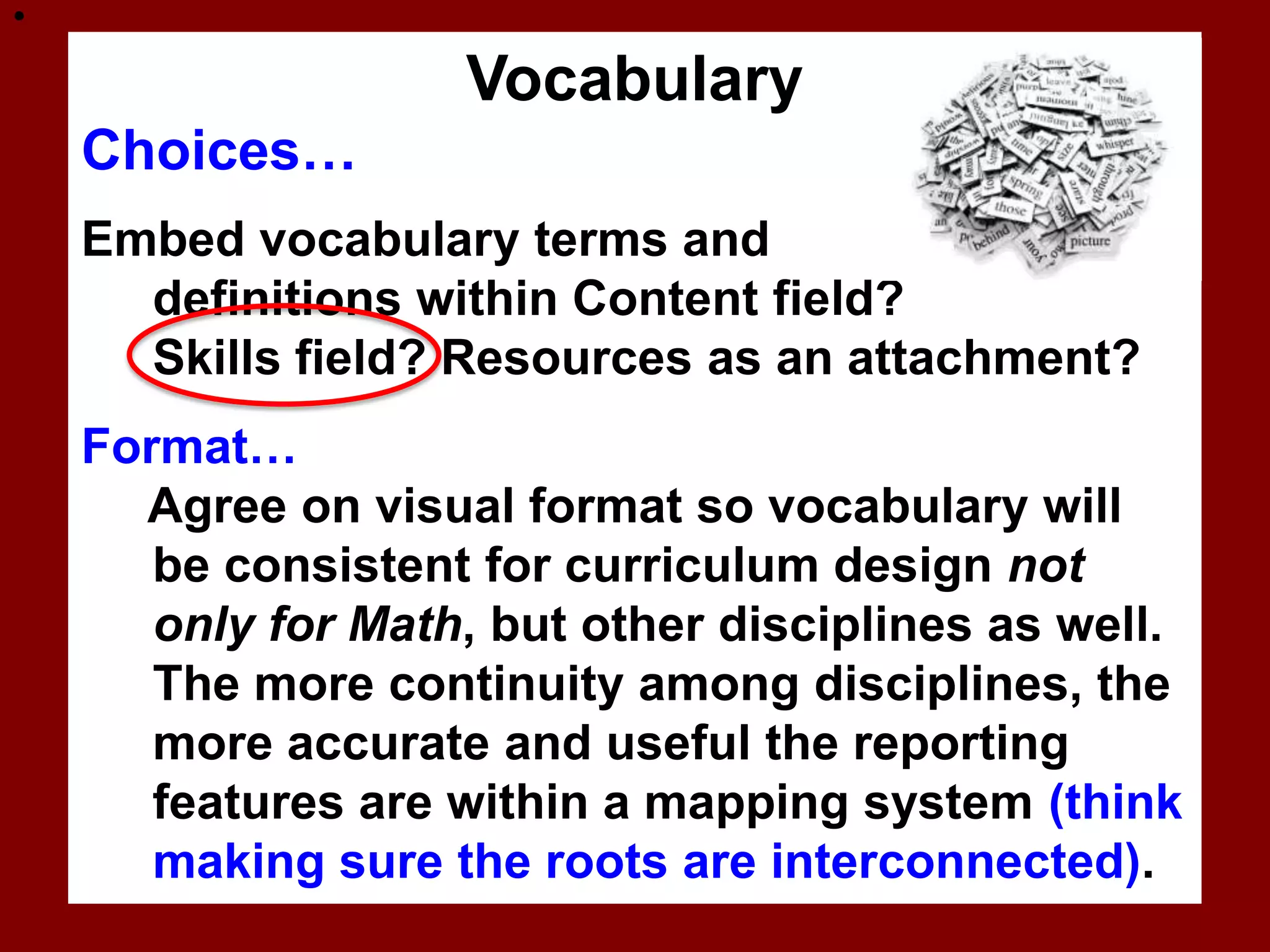
                    Vocabulary
    Choices…
    Embed vocabulary terms and
      definitions within Content field?
      Skills field? Resources as an attachment?
    Format…
      Agree on visual format so vocabulary will
       be consistent for curriculum design not
       only for Math, but other disciplines as well.
       The more continuity among disciplines, the
       more accurate and useful the reporting
       features are within a mapping system (think
       making sure the roots are interconnected).
Part 1: Laying a Solid Foundation

• Unit Names

• Enduring Understandings/
  Essential Questions

• Standards for Mathematical Practice

• Vocabulary
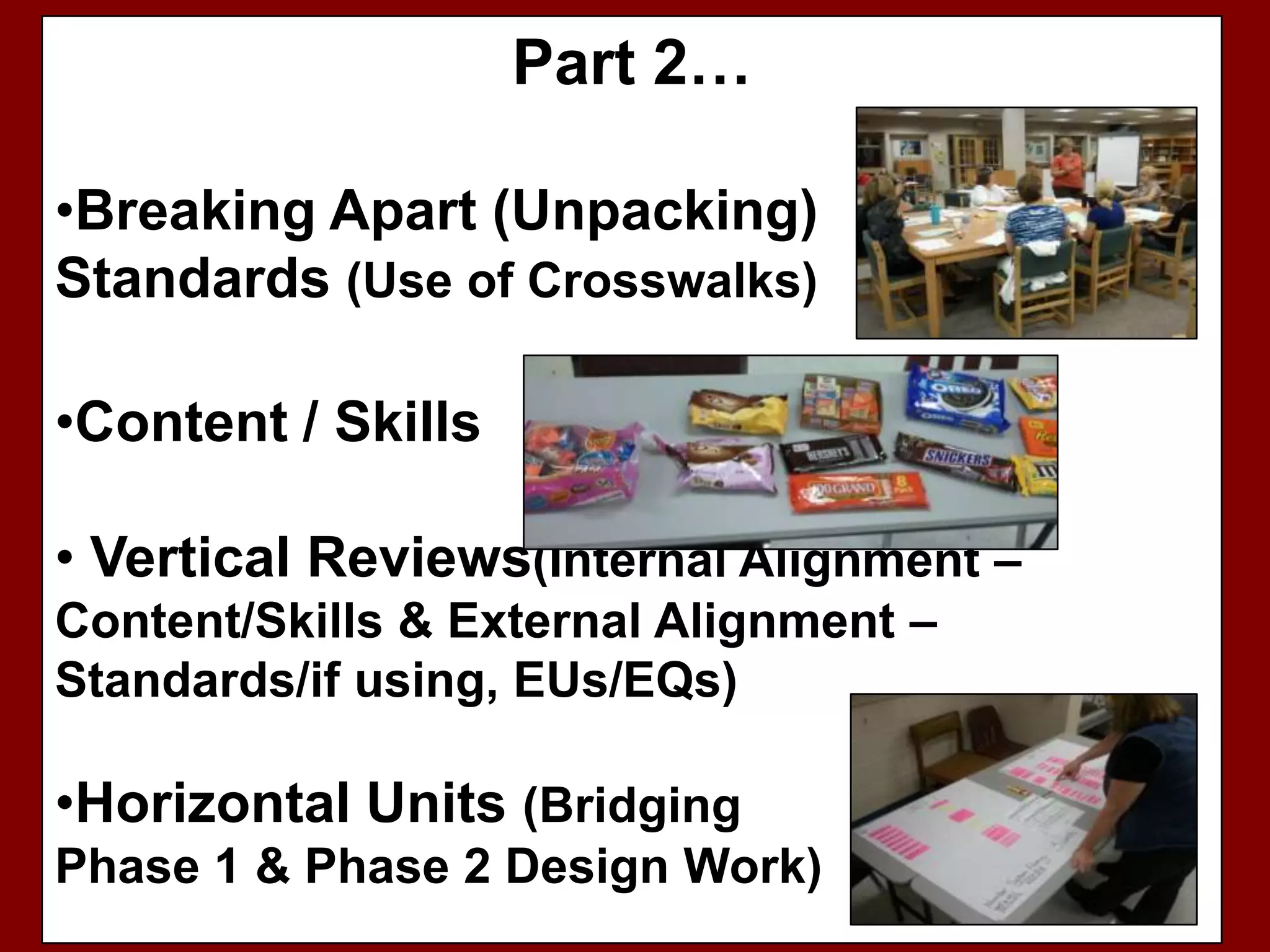
Part 2…

•Breaking Apart (Unpacking)
Standards (Use of Crosswalks)

•Content / Skills

• Vertical Reviews(Internal Alignment –
Content/Skills & External Alignment –
Standards/if using, EUs/EQs)

•Horizontal Units (Bridging
Phase 1 & Phase 2 Design Work)
Slow and steady stays the course(s).
“Race” to the top step-by-step and intentionally.
Janet Hale
  www.CurriculumMapping101.com
teachtucson@aol.com 520-241-8797

Designing Common Core State Standards Systemic Mathematics Curriculum: Part 1

  • 1.
    Designing Common CoreState Standards Systemic Mathematics Curriculum Part 1 Presented By Janet Hale  www.CurriculumMapping101
  • 2.
    Oak Grove Mentality Independent 1 Grove … Multiple Root Systems
  • 3.
    Aspen Grove Mentality SystemicDesign - Interdependent 1 Grove…1 Root System
  • 4.
    Architects Contractors design. build. LEARN TEACH
  • 5.
    Prologue (before thespeech) K-12 Task Force
  • 6.
    If a largerdistrict… K 1 2… Need to figure out how to have balanced representation from each school in/among grade levels for the K-12 Math Task Force. If one school… All teachers (K-5, Math Department – MS/HS) will be part of the K-12 Math Task Force. Specialist/Special Ed?
  • 7.
    Map Type Clarification… Essential Maps Consensus Maps 2 or more like schools 1 school per level in district in district (e.g., 4 ES, 2 MS, 1 HS) (e.g., 1 ES, 1 MS, 1 HS)
  • 8.
    Phase 1 Design/ Phase 2 Design Vertical Alignment Horizontal Alignment Design units that represent K- Design units of study that 12 learning continuum (e.g., integrate learning among Geometry, Measurement/Data) strands in one grade level by domains with (e.g., intradisciplinary, cross-connections program-based, interdisciplinary)
  • 9.
    Part 1: Layinga Solid Foundation • Unit Names • Enduring Understandings/ Essential Questions • Standards for Mathematical Practice • Vocabulary
  • 10.
    Designing Phase 1 UNIT NAMES Quickly locating learning by reading electronic (Pre-K) K through 12 “binder” spine.
  • 11.
    Arizona http://www.azed.gov/standards- practices/mathematics-standards/ Ohio http://education.ohio.gov/GD/Templates/Pages/ODE/ ODEDetail.aspxPage=3&TopicRelationID=1704&Con tent=123507(Transitional Tools)
  • 12.
    High School Course Design Determine Desired Pathway Math CCSS Appendix A
  • 13.
    Math CCSS Courses UNIT NAME SIGNIFIERS: ____________ Math (K-8) GEOMETRY (K-8) = Suggested Starting Point K-8 DATA: MEASUREMENT/DATA (K-5) DATA: STATISTICS/PROBABILITY (6-8) NUMBER/QUANTITATIVE: COUNTING/CARDINALITY (K) NUMBER/ALGEBRAIC: NUMBER BASE 10/OPERATIONS (K-5) NUMBER: NUMBER SYSTEM/EXPRESSIONS/EQUATIONS (6-8) QUANTITATIVE: RATIOS/PROPORTIONAL RELATIONSHIPS (6-8) Coordinate Algebra (9) (Integrated Pathway) EXPRESSIONS/EQUATIONS LINEAR FUNCTIONS EXPOTENTIAL FUNCTIONS DATA ANALYSIS COORDINATE PLANE INEQUALITIES Analytic Geometry (10) Advanced Algebra (11) (Above examples based on work in Muscogee CSD, Columbus, GA)
  • 14.
    Part 1: Layinga Solid Foundation • Unit Names • Enduring Understandings/ Essential Questions • Standards for Mathematical Practice • Vocabulary
  • 15.
    Enduring Understandings/ Essential Questions Choices… 1. Create vertically aligned CCSS-based EUs/EQs as part of Phase 1 2. Create vertically aligned CCSS-based EUs/EQs as part of Phase 2
  • 16.
    Enduring Understandings/ Essential Questions It usually takes a task force two full days (including initial training: “What are EUs/EQs/SQs?”) to create K-12 CCSS-based Math EUs/EQs.
  • 17.
    Exploring Enduring Understandings and Essential Questions
  • 18.
    Enduring Understandings (EUs)are the binding threads that connect (synthesize)Essential Questions (EQs) throughout students’ vertical learning. Supporting Questions (SQs) add connections to specific unit-of-study learning based on EQs/EUs. Enduring Understandings are declarative statements that describe concepts that transcend grade levels (generalize). Essential Questions are concept-based questions that probe for deeper meaning and promote inquiry across grade levels. Supporting (Unit) Questions are a mix of concept-based/fact-based questions that probe for deeper meaning and promote inquiry in a unit of study.
  • 19.
    Relationships existamongthe manyattributes of geometric figures. EQ: How/Why do attributes of geometric figures relate to one another? (3-12) EQ: How are shapes alike and different? (PreK-2) Shawnee School District Numbers, measures, expressions, equations, and inequalitiescan representmathematical situations and structures in many equivalent forms. EQ: How do you translate given situations into math expressions, equations, and formulas and use these to solve problems? (6-8) EQ: What strategies and models help us understand how to solve multiplication and division problems and how multiplication and division are related/connected? (3-5) EQ: When solving a problem, how do we know how to solve it? (K-2) Pennsylvania Department of Ed. http://www.pdesas.org/module/sas/curriculumframework/
  • 20.
    Design EUs/EQs on Domains/Cluster Standard Statements (CCSS, p. 5)
  • 21.
    Part 1: Layinga Solid Foundation • Unit Names • Enduring Understandings/ Essential Questions • Standards for Mathematical Practice • Vocabulary
  • 22.
    1. Make senseof problems and persevere in solving them. 2. Reason abstractly and quantitatively. 3. Construct viable arguments and critique the reasoning of others. 4. Model with mathematics. 5. Use appropriate tools strategically. 6. Attend to precision. 7. Look for and make use of structure. 8. Look for and express regularity in repeated reasoning. (CCSS, pp. 7-8) Standards for Mathematical Practice are the same K-12…
  • 23.
  • 24.
  • 26.
    Standards for Mathematical Practice Choices… 1. Embed SMP expectations as part of skill statements by asking for justifying reasoning and provide example (e.g., ____) for teachers to gain insight into higher level of expectation (students “owning” the learning) 3. Construct viable arguments and critique the reasoning of 1. Create SMP skill statements others. that represent the essence of the eight practices to be included in Phase 1 and/or Phase 2 curriculum-map units of study.
  • 27.
    Part 1: Layinga Solid Foundation • Unit Names • Enduring Understandings/ Essential Questions • Standards for Mathematical Practice • Vocabulary
  • 28.
    Vocabulary Choices… Embed vocabulary terms and definitions within Content field? Skills field? Resources as an attachment? Format… Agree on visual format so vocabulary will be consistent for curriculum design not only for Math, but other disciplines as well. The more continuity among disciplines, the more accurate and useful the reporting features are within a mapping system (think making sure the roots are interconnected).
  • 29.
    Part 1: Layinga Solid Foundation • Unit Names • Enduring Understandings/ Essential Questions • Standards for Mathematical Practice • Vocabulary
  • 30.
    Part 2… •Breaking Apart(Unpacking) Standards (Use of Crosswalks) •Content / Skills • Vertical Reviews(Internal Alignment – Content/Skills & External Alignment – Standards/if using, EUs/EQs) •Horizontal Units (Bridging Phase 1 & Phase 2 Design Work)
  • 31.
    Slow and steadystays the course(s). “Race” to the top step-by-step and intentionally.
  • 32.
    Janet Hale www.CurriculumMapping101.com teachtucson@aol.com 520-241-8797