Calculator Use in the Mathematics Classroom By: Christina Jowell
Is the use of a calculator taking away from students learning the math? Should calculators only be used in a secondary math classroom? Is the use of calculators preparing our students for the future of math? Are calculators enhancing or hindering learning?
Problem Statement The purpose of this research is to compare research to show calculator use in a mathematics classroom can enhance student learning and the benefits to our students learning to use a calculator.
The significance of this research  To know the positive outcomes of using a calculator in the classroom To know effective strategies to using a calculator in the classroom To know the purposes of teaching students how to use a calculator
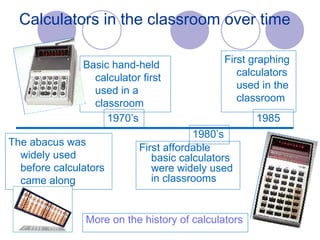
Calculators in the classroom over time First affordable basic calculators were widely used in classrooms First graphing calculators used in the classroom Basic hand-held calculator first used in a classroom 1970’s 1980’s 1985 The abacus was widely used before calculators came along More on the history of calculators
According to the National Council of Teaching Mathematics (NCTM) “the use of calculators along with the traditional paper-and-pencil instruction enhances the learning of basic skills.” “the integration of the calculator into the school mathematics programs at all grade levels in class work, homework, and evaluation” is something the NCTM supports.
Benefits to using a calculator Allows students to  focus on problem solving  rather than the basic computations Allows students to  try new math concepts  they may not have tried because of the computations involved Makes students  more confident  in their abilities Time - students can solve problems at a more reasonable time frame Allows students to  practice the skill  being taught rather than the computations Prevents silly mistakes  in computation Prepares them for the future  whether introducing them to a calculator before high school or for a standardized test or for a profession
Evidence of the effectiveness of calculators in the math classroom Children who use calculators on tests have  higher scores  in both basic computation skills and problem solving.  Students who use calculators within a mix of instructional styles do not lose their paper and pencil skills.  Calculator use in the classroom  improves the paper and pencil skills  of students regardless of their ability levels.  Those who use calculators in class have  better attitudes toward mathematics  than children who do not use them.   - According to a 1986 study done in the Journal for Research in Mathematics Education
How does calculator use in the classroom translate to calculators in the adult world? According to SEDL, a website committed to researching to improve education  “Even a part-time job at the corner fast-food chain requires the use of a calculator in some form.  If schools do not teach students to use these devices from an early age, the rising generation will lack necessary work skills .  Calculators are one tool almost every employer expects employees to use. Calculators are ubiquitous in the work world and as important for employees as voice mail and word processing.”
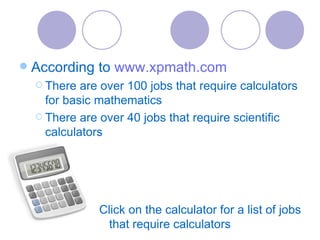
According to  www.xpmath.com   There are over 100 jobs that require calculators for basic mathematics There are over 40 jobs that require scientific calculators  Click on the calculator for a list of jobs that require calculators
Conclusion Though calculator use in the classroom is still under debate with many educators there are many benefits to their use.  A balance is needed of calculators and pencil-and-paper in the classroom.  The use of calculators can enhance a math classroom and prepare students for the future.
Bibliography Collins, S. (n.d.).  Calculators and Calculating Devices.  Retrieved from  http://www.math.wichita.edu/history/topics/calculators.html#top . Eisenhower, S. (2011).  Quick Takes: Calculators in the Classroom.  Retrieved from  http://www.sedl.org/scimath/quicktakes/qt9803.html . Hui, T. (2001-2009).  Basic Calculator Use.  Retrieved from  http:// www.xpmath.com/careers/topicsresult.php?subjectID =5&topicID=2 . Hui, T. (2001-2009).  Scientific Calculator Use.  Retrieved from  http:// www.xpmath.com/careers/topicsresult.php?subjectID =5&topicID=3 Johnson, L. (2001, April).  Middle School Math and the Calculator.  Retrieved from  http://www.iched.org/cms/scripts/page.php?site_id=iched&item_id=math_calculator .
Continued Bibliography McCauliff, E. (n.d.).  The Calculator in the Elementary Classroom: Making a Useful Tool Out of an Ineffective Crutch.  Retrieved from  http://www.publications.villanova.edu/Concept/2004/The%20Calculator%20in%20the%20Elementary%20Classroom.htm . Starr, L. (2002).  Educators Battle Over Calculator Use: Both Sides Claim Casualties.  Retrieved from  http://www.educationworld.com/a_curr/curr072.shtml . Stiff, L. (2001, April).  Making Calculator Use Add Up.  Retrieved from  http:// www.nctm.org/about/content.aspx?id =1242 . Tout, N. (2000-2011).  Vintage Calculators Web Museum.  Retrieved from  http://www.vintagecalculators.com/html/hand-held_calculators.html . Vanderbilt University (2008, August 20).  Calculators Okay In Math Class, If Students Know The Facts First, Study Finds.   Retrieved from  http://www.sciencedaily.com/releases/2008/08/080819160203.htm .

Calculator use in the mathematics classroom

  • 1.
    Calculator Use inthe Mathematics Classroom By: Christina Jowell
  • 2.
    Is the useof a calculator taking away from students learning the math? Should calculators only be used in a secondary math classroom? Is the use of calculators preparing our students for the future of math? Are calculators enhancing or hindering learning?
  • 3.
    Problem Statement Thepurpose of this research is to compare research to show calculator use in a mathematics classroom can enhance student learning and the benefits to our students learning to use a calculator.
  • 4.
    The significance ofthis research To know the positive outcomes of using a calculator in the classroom To know effective strategies to using a calculator in the classroom To know the purposes of teaching students how to use a calculator
  • 5.
    Calculators in theclassroom over time First affordable basic calculators were widely used in classrooms First graphing calculators used in the classroom Basic hand-held calculator first used in a classroom 1970’s 1980’s 1985 The abacus was widely used before calculators came along More on the history of calculators
  • 6.
    According to theNational Council of Teaching Mathematics (NCTM) “the use of calculators along with the traditional paper-and-pencil instruction enhances the learning of basic skills.” “the integration of the calculator into the school mathematics programs at all grade levels in class work, homework, and evaluation” is something the NCTM supports.
  • 7.
    Benefits to usinga calculator Allows students to focus on problem solving rather than the basic computations Allows students to try new math concepts they may not have tried because of the computations involved Makes students more confident in their abilities Time - students can solve problems at a more reasonable time frame Allows students to practice the skill being taught rather than the computations Prevents silly mistakes in computation Prepares them for the future whether introducing them to a calculator before high school or for a standardized test or for a profession
  • 8.
    Evidence of theeffectiveness of calculators in the math classroom Children who use calculators on tests have higher scores in both basic computation skills and problem solving. Students who use calculators within a mix of instructional styles do not lose their paper and pencil skills. Calculator use in the classroom improves the paper and pencil skills of students regardless of their ability levels. Those who use calculators in class have better attitudes toward mathematics than children who do not use them. - According to a 1986 study done in the Journal for Research in Mathematics Education
  • 9.
    How does calculatoruse in the classroom translate to calculators in the adult world? According to SEDL, a website committed to researching to improve education “Even a part-time job at the corner fast-food chain requires the use of a calculator in some form. If schools do not teach students to use these devices from an early age, the rising generation will lack necessary work skills . Calculators are one tool almost every employer expects employees to use. Calculators are ubiquitous in the work world and as important for employees as voice mail and word processing.”
  • 10.
    According to www.xpmath.com There are over 100 jobs that require calculators for basic mathematics There are over 40 jobs that require scientific calculators Click on the calculator for a list of jobs that require calculators
  • 11.
    Conclusion Though calculatoruse in the classroom is still under debate with many educators there are many benefits to their use. A balance is needed of calculators and pencil-and-paper in the classroom. The use of calculators can enhance a math classroom and prepare students for the future.
  • 12.
    Bibliography Collins, S.(n.d.). Calculators and Calculating Devices. Retrieved from http://www.math.wichita.edu/history/topics/calculators.html#top . Eisenhower, S. (2011). Quick Takes: Calculators in the Classroom. Retrieved from http://www.sedl.org/scimath/quicktakes/qt9803.html . Hui, T. (2001-2009). Basic Calculator Use. Retrieved from http:// www.xpmath.com/careers/topicsresult.php?subjectID =5&topicID=2 . Hui, T. (2001-2009). Scientific Calculator Use. Retrieved from http:// www.xpmath.com/careers/topicsresult.php?subjectID =5&topicID=3 Johnson, L. (2001, April). Middle School Math and the Calculator. Retrieved from http://www.iched.org/cms/scripts/page.php?site_id=iched&item_id=math_calculator .
  • 13.
    Continued Bibliography McCauliff,E. (n.d.). The Calculator in the Elementary Classroom: Making a Useful Tool Out of an Ineffective Crutch. Retrieved from http://www.publications.villanova.edu/Concept/2004/The%20Calculator%20in%20the%20Elementary%20Classroom.htm . Starr, L. (2002). Educators Battle Over Calculator Use: Both Sides Claim Casualties. Retrieved from http://www.educationworld.com/a_curr/curr072.shtml . Stiff, L. (2001, April). Making Calculator Use Add Up. Retrieved from http:// www.nctm.org/about/content.aspx?id =1242 . Tout, N. (2000-2011). Vintage Calculators Web Museum. Retrieved from http://www.vintagecalculators.com/html/hand-held_calculators.html . Vanderbilt University (2008, August 20). Calculators Okay In Math Class, If Students Know The Facts First, Study Finds.  Retrieved from http://www.sciencedaily.com/releases/2008/08/080819160203.htm .