Chapter 1: Vocabulary Words
   Divide - To separate into equal groups; the opposite
    operation of multiplication

   Dividend – Total amount ~ the number being divided in a
    division problem
     Example: 500 ÷ 10 = 50


   Divisor – The number that divides the dividend ~
    number of equal groups or number in each group
     Example: 500 ÷ 10 = 50


   Quotient – The answer to a division problem (not including
    the remainder)
     Example: 500 ÷ 10 = 50
Vocabulary continued
   Equation – uses an equal sign to show that two
    amounts are equal

   Inverse Operations – operations that undo one
    another
     Example: multiplication & division; addition & subtraction

   Variable – a letter or symbol that stands for one or more
    numbers

   Remainder – the amount left over when a number cannot be
    divided equally
     Example: 501 ÷ 10 = 50 r1
Vocabulary continued
   Distributive Property - The property that
    states that multiplying a sum by a
    number is the same as multiplying each
    addend by the number and then adding
    the products

   Partial Quotients - A method of dividing
    in which multiples of the divisor are
    subtracted from the dividend and then
    the quotients are added together.
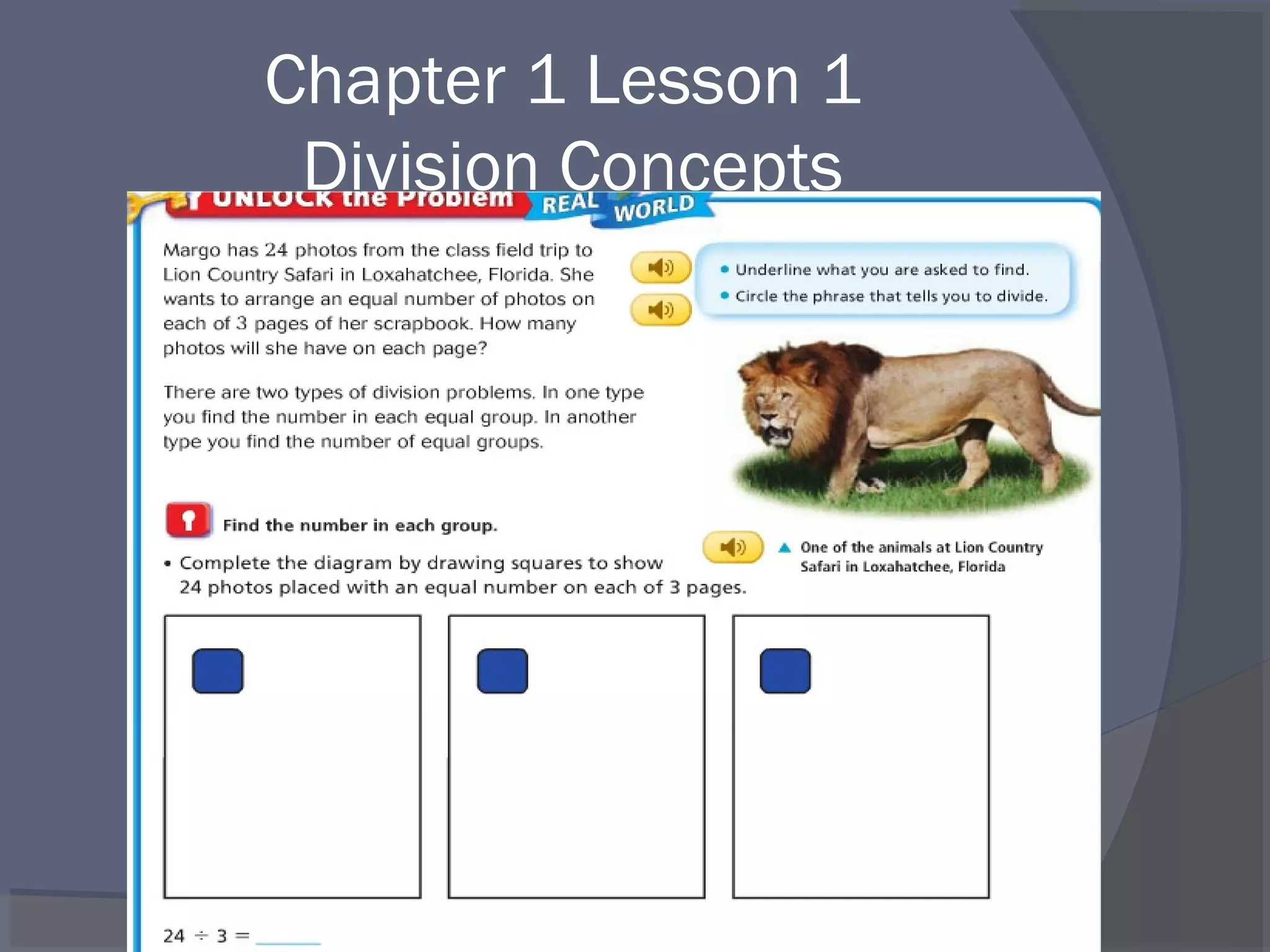
Chapter 1 Lesson 1
 Division Concepts
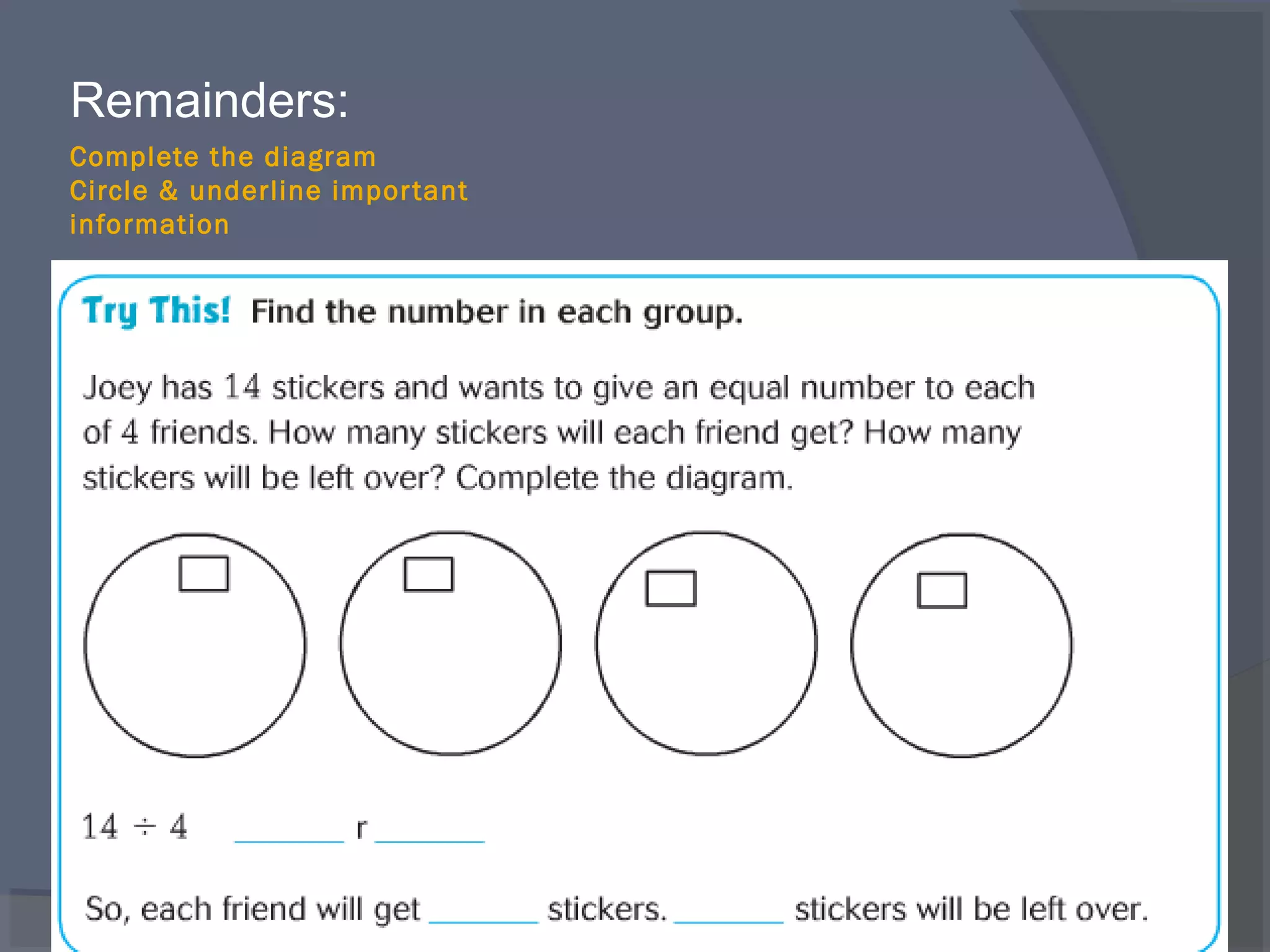
Remainders:
Complete the diagram
Circle & underline impor tant
information
Problem Solving pg.8
             Draw a picture to solve.


14. Lindsey took 40 photos. She wants to
  arrange her photos in a scrapbook, with
  5 photos on each page. How many
  pages will Lindsey need? How many
  photos will Lindsey have left over?
Draw a picture to solve

15. Grace arranges 20 field trip photos
  equally on 4 pages. Dan arranges 18
  photos equally on 3 pages. Who has
  more field trip photos on a page?
Write Math – Journal
  When you divide, how do you know if
   you are finding the number in each
   equal group or the number of equal
                 groups?
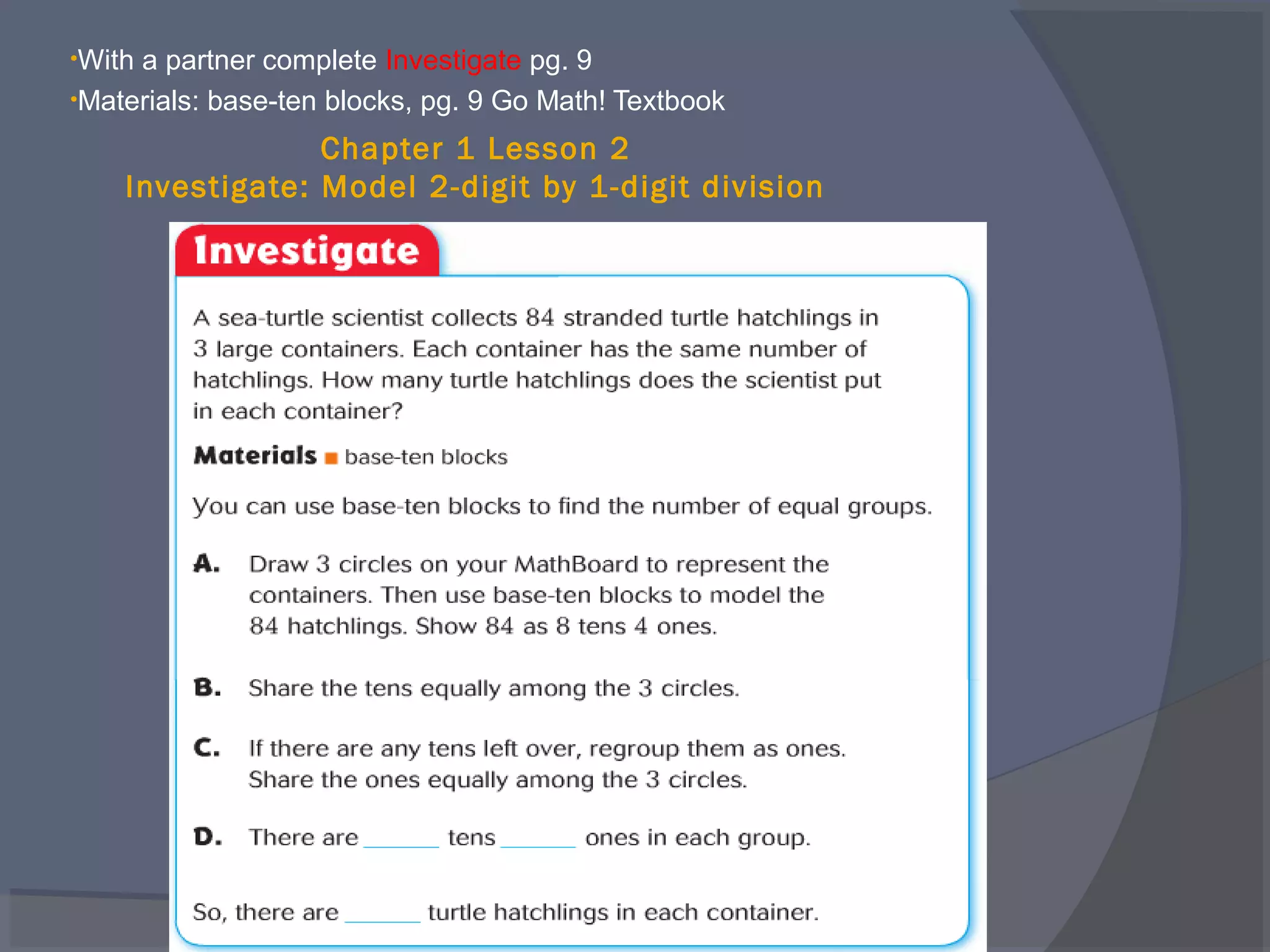
•Witha partner complete Investigate pg. 9
•Materials: base-ten blocks, pg. 9 Go Math! Textbook

                 Chapter 1 Lesson 2
    Investigate: Model 2-digit by 1-digit division
Model Division & Draw a Quick Picture
   Connect pg. 10

    Five types of turtles live in Florida’s waters. They are
    the green turtle, the hawksbill, the Kemp’s ridley, the
    leatherback, and the loggerhead.

    Suppose there are 63 rescued sea turtles. They are
    divided equally among 4 large tanks. Any turtles left
    over are put in a small tank. How many turtles are in
    each large tank? How many are in the small tank?

Use the base-ten blocks to solve.
Then draw a quick picture.

    There are _____ sea turtles in each of the 4 tanks and
    ____ sea turtles in the small tank.
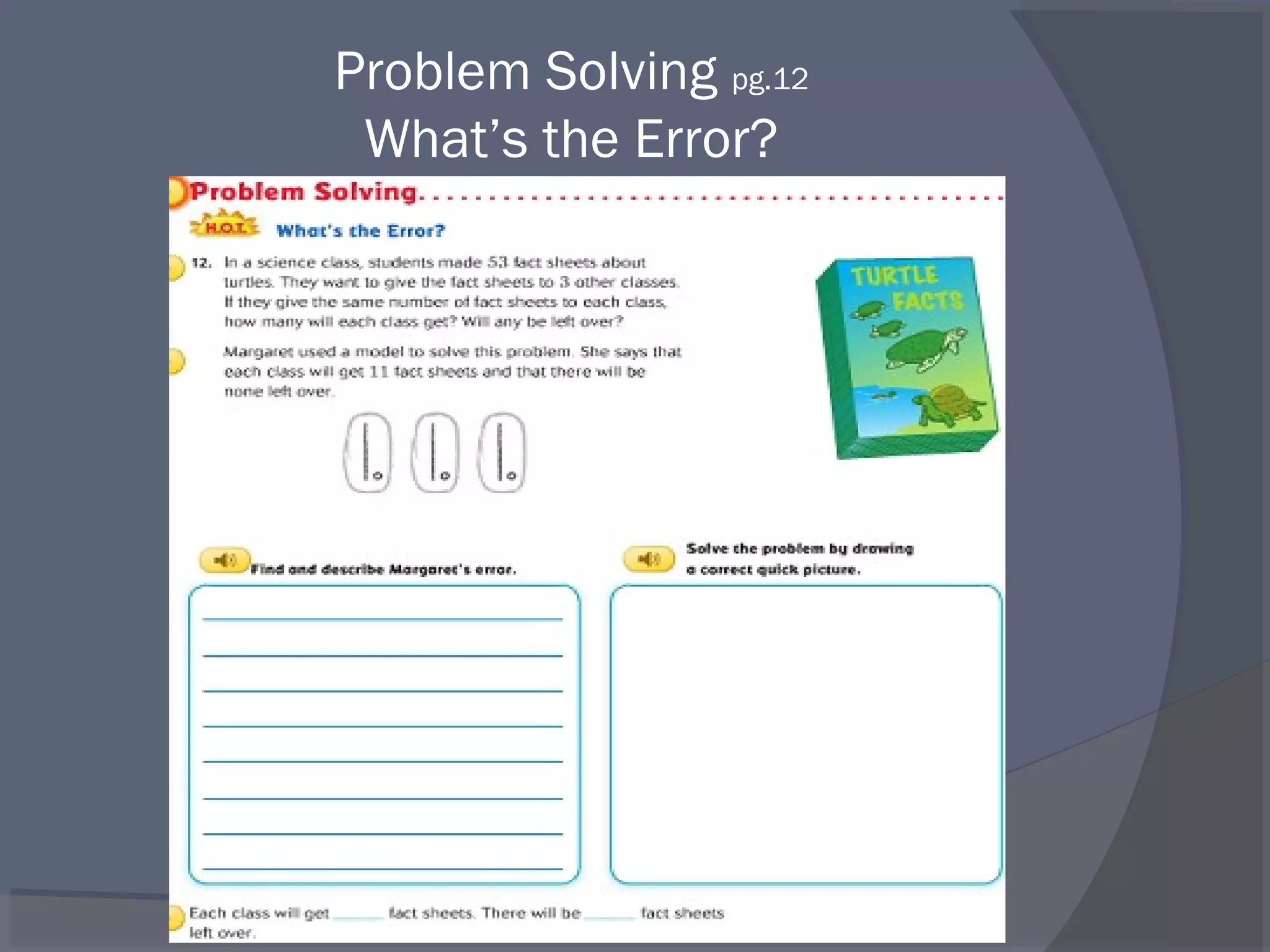
Problem Solving pg.12
 What’s the Error?
Write Math - Journal
   How can you use base-ten blocks to
   model and understand how to divide
           whole numbers?
Chapter 1 Lesson 4
                   Solve a Simpler Problem
                        Division & Multiplication
       Use multiples of the divisor to help you solve a simpler
        problem.

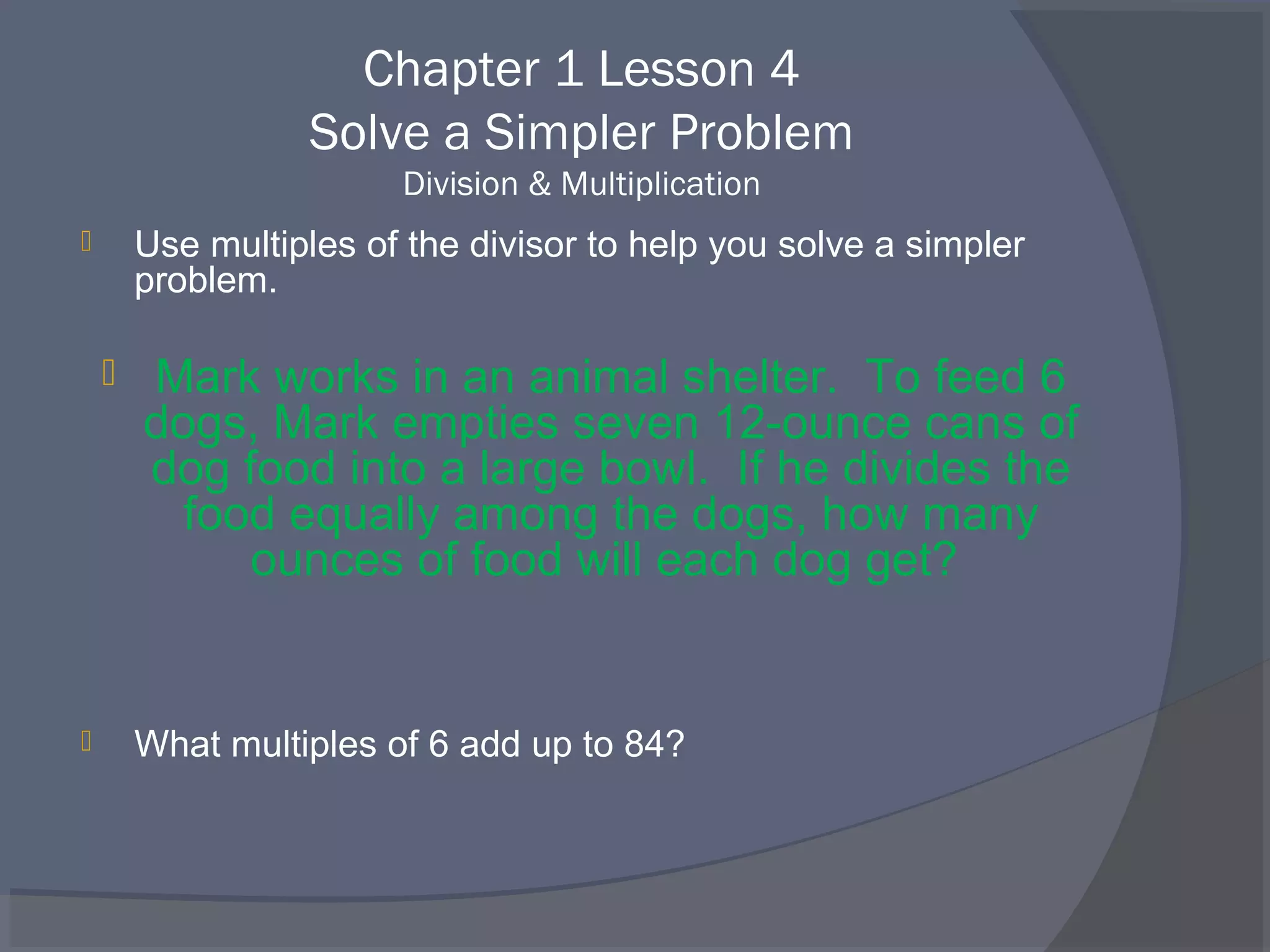
       Mark works in an animal shelter. To feed 6
        dogs, Mark empties seven 12-ounce cans of
        dog food into a large bowl. If he divides the
          food equally among the dogs, how many
             ounces of food will each dog get?


       What multiples of 6 add up to 84?
Solve a simpler problem
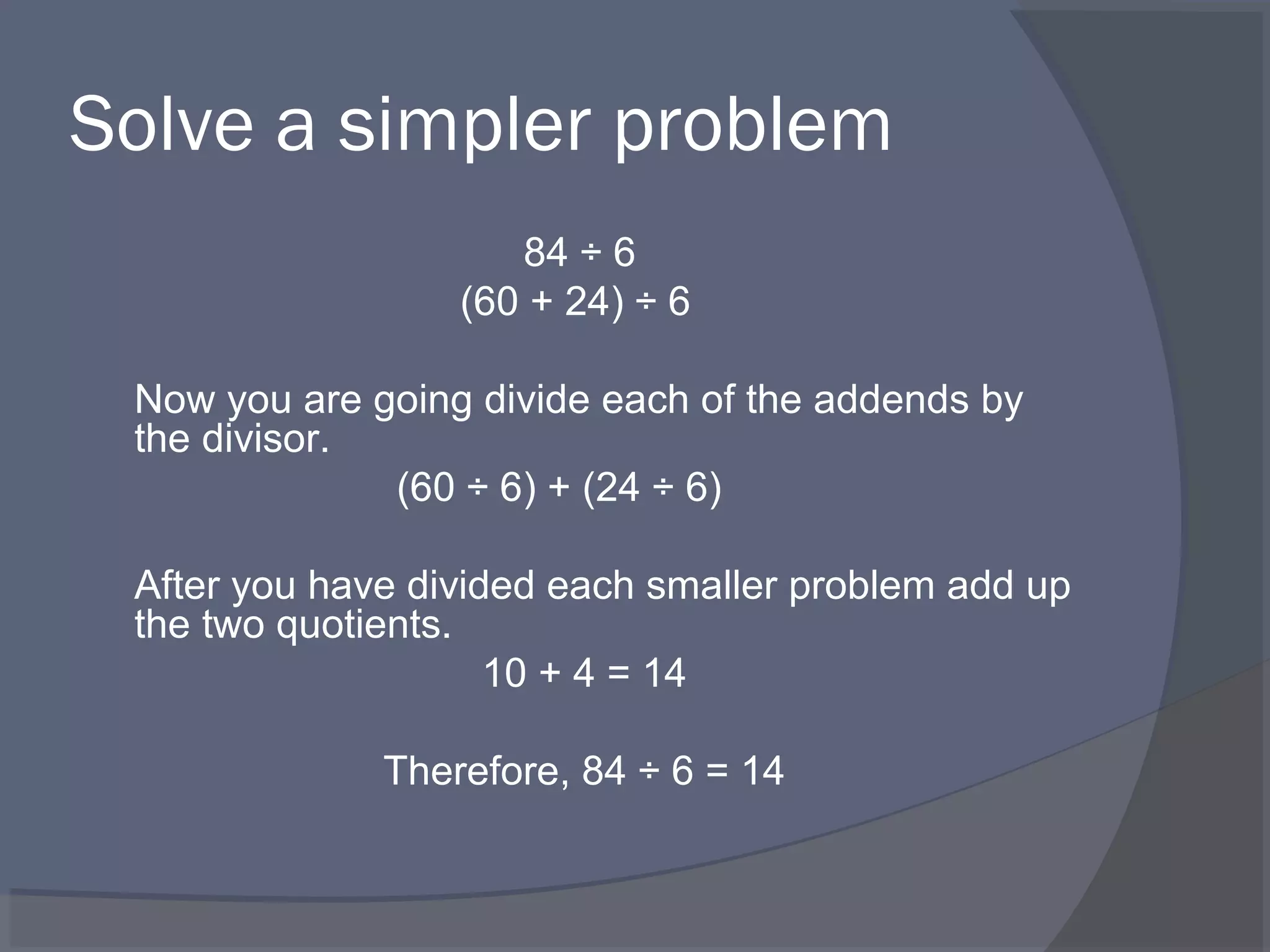
                     84 ÷ 6
                  (60 + 24) ÷ 6

 Now you are going divide each of the addends by
 the divisor.
              (60 ÷ 6) + (24 ÷ 6)

 After you have divided each smaller problem add up
 the two quotients.
                     10 + 4 = 14

              Therefore, 84 ÷ 6 = 14
Rules for solving a simpler division
      problem (distributive property)
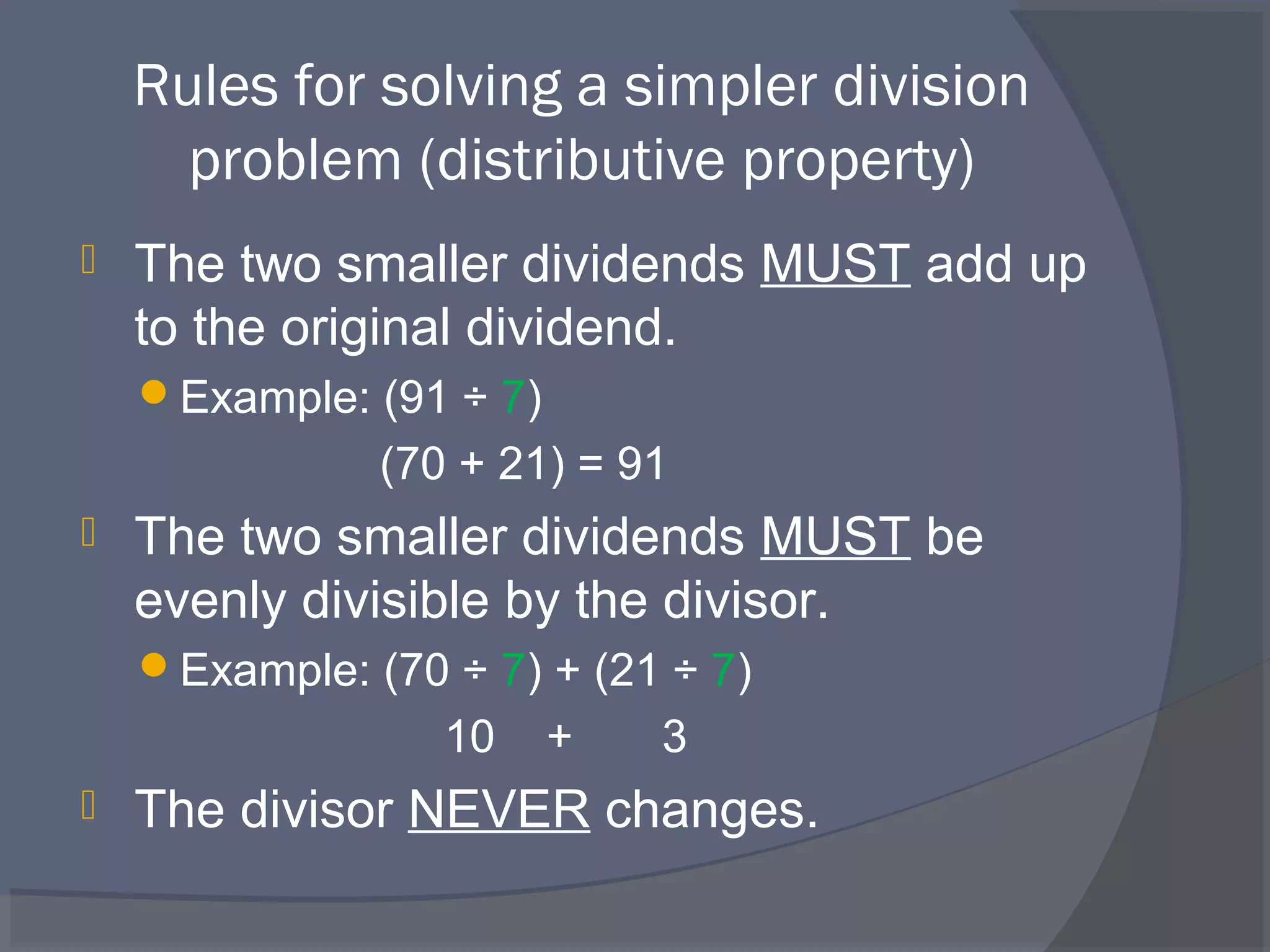
   The two smaller dividends MUST add up
    to the original dividend.
    Example: (91 ÷ 7)
               (70 + 21) = 91
   The two smaller dividends MUST be
    evenly divisible by the divisor.
    Example: (70 ÷ 7) + (21 ÷ 7)
                  10     +   3
   The divisor NEVER changes.
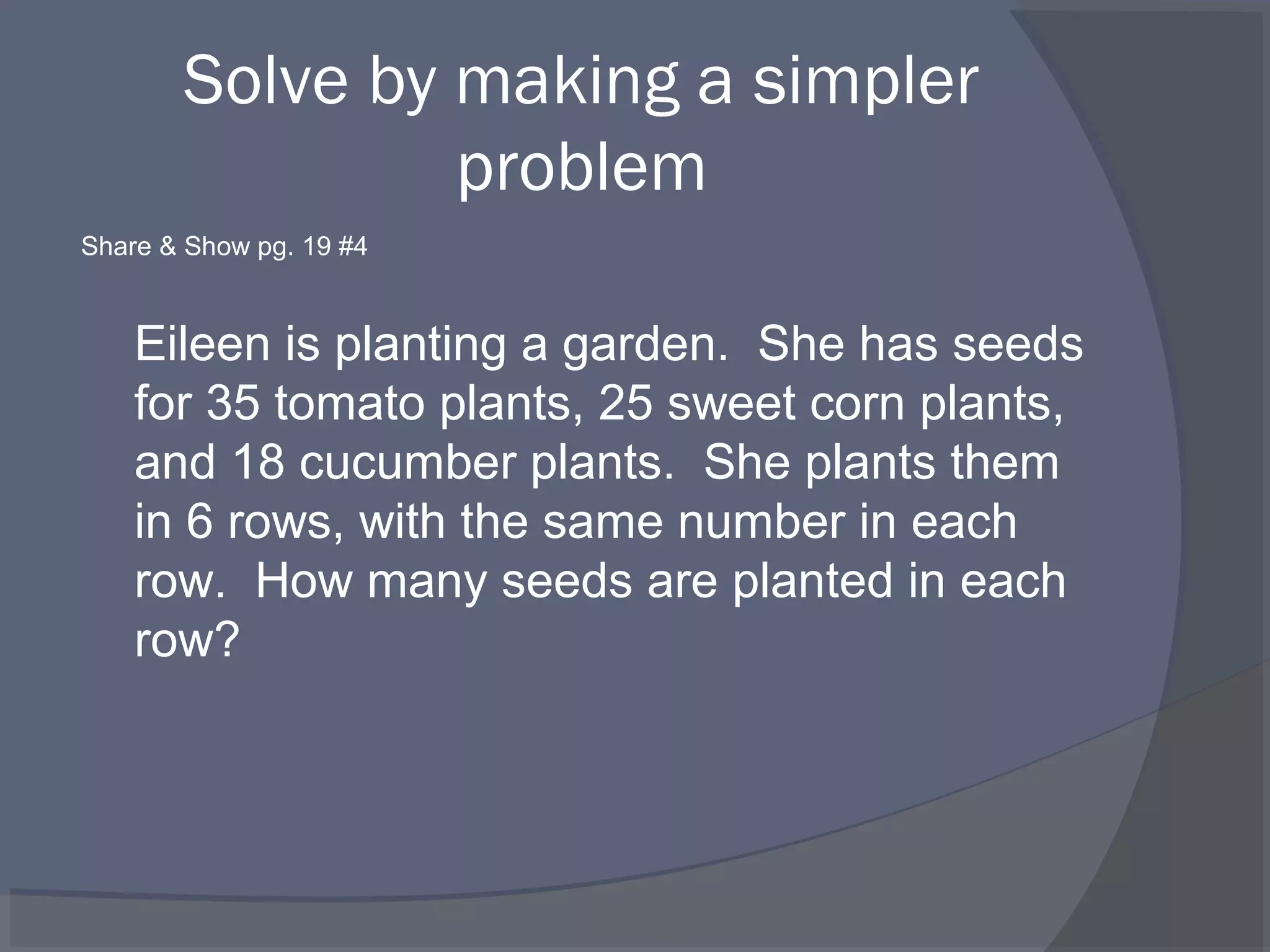
Solve by making a simpler
                problem
Share & Show pg. 19 #4


    Eileen is planting a garden. She has seeds
    for 35 tomato plants, 25 sweet corn plants,
    and 18 cucumber plants. She plants them
    in 6 rows, with the same number in each
    row. How many seeds are planted in each
    row?
Write Math – Journal
 How can solving a simpler problem help
     you to solve a difficult problem?
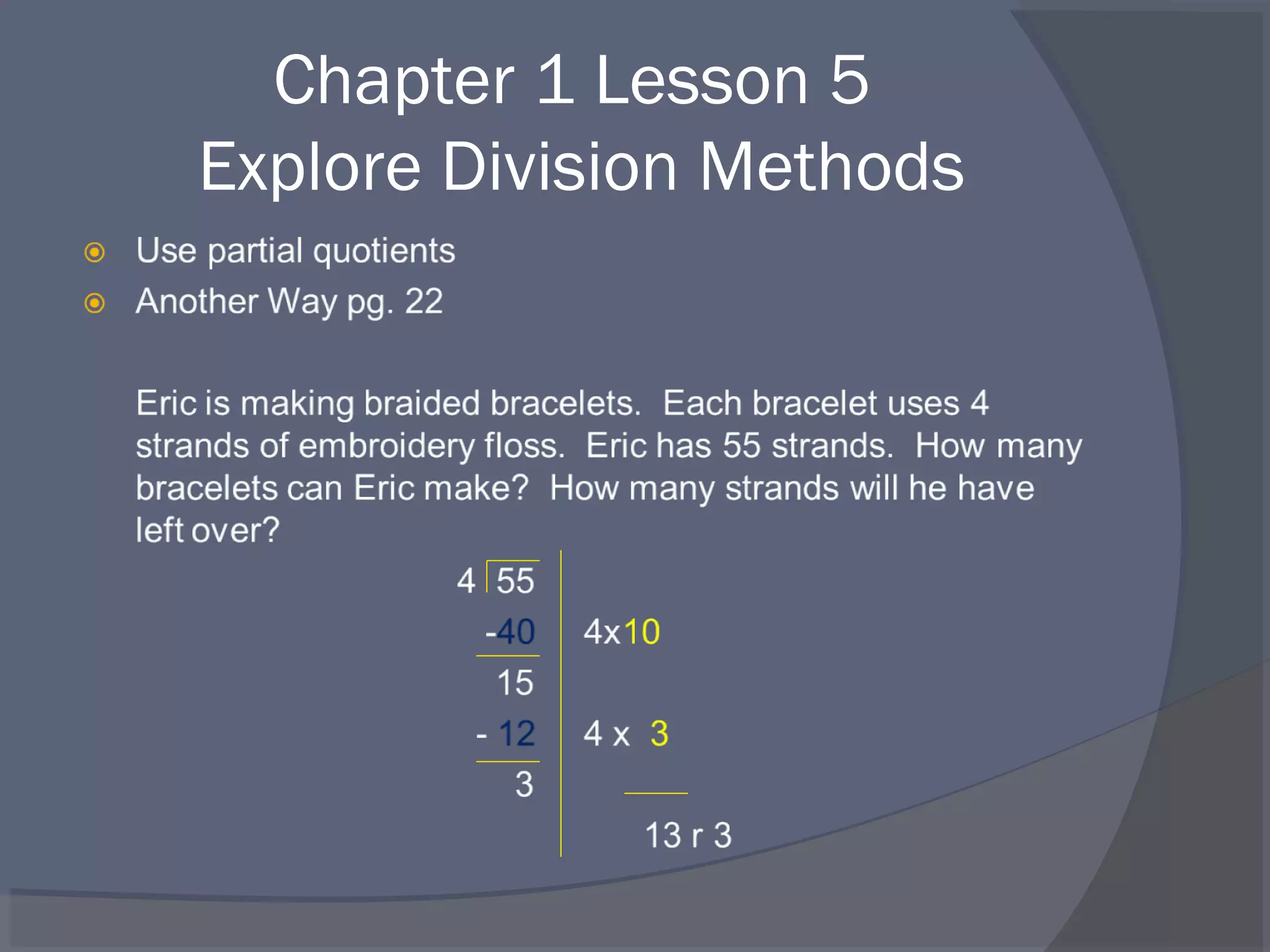
Chapter 1 Lesson 5
Explore Division Methods
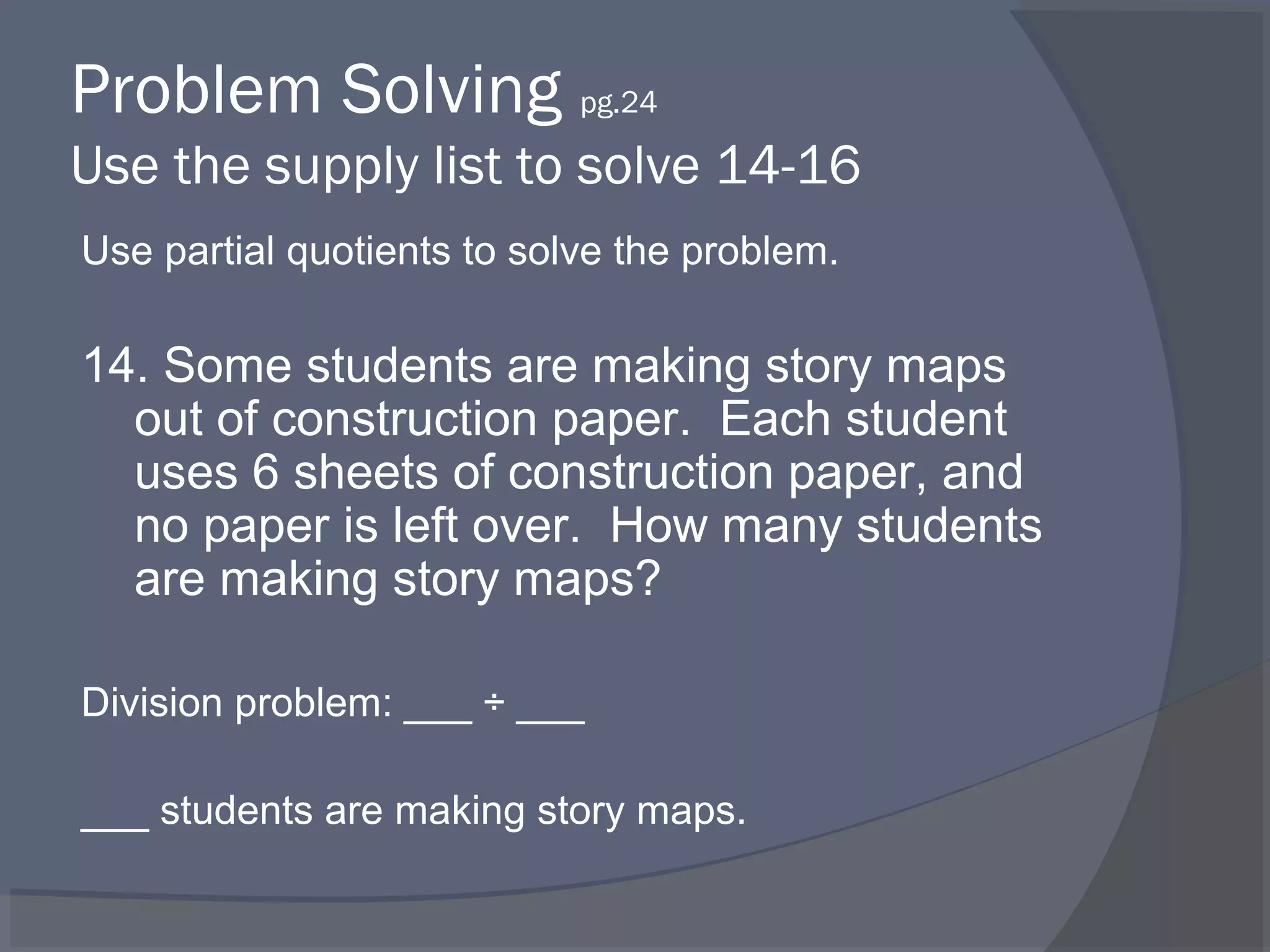
Problem Solving pg.24
Use the supply list to solve 14-16
Use partial quotients to solve the problem.

14. Some students are making story maps
  out of construction paper. Each student
  uses 6 sheets of construction paper, and
  no paper is left over. How many students
  are making story maps?

Division problem: ___ ÷ ___

___ students are making story maps.
Problem Solving pg.24
Use the supply list to solve 14-16
Use partial quotients to solve the problem.


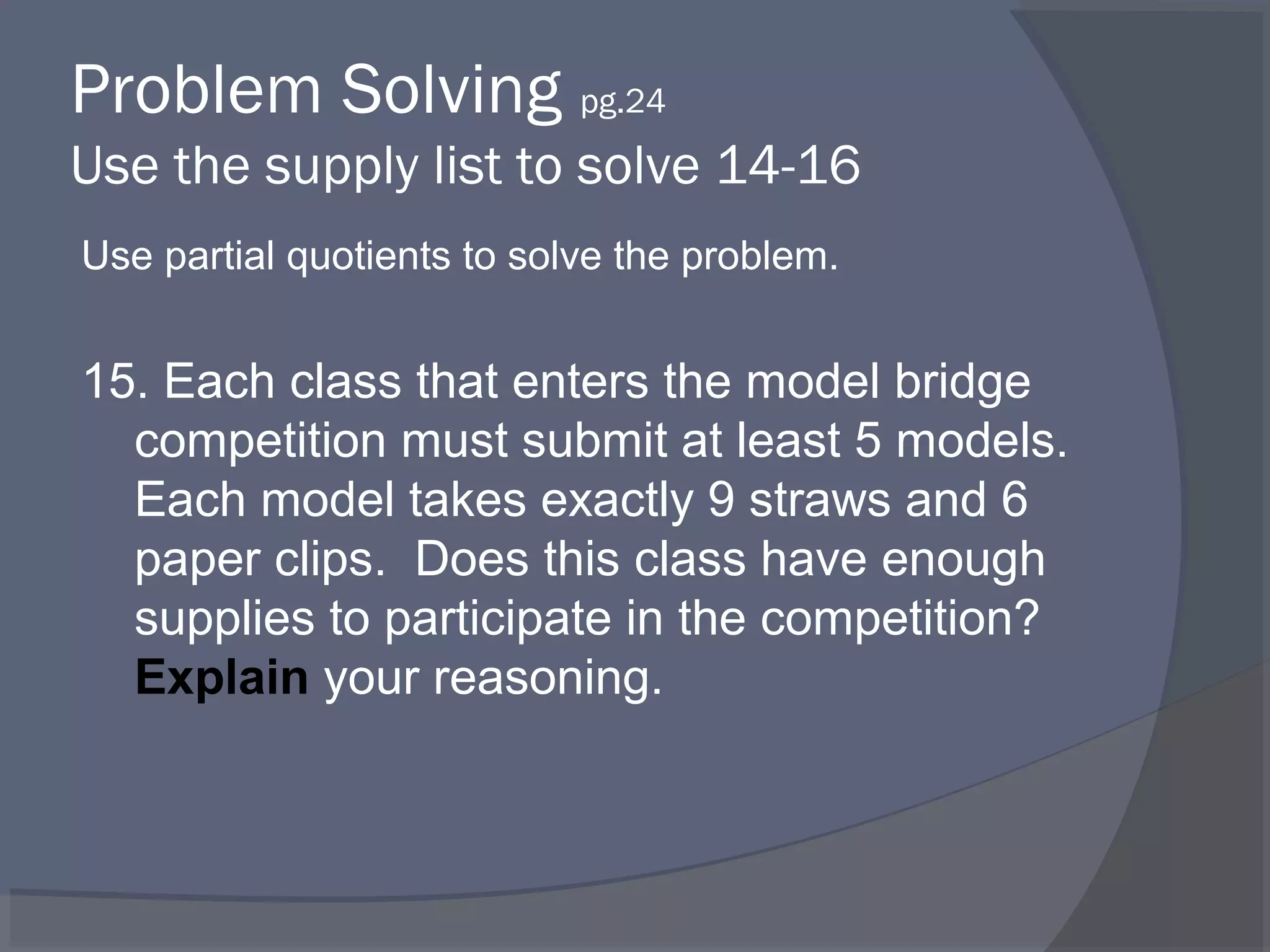
15. Each class that enters the model bridge
  competition must submit at least 5 models.
  Each model takes exactly 9 straws and 6
  paper clips. Does this class have enough
  supplies to participate in the competition?
  Explain your reasoning.
Write Math - Journal
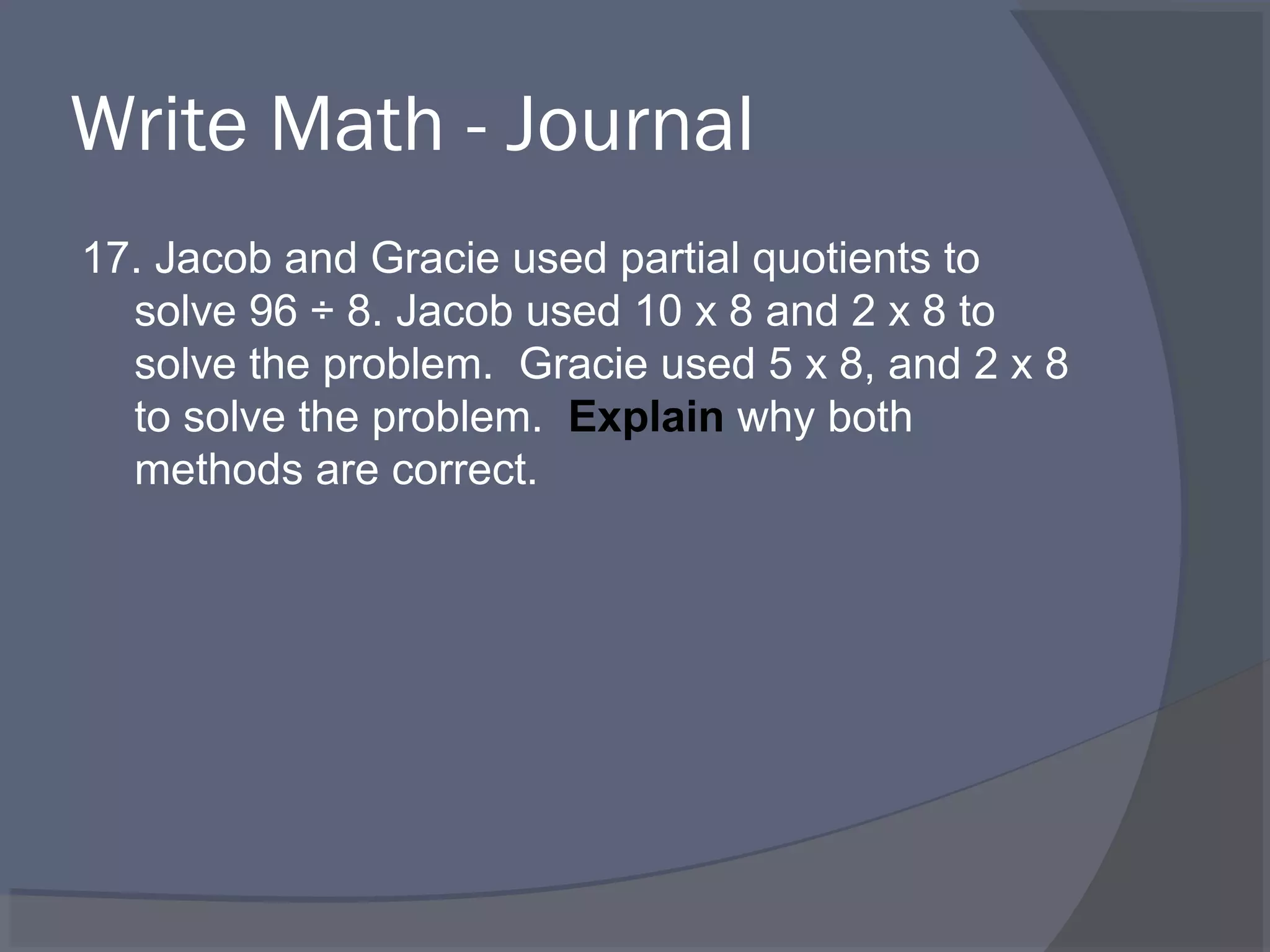
17. Jacob and Gracie used partial quotients to
  solve 96 ÷ 8. Jacob used 10 x 8 and 2 x 8 to
  solve the problem. Gracie used 5 x 8, and 2 x 8
  to solve the problem. Explain why both
  methods are correct.
Chapter 1 Lesson 6
    Estimate Quotients and Use Mental Math
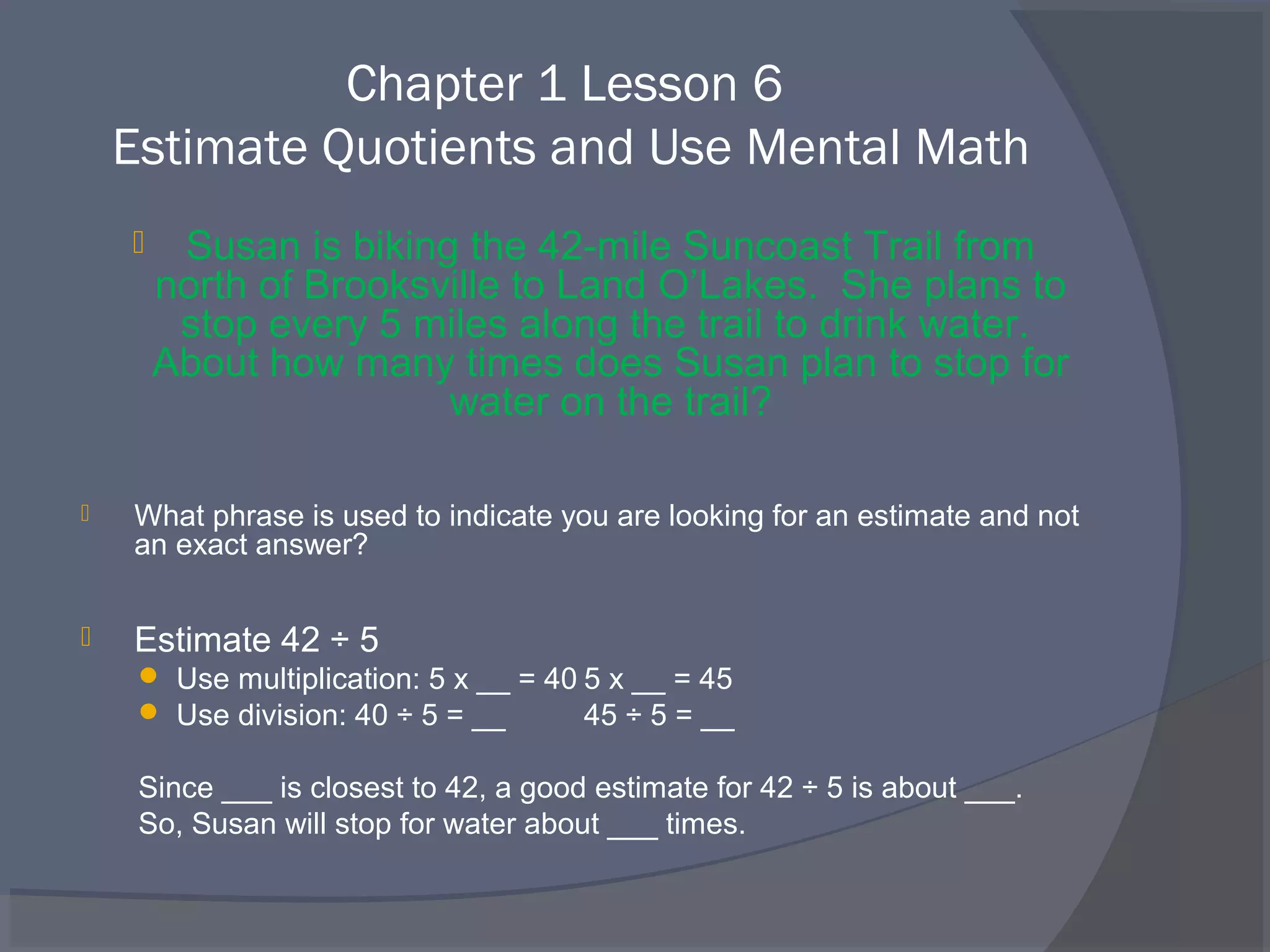
        Susan is biking the 42-mile Suncoast Trail from
        north of Brooksville to Land O’Lakes. She plans to
         stop every 5 miles along the trail to drink water.
        About how many times does Susan plan to stop for
                        water on the trail?

   What phrase is used to indicate you are looking for an estimate and not
    an exact answer?


   Estimate 42 ÷ 5
      Use multiplication: 5 x __ = 40 5 x __ = 45
      Use division: 40 ÷ 5 = __       45 ÷ 5 = __

     Since ___ is closest to 42, a good estimate for 42 ÷ 5 is about ___.
     So, Susan will stop for water about ___ times.
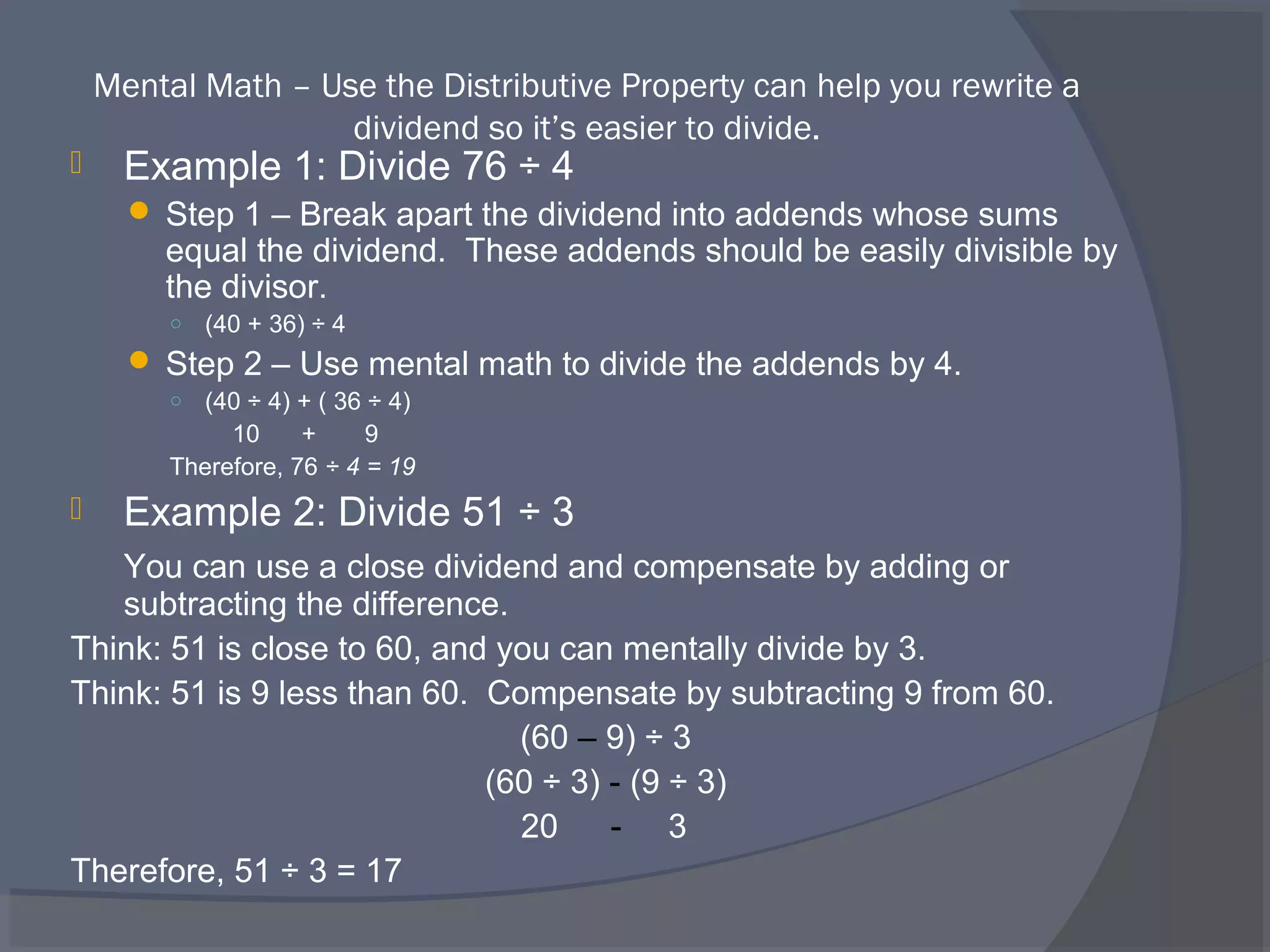
Mental Math – Use the Distributive Property can help you rewrite a
                    dividend so it’s easier to divide.
     Example 1: Divide 76 ÷ 4
       Step 1 – Break apart the dividend into addends whose sums
        equal the dividend. These addends should be easily divisible by
        the divisor.
         ○   (40 + 36) ÷ 4
       Step 2 – Use mental math to divide the addends by 4.
         ○ (40 ÷ 4) + ( 36 ÷ 4)
              10     +     9
         Therefore, 76 ÷ 4 = 19
     Example 2: Divide 51 ÷ 3
   You can use a close dividend and compensate by adding or
   subtracting the difference.
Think: 51 is close to 60, and you can mentally divide by 3.
Think: 51 is 9 less than 60. Compensate by subtracting 9 from 60.
                               (60 – 9) ÷ 3
                             (60 ÷ 3) - (9 ÷ 3)
                               20     - 3
Therefore, 51 ÷ 3 = 17
Problem Solving pg. 30
18. Mrs. Johnson makes 78 cupcakes for the
  fifth-grade classes. She will put the 6
  cupcakes in each of several boxes. How
  many boxes will Mrs. Johnson need for all
  of the cupcakes?

  Write a division problem that can be used
  to solve the problem.

  Solve the problem and explain your
  reasoning.
Write Math – Journal
 How can basic facts and the Distributive
  Property help you estimate a quotient or
      calculate the quotient mentally?
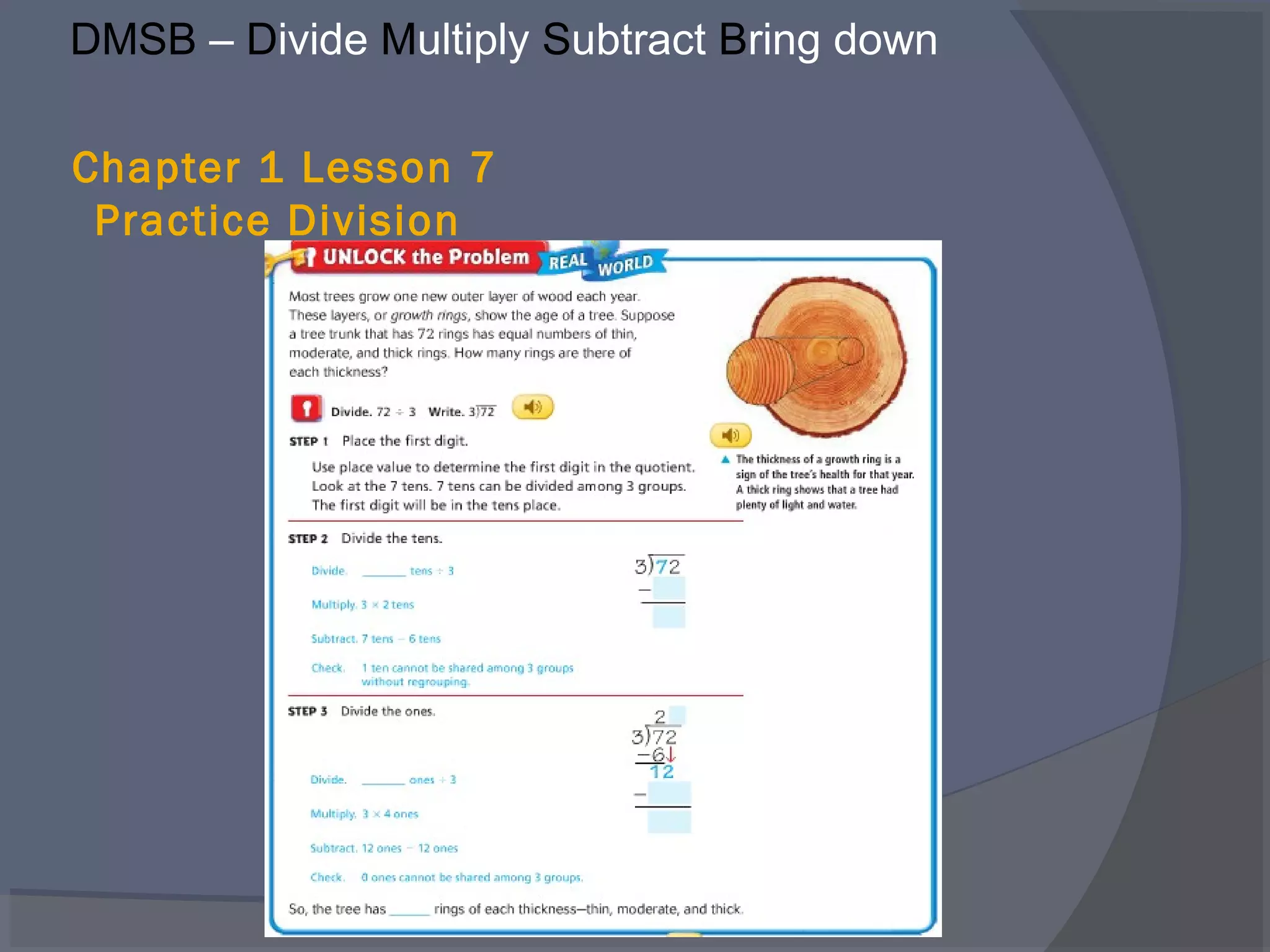
DMSB – Divide Multiply Subtract Bring down

Chapter 1 Lesson 7
 Practice Division
Checking division – use the inverse operation of division

(multiplication) to check your answer to a division problem   .
  To check your answer to a division problem,
  multiply the quotient by the divisor. The product
  should be the dividend.
 Divide: 84 ÷ 7          Divide: 79 ÷ 6


   Check:                     Check:
Unlock the Problem pg. 34
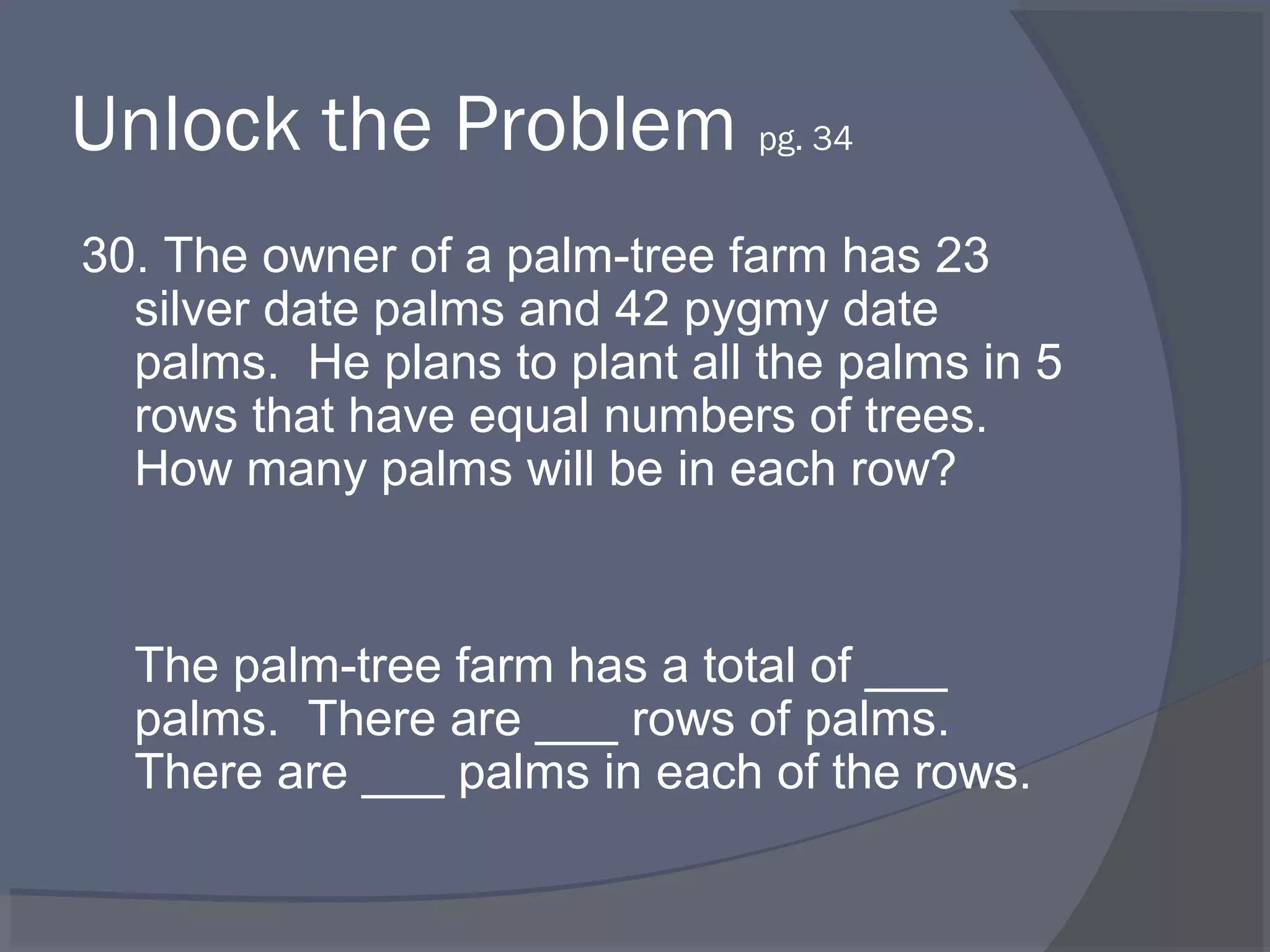
30. The owner of a palm-tree farm has 23
  silver date palms and 42 pygmy date
  palms. He plans to plant all the palms in 5
  rows that have equal numbers of trees.
  How many palms will be in each row?


  The palm-tree farm has a total of ___
  palms. There are ___ rows of palms.
  There are ___ palms in each of the rows.
Write Math – Journal
 How can you use place value to solve a
           division problem?
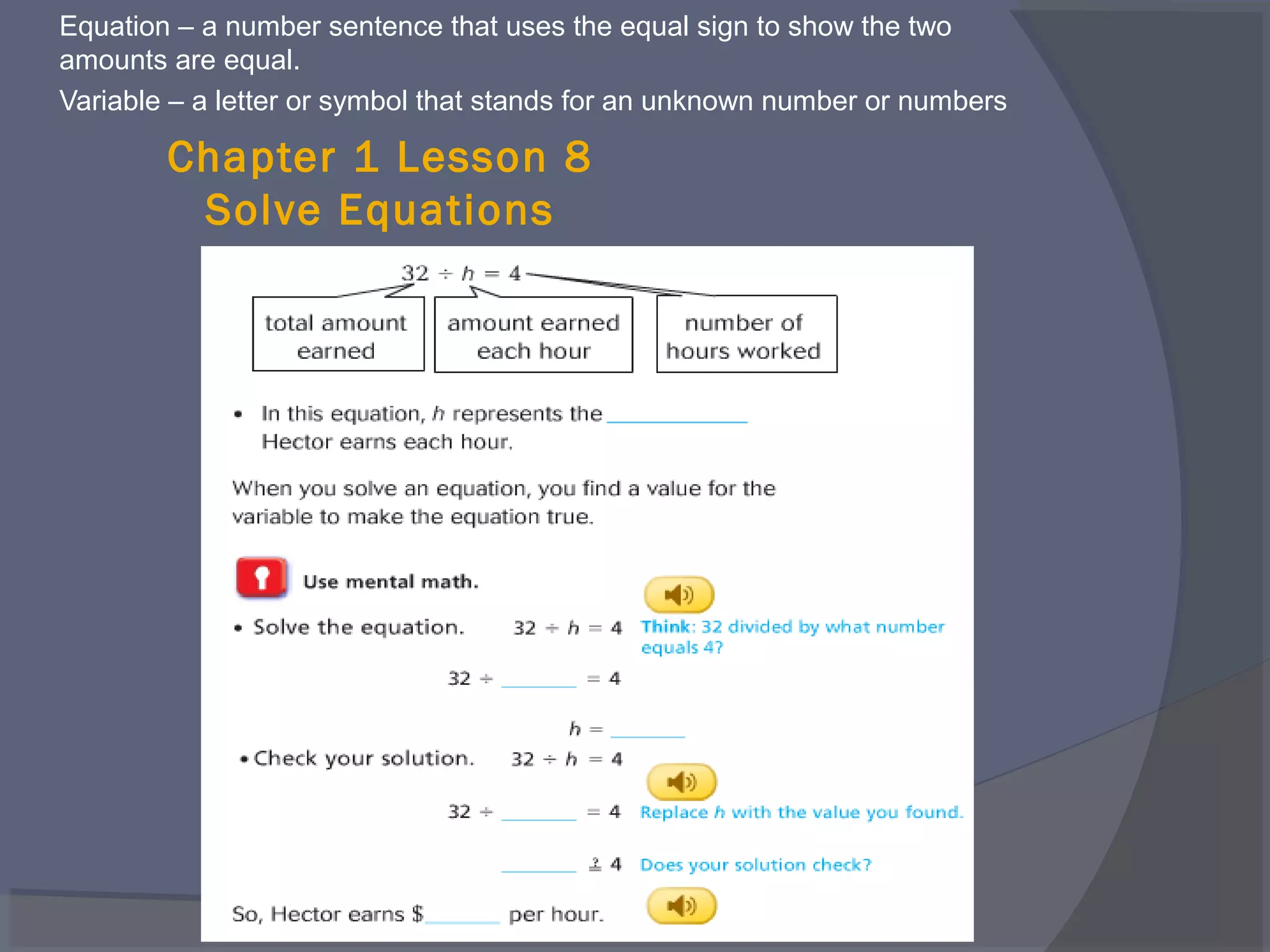
Equation – a number sentence that uses the equal sign to show the two
amounts are equal.
Variable – a letter or symbol that stands for an unknown number or numbers

        Chapter 1 Lesson 8
         Solve Equations
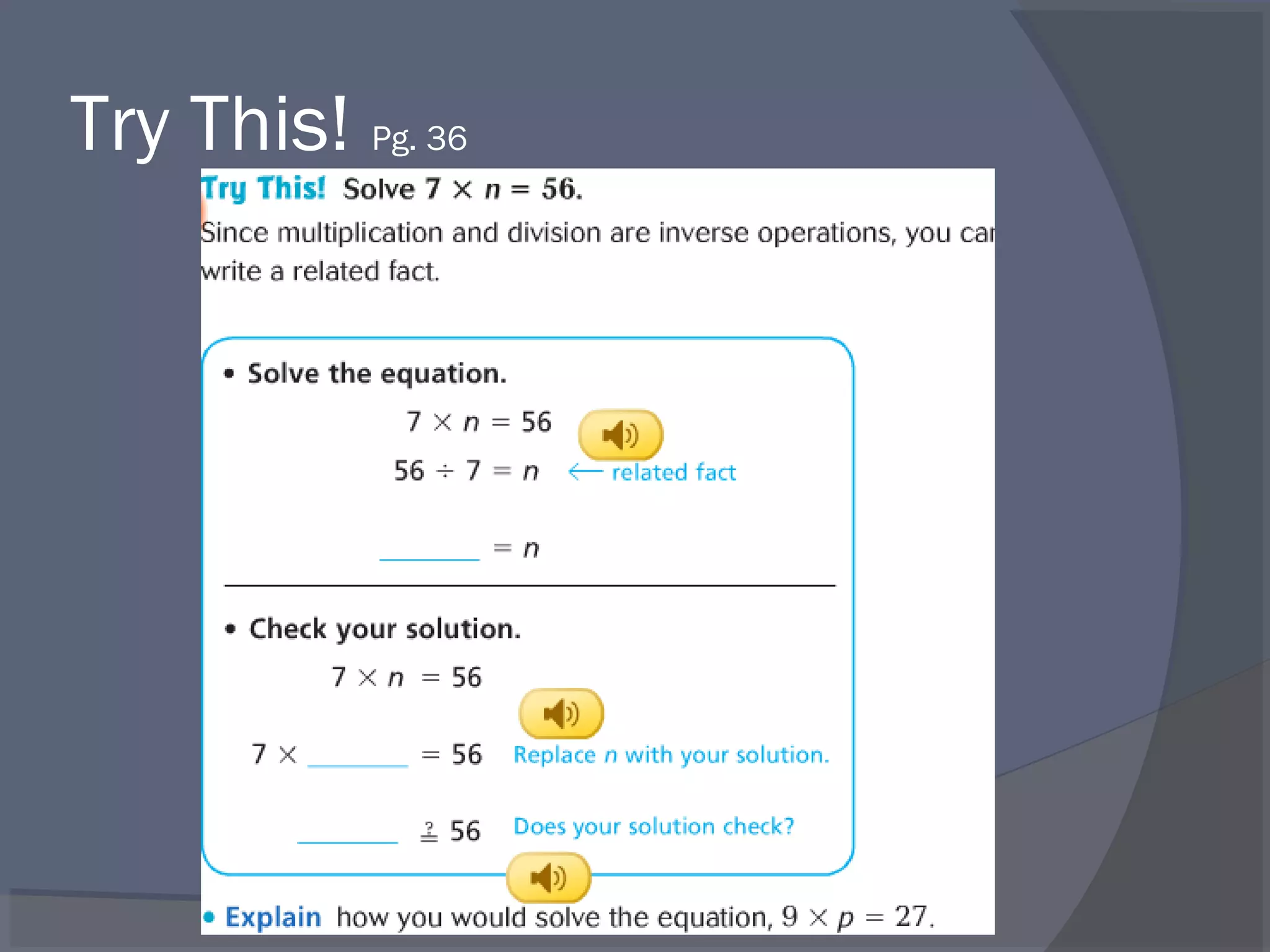
Try This! Pg. 36
Problem Solving pg. 37
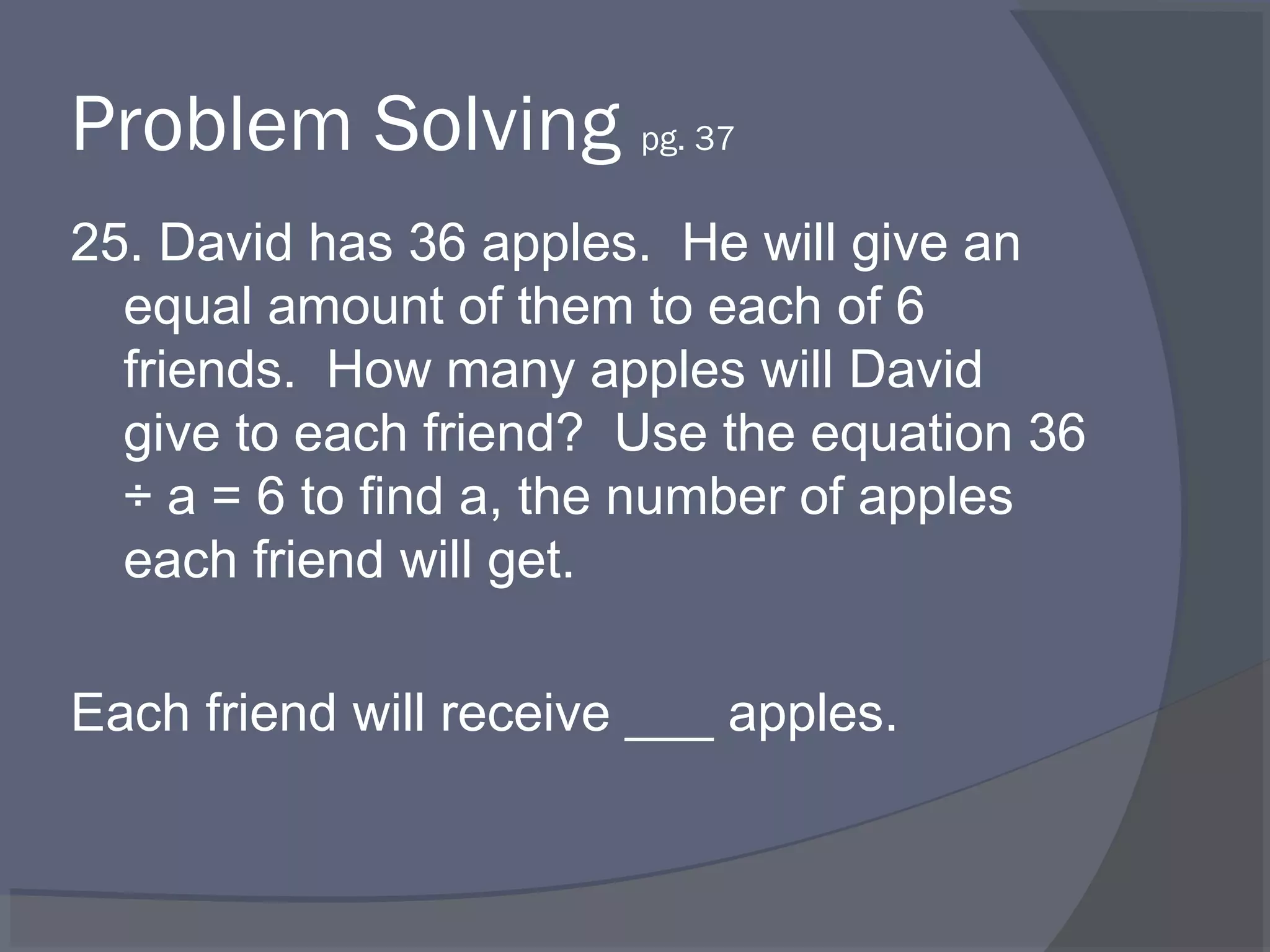
25. David has 36 apples. He will give an
  equal amount of them to each of 6
  friends. How many apples will David
  give to each friend? Use the equation 36
  ÷ a = 6 to find a, the number of apples
  each friend will get.

Each friend will receive ___ apples.
Problem Solving pg. 37
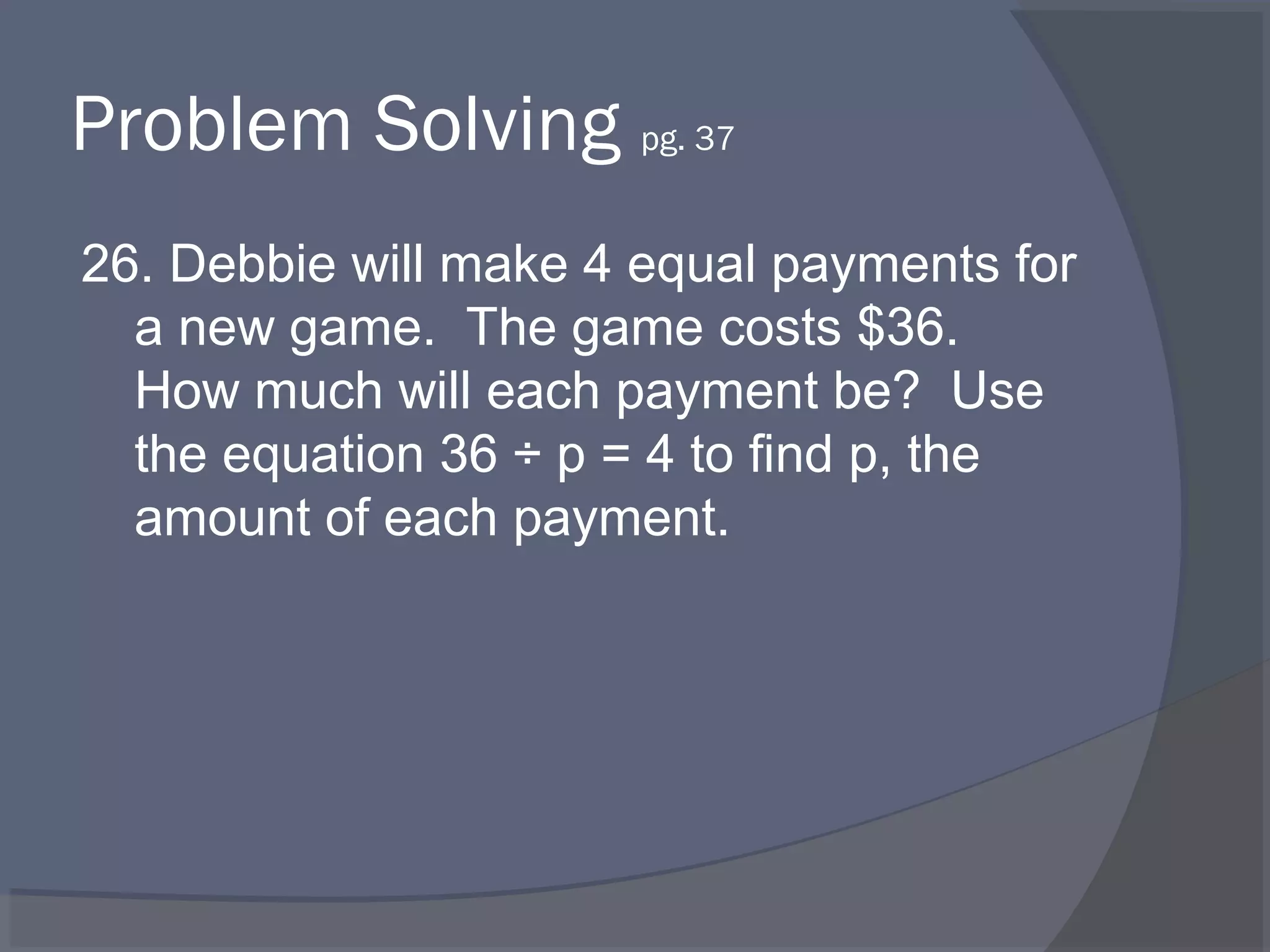
26. Debbie will make 4 equal payments for
  a new game. The game costs $36.
  How much will each payment be? Use
  the equation 36 ÷ p = 4 to find p, the
  amount of each payment.
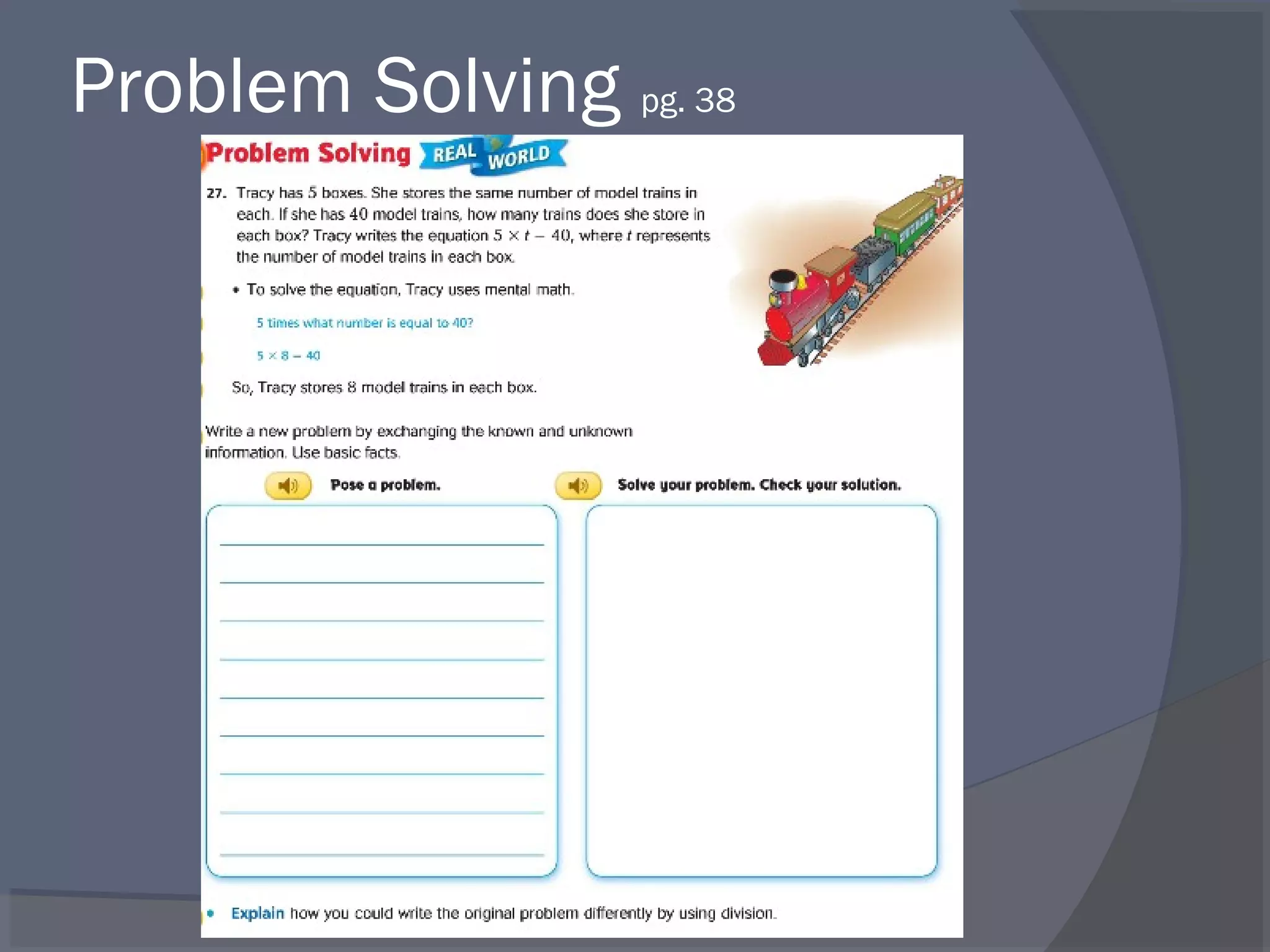
Problem Solving pg. 38
Write Math - Journal
 How can you use mental math to solve a
            division problem?
Chapter 1 Review

Math chapter 1

  • 2.
    Chapter 1: VocabularyWords  Divide - To separate into equal groups; the opposite operation of multiplication  Dividend – Total amount ~ the number being divided in a division problem  Example: 500 ÷ 10 = 50  Divisor – The number that divides the dividend ~ number of equal groups or number in each group  Example: 500 ÷ 10 = 50  Quotient – The answer to a division problem (not including the remainder)  Example: 500 ÷ 10 = 50
  • 3.
    Vocabulary continued  Equation – uses an equal sign to show that two amounts are equal  Inverse Operations – operations that undo one another  Example: multiplication & division; addition & subtraction  Variable – a letter or symbol that stands for one or more numbers  Remainder – the amount left over when a number cannot be divided equally  Example: 501 ÷ 10 = 50 r1
  • 4.
    Vocabulary continued  Distributive Property - The property that states that multiplying a sum by a number is the same as multiplying each addend by the number and then adding the products  Partial Quotients - A method of dividing in which multiples of the divisor are subtracted from the dividend and then the quotients are added together.
  • 5.
    Chapter 1 Lesson1 Division Concepts
  • 6.
    Remainders: Complete the diagram Circle& underline impor tant information
  • 7.
    Problem Solving pg.8 Draw a picture to solve. 14. Lindsey took 40 photos. She wants to arrange her photos in a scrapbook, with 5 photos on each page. How many pages will Lindsey need? How many photos will Lindsey have left over?
  • 8.
    Draw a pictureto solve 15. Grace arranges 20 field trip photos equally on 4 pages. Dan arranges 18 photos equally on 3 pages. Who has more field trip photos on a page?
  • 9.
    Write Math –Journal When you divide, how do you know if you are finding the number in each equal group or the number of equal groups?
  • 10.
    •Witha partner completeInvestigate pg. 9 •Materials: base-ten blocks, pg. 9 Go Math! Textbook Chapter 1 Lesson 2 Investigate: Model 2-digit by 1-digit division
  • 11.
    Model Division &Draw a Quick Picture  Connect pg. 10 Five types of turtles live in Florida’s waters. They are the green turtle, the hawksbill, the Kemp’s ridley, the leatherback, and the loggerhead. Suppose there are 63 rescued sea turtles. They are divided equally among 4 large tanks. Any turtles left over are put in a small tank. How many turtles are in each large tank? How many are in the small tank? Use the base-ten blocks to solve. Then draw a quick picture. There are _____ sea turtles in each of the 4 tanks and ____ sea turtles in the small tank.
  • 12.
    Problem Solving pg.12 What’s the Error?
  • 13.
    Write Math -Journal How can you use base-ten blocks to model and understand how to divide whole numbers?
  • 14.
    Chapter 1 Lesson4 Solve a Simpler Problem Division & Multiplication  Use multiples of the divisor to help you solve a simpler problem.  Mark works in an animal shelter. To feed 6 dogs, Mark empties seven 12-ounce cans of dog food into a large bowl. If he divides the food equally among the dogs, how many ounces of food will each dog get?  What multiples of 6 add up to 84?
  • 15.
    Solve a simplerproblem 84 ÷ 6 (60 + 24) ÷ 6 Now you are going divide each of the addends by the divisor. (60 ÷ 6) + (24 ÷ 6) After you have divided each smaller problem add up the two quotients. 10 + 4 = 14 Therefore, 84 ÷ 6 = 14
  • 16.
    Rules for solvinga simpler division problem (distributive property)  The two smaller dividends MUST add up to the original dividend. Example: (91 ÷ 7) (70 + 21) = 91  The two smaller dividends MUST be evenly divisible by the divisor. Example: (70 ÷ 7) + (21 ÷ 7) 10 + 3  The divisor NEVER changes.
  • 17.
    Solve by makinga simpler problem Share & Show pg. 19 #4 Eileen is planting a garden. She has seeds for 35 tomato plants, 25 sweet corn plants, and 18 cucumber plants. She plants them in 6 rows, with the same number in each row. How many seeds are planted in each row?
  • 18.
    Write Math –Journal How can solving a simpler problem help you to solve a difficult problem?
  • 19.
    Chapter 1 Lesson5 Explore Division Methods
  • 20.
    Problem Solving pg.24 Usethe supply list to solve 14-16 Use partial quotients to solve the problem. 14. Some students are making story maps out of construction paper. Each student uses 6 sheets of construction paper, and no paper is left over. How many students are making story maps? Division problem: ___ ÷ ___ ___ students are making story maps.
  • 21.
    Problem Solving pg.24 Usethe supply list to solve 14-16 Use partial quotients to solve the problem. 15. Each class that enters the model bridge competition must submit at least 5 models. Each model takes exactly 9 straws and 6 paper clips. Does this class have enough supplies to participate in the competition? Explain your reasoning.
  • 22.
    Write Math -Journal 17. Jacob and Gracie used partial quotients to solve 96 ÷ 8. Jacob used 10 x 8 and 2 x 8 to solve the problem. Gracie used 5 x 8, and 2 x 8 to solve the problem. Explain why both methods are correct.
  • 23.
    Chapter 1 Lesson6 Estimate Quotients and Use Mental Math  Susan is biking the 42-mile Suncoast Trail from north of Brooksville to Land O’Lakes. She plans to stop every 5 miles along the trail to drink water. About how many times does Susan plan to stop for water on the trail?  What phrase is used to indicate you are looking for an estimate and not an exact answer?  Estimate 42 ÷ 5  Use multiplication: 5 x __ = 40 5 x __ = 45  Use division: 40 ÷ 5 = __ 45 ÷ 5 = __ Since ___ is closest to 42, a good estimate for 42 ÷ 5 is about ___. So, Susan will stop for water about ___ times.
  • 24.
    Mental Math –Use the Distributive Property can help you rewrite a dividend so it’s easier to divide.  Example 1: Divide 76 ÷ 4  Step 1 – Break apart the dividend into addends whose sums equal the dividend. These addends should be easily divisible by the divisor. ○ (40 + 36) ÷ 4  Step 2 – Use mental math to divide the addends by 4. ○ (40 ÷ 4) + ( 36 ÷ 4) 10 + 9 Therefore, 76 ÷ 4 = 19  Example 2: Divide 51 ÷ 3 You can use a close dividend and compensate by adding or subtracting the difference. Think: 51 is close to 60, and you can mentally divide by 3. Think: 51 is 9 less than 60. Compensate by subtracting 9 from 60. (60 – 9) ÷ 3 (60 ÷ 3) - (9 ÷ 3) 20 - 3 Therefore, 51 ÷ 3 = 17
  • 25.
    Problem Solving pg.30 18. Mrs. Johnson makes 78 cupcakes for the fifth-grade classes. She will put the 6 cupcakes in each of several boxes. How many boxes will Mrs. Johnson need for all of the cupcakes? Write a division problem that can be used to solve the problem. Solve the problem and explain your reasoning.
  • 26.
    Write Math –Journal How can basic facts and the Distributive Property help you estimate a quotient or calculate the quotient mentally?
  • 27.
    DMSB – DivideMultiply Subtract Bring down Chapter 1 Lesson 7 Practice Division
  • 28.
    Checking division –use the inverse operation of division (multiplication) to check your answer to a division problem .  To check your answer to a division problem, multiply the quotient by the divisor. The product should be the dividend.  Divide: 84 ÷ 7 Divide: 79 ÷ 6  Check: Check:
  • 29.
    Unlock the Problempg. 34 30. The owner of a palm-tree farm has 23 silver date palms and 42 pygmy date palms. He plans to plant all the palms in 5 rows that have equal numbers of trees. How many palms will be in each row? The palm-tree farm has a total of ___ palms. There are ___ rows of palms. There are ___ palms in each of the rows.
  • 30.
    Write Math –Journal How can you use place value to solve a division problem?
  • 31.
    Equation – anumber sentence that uses the equal sign to show the two amounts are equal. Variable – a letter or symbol that stands for an unknown number or numbers Chapter 1 Lesson 8 Solve Equations
  • 32.
  • 33.
    Problem Solving pg.37 25. David has 36 apples. He will give an equal amount of them to each of 6 friends. How many apples will David give to each friend? Use the equation 36 ÷ a = 6 to find a, the number of apples each friend will get. Each friend will receive ___ apples.
  • 34.
    Problem Solving pg.37 26. Debbie will make 4 equal payments for a new game. The game costs $36. How much will each payment be? Use the equation 36 ÷ p = 4 to find p, the amount of each payment.
  • 35.
  • 36.
    Write Math -Journal How can you use mental math to solve a division problem?
  • 37.