By: Jasmine, Katherine and Sherita
CHD 120
As adults we use abstract MATH
everyday. We use math when we are
making a purchase or measuring are food
as we prepare dinner. We even use math
when planning our days, but did you
ever stop to think how we learned these
abstract math skills?
The Foundational Stepping Stone
 Learning begins at an early age for our early learners.
 Our early learners begin to learn foundational math skills in early education
such as: counting, shapes, and time.
 Our early mathmaticians learns these foundational concepts by exploring
there world.
 As they move along academically they build on top of these foundational
stones to what we know as abstract math.
Teaching Math with your Everyday Materials
 In early education, our little learners learn best by exploring there world.
 For example a small toddler, begins learning their shapes by picking up
different items and examining them like a block. Our four year olds, may
begin to use those same blocks to count. Our five year olds, can then use the
same blocks to recognize their shapes.
 The point is simple every day items can begin to teach our children their
basic math skills, as we add in instruction they can learn even more.
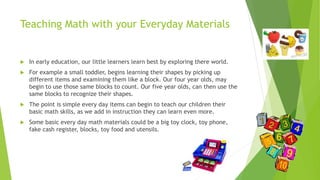
 Some basic every day math materials could be a big toy clock, toy phone,
fake cash register, blocks, toy food and utensils.
Math and other Activities
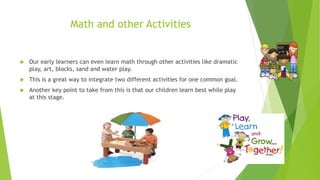
 Our early learners can even learn math through other activities like dramatic
play, art, blocks, sand and water play.
 This is a great way to integrate two different activities for one common goal.
 Another key point to take from this is that our children learn best while play
at this stage.
Inclusion… Everyone needs Math
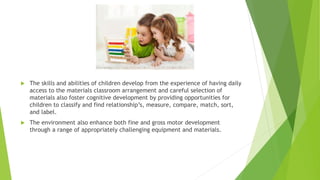
 When teaching our early learners we want to be sure to include everyone
regardless of culture, race, disability, and etc.
 Make sure your math center is easily assessable. Have some toys in a place
where even children in a wheel chair can reach them.
 Label the different toys in different languages. For example, the container
with the blocks label it blocks as well as el bloque for a Spanish student. Of
course you can use other languages than Spanish.
 Incorporate toys from different part of the world.
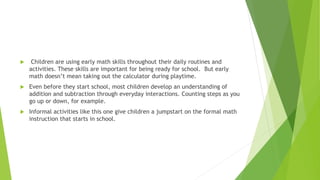
 The skills and abilities of children develop from the experience of having daily
access to the materials classroom arrangement and careful selection of
materials also foster cognitive development by providing opportunities for
children to classify and find relationship’s, measure, compare, match, sort,
and label.
 The environment also enhance both fine and gross motor development
through a range of appropriately challenging equipment and materials.
 Children are using early math skills throughout their daily routines and
activities. These skills are important for being ready for school. But early
math doesn’t mean taking out the calculator during playtime.
 Even before they start school, most children develop an understanding of
addition and subtraction through everyday interactions. Counting steps as you
go up or down, for example.
 Informal activities like this one give children a jumpstart on the formal math
instruction that starts in school.
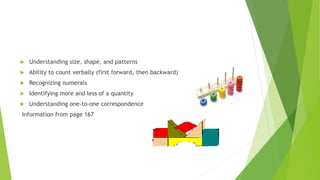
 Understanding size, shape, and patterns
 Ability to count verbally (first forward, then backward)
 Recognizing numerals
 Identifying more and less of a quantity
 Understanding one-to-one correspondence
Information from page 167
 One of the main roles that teachers should fulfill is to facilitate learning.
 In other words, our task is to make the process of learning easier for students to
accomplish.
 This does not mean that our curriculum should be watered down or our standards
should be lowered.
 Facilitating learning goes beyond our own classroom doors.
 If we as teachers spend our time delivering material without an eye towards
how what they are learning fits into the student's overall educational
experience, our results will be so good if Students will leave our class little
better than when the year began.
 Instead, we want students to leave use with a greater capacity and desire to
learn on their own.
 Providing students with choice to build a greater interest in the topics being
taught.
 Making real world connections to make the learning more meaningful
 Making cross-curricular connections so the information is not learned in isolation.
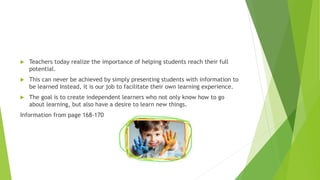
 Teachers today realize the importance of helping students reach their full
potential.
 This can never be achieved by simply presenting students with information to
be learned Instead, it is our job to facilitate their own learning experience.
 The goal is to create independent learners who not only know how to go
about learning, but also have a desire to learn new things.
Information from page 168-170
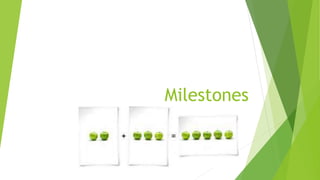
Milestones
Domain: APPROACH TO LEARNING
STRAND 1:REASONING AND PROBLEM
SOLVING
 A8: RECOGNIIZE AND SOLVE PROBLEMS INDEPENTLY THROUGH TRIAL AND ERROR
AND BY INTERACTING WITH PEERS AND ADULTS
 STRATEGIES : 48 months or order
1. ENCOURAGING CHILD TO TRY NEW APPROACHES WITHOUT INTERVENING (pg. 10)
2. TALKING WITH CHILD ABOUT ACTIVIES AND PLANS (pg. 8)
Domain: Approaches to Learning
Strand 2: Persistence
 A7. Increase persistence in activities despite frustration or disappointment.
(pg.7)
 Strategies: 48 months or older
1. Encouraging child to try things in new ways. (pg. 10)
2. Using open-ended questions and descriptive language (pg. 10)
Domain: Cognition and General Knowledge
Strand 1: Learning about Mathematical
Concept
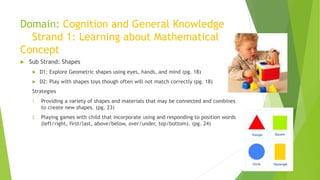
 Sub Strand: Shapes
 D1: Explore Geometric shapes using eyes, hands, and mind (pg. 18)
 D2: Play with shapes toys though often will not match correctly (pg. 18)
Strategies
1. Providing a variety of shapes and materials that may be connected and combines
to create new shapes. (pg. 23)
2. Playing games with child that incorporate using and responding to position words
(left/right, first/last, above/below, over/under, top/bottom). (pg. 24)
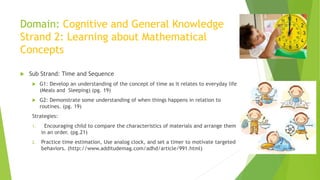
Domain: Cognitive and General Knowledge
Strand 2: Learning about Mathematical
Concepts
 Sub Strand: Time and Sequence
 G1: Develop an understanding of the concept of time as it relates to everyday life
(Meals and Sleeping) (pg. 19)
 G2: Demonstrate some understanding of when things happens in relation to
routines. (pg. 19)
Strategies:
1. Encouraging child to compare the characteristics of materials and arrange them
in an order. (pg.21)
2. Practice time estimation, Use analog clock, and set a timer to motivate targeted
behaviors. (http://www.additudemag.com/adhd/article/991.html)
All Milestone
information from
Book: Milestones of Child Development

Math

  • 1.
    By: Jasmine, Katherineand Sherita CHD 120
  • 2.
    As adults weuse abstract MATH everyday. We use math when we are making a purchase or measuring are food as we prepare dinner. We even use math when planning our days, but did you ever stop to think how we learned these abstract math skills?
  • 3.
    The Foundational SteppingStone  Learning begins at an early age for our early learners.  Our early learners begin to learn foundational math skills in early education such as: counting, shapes, and time.  Our early mathmaticians learns these foundational concepts by exploring there world.  As they move along academically they build on top of these foundational stones to what we know as abstract math.
  • 4.
    Teaching Math withyour Everyday Materials  In early education, our little learners learn best by exploring there world.  For example a small toddler, begins learning their shapes by picking up different items and examining them like a block. Our four year olds, may begin to use those same blocks to count. Our five year olds, can then use the same blocks to recognize their shapes.  The point is simple every day items can begin to teach our children their basic math skills, as we add in instruction they can learn even more.  Some basic every day math materials could be a big toy clock, toy phone, fake cash register, blocks, toy food and utensils.
  • 5.
    Math and otherActivities  Our early learners can even learn math through other activities like dramatic play, art, blocks, sand and water play.  This is a great way to integrate two different activities for one common goal.  Another key point to take from this is that our children learn best while play at this stage.
  • 6.
    Inclusion… Everyone needsMath  When teaching our early learners we want to be sure to include everyone regardless of culture, race, disability, and etc.  Make sure your math center is easily assessable. Have some toys in a place where even children in a wheel chair can reach them.  Label the different toys in different languages. For example, the container with the blocks label it blocks as well as el bloque for a Spanish student. Of course you can use other languages than Spanish.  Incorporate toys from different part of the world.
  • 7.
     The skillsand abilities of children develop from the experience of having daily access to the materials classroom arrangement and careful selection of materials also foster cognitive development by providing opportunities for children to classify and find relationship’s, measure, compare, match, sort, and label.  The environment also enhance both fine and gross motor development through a range of appropriately challenging equipment and materials.
  • 8.
     Children areusing early math skills throughout their daily routines and activities. These skills are important for being ready for school. But early math doesn’t mean taking out the calculator during playtime.  Even before they start school, most children develop an understanding of addition and subtraction through everyday interactions. Counting steps as you go up or down, for example.  Informal activities like this one give children a jumpstart on the formal math instruction that starts in school.
  • 9.
     Understanding size,shape, and patterns  Ability to count verbally (first forward, then backward)  Recognizing numerals  Identifying more and less of a quantity  Understanding one-to-one correspondence Information from page 167
  • 10.
     One ofthe main roles that teachers should fulfill is to facilitate learning.  In other words, our task is to make the process of learning easier for students to accomplish.  This does not mean that our curriculum should be watered down or our standards should be lowered.  Facilitating learning goes beyond our own classroom doors.
  • 11.
     If weas teachers spend our time delivering material without an eye towards how what they are learning fits into the student's overall educational experience, our results will be so good if Students will leave our class little better than when the year began.  Instead, we want students to leave use with a greater capacity and desire to learn on their own.  Providing students with choice to build a greater interest in the topics being taught.  Making real world connections to make the learning more meaningful  Making cross-curricular connections so the information is not learned in isolation.
  • 12.
     Teachers todayrealize the importance of helping students reach their full potential.  This can never be achieved by simply presenting students with information to be learned Instead, it is our job to facilitate their own learning experience.  The goal is to create independent learners who not only know how to go about learning, but also have a desire to learn new things. Information from page 168-170
  • 13.
  • 14.
    Domain: APPROACH TOLEARNING STRAND 1:REASONING AND PROBLEM SOLVING  A8: RECOGNIIZE AND SOLVE PROBLEMS INDEPENTLY THROUGH TRIAL AND ERROR AND BY INTERACTING WITH PEERS AND ADULTS  STRATEGIES : 48 months or order 1. ENCOURAGING CHILD TO TRY NEW APPROACHES WITHOUT INTERVENING (pg. 10) 2. TALKING WITH CHILD ABOUT ACTIVIES AND PLANS (pg. 8)
  • 15.
    Domain: Approaches toLearning Strand 2: Persistence  A7. Increase persistence in activities despite frustration or disappointment. (pg.7)  Strategies: 48 months or older 1. Encouraging child to try things in new ways. (pg. 10) 2. Using open-ended questions and descriptive language (pg. 10)
  • 16.
    Domain: Cognition andGeneral Knowledge Strand 1: Learning about Mathematical Concept  Sub Strand: Shapes  D1: Explore Geometric shapes using eyes, hands, and mind (pg. 18)  D2: Play with shapes toys though often will not match correctly (pg. 18) Strategies 1. Providing a variety of shapes and materials that may be connected and combines to create new shapes. (pg. 23) 2. Playing games with child that incorporate using and responding to position words (left/right, first/last, above/below, over/under, top/bottom). (pg. 24)
  • 17.
    Domain: Cognitive andGeneral Knowledge Strand 2: Learning about Mathematical Concepts  Sub Strand: Time and Sequence  G1: Develop an understanding of the concept of time as it relates to everyday life (Meals and Sleeping) (pg. 19)  G2: Demonstrate some understanding of when things happens in relation to routines. (pg. 19) Strategies: 1. Encouraging child to compare the characteristics of materials and arrange them in an order. (pg.21) 2. Practice time estimation, Use analog clock, and set a timer to motivate targeted behaviors. (http://www.additudemag.com/adhd/article/991.html)
  • 18.
    All Milestone information from Book:Milestones of Child Development