On Teaching and Learning
Mathematics :
Developing & Assessing Math
Skills
Prof. Leonor Ercillo Diaz, PhD.
UP College of Education
Outline of the Session
How do the K-3 children learn Mathematics?
What do they have to learn in Mathematics?
(a look into standards, content &
competencies)
How do we teach and assess Mathematics
skills?
How do Kids Really Learn Math
Is Math a set of
answers to
questions?
Is Math a process of
investigation and
exploration? Are kids
allowed to actively work
with materials & ideas?
Is short-term
success the goal?
Do we aim for long term
understanding?
How do Kids Really Learn Math
Is there much rote
learning involved?
Are we allowing kids
to think and figure
things out?
Is the goal for future
application?
Is our purpose
immediate
application?
Are the steps in
solving specified by
the teacher?
Are the students also
allowed to discover the
steps?
Learning Theories with Implications
for Math Instruction (Hatfield, et.al. 1997)
Learning is Action
Learning is Reaction
Learning is Process
Learning Theories with Implications for
Math Instruction (Hatfield, et.al. 1997)
Learning is Action
Cognitive/Constructivist
Bruner - Modes of Reality
Enactive - action on reality on concrete
ways w/o the need for imagery, inference,
or words
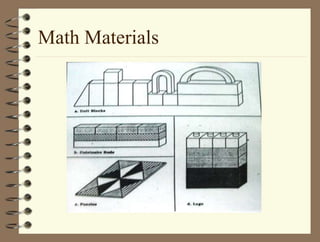
Math Materials
Learning Theories with Implications for
Math Instruction (Hatfield, et.al. 1997)
Learning is Action
Cognitive/Constructivist
Bruner - Modes of Reality
Enactive
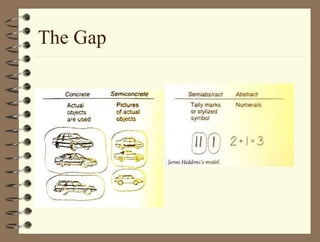
Iconic – pictorial need to represent reality;
internal imagery that stands for a concept
Symbolic –abstract, arbitrary systems of
thought
The Gap
Learning Theories with Implications for
Math Instruction (Hatfield, et.al. 1997)
Learning is Action
Cognitive/Constructivist
Vygotsky
 Zone of Proximal Development
The area where the child cannot solve a
problem alone but can be successful
under adult guidance or in collaboration
with a more abled peer.
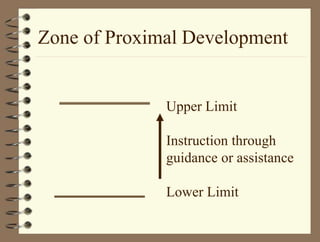
Zone of Proximal Development
Upper Limit
Instruction through
guidance or assistance
Lower Limit
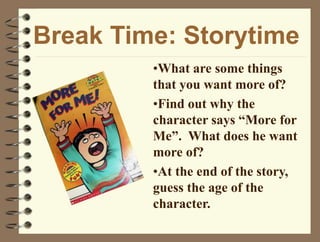
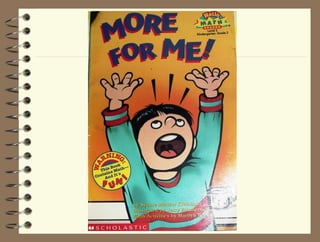
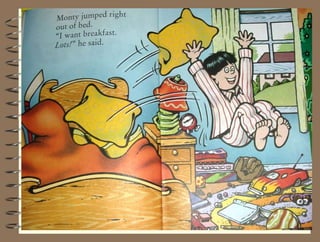
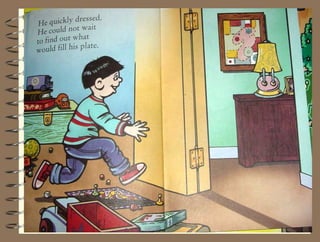
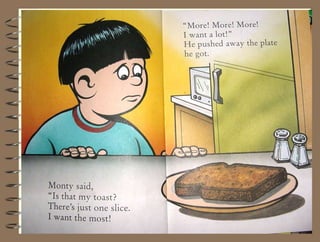
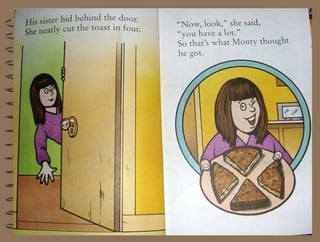
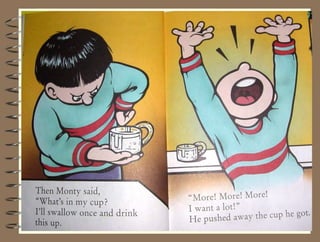
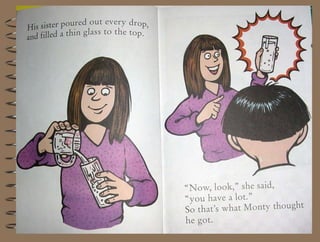
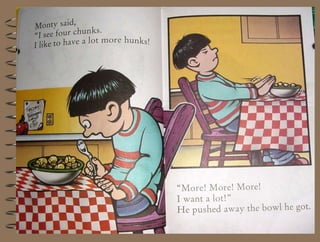
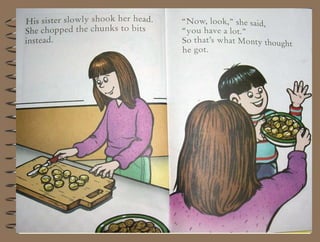
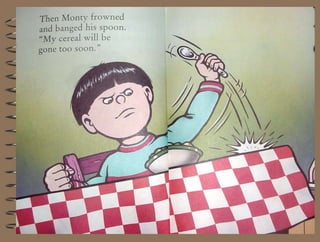
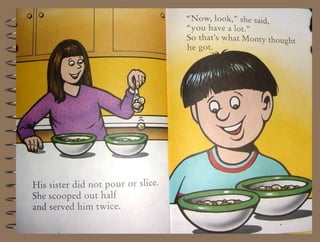
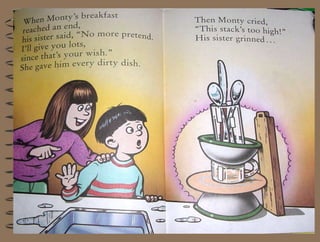
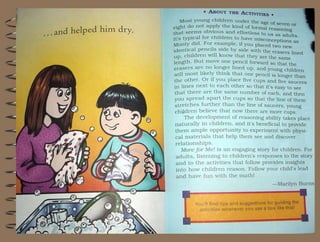
Break Time: Storytime
•What are some things
that you want more of?
•Find out why the
character says “More for
Me”. What does he want
more of?
•At the end of the story,
guess the age of the
character.
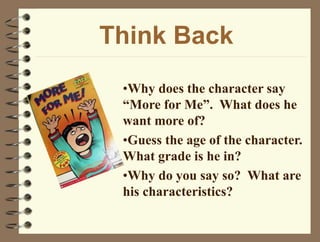
Think Back
•Why does the character say
“More for Me”. What does he
want more of?
•Guess the age of the character.
What grade is he in?
•Why do you say so? What are
his characteristics?
Learning Theories with Implications for
Math Instruction (Hatfield, et.al. 1997)
Learning is Action
Cognitive/Constructivist (Piaget)
Stages of Development
Sensorimotor – actions on objects
Preoperations – actions on reality
Concrete operations -
Formal Operations
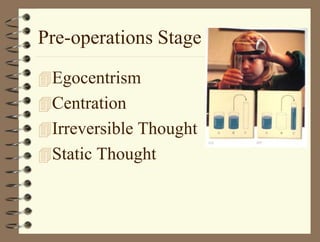
Pre-operations Stage
Egocentrism
Centration
Irreversible Thought
Static Thought
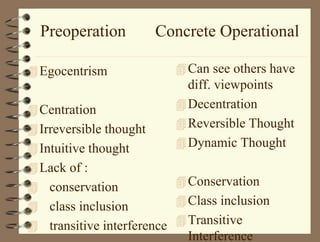
Preoperation Concrete Operational
Egocentrism
Centration
Irreversible thought
Intuitive thought
Lack of :
 conservation
 class inclusion
 transitive interference
Can see others have
diff. viewpoints
Decentration
Reversible Thought
Dynamic Thought
Conservation
Class inclusion
Transitive
Interference
Learning Theories with Implications for
Math Instruction (Hatfield, et.al. 1997)
Learning is Reaction
Behaviorist
Reinforcement Theory
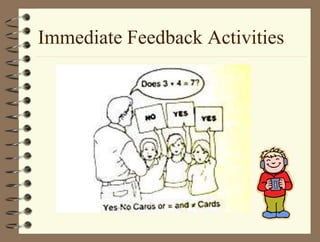
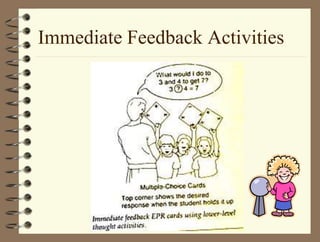
Immediate feedback
Programmed learning
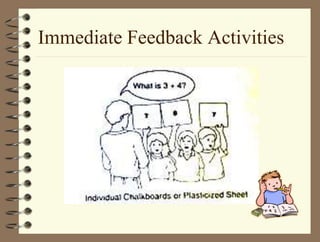
Immediate Feedback Activities
Information Processing
How we encode, store and retrieve
information
Thought Processing
Learning Styles
Rewind Time!

•Which of the
next two
activities do
your pupils
answer easier?
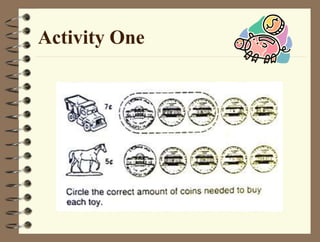
Activity One
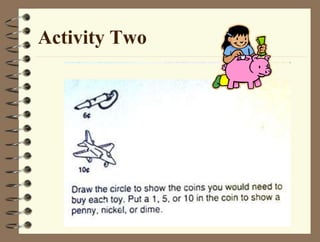
Activity Two
Information Processing
Thought Processing
Strategies used to organize and classify
new information or skills to obtain
order out of a confusing series of
stimulus events.
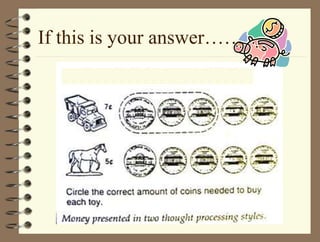
If this is your answer……
Learning Theories with Implications for
Math Instruction (Hatfield, et.al. 1997)
Learning is Process
Information Processing
Thought Processing
Field-dependent (Simultaneous
processing)
requires stimulus materials to be
presented all at once, seeing the whole
before its parts; look for patterns to
break down the whole into its respective
parts to arrive at a solution
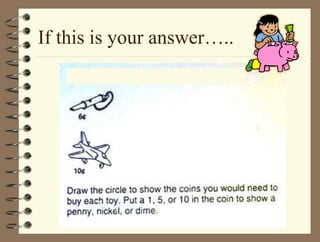
If this is your answer…..
Learning Theories with Implications for
Math Instruction (Hatfield, et.al. 1997)
Learning is Process
Information Processing
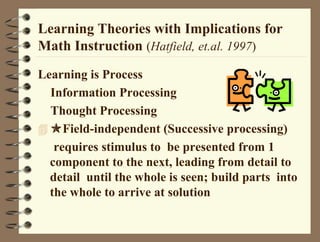
Thought Processing
 Field-independent (Successive processing)
requires stimulus to be presented from 1
component to the next, leading from detail to
detail until the whole is seen; build parts into
the whole to arrive at solution
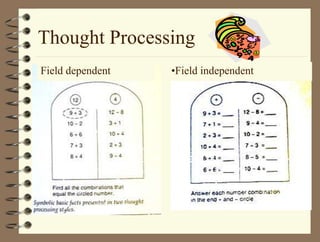
Thought Processing
Field dependent •Field independent
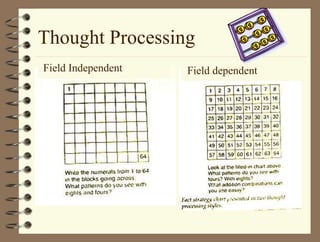
Thought Processing
Field dependent
Field Independent
Learning Theories with Implications for
Math Instruction (Hatfield, et.al. 1997)
Learning is Process
Information Processing
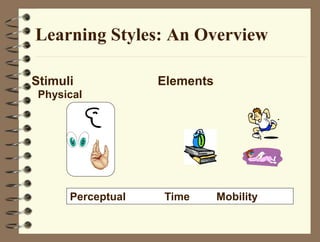
Learning Styles
 Perceptual Factors – Preference for
materials presented through one or
more of the 5 senses
 Visual
 Auditory
F Tactile
Learning Styles: An Overview
Perceptual Time Mobility
Stimuli Elements
Physical
Learning Theories with Implications
for Math Instruction (Hatfield, et.al. 1997)
Learning is Process
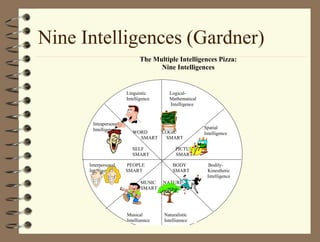
Gardner’s Multiple Intelligences
Nine intelligences
Nine Intelligences (Gardner)
The Multiple Intelligences Pizza:
Nine Intelligences
MUSIC NATURE
SMART SMART
Musical Naturalistic
Intelligence Intelligence
Interpersonal PEOPLE BODY Bodily-
Intelligence SMART SMART Kinesthetic
Intelligence
Linguistic Logical-
Intelligence Mathematical
Intelligence
WORD LOGIC
SMART SMART
SELF PICTURE
SMART SMART
Intrapersonal
Intelligence Spatial
Intelligence
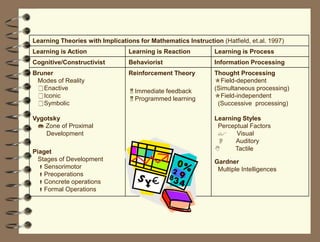
Learning Theories with Implications for Mathematics Instruction (Hatfield, et.al. 1997)
Learning is Action Learning is Reaction Learning is Process
Cognitive/Constructivist Behaviorist Information Processing
Bruner
Modes of Reality
Enactive
Iconic
Symbolic
Vygotsky
 Zone of Proximal
Development
Piaget
Stages of Development
Sensorimotor
Preoperations
Concrete operations
Formal Operations
Reinforcement Theory
Immediate feedback
Programmed learning
Thought Processing
Field-dependent
(Simultaneous processing)
Field-independent
(Successive processing)
Learning Styles
Perceptual Factors
 Visual
 Auditory
 Tactile
Gardner
Multiple Intelligences
Good job! 
Standards
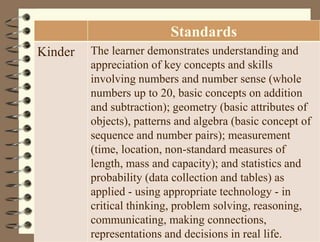
Kinder The learner demonstrates understanding and
appreciation of key concepts and skills
involving numbers and number sense (whole
numbers up to 20, basic concepts on addition
and subtraction); geometry (basic attributes of
objects), patterns and algebra (basic concept of
sequence and number pairs); measurement
(time, location, non-standard measures of
length, mass and capacity); and statistics and
probability (data collection and tables) as
applied - using appropriate technology - in
critical thinking, problem solving, reasoning,
communicating, making connections,
representations and decisions in real life.
Standards
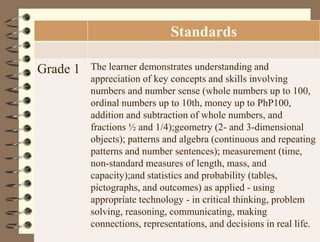
Grade 1 The learner demonstrates understanding and
appreciation of key concepts and skills involving
numbers and number sense (whole numbers up to 100,
ordinal numbers up to 10th, money up to PhP100,
addition and subtraction of whole numbers, and
fractions ½ and 1/4);geometry (2- and 3-dimensional
objects); patterns and algebra (continuous and repeating
patterns and number sentences); measurement (time,
non-standard measures of length, mass, and
capacity);and statistics and probability (tables,
pictographs, and outcomes) as applied - using
appropriate technology - in critical thinking, problem
solving, reasoning, communicating, making
connections, representations, and decisions in real life.
Standards
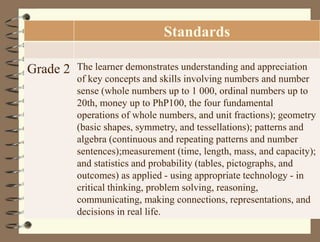
Grade 2 The learner demonstrates understanding and appreciation
of key concepts and skills involving numbers and number
sense (whole numbers up to 1 000, ordinal numbers up to
20th, money up to PhP100, the four fundamental
operations of whole numbers, and unit fractions); geometry
(basic shapes, symmetry, and tessellations); patterns and
algebra (continuous and repeating patterns and number
sentences);measurement (time, length, mass, and capacity);
and statistics and probability (tables, pictographs, and
outcomes) as applied - using appropriate technology - in
critical thinking, problem solving, reasoning,
communicating, making connections, representations, and
decisions in real life.
Standards
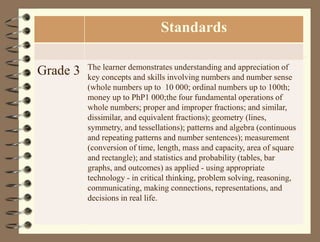
Grade 3 The learner demonstrates understanding and appreciation of
key concepts and skills involving numbers and number sense
(whole numbers up to 10 000; ordinal numbers up to 100th;
money up to PhP1 000;the four fundamental operations of
whole numbers; proper and improper fractions; and similar,
dissimilar, and equivalent fractions); geometry (lines,
symmetry, and tessellations); patterns and algebra (continuous
and repeating patterns and number sentences); measurement
(conversion of time, length, mass and capacity, area of square
and rectangle); and statistics and probability (tables, bar
graphs, and outcomes) as applied - using appropriate
technology - in critical thinking, problem solving, reasoning,
communicating, making connections, representations, and
decisions in real life.
Content: K-3
Numbers & Number Sense
Measurement
Geometry
Patterns & Algebra
Statistics & Probability
Building the Concept of Number
Counting
–Rote Counting
–Rational Counting
–Writing Numerals
Numbers and Counting
Rote counting
saying from memory the names of the
numerals in order.
Rational counting
attaching the number names in order to
items in a group to find out the total
number of items in the group.
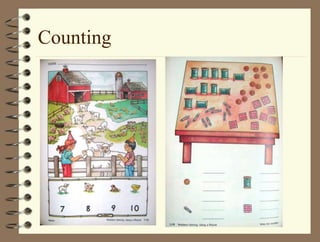
Counting
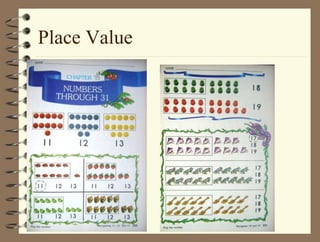
Place Value
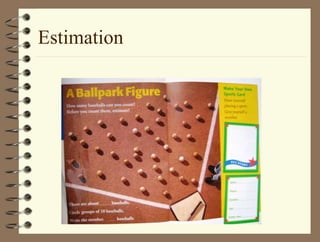
Estimation
Operations of Whole Numbers
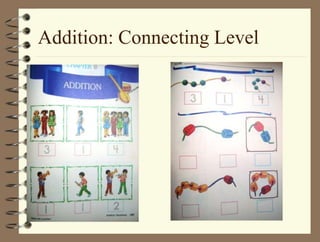
Addition: Connecting Level
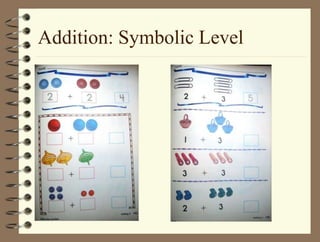
Addition: Symbolic Level
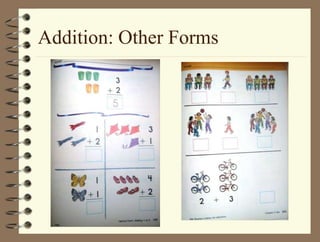
Addition: Other Forms
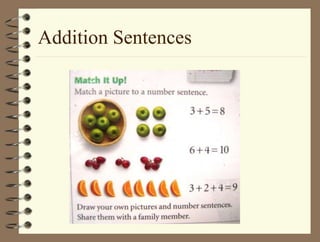
Addition Sentences
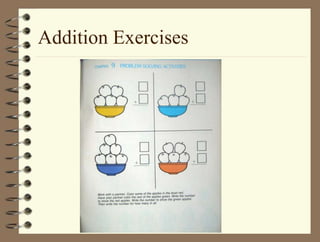
Addition Exercises
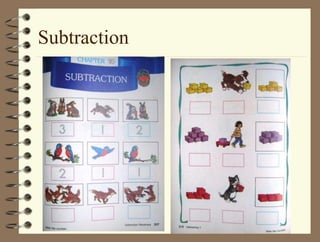
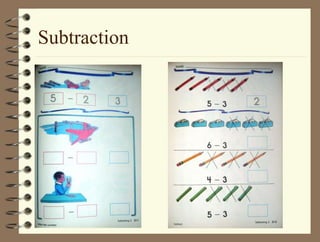
Subtraction
Subtraction
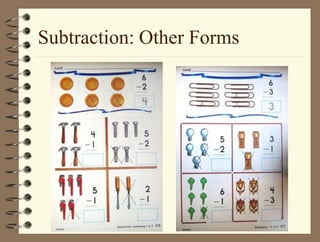
Subtraction: Other Forms
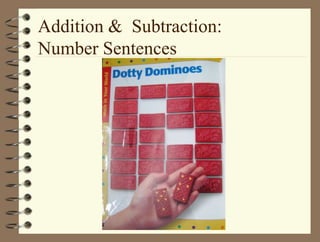
Addition & Subtraction:
Number Sentences
Number Sense of Fractions
Geometry
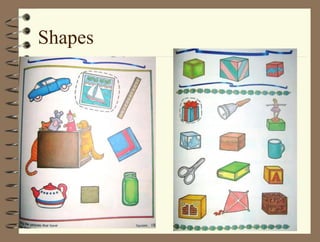
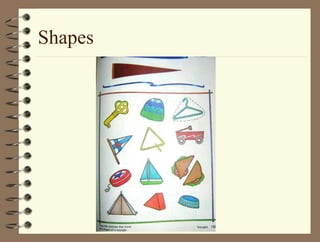
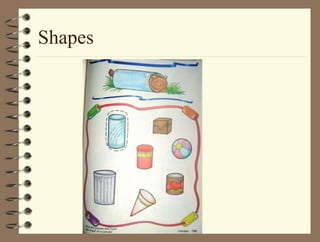
Shapes
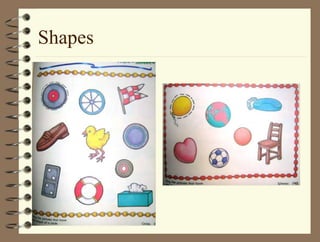
What objects do we use to
teach shapes?
Shapes
Shapes
Shapes
Shapes
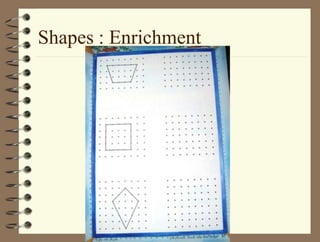
Shapes : Enrichment
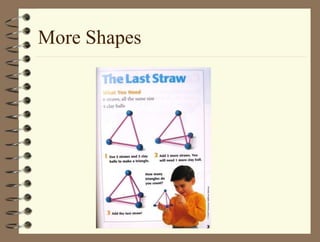
More Shapes
Introducing a Lesson on
Geometry
Patterns & Algebra
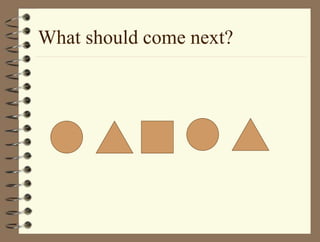
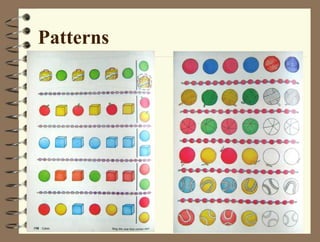
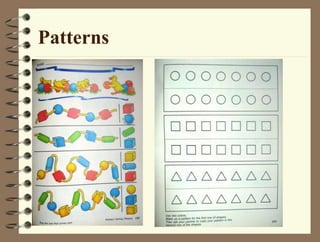
Patterns
 Patterning includes auditory,
visual, and physical motor
sequences that are repeated.
 Patterns may be :
formed, verbally described,
copied, created and extended
What should come next?
Patterns
 Patterns have to be repeated
at least twice….
Patterns
Patterns
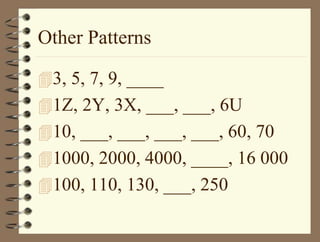
Other Patterns
3, 5, 7, 9, ____
1Z, 2Y, 3X, ___, ___, 6U
10, ___, ___, ___, ___, 60, 70
1000, 2000, 4000, ____, 16 000
100, 110, 130, ___, 250
Measurement
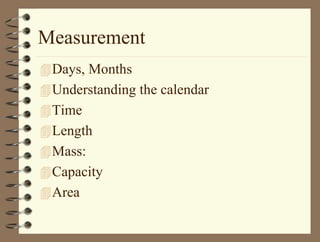
Measurement
Days, Months
Understanding the calendar
Time
Length
Mass:
Capacity
Area
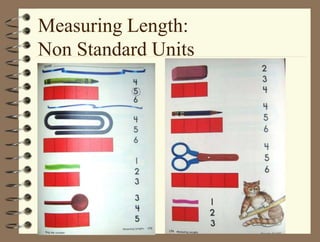
Measuring Length:
Non Standard Units
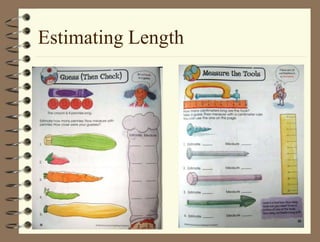
Estimating Length
Use of standard units
Comparison using standard
units
Conversions
Problem Solving
Statistics & Probability
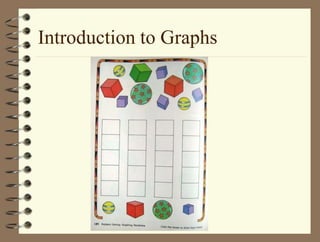
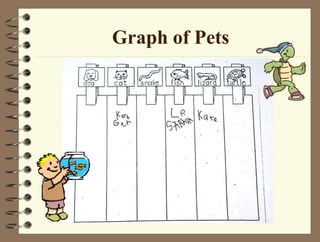
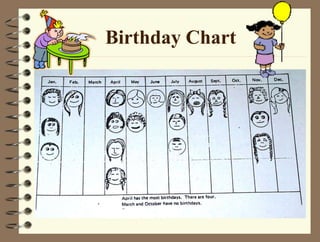
 Graphs
 Children can put into a picture
form the results of classifying,
comparing, counting and
measuring activities.
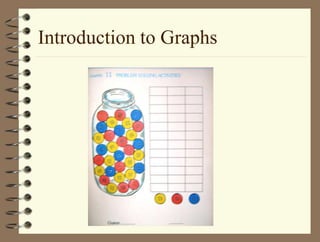
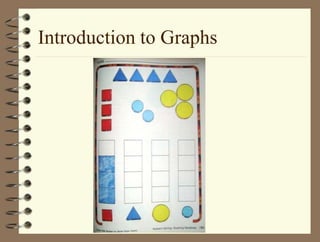
Introduction to Graphs
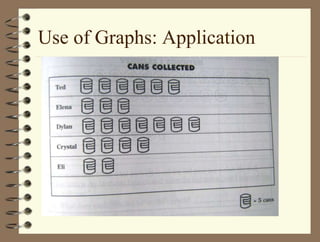
Use of Graphs: Application
Statistics
Graph of Pets
Birthday Chart

For DepEd_Mathematics PResentation ELLN.pptx

  • 1.
    On Teaching andLearning Mathematics : Developing & Assessing Math Skills Prof. Leonor Ercillo Diaz, PhD. UP College of Education
  • 2.
    Outline of theSession How do the K-3 children learn Mathematics? What do they have to learn in Mathematics? (a look into standards, content & competencies) How do we teach and assess Mathematics skills?
  • 3.
    How do KidsReally Learn Math Is Math a set of answers to questions? Is Math a process of investigation and exploration? Are kids allowed to actively work with materials & ideas? Is short-term success the goal? Do we aim for long term understanding?
  • 4.
    How do KidsReally Learn Math Is there much rote learning involved? Are we allowing kids to think and figure things out? Is the goal for future application? Is our purpose immediate application? Are the steps in solving specified by the teacher? Are the students also allowed to discover the steps?
  • 5.
    Learning Theories withImplications for Math Instruction (Hatfield, et.al. 1997) Learning is Action Learning is Reaction Learning is Process
  • 6.
    Learning Theories withImplications for Math Instruction (Hatfield, et.al. 1997) Learning is Action Cognitive/Constructivist Bruner - Modes of Reality Enactive - action on reality on concrete ways w/o the need for imagery, inference, or words
  • 7.
  • 8.
    Learning Theories withImplications for Math Instruction (Hatfield, et.al. 1997) Learning is Action Cognitive/Constructivist Bruner - Modes of Reality Enactive Iconic – pictorial need to represent reality; internal imagery that stands for a concept Symbolic –abstract, arbitrary systems of thought
  • 9.
  • 10.
    Learning Theories withImplications for Math Instruction (Hatfield, et.al. 1997) Learning is Action Cognitive/Constructivist Vygotsky  Zone of Proximal Development The area where the child cannot solve a problem alone but can be successful under adult guidance or in collaboration with a more abled peer.
  • 11.
    Zone of ProximalDevelopment Upper Limit Instruction through guidance or assistance Lower Limit
  • 12.
    Break Time: Storytime •Whatare some things that you want more of? •Find out why the character says “More for Me”. What does he want more of? •At the end of the story, guess the age of the character.
  • 27.
    Think Back •Why doesthe character say “More for Me”. What does he want more of? •Guess the age of the character. What grade is he in? •Why do you say so? What are his characteristics?
  • 28.
    Learning Theories withImplications for Math Instruction (Hatfield, et.al. 1997) Learning is Action Cognitive/Constructivist (Piaget) Stages of Development Sensorimotor – actions on objects Preoperations – actions on reality Concrete operations - Formal Operations
  • 29.
  • 30.
    Preoperation Concrete Operational Egocentrism Centration Irreversiblethought Intuitive thought Lack of :  conservation  class inclusion  transitive interference Can see others have diff. viewpoints Decentration Reversible Thought Dynamic Thought Conservation Class inclusion Transitive Interference
  • 31.
    Learning Theories withImplications for Math Instruction (Hatfield, et.al. 1997) Learning is Reaction Behaviorist Reinforcement Theory Immediate feedback Programmed learning
  • 32.
  • 33.
  • 34.
  • 35.
    Information Processing How weencode, store and retrieve information Thought Processing Learning Styles
  • 36.
    Rewind Time!  •Which ofthe next two activities do your pupils answer easier?
  • 37.
  • 38.
  • 39.
    Information Processing Thought Processing Strategiesused to organize and classify new information or skills to obtain order out of a confusing series of stimulus events.
  • 40.
    If this isyour answer……
  • 41.
    Learning Theories withImplications for Math Instruction (Hatfield, et.al. 1997) Learning is Process Information Processing Thought Processing Field-dependent (Simultaneous processing) requires stimulus materials to be presented all at once, seeing the whole before its parts; look for patterns to break down the whole into its respective parts to arrive at a solution
  • 42.
    If this isyour answer…..
  • 43.
    Learning Theories withImplications for Math Instruction (Hatfield, et.al. 1997) Learning is Process Information Processing Thought Processing  Field-independent (Successive processing) requires stimulus to be presented from 1 component to the next, leading from detail to detail until the whole is seen; build parts into the whole to arrive at solution
  • 44.
  • 45.
  • 46.
    Learning Theories withImplications for Math Instruction (Hatfield, et.al. 1997) Learning is Process Information Processing Learning Styles  Perceptual Factors – Preference for materials presented through one or more of the 5 senses  Visual  Auditory F Tactile
  • 47.
    Learning Styles: AnOverview Perceptual Time Mobility Stimuli Elements Physical
  • 48.
    Learning Theories withImplications for Math Instruction (Hatfield, et.al. 1997) Learning is Process Gardner’s Multiple Intelligences Nine intelligences
  • 49.
    Nine Intelligences (Gardner) TheMultiple Intelligences Pizza: Nine Intelligences MUSIC NATURE SMART SMART Musical Naturalistic Intelligence Intelligence Interpersonal PEOPLE BODY Bodily- Intelligence SMART SMART Kinesthetic Intelligence Linguistic Logical- Intelligence Mathematical Intelligence WORD LOGIC SMART SMART SELF PICTURE SMART SMART Intrapersonal Intelligence Spatial Intelligence
  • 50.
    Learning Theories withImplications for Mathematics Instruction (Hatfield, et.al. 1997) Learning is Action Learning is Reaction Learning is Process Cognitive/Constructivist Behaviorist Information Processing Bruner Modes of Reality Enactive Iconic Symbolic Vygotsky  Zone of Proximal Development Piaget Stages of Development Sensorimotor Preoperations Concrete operations Formal Operations Reinforcement Theory Immediate feedback Programmed learning Thought Processing Field-dependent (Simultaneous processing) Field-independent (Successive processing) Learning Styles Perceptual Factors  Visual  Auditory  Tactile Gardner Multiple Intelligences
  • 51.
  • 52.
    Standards Kinder The learnerdemonstrates understanding and appreciation of key concepts and skills involving numbers and number sense (whole numbers up to 20, basic concepts on addition and subtraction); geometry (basic attributes of objects), patterns and algebra (basic concept of sequence and number pairs); measurement (time, location, non-standard measures of length, mass and capacity); and statistics and probability (data collection and tables) as applied - using appropriate technology - in critical thinking, problem solving, reasoning, communicating, making connections, representations and decisions in real life.
  • 53.
    Standards Grade 1 Thelearner demonstrates understanding and appreciation of key concepts and skills involving numbers and number sense (whole numbers up to 100, ordinal numbers up to 10th, money up to PhP100, addition and subtraction of whole numbers, and fractions ½ and 1/4);geometry (2- and 3-dimensional objects); patterns and algebra (continuous and repeating patterns and number sentences); measurement (time, non-standard measures of length, mass, and capacity);and statistics and probability (tables, pictographs, and outcomes) as applied - using appropriate technology - in critical thinking, problem solving, reasoning, communicating, making connections, representations, and decisions in real life.
  • 54.
    Standards Grade 2 Thelearner demonstrates understanding and appreciation of key concepts and skills involving numbers and number sense (whole numbers up to 1 000, ordinal numbers up to 20th, money up to PhP100, the four fundamental operations of whole numbers, and unit fractions); geometry (basic shapes, symmetry, and tessellations); patterns and algebra (continuous and repeating patterns and number sentences);measurement (time, length, mass, and capacity); and statistics and probability (tables, pictographs, and outcomes) as applied - using appropriate technology - in critical thinking, problem solving, reasoning, communicating, making connections, representations, and decisions in real life.
  • 55.
    Standards Grade 3 Thelearner demonstrates understanding and appreciation of key concepts and skills involving numbers and number sense (whole numbers up to 10 000; ordinal numbers up to 100th; money up to PhP1 000;the four fundamental operations of whole numbers; proper and improper fractions; and similar, dissimilar, and equivalent fractions); geometry (lines, symmetry, and tessellations); patterns and algebra (continuous and repeating patterns and number sentences); measurement (conversion of time, length, mass and capacity, area of square and rectangle); and statistics and probability (tables, bar graphs, and outcomes) as applied - using appropriate technology - in critical thinking, problem solving, reasoning, communicating, making connections, representations, and decisions in real life.
  • 56.
    Content: K-3 Numbers &Number Sense Measurement Geometry Patterns & Algebra Statistics & Probability
  • 57.
    Building the Conceptof Number Counting –Rote Counting –Rational Counting –Writing Numerals
  • 58.
    Numbers and Counting Rotecounting saying from memory the names of the numerals in order. Rational counting attaching the number names in order to items in a group to find out the total number of items in the group.
  • 59.
  • 60.
  • 61.
  • 62.
  • 63.
  • 64.
  • 65.
  • 66.
  • 67.
  • 68.
  • 69.
  • 70.
  • 71.
  • 72.
  • 73.
  • 74.
    Shapes What objects dowe use to teach shapes?
  • 76.
  • 77.
  • 78.
  • 79.
  • 80.
  • 81.
  • 82.
  • 83.
  • 84.
    Patterns  Patterning includesauditory, visual, and physical motor sequences that are repeated.  Patterns may be : formed, verbally described, copied, created and extended
  • 85.
  • 86.
    Patterns  Patterns haveto be repeated at least twice….
  • 87.
  • 88.
  • 89.
    Other Patterns 3, 5,7, 9, ____ 1Z, 2Y, 3X, ___, ___, 6U 10, ___, ___, ___, ___, 60, 70 1000, 2000, 4000, ____, 16 000 100, 110, 130, ___, 250
  • 90.
  • 91.
    Measurement Days, Months Understanding thecalendar Time Length Mass: Capacity Area
  • 92.
  • 93.
  • 94.
    Use of standardunits Comparison using standard units Conversions Problem Solving
  • 95.
    Statistics & Probability Graphs  Children can put into a picture form the results of classifying, comparing, counting and measuring activities.
  • 96.
  • 97.
  • 98.
  • 99.
    Use of Graphs:Application
  • 100.
  • 101.
  • 102.