There are four categories in the fine motor
center. There should be daily access to at
least 3-5 materials in each category.
The four categories include:
1. Small building materials
2. Art Materials
3. Manipulative materials
4. Puzzles
Small building materials – (ex. legos,
duplos)
Art materials – (ex. Painting, drawing,
molding, cutting, pasting, sculpture)
 Manipulative materials – (ex. Links, lacing,
beading, sewing, weaving, busy boards, Dressy-
Bessie)
Puzzles – (Different ability levels available; ex.
Knobbed, jigsaw, large, small)
Diversity can be represented within the fine
motor center by hanging the art work of
each child.
Skills and abilities developed from the experience
of having daily access to the materials and
interactions in the fine motor center are:
 Eye-hand coordination – (ex. Looking to see
where the hole is on a lacing board in order to
push the string through)
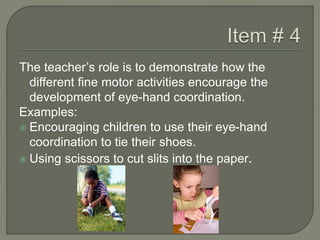
The teacher’s role is to demonstrate how the
different fine motor activities encourage the
development of eye-hand coordination.
Examples:
 Encouraging children to use their eye-hand
coordination to tie their shoes.
 Using scissors to cut slits into the paper.
Strand 5: Early Writing
E2. Experiment with grasp when using a
variety of writing tools (PG. 80)
Strategies:
 Supervising child’s exploration of child-
safe writing tools
 Providing writing and drawing tools (e.g.,
crayons, chalk, finger paint) that can be
used both indoors and outdoors.
Strand 5: Early Writing
E9: Use letter-like shapes, symbols, and letters to
convey meaning (PG 80)
Strategies:
 Positively acknowledging child’s attempts at writing
(e.g., display writing in visible locations).
 Leaving fun notes for child in child's bed, and when
child finds the notes, reading them aloud together
 Providing opportunities for child to manipulate
magnetic letters, naming the letters or using them
to spell out simple words.
Strand 2: Music
B9: Show interest in more complicated
instruments (e.g., piano, guitar) (PG 118)
Strategies:
Providing opportunities for child to listen to
music of all cultures and styles.
Taking child to music, dance, and theatre
performances appropriate for young
children.
Strand 4: Visual Arts
D9: Create drawings, paintings, models, and other
art creations that are more detailed, creative or
realistic (PG 118)
Strategies:
 Planning enough time for child to be able to delve
into an art project and be creative without much
interruption.
 Sharing and discussing with child colorful
illustrations in books and magazines.
 Providing the child with various art materials.
 Integrating natural discussions of art elements into
daily conversation.

Fine Motor 1

  • 2.
    There are fourcategories in the fine motor center. There should be daily access to at least 3-5 materials in each category. The four categories include: 1. Small building materials 2. Art Materials 3. Manipulative materials 4. Puzzles
  • 3.
    Small building materials– (ex. legos, duplos) Art materials – (ex. Painting, drawing, molding, cutting, pasting, sculpture)
  • 4.
     Manipulative materials– (ex. Links, lacing, beading, sewing, weaving, busy boards, Dressy- Bessie) Puzzles – (Different ability levels available; ex. Knobbed, jigsaw, large, small)
  • 5.
    Diversity can berepresented within the fine motor center by hanging the art work of each child.
  • 6.
    Skills and abilitiesdeveloped from the experience of having daily access to the materials and interactions in the fine motor center are:  Eye-hand coordination – (ex. Looking to see where the hole is on a lacing board in order to push the string through)
  • 7.
    The teacher’s roleis to demonstrate how the different fine motor activities encourage the development of eye-hand coordination. Examples:  Encouraging children to use their eye-hand coordination to tie their shoes.  Using scissors to cut slits into the paper.
  • 8.
    Strand 5: EarlyWriting E2. Experiment with grasp when using a variety of writing tools (PG. 80) Strategies:  Supervising child’s exploration of child- safe writing tools  Providing writing and drawing tools (e.g., crayons, chalk, finger paint) that can be used both indoors and outdoors.
  • 9.
    Strand 5: EarlyWriting E9: Use letter-like shapes, symbols, and letters to convey meaning (PG 80) Strategies:  Positively acknowledging child’s attempts at writing (e.g., display writing in visible locations).  Leaving fun notes for child in child's bed, and when child finds the notes, reading them aloud together  Providing opportunities for child to manipulate magnetic letters, naming the letters or using them to spell out simple words.
  • 10.
    Strand 2: Music B9:Show interest in more complicated instruments (e.g., piano, guitar) (PG 118) Strategies: Providing opportunities for child to listen to music of all cultures and styles. Taking child to music, dance, and theatre performances appropriate for young children.
  • 11.
    Strand 4: VisualArts D9: Create drawings, paintings, models, and other art creations that are more detailed, creative or realistic (PG 118) Strategies:  Planning enough time for child to be able to delve into an art project and be creative without much interruption.  Sharing and discussing with child colorful illustrations in books and magazines.  Providing the child with various art materials.  Integrating natural discussions of art elements into daily conversation.