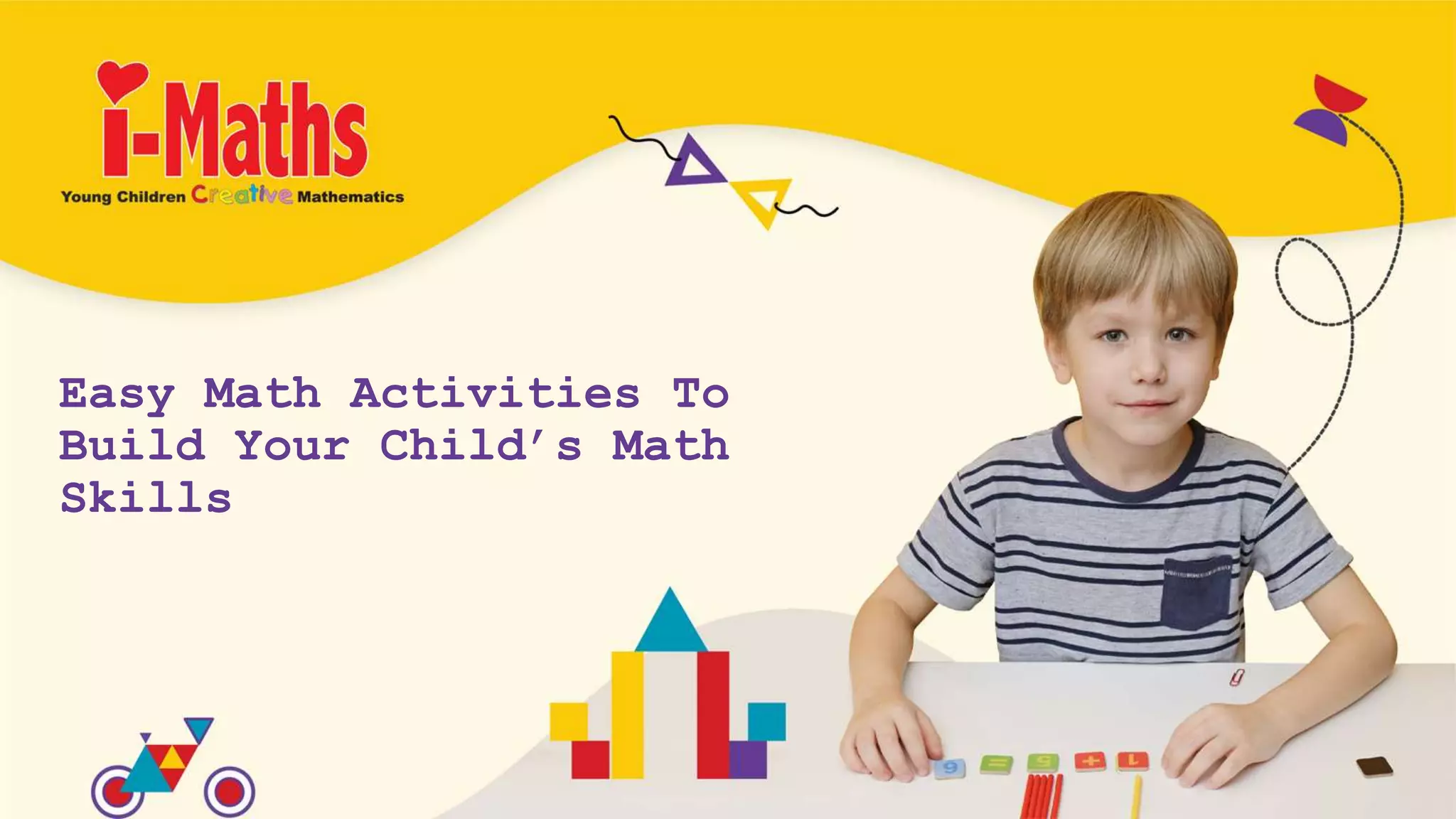
Easy Math Activities To
Build Your Child’s Math
Skills
About i-Maths
• i-Maths is a leading early childhood education
program designed in accordance with how children
learn Mathematics and aim to foster creativity
and lateral thinking abilities in young children.
Our early learning center caters to children in
the age group of 3 to 7 years.
• i-Maths, a globally successful early childhood
education program, provides children an ideal
platform to learn by systematically guiding them
through various modes of learning such as
Sensorial, Kinesthetic, and Visual. Our early
learning center methodologies not only help keep
the process fun-filled and interactive but also
makes learning deep-rooted and lasting.
Blog
• Before your little one starts school, most
children develop an understanding of addition and
subtraction through everyday interactions, games,
and activities. Learning with informal activities
gives children a head start when they start
learning math in school.
• The tips below highlight ways that you can help
your child learn early math skills by building on
their natural curiosity and having fun. Most of
these tips are designed for children aged 2–3.
Younger children can be exposed to stories and
songs using repetition, rhymes, and numbers.
• Shapes - Play with shape-sorters. Make your child count the sides
of the shapes, and describe the colors. Make their own shapes by
cutting large shapes out of colored construction paper.
• Place the call - Begin teaching your kid the address and phone
number of your home. Talk with your child about how each house
has a number, and how their house or apartment is one of a
series, each with its own number.
• You’re cookin’ now! - Even young children can help fill, stir,
and pour. Through these activities, children learn, quite
naturally, to count, measure, add, and estimate.
• Picture time - Use an hourglass, stopwatch, or timer to time
short (1–3 minute) activities. This helps children develop a
sense of time and to understand that some things take longer than
others.
• Read and sing your numbers - Sing songs that rhyme, repeat, or
have numbers in them. Songs reinforce patterns (which is a math
skill as well). They also are quite fun to practice language and
• Start today - Use a calendar to talk about the date, and
the day of the week. Calendars reinforce counting,
sequences, and patterns.
• Pass it around - Ask for your child’s help in distributing
items like snacks or in laying napkins out on the dinner
table. Help them give one cracker to each child. This
helps children understand one-to-one correspondence.
• The long and the short of it - Cut a few (3–5) pieces of
ribbon, yarn, or paper into different lengths. Talk about
ideas like long and short. With your child, put in order
of longest to shortest
• Learn through touch - Cut shapes—circle, square, triangle—
out of sturdy cardboard. Let your child touch the shape
with their eyes open and then closed
• Pattern play - Have fun with patterns by letting children
• Graphing games - As your child nears three and beyond,
make a chart where your child can put a sticker each time
it rains or each time it is sunny. At the end of a week,
you can estimate together which column has more or fewer
stickers, and count how many to be sure.
• With simple tricks, you can make any simple task an
activity. Kindergarten math activities are designed for
children to develop an interest in math. There are
different child development programs that use such simple
and fun activities to reinforce math skills in children.
i-Maths is one such Child Enrichment program that makes
learning math- fun, easy and fruitful for children. Learn
more about these activities on our i-Maths website.
Easy Math Activities to Build Your Child's Math Skills

Easy Math Activities to Build Your Child's Math Skills

  • 1.
    Easy Math ActivitiesTo Build Your Child’s Math Skills
  • 2.
    About i-Maths • i-Mathsis a leading early childhood education program designed in accordance with how children learn Mathematics and aim to foster creativity and lateral thinking abilities in young children. Our early learning center caters to children in the age group of 3 to 7 years. • i-Maths, a globally successful early childhood education program, provides children an ideal platform to learn by systematically guiding them through various modes of learning such as Sensorial, Kinesthetic, and Visual. Our early learning center methodologies not only help keep the process fun-filled and interactive but also makes learning deep-rooted and lasting.
  • 3.
    Blog • Before yourlittle one starts school, most children develop an understanding of addition and subtraction through everyday interactions, games, and activities. Learning with informal activities gives children a head start when they start learning math in school. • The tips below highlight ways that you can help your child learn early math skills by building on their natural curiosity and having fun. Most of these tips are designed for children aged 2–3. Younger children can be exposed to stories and songs using repetition, rhymes, and numbers.
  • 5.
    • Shapes -Play with shape-sorters. Make your child count the sides of the shapes, and describe the colors. Make their own shapes by cutting large shapes out of colored construction paper. • Place the call - Begin teaching your kid the address and phone number of your home. Talk with your child about how each house has a number, and how their house or apartment is one of a series, each with its own number. • You’re cookin’ now! - Even young children can help fill, stir, and pour. Through these activities, children learn, quite naturally, to count, measure, add, and estimate. • Picture time - Use an hourglass, stopwatch, or timer to time short (1–3 minute) activities. This helps children develop a sense of time and to understand that some things take longer than others. • Read and sing your numbers - Sing songs that rhyme, repeat, or have numbers in them. Songs reinforce patterns (which is a math skill as well). They also are quite fun to practice language and
  • 6.
    • Start today- Use a calendar to talk about the date, and the day of the week. Calendars reinforce counting, sequences, and patterns. • Pass it around - Ask for your child’s help in distributing items like snacks or in laying napkins out on the dinner table. Help them give one cracker to each child. This helps children understand one-to-one correspondence. • The long and the short of it - Cut a few (3–5) pieces of ribbon, yarn, or paper into different lengths. Talk about ideas like long and short. With your child, put in order of longest to shortest • Learn through touch - Cut shapes—circle, square, triangle— out of sturdy cardboard. Let your child touch the shape with their eyes open and then closed • Pattern play - Have fun with patterns by letting children
  • 7.
    • Graphing games- As your child nears three and beyond, make a chart where your child can put a sticker each time it rains or each time it is sunny. At the end of a week, you can estimate together which column has more or fewer stickers, and count how many to be sure. • With simple tricks, you can make any simple task an activity. Kindergarten math activities are designed for children to develop an interest in math. There are different child development programs that use such simple and fun activities to reinforce math skills in children. i-Maths is one such Child Enrichment program that makes learning math- fun, easy and fruitful for children. Learn more about these activities on our i-Maths website.