Environments Project
Music Activity Center
Keisha White - CHD 120
Music is...
The combination of tones and rhythms that often follow a
melodic pattern - either using voices
or sound making instruments (ITER-S pg. 237).
Materials
● This music station will provide enough materials for at least half of the
children to use at once (ECERS pg. 215).
● This station will be accessible for at least one and a half hours per day.
● Free choice play will be allowed for the children for one hour each day.
● Teacher initiated play will be 30 minutes per day broken up doing the
course of the day. This type of play will include circle time, transitional
music, and other activities as requested by the children.
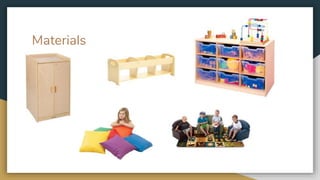
Materials
● A combination of storage and seating that can accomodate all children.
● Highly accessible storage areas.
● An audio cabinet to house music technology such as a CD player.
● Soft seating that can be used by children with disabilities as well as easy
listening style group seating.
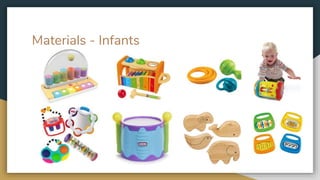
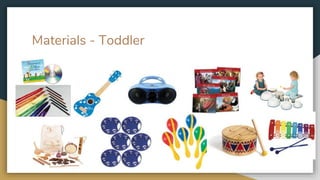
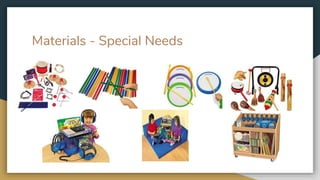
● A variety of music instruments for both infants, toddlers and children
with disabilities.
Materials
Materials - Infants
Materials - Toddler
Materials - Special Needs
Diversity
● The center will provide music and musical instruments from all
different cultures to include classical, jazz, pop, reggae etc.
● Materials will also be geared to various ages and abilities.
● Cultural dances, books and instruments.
Skills and Abilities
The music center should encourage language,
social-emotional and motor development.
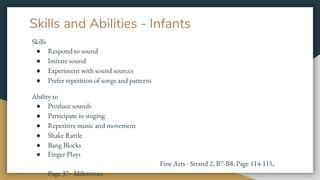
Skills and Abilities - Infants
Skills
● Respond to sound
● Imitate sound
● Experiment with sound sources
● Prefer repetition of songs and patterns
Ability to
● Produce sounds
● Participate in singing
● Repetitive music and movement
● Shake Rattle
● Bang Blocks
● Finger Plays
Fine Arts - Strand 2, B7-B8, Page 114-115,
Page 37- Milestones
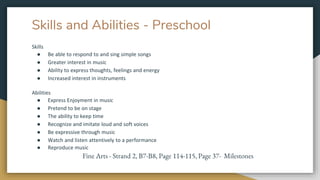
Skills and Abilities - Preschool
Skills
● Be able to respond to and sing simple songs
● Greater interest in music
● Ability to express thoughts, feelings and energy
● Increased interest in instruments
Abilities
● Express Enjoyment in music
● Pretend to be on stage
● The ability to keep time
● Recognize and imitate loud and soft voices
● Be expressive through music
● Watch and listen attentively to a performance
● Reproduce music
Fine Arts - Strand 2, B7-B8, Page 114-115, Page 37- Milestones
Skills and Abilities
● Use imagination to create original thoughts, ideas or products.
● Make up songs, words or stories, or create a dance.
● Being comfortable answering open-ended questions that have no “right”
answer.
Creativity and Inventiveness, Strand 3, C7, page 10, Page 63 - Milestones
Teacher’s Role
★ Assist children in making up their own songs.
★ Encourage children to sing the way he/she feels.
★ Clapping along to the beat of the songs.
★ Sing 3 pitch songs.
Fine Arts - Strand 2, B7-B8, Page 114-115, Page 37- Milestones
Teacher’s Role
★ Provide space, materials/supplies, time and freedom for creative
expression.
★ Provide opportunities to be spontaneous, silly and messy in order to
experiment with possibilities.
★ Ask a child to explain ideas and intent and observing or entering
dramatic play without impeding creativity.
Creativity and Inventiveness, Strand 3, C7, page 10, Page 63 - Milestones
Teacher’s Role
The teacher supports children in the music center by being creative yet informal. Children
should have many options and not be forced to participate. Teacher led music experiences
should involve different instruments and props. Music can also be used during transitions and
to teach new skills. Teachers can also promote learning by teaching the names of the
instruments and the sounds they make, tones and pitch, rhythm and tempos, phrases and
musical patterns. Several activities can also be incorporated into teacher initiated music time
such as freeze dance, parachute dancing and cultural dances. Music from different cultures and
genres should be incorporated to promote diversity. Music time can be catered to the whole
group (circle time) or individuals. Always allow for free choice.
Citations
Cryer, D, Harms, T, and Riley, C. (2003). All about the ECERS-R. New York, NY: Teacher’s
College Press.
Cryer, D, Harms, T, and Riley, C. (2004). All about the ITERS-R. New York, NY: Teacher’s
College Press.
Harms, T, Clifford, R, and Cryer, D. (2003). Infant toddler environmental rating scale.
New York, NY: Teacher’s College Press.
Harms, T, Clifford, R, and Cryer, D. (2005). Early childhood environmental rating scale.
New York, NY: Teacher’s College Press.
Virginia Department of Social Services. Milestones of Child Development. Retrieved from
http://va.gapitc.org/wp-content/uploads/2014/03/Milestones_Revised2014.pdf
Whitener, C. (n.d.). Activities. [PowerPoint slides].

Music by keisha

  • 1.
    Environments Project Music ActivityCenter Keisha White - CHD 120
  • 2.
    Music is... The combinationof tones and rhythms that often follow a melodic pattern - either using voices or sound making instruments (ITER-S pg. 237).
  • 3.
    Materials ● This musicstation will provide enough materials for at least half of the children to use at once (ECERS pg. 215). ● This station will be accessible for at least one and a half hours per day. ● Free choice play will be allowed for the children for one hour each day. ● Teacher initiated play will be 30 minutes per day broken up doing the course of the day. This type of play will include circle time, transitional music, and other activities as requested by the children.
  • 4.
    Materials ● A combinationof storage and seating that can accomodate all children. ● Highly accessible storage areas. ● An audio cabinet to house music technology such as a CD player. ● Soft seating that can be used by children with disabilities as well as easy listening style group seating. ● A variety of music instruments for both infants, toddlers and children with disabilities.
  • 5.
  • 6.
  • 7.
  • 8.
  • 9.
    Diversity ● The centerwill provide music and musical instruments from all different cultures to include classical, jazz, pop, reggae etc. ● Materials will also be geared to various ages and abilities. ● Cultural dances, books and instruments.
  • 10.
    Skills and Abilities Themusic center should encourage language, social-emotional and motor development.
  • 11.
    Skills and Abilities- Infants Skills ● Respond to sound ● Imitate sound ● Experiment with sound sources ● Prefer repetition of songs and patterns Ability to ● Produce sounds ● Participate in singing ● Repetitive music and movement ● Shake Rattle ● Bang Blocks ● Finger Plays Fine Arts - Strand 2, B7-B8, Page 114-115, Page 37- Milestones
  • 12.
    Skills and Abilities- Preschool Skills ● Be able to respond to and sing simple songs ● Greater interest in music ● Ability to express thoughts, feelings and energy ● Increased interest in instruments Abilities ● Express Enjoyment in music ● Pretend to be on stage ● The ability to keep time ● Recognize and imitate loud and soft voices ● Be expressive through music ● Watch and listen attentively to a performance ● Reproduce music Fine Arts - Strand 2, B7-B8, Page 114-115, Page 37- Milestones
  • 13.
    Skills and Abilities ●Use imagination to create original thoughts, ideas or products. ● Make up songs, words or stories, or create a dance. ● Being comfortable answering open-ended questions that have no “right” answer. Creativity and Inventiveness, Strand 3, C7, page 10, Page 63 - Milestones
  • 14.
    Teacher’s Role ★ Assistchildren in making up their own songs. ★ Encourage children to sing the way he/she feels. ★ Clapping along to the beat of the songs. ★ Sing 3 pitch songs. Fine Arts - Strand 2, B7-B8, Page 114-115, Page 37- Milestones
  • 15.
    Teacher’s Role ★ Providespace, materials/supplies, time and freedom for creative expression. ★ Provide opportunities to be spontaneous, silly and messy in order to experiment with possibilities. ★ Ask a child to explain ideas and intent and observing or entering dramatic play without impeding creativity. Creativity and Inventiveness, Strand 3, C7, page 10, Page 63 - Milestones
  • 16.
    Teacher’s Role The teachersupports children in the music center by being creative yet informal. Children should have many options and not be forced to participate. Teacher led music experiences should involve different instruments and props. Music can also be used during transitions and to teach new skills. Teachers can also promote learning by teaching the names of the instruments and the sounds they make, tones and pitch, rhythm and tempos, phrases and musical patterns. Several activities can also be incorporated into teacher initiated music time such as freeze dance, parachute dancing and cultural dances. Music from different cultures and genres should be incorporated to promote diversity. Music time can be catered to the whole group (circle time) or individuals. Always allow for free choice.
  • 17.
    Citations Cryer, D, Harms,T, and Riley, C. (2003). All about the ECERS-R. New York, NY: Teacher’s College Press. Cryer, D, Harms, T, and Riley, C. (2004). All about the ITERS-R. New York, NY: Teacher’s College Press. Harms, T, Clifford, R, and Cryer, D. (2003). Infant toddler environmental rating scale. New York, NY: Teacher’s College Press. Harms, T, Clifford, R, and Cryer, D. (2005). Early childhood environmental rating scale. New York, NY: Teacher’s College Press. Virginia Department of Social Services. Milestones of Child Development. Retrieved from http://va.gapitc.org/wp-content/uploads/2014/03/Milestones_Revised2014.pdf Whitener, C. (n.d.). Activities. [PowerPoint slides].