


RECURRENT
PREGNANCY LOSS
DEFINITION
3 Or more consecutive pregnancies ending
spontaneously before viability.
2 Or more because recurrent risks & subsequent
outcomes are similar for woman having 2 or 3
prior losses (Hill,1994)
Recurrent early pregnancy loss:<15w(ACOG,2001)
Or <20 W(Speroff,1999)
Primary: No Previous full term pregnancy.
Secondary: previous full term pregnancy. The prognosis of
Secondary RPL is better than primary (Roman et al,1980).
Infections
Miscellaneous
Is your Body Baby –
Friendly ?
IMPACT OF THE PROBLEM
 Couples: extreme distress
 Doctor : Many causes & investigations but
few specific treatment
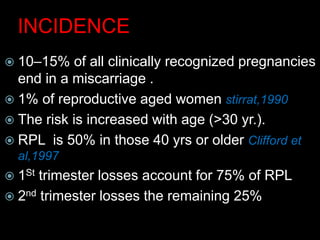
INCIDENCE
 10–15% of all clinically recognized pregnancies
end in a miscarriage .
 1% of reproductive aged women stirrat,1990
 The risk is increased with age (>30 yr.).
 RPL is 50% in those 40 yrs or older Clifford et
al,1997
 1St trimester losses account for 75% of RPL
 2nd trimester losses the remaining 25%
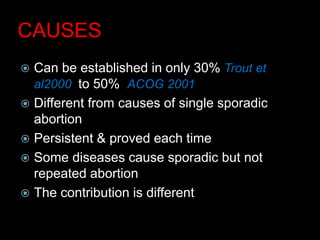
CAUSES
 Can be established in only 30% Trout et
al2000 to 50% ACOG 2001
 Different from causes of single sporadic
abortion
 Persistent & proved each time
 Some diseases cause sporadic but not
repeated abortion
 The contribution is different
CAUSES
 Possible
 Doubtful
 Despite a through evolution no etiology
is identified in 30-40 % of habitual
abortion .
 Treatment 65-75% chance
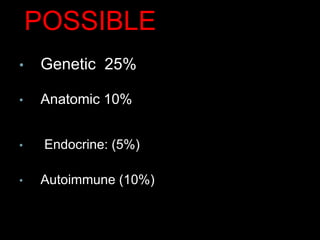
POSSIBLE
• Genetic 25%
• Anatomic 10%
• Endocrine: (5%)
• Autoimmune (10%)
Doubtful
• Infections
• Environmental
Chromosomal fetal anomalies: 25%
Different from those in single spontaneous abortion
:Aneuploidy:Trisomy:50%
Due to non disjunction or translocation,Monosomy:25%,Triploidy:15%,
Tetraploidy:5%,
Structural anomaly:3%
Chromosomal anomalies in the parents:5%
Suggesting that the fetal abnormality is not secondary to a parental problem.
Most frequently balanced translocation
Effect of aging of the ovum or sperm:
>days: increased chromosomal
abnormalities (aneuploidy)
Recurrence: Most occur as non-recurrent
chance phenomenon, but if first abortion
was chromosomally abnormal:increased
risk of chromosomal abnormalities in
subsequent pregnancies
Diagnosis
1. Peripheral blood karyotyping of the
parents in all couples with RPL
2. Karyotyping of the abort us
(fetal/placental chromosome)
Treatment: No treatment
 Gamete donation
 Genetic counseling to alleviate stress
 If aneuplody is documented: accurately
timed insemination as aneuploidy is due
to aging of ovum & sperm
 If euploidy:look for other causes
II. ANATOMIC
1.Congenital anomalies of the uterus
Incidence: 10% of RPL
Types
1.Septate uterus: is the most frequent
abnormality associated with RPL
Incidence of uterine septum in women with a history of RA is similar to
that identified in women with reproductive histories (Simon et
al,1999).septate or bicornuate uteri are unlikely to cause RPL
(Balen,1999)
2.Bicornuate, didelphic,.unicornuate,DES
uterus
Mechanism
Impaired vascularization of pregnancy &
limited space for the fetus. However the
vascular density of uterine septa is similar
to that of the normal uterine wall
(Dabiarashrafi et al,1995)
Diagnosis:
1.TVS
2.Sonohysterography
3.3D US
4.HSG:as a routine is questionable since it is
associated with patient discomfort,risk of
pelvic infection, relatively inaccurate &
offers the same diagnostic sensitivitiy as
TVS(Clifotd et al,1994).
5.Hysteroscopy
6.MRi
Treatment
Hysteroscopic division of the septum;
reduction of miscarriage rate from 85% to
10% (Daiter,2001)
Prophylactic cerclage has not been supported
from RC study (Lazar et al, 1984).
However when nothing else to offer,cerclage
is worthwhile;e.g in patients with late
losses & mullerian anomalies e.g
bicornuate uterus or unicornuate uterus
2.Cervical incompetence
May cause 2nd trimester abortion.
it is thought to be over-diagnosed because
there is no reliable diagnostic tests & the
diagnosis is most commonly based on
characteristic history.
Cervical cerclage should only be considered
when the history of miscarriage is
preceded by spontaneous rupture of
membranes or painless cervical dilatation.
The MRC/RCOG trial of the use of cervical cerclage
reported a small decrease in PTL,but no
significant improvement in fetal survival (1993)(B)
3.Submucous Fibroid
Hysteroscopic removal of submucous
fibroid
4.Severe Intrautrine synechiae
Hysteroscopic treatment of severe IU
Synechiae
III. ENDOCRINE
1.D.M & thyroid disease
Well controlled D.M.is not a risk factor for
RPL, nor treated thyroid dysfunction.
Routine screening for occult D.M&thyroid
disease should not be performed in
asymptomatic women with RPL.(C).
The high frequency of hypothyroidism
warrants screening of TSH(Plouffe et
al,1992).
Acguired uterine anomalies include uterine
adhesions and leiomyomata
IV.Autoimmune
 Self Ag.=hum oral or cellular response is
directed against a specific component of
the host.
 Antiphospholipid Ad (aPL):Lupus
anticoagulant (LA),anticardiolipin
(aCL).Other aP1 are of no clinical value (c)
(Branch et al,1997)
 Mechanism: Abs are directed against
platelets & vascular endothelium
 Vascular damage, thrombosis &placental
infarction abortion, fetal morbidity & death.
Treatment
 Low dose aspirin (75 mg daily)started at
the time of positive pregnancy test together
with low dose heparin(5000 iu
SC/12h):Success:70%(A).
 Treatment with aspirin & / or heparin is
discontinued at 34 W.
 Corticosteroids does not improve the live
birth & since it is associated with significant
maternal &fetal morbidity should be
abandoned (Laskin et al,19997)(C)
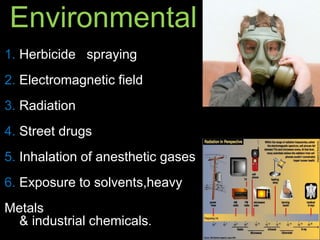
Environmental
1. Herbicide spraying
2. Electromagnetic field
3. Radiation
4. Street drugs
5. Inhalation of anesthetic gases
6. Exposure to solvents,heavy
Metals
& industrial chemicals.
 In one study by Viera et al. (1980), with
anesthetic gases spontaneous abortion
was observed in rats at 1000 ppm or
more. According to NIOSH (1994),
similar concentrations of 1000 ppm have
been found in operating rooms and in
dental operatories not equipped with
scavenging systems.
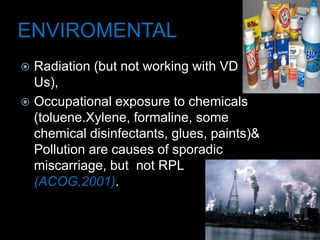
ENVIROMENTAL
 Radiation (but not working with VD
Us),
 Occupational exposure to chemicals
(toluene.Xylene, formaline, some
chemical disinfectants, glues, paints)&
Pollution are causes of sporadic
miscarriage, but not RPL
(ACOG,2001).
 An australian group has assessed
multiplicity of possible risk factors which
increase RPL are age , visiting factories
in the course of work , radiograms and
home exposure to chemicals.
 The observed rate of pregnancy loss
ranged from 3.7 – 7.5% with multiple
factors.
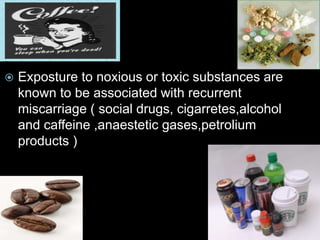
 Exposture to noxious or toxic substances are
known to be associated with recurrent
miscarriage ( social drugs, cigarretes,alcohol
and caffeine ,anaestetic gases,petrolium
products )
A large-scale Danish study
polled more than 80,000
pregnant women regarding their
coffee intake. This study found
that women who drank large
amounts of coffee during
pregnancy were more likely to
experience a miscarriage.
Women who drank more than 2
cups of coffee a day had a
slightly increased risk of
miscarriage, while those that
drank 8 or more cups
experienced a 59% increase.
•Cigarettes accounted for about
11% of all spontaneous abortions(40% in
women who smoked 20 or more cigarettes
per day.) Am J Public health 1992
• Alcohol consumption for about
5% (45% in women drinking 3 or more
drinks per day)
•Coffee for about 2%
(16% in women drinking 10 cups per day).
INFECTIONS
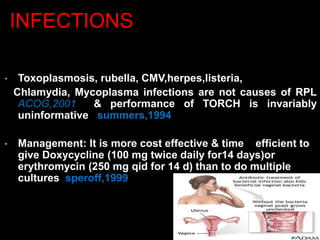
• Toxoplasmosis, rubella, CMV,herpes,listeria,
Chlamydia, Mycoplasma infections are not causes of RPL
ACOG,2001 & performance of TORCH is invariably
uninformative summers,1994
• Management: It is more cost effective & time efficient to
give Doxycycline (100 mg twice daily for14 days)or
erythromycin (250 mg qid for 14 d) than to do multiple
cultures speroff,1999
 Bacterial vaginosis including infection with
G.vaginalis m.Hominis has been associated
with pregnancy loss .
 Empiric antibiotic treatment with doxycycline
& erythromycin is frequently prescribed
 TORCH (toxoplasmosis rubella,
cytomegalovirus and herpes simplex virus),
other [congenital syphilis and viruses],
screening is unhelpful in the investigation
of recurrent miscarriage.
 For an infective agent to be implicated in the
etiology of repeated pregnancy loss, it must be
capable of persisting in the genital tract and
avoiding detection or must cause insufficient
symptoms to disturb the women.
Toxoplasmosis, rubella, cytomegalovirus,
herpes and listeria infections do not fulfil these
criteria and routine TORCH screening should
be abandoned.
 Screening for and treatment of
bacterial vaginosis in early pregnancy
among high risk women with a
previous history of second-trimester
miscarriage or spontaneous preterm
labour may reduce the risk of recurrent
late loss and preterm birth.
Group B Streptococcus
 Pre and Post-conceptional, broad-
spectrum intravenous antibiotic therapy
was used in patients with multiple
miscarriages
 Although this is a relatively small series
and does not establish a cause and effect
relationship between Group B
Streptococcus and habitual abortions, the
beneficial effects of antibiotic therapy is
unquestionable .
 Miscarriage is usually a random event,
not a sign of an ongoing reproductive
problem. If you have had one
miscarriage, your chances for future
successful pregnancies are good.
Bacterial Vaginosis
Def : A polymicrobial superficial vaginal infection
involving a loss of normal lactobacilli &
overgrowth of anaerobes such as gardnerella ,
bacteroides , mycoplasma , mobiluncus &
peptostreptococcus
Inci : 8 to 20% in pregnant women
No sign or symptoms at all. 50% complain of fishy
vaginal discharge , itching , burning urination
Risk Factors
 Exposure to multiple sexual partners.
 Vaginal douching for hygiene.
 Presence of I U D
 Presence of foreign body eg : retained
tampoons.
 Although BV is not classified as a STD
currently , there is evidence that it does
hav sexual transmission.
Mechanism of action
 Enzyme phospholipase A2 responsible
for prostaglandin synthesis.
 Bacterial end products increase
prostaglandin E2 production by amnion
cells – cervical effacement & uterine
contraction .
 Endotoxins induce macrophages &
monocytes to produce TNF &
interleukin -1 which stimulate
prostaglandin synthesis.
 Most inflammatory lesions of chorion ,
amnion & umbilical cord are due to
infection.
 Bacteria hav been recovered from 72%
of placenta of women with clinical &
histological evidence of
chorioamnionitis.
 In BV even with intact membranes were
able to infect amniotic fluid & invite
production of cytokines that induce
labour.
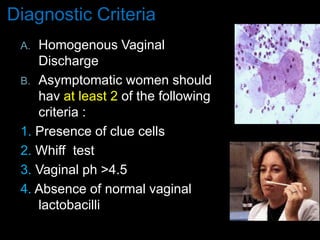
Diagnostic Criteria
A. Homogenous Vaginal
Discharge
B. Asymptomatic women should
hav at least 2 of the following
criteria :
1. Presence of clue cells
2. Whiff test
3. Vaginal ph >4.5
4. Absence of normal vaginal
lactobacilli
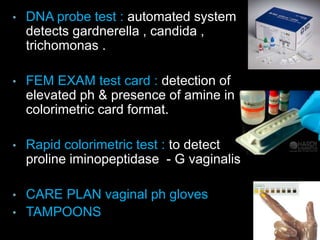
• DNA probe test : automated system
detects gardnerella , candida ,
trichomonas .
• FEM EXAM test card : detection of
elevated ph & presence of amine in a
colorimetric card format.
• Rapid colorimetric test : to detect
proline iminopeptidase - G vaginalis
• CARE PLAN vaginal ph gloves
• TAMPOONS
Effects of Bacterial
Vaginosis
 Amniotic fluid infection
 Chorion amnionitis
 Preterm Premature Rupture of
membranes
 Preterm labour
 Low birth weight
 Postpartum endometritis
When To Screen
 At first visit and again at 20 wks
 Preconception screening for abnormal
vaginal flora 6 wks prior to conception in
patients with previous history of BV.
 Screening at booking and at 36 wks
along with screening for group beta
streptococcal colonisation.
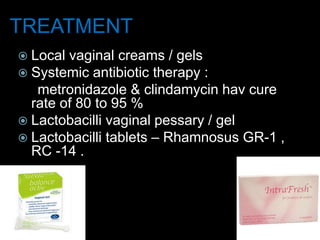
TREATMENT
 Local vaginal creams / gels
 Systemic antibiotic therapy :
metronidazole & clindamycin hav cure
rate of 80 to 95 %
 Lactobacilli vaginal pessary / gel
 Lactobacilli tablets – Rhamnosus GR-1 ,
RC -14 .
 In a randomised control trial combining
GR-1 with metronidazole , showed some
benefit in black african women .
 These can be used in non-pregnant
state as their use during pregnancy has
not been tested yet.
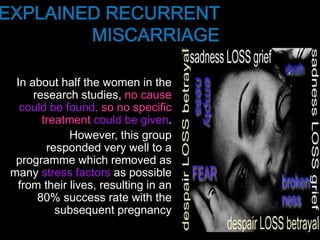
In about half the women in the
research studies, no cause
could be found, so no specific
treatment could be given.
However, this group
responded very well to a
programme which removed as
many stress factors as possible
from their lives, resulting in an
80% success rate with the
subsequent pregnancy
STRESS IN
RPL
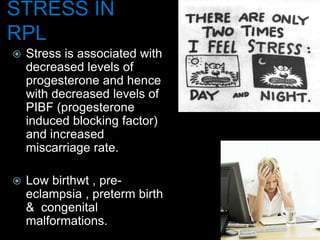
 Stress is associated with
decreased levels of
progesterone and hence
with decreased levels of
PIBF (progesterone
induced blocking factor)
and increased
miscarriage rate.
 Low birthwt , pre-
eclampsia , preterm birth
& congenital
malformations.
A R T FAILURES
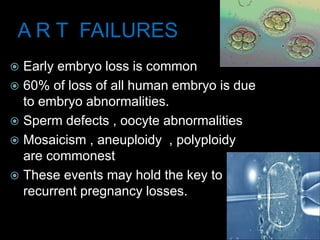
 Early embryo loss is common
 60% of loss of all human embryo is due
to embryo abnormalities.
 Sperm defects , oocyte abnormalities
 Mosaicism , aneuploidy , polyploidy
are commonest
 These events may hold the key to
recurrent pregnancy losses.
Things unlikely to cause recurrent
miscarriage
 Not resting enough - bedrest doesn't alter whether you
miscarry or not. Nor does working when you're pregnant,
exercise or flying.
Psychological support
 The value of psychological support in
improving pregnancy outcome has not
been tested in the form of a
randomized controlled trial. However,
data from several non-randomized
studies 86–88 have suggested that
attendance at a dedicated early
pregnancy clinic has a beneficial
effect, although the mechanism is
unclear .
 All professionals should be aware
of the psychological squeal
associated with miscarriage and
should provide support and follow-
up, as well as access to formal
counseling when necessary.
Women with unexplained recurrent
miscarriage have an excellent prognosis for
future pregnancy outcome without
pharmacological intervention ,if offered
supportive care alone in the setting of a
dedicated early pregnancy assessment
unit.
After all these investigations 50% of recurrent
aborters will be found to have no abnormalities
and these should be attributed to chromosomal
defect in the conceptus.
Fate
 A woman who has suffered a single
sporadic miscarriage has an 80%
chance and a woman with three
consecutive miscarriages a 60% chance
of her next pregnancy being successful
Recommendation
(RCOG,2001;ACOG,2001)
Investigations
1. Karyotyping of the peripheral blood of
parents & of the abortus
2. Pelivic US to assess ovarian
morphology &the uterine cavity
3. LA & Acl
CONCLUSIONS
 RPL is defined as three or more consecutive
losses before 20 weeks gestation
 RPL can have diverse etiologies including
genetic structural uterine endocrine infectors
thrombophilic immunologic and environmental
factors
 An indentcate etiology is not found in
30%<40% of RPL
 Treatment decisions should be based on
evidence form well –designed clinical trials
 RPL is Frustrating and frightening for couple
and and appropriate phychological support is
important

Recurrent Pregnancy Loss

  • 1.
  • 2.
    DEFINITION 3 Or moreconsecutive pregnancies ending spontaneously before viability. 2 Or more because recurrent risks & subsequent outcomes are similar for woman having 2 or 3 prior losses (Hill,1994) Recurrent early pregnancy loss:<15w(ACOG,2001) Or <20 W(Speroff,1999) Primary: No Previous full term pregnancy. Secondary: previous full term pregnancy. The prognosis of Secondary RPL is better than primary (Roman et al,1980).
  • 3.
  • 4.
    Is your BodyBaby – Friendly ?
  • 5.
    IMPACT OF THEPROBLEM  Couples: extreme distress  Doctor : Many causes & investigations but few specific treatment
  • 6.
    INCIDENCE  10–15% ofall clinically recognized pregnancies end in a miscarriage .  1% of reproductive aged women stirrat,1990  The risk is increased with age (>30 yr.).  RPL is 50% in those 40 yrs or older Clifford et al,1997  1St trimester losses account for 75% of RPL  2nd trimester losses the remaining 25%
  • 7.
    CAUSES  Can beestablished in only 30% Trout et al2000 to 50% ACOG 2001  Different from causes of single sporadic abortion  Persistent & proved each time  Some diseases cause sporadic but not repeated abortion  The contribution is different
  • 8.
    CAUSES  Possible  Doubtful Despite a through evolution no etiology is identified in 30-40 % of habitual abortion .  Treatment 65-75% chance
  • 9.
    POSSIBLE • Genetic 25% •Anatomic 10% • Endocrine: (5%) • Autoimmune (10%)
  • 10.
  • 11.
    Chromosomal fetal anomalies:25% Different from those in single spontaneous abortion :Aneuploidy:Trisomy:50% Due to non disjunction or translocation,Monosomy:25%,Triploidy:15%, Tetraploidy:5%, Structural anomaly:3% Chromosomal anomalies in the parents:5% Suggesting that the fetal abnormality is not secondary to a parental problem. Most frequently balanced translocation
  • 12.
    Effect of agingof the ovum or sperm: >days: increased chromosomal abnormalities (aneuploidy) Recurrence: Most occur as non-recurrent chance phenomenon, but if first abortion was chromosomally abnormal:increased risk of chromosomal abnormalities in subsequent pregnancies
  • 13.
    Diagnosis 1. Peripheral bloodkaryotyping of the parents in all couples with RPL 2. Karyotyping of the abort us (fetal/placental chromosome)
  • 14.
    Treatment: No treatment Gamete donation  Genetic counseling to alleviate stress  If aneuplody is documented: accurately timed insemination as aneuploidy is due to aging of ovum & sperm  If euploidy:look for other causes
  • 15.
    II. ANATOMIC 1.Congenital anomaliesof the uterus Incidence: 10% of RPL
  • 16.
    Types 1.Septate uterus: isthe most frequent abnormality associated with RPL Incidence of uterine septum in women with a history of RA is similar to that identified in women with reproductive histories (Simon et al,1999).septate or bicornuate uteri are unlikely to cause RPL (Balen,1999) 2.Bicornuate, didelphic,.unicornuate,DES uterus Mechanism Impaired vascularization of pregnancy & limited space for the fetus. However the vascular density of uterine septa is similar to that of the normal uterine wall (Dabiarashrafi et al,1995)
  • 17.
    Diagnosis: 1.TVS 2.Sonohysterography 3.3D US 4.HSG:as aroutine is questionable since it is associated with patient discomfort,risk of pelvic infection, relatively inaccurate & offers the same diagnostic sensitivitiy as TVS(Clifotd et al,1994). 5.Hysteroscopy 6.MRi
  • 18.
    Treatment Hysteroscopic division ofthe septum; reduction of miscarriage rate from 85% to 10% (Daiter,2001) Prophylactic cerclage has not been supported from RC study (Lazar et al, 1984). However when nothing else to offer,cerclage is worthwhile;e.g in patients with late losses & mullerian anomalies e.g bicornuate uterus or unicornuate uterus
  • 19.
    2.Cervical incompetence May cause2nd trimester abortion. it is thought to be over-diagnosed because there is no reliable diagnostic tests & the diagnosis is most commonly based on characteristic history. Cervical cerclage should only be considered when the history of miscarriage is preceded by spontaneous rupture of membranes or painless cervical dilatation. The MRC/RCOG trial of the use of cervical cerclage reported a small decrease in PTL,but no significant improvement in fetal survival (1993)(B)
  • 20.
    3.Submucous Fibroid Hysteroscopic removalof submucous fibroid 4.Severe Intrautrine synechiae Hysteroscopic treatment of severe IU Synechiae
  • 21.
    III. ENDOCRINE 1.D.M &thyroid disease Well controlled D.M.is not a risk factor for RPL, nor treated thyroid dysfunction. Routine screening for occult D.M&thyroid disease should not be performed in asymptomatic women with RPL.(C). The high frequency of hypothyroidism warrants screening of TSH(Plouffe et al,1992). Acguired uterine anomalies include uterine adhesions and leiomyomata
  • 22.
    IV.Autoimmune  Self Ag.=humoral or cellular response is directed against a specific component of the host.  Antiphospholipid Ad (aPL):Lupus anticoagulant (LA),anticardiolipin (aCL).Other aP1 are of no clinical value (c) (Branch et al,1997)  Mechanism: Abs are directed against platelets & vascular endothelium  Vascular damage, thrombosis &placental infarction abortion, fetal morbidity & death.
  • 23.
    Treatment  Low doseaspirin (75 mg daily)started at the time of positive pregnancy test together with low dose heparin(5000 iu SC/12h):Success:70%(A).  Treatment with aspirin & / or heparin is discontinued at 34 W.  Corticosteroids does not improve the live birth & since it is associated with significant maternal &fetal morbidity should be abandoned (Laskin et al,19997)(C)
  • 24.
    Environmental 1. Herbicide spraying 2.Electromagnetic field 3. Radiation 4. Street drugs 5. Inhalation of anesthetic gases 6. Exposure to solvents,heavy Metals & industrial chemicals.
  • 25.
     In onestudy by Viera et al. (1980), with anesthetic gases spontaneous abortion was observed in rats at 1000 ppm or more. According to NIOSH (1994), similar concentrations of 1000 ppm have been found in operating rooms and in dental operatories not equipped with scavenging systems.
  • 26.
    ENVIROMENTAL  Radiation (butnot working with VD Us),  Occupational exposure to chemicals (toluene.Xylene, formaline, some chemical disinfectants, glues, paints)& Pollution are causes of sporadic miscarriage, but not RPL (ACOG,2001).
  • 27.
     An australiangroup has assessed multiplicity of possible risk factors which increase RPL are age , visiting factories in the course of work , radiograms and home exposure to chemicals.  The observed rate of pregnancy loss ranged from 3.7 – 7.5% with multiple factors.
  • 28.
     Exposture tonoxious or toxic substances are known to be associated with recurrent miscarriage ( social drugs, cigarretes,alcohol and caffeine ,anaestetic gases,petrolium products )
  • 29.
    A large-scale Danishstudy polled more than 80,000 pregnant women regarding their coffee intake. This study found that women who drank large amounts of coffee during pregnancy were more likely to experience a miscarriage. Women who drank more than 2 cups of coffee a day had a slightly increased risk of miscarriage, while those that drank 8 or more cups experienced a 59% increase.
  • 30.
    •Cigarettes accounted forabout 11% of all spontaneous abortions(40% in women who smoked 20 or more cigarettes per day.) Am J Public health 1992 • Alcohol consumption for about 5% (45% in women drinking 3 or more drinks per day) •Coffee for about 2% (16% in women drinking 10 cups per day).
  • 31.
    INFECTIONS • Toxoplasmosis, rubella,CMV,herpes,listeria, Chlamydia, Mycoplasma infections are not causes of RPL ACOG,2001 & performance of TORCH is invariably uninformative summers,1994 • Management: It is more cost effective & time efficient to give Doxycycline (100 mg twice daily for14 days)or erythromycin (250 mg qid for 14 d) than to do multiple cultures speroff,1999
  • 32.
     Bacterial vaginosisincluding infection with G.vaginalis m.Hominis has been associated with pregnancy loss .  Empiric antibiotic treatment with doxycycline & erythromycin is frequently prescribed
  • 33.
     TORCH (toxoplasmosisrubella, cytomegalovirus and herpes simplex virus), other [congenital syphilis and viruses], screening is unhelpful in the investigation of recurrent miscarriage.  For an infective agent to be implicated in the etiology of repeated pregnancy loss, it must be capable of persisting in the genital tract and avoiding detection or must cause insufficient symptoms to disturb the women. Toxoplasmosis, rubella, cytomegalovirus, herpes and listeria infections do not fulfil these criteria and routine TORCH screening should be abandoned.
  • 34.
     Screening forand treatment of bacterial vaginosis in early pregnancy among high risk women with a previous history of second-trimester miscarriage or spontaneous preterm labour may reduce the risk of recurrent late loss and preterm birth.
  • 35.
    Group B Streptococcus Pre and Post-conceptional, broad- spectrum intravenous antibiotic therapy was used in patients with multiple miscarriages  Although this is a relatively small series and does not establish a cause and effect relationship between Group B Streptococcus and habitual abortions, the beneficial effects of antibiotic therapy is unquestionable .
  • 37.
     Miscarriage isusually a random event, not a sign of an ongoing reproductive problem. If you have had one miscarriage, your chances for future successful pregnancies are good.
  • 38.
    Bacterial Vaginosis Def :A polymicrobial superficial vaginal infection involving a loss of normal lactobacilli & overgrowth of anaerobes such as gardnerella , bacteroides , mycoplasma , mobiluncus & peptostreptococcus Inci : 8 to 20% in pregnant women No sign or symptoms at all. 50% complain of fishy vaginal discharge , itching , burning urination
  • 39.
    Risk Factors  Exposureto multiple sexual partners.  Vaginal douching for hygiene.  Presence of I U D  Presence of foreign body eg : retained tampoons.  Although BV is not classified as a STD currently , there is evidence that it does hav sexual transmission.
  • 40.
    Mechanism of action Enzyme phospholipase A2 responsible for prostaglandin synthesis.  Bacterial end products increase prostaglandin E2 production by amnion cells – cervical effacement & uterine contraction .  Endotoxins induce macrophages & monocytes to produce TNF & interleukin -1 which stimulate prostaglandin synthesis.
  • 41.
     Most inflammatorylesions of chorion , amnion & umbilical cord are due to infection.  Bacteria hav been recovered from 72% of placenta of women with clinical & histological evidence of chorioamnionitis.  In BV even with intact membranes were able to infect amniotic fluid & invite production of cytokines that induce labour.
  • 42.
    Diagnostic Criteria A. HomogenousVaginal Discharge B. Asymptomatic women should hav at least 2 of the following criteria : 1. Presence of clue cells 2. Whiff test 3. Vaginal ph >4.5 4. Absence of normal vaginal lactobacilli
  • 43.
    • DNA probetest : automated system detects gardnerella , candida , trichomonas . • FEM EXAM test card : detection of elevated ph & presence of amine in a colorimetric card format. • Rapid colorimetric test : to detect proline iminopeptidase - G vaginalis • CARE PLAN vaginal ph gloves • TAMPOONS
  • 44.
    Effects of Bacterial Vaginosis Amniotic fluid infection  Chorion amnionitis  Preterm Premature Rupture of membranes  Preterm labour  Low birth weight  Postpartum endometritis
  • 45.
    When To Screen At first visit and again at 20 wks  Preconception screening for abnormal vaginal flora 6 wks prior to conception in patients with previous history of BV.  Screening at booking and at 36 wks along with screening for group beta streptococcal colonisation.
  • 46.
    TREATMENT  Local vaginalcreams / gels  Systemic antibiotic therapy : metronidazole & clindamycin hav cure rate of 80 to 95 %  Lactobacilli vaginal pessary / gel  Lactobacilli tablets – Rhamnosus GR-1 , RC -14 .
  • 47.
     In arandomised control trial combining GR-1 with metronidazole , showed some benefit in black african women .  These can be used in non-pregnant state as their use during pregnancy has not been tested yet.
  • 48.
    In about halfthe women in the research studies, no cause could be found, so no specific treatment could be given. However, this group responded very well to a programme which removed as many stress factors as possible from their lives, resulting in an 80% success rate with the subsequent pregnancy
  • 49.
    STRESS IN RPL  Stressis associated with decreased levels of progesterone and hence with decreased levels of PIBF (progesterone induced blocking factor) and increased miscarriage rate.  Low birthwt , pre- eclampsia , preterm birth & congenital malformations.
  • 50.
    A R TFAILURES  Early embryo loss is common  60% of loss of all human embryo is due to embryo abnormalities.  Sperm defects , oocyte abnormalities  Mosaicism , aneuploidy , polyploidy are commonest  These events may hold the key to recurrent pregnancy losses.
  • 51.
    Things unlikely tocause recurrent miscarriage  Not resting enough - bedrest doesn't alter whether you miscarry or not. Nor does working when you're pregnant, exercise or flying.
  • 52.
    Psychological support  Thevalue of psychological support in improving pregnancy outcome has not been tested in the form of a randomized controlled trial. However, data from several non-randomized studies 86–88 have suggested that attendance at a dedicated early pregnancy clinic has a beneficial effect, although the mechanism is unclear .  All professionals should be aware of the psychological squeal associated with miscarriage and should provide support and follow- up, as well as access to formal counseling when necessary.
  • 53.
    Women with unexplainedrecurrent miscarriage have an excellent prognosis for future pregnancy outcome without pharmacological intervention ,if offered supportive care alone in the setting of a dedicated early pregnancy assessment unit. After all these investigations 50% of recurrent aborters will be found to have no abnormalities and these should be attributed to chromosomal defect in the conceptus.
  • 54.
    Fate  A womanwho has suffered a single sporadic miscarriage has an 80% chance and a woman with three consecutive miscarriages a 60% chance of her next pregnancy being successful
  • 56.
    Recommendation (RCOG,2001;ACOG,2001) Investigations 1. Karyotyping ofthe peripheral blood of parents & of the abortus 2. Pelivic US to assess ovarian morphology &the uterine cavity 3. LA & Acl
  • 57.
    CONCLUSIONS  RPL isdefined as three or more consecutive losses before 20 weeks gestation  RPL can have diverse etiologies including genetic structural uterine endocrine infectors thrombophilic immunologic and environmental factors  An indentcate etiology is not found in 30%<40% of RPL  Treatment decisions should be based on evidence form well –designed clinical trials  RPL is Frustrating and frightening for couple and and appropriate phychological support is important