welcome . 
1
PRESENTATION BY, 
JERRY PAUL VARGHESE 
REG.NO:11021149 
SNGIST 2 
GUIDED BY: 
SHINE JOB 
SENIOR TUTOR 
DEPT. OF CIVIL ENGINEERING 
SNGIST
Introduction 
Introduction to nano materials 
Applications in civil engineering 
• Concrete 
• Steel 
• High strength bolts 
• Nanotech in glass 
• Fire and heat protection 
 Nanotechnology in other disciplines 
 Introductions to some new technology using nanotehnology 
 Conclusion 
 References 
3
 Nanotechnology deals with understanding, controlling and 
manipulating the matter at the level of individual atoms and 
molecules at the range of 0.1-100nm. 
“Nanotechnology is an enabling technology that allows us 
to develop materials with improved or totally new 
properties” 
 A nanometer is a billionth of a meter. 
At the length scale of the nanometer ,10-9m,the 
properties of the material actually become affected. 
NANOTECHNOLOGY IN CIVIL ENGINEERING 4
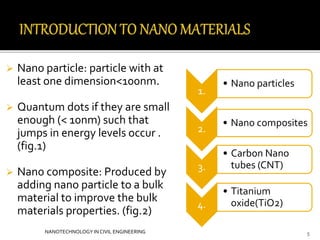
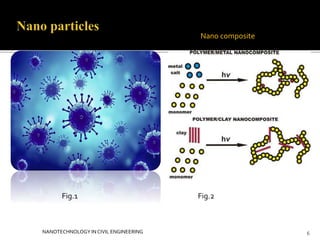
 Nano particle: particle with at 
least one dimension<100nm. 
 Quantum dots if they are small 
enough (< 10nm) such that 
jumps in energy levels occur . 
(fig.1) 
 Nano composite: Produced by 
adding nano particle to a bulk 
material to improve the bulk 
materials properties. (fig.2) 
5 
1. 
• Nano particles 
2. 
• Nano composites 
3. 
• Carbon Nano 
tubes (CNT) 
4. 
• Titanium 
oxide(TiO2) 
NANOTECHNOLOGY IN CIVIL ENGINEERING
6 
Fig.1 Fig.2 
NANOTECHNOLOGY IN CIVIL ENGINEERING 
Nano composite
7
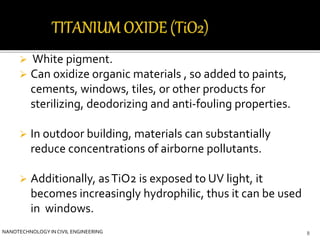
 White pigment. 
 Can oxidize organic materials , so added to paints, 
cements, windows, tiles, or other products for 
sterilizing, deodorizing and anti-fouling properties. 
 In outdoor building, materials can substantially 
reduce concentrations of airborne pollutants. 

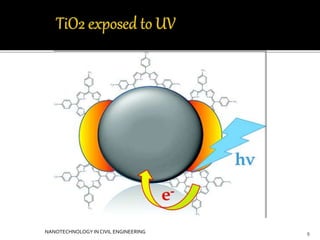
 Additionally, as TiO2 is exposed to UV light, it 
becomes increasingly hydrophilic, thus it can be used 
in windows. 
NANOTECHNOLOGY IN CIVIL ENGINEERING 8
NANOTECHNOLOGY IN CIVIL ENGINEERING 9
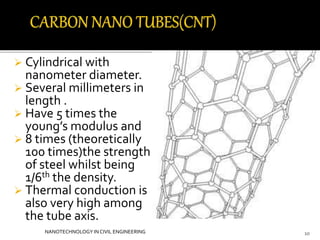
 Cylindrical with 
nanometer diameter. 
 Several millimeters in 
length . 
 Have 5 times the 
young’s modulus and 
 8 times (theoretically 
100 times)the strength 
of steel whilst being 
1/6th the density. 
 Thermal conduction is 
also very high among 
the tube axis. 
NANOTECHNOLOGY IN CIVIL ENGINEERING 10
11
 CONSTRUCTION 
 Inevitably be a beneficiary 
 Already is in the fields of concrete, steel and 
Glass, and many more. 
 Concrete is stronger ,more durable and more 
easily placed: 
 Steel is made tougher: 
 Glass is self-cleaning. 
 Paints are made more insulating and water 
repelling. 
NANOTECHNOLOGY IN CIVIL ENGINEERING 12
NANOTECHNOLOGY IN CIVIL ENGINEERING 13
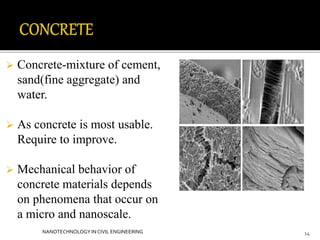
 Concrete-mixture of cement, 
sand(fine aggregate) and 
water. 
 As concrete is most usable. 
Require to improve. 
 Mechanical behavior of 
concrete materials depends 
on phenomena that occur on 
a micro and nanoscale. 
NANOTECHNOLOGY IN CIVIL ENGINEERING 14
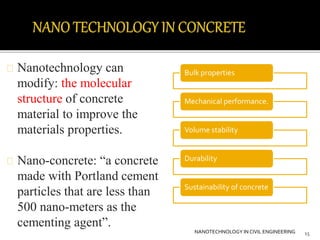
Nanotechnology can 
modify: the molecular 
structure of concrete 
material to improve the 
materials properties. 
Nano-concrete: “a concrete 
made with Portland cement 
particles that are less than 
500 nano-meters as the 
cementing agent”. 
15 
Bulk properties 
Mechanical performance. 
Volume stability 
Durability 
Sustainability of concrete 
NANOTECHNOLOGY IN CIVIL ENGINEERING
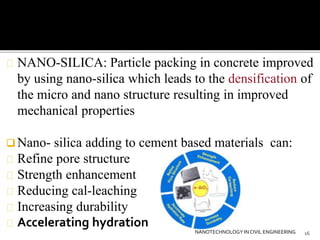
NANO-SILICA: Particle packing in concrete improved 
by using nano-silica which leads to the densification of 
the micro and nano structure resulting in improved 
mechanical properties 
Nano- silica adding to cement based materials can: 
Refine pore structure 
Strength enhancement 
Reducing cal-leaching 
Increasing durability 
Accelerating hydration 
NANOTECHNOLOGY IN CIVIL ENGINEERING 16
 Average size of Portland cement particle 
is about 50 microns. 
In thinner products for faster setting time, 
micro cement with maximum particle size 
of about 5 microns is being used. 
Hydration tests indicated that the nano-cement 
had a more rapid hydration rate 
17
Can be used as an excellent reflective coating. 
Hydrophilic and therefore gives self cleaning 
properties to surfaces to which it is applied. 
Rain water is attracted to the surface and 
forms sheets . 
The resulting concrete ,already used in 
projects around the world has a white color 
that retains its whiteness very effectively 
unlike the stained building of the material’s 
pioneering past. 
18
The addition of small amounts (1%wt)of CNT’s 
can improve the mechanical properties of 
samples consisting of the main Portland cement 
phase and water. 
Oxidized multi-walled nano tubes (MWNT’s) 
show the best improvements both in 
compressive strength(+25N/mm2) and flexural 
strength(+8N/mm2)compared to the samples 
without the reinforcement. 
A number of investigations have been carried 
out for developing smart concrete using carbon 
fibers. 
19
20
Fatigue leads to the structural failure of steel 
subject to cyclic loading, such as in bridge or 
towers. 
Stress risers are responsible for initiating cracks 
from which fatigue failure results and research has 
shown that the addition of copper nanoparticle 
reduces the surface unevenness of steel which then 
limits the number of stress risers. 
Advancements in this technology lead to increased 
safety, less need for monitoring and more efficient 
materials use in construction prone to fatigue 
issues. 
21
Above 75 deg.Fa,regular steel starts to lose its 
structural integrity ,and at 1100 F, steel loses 
50% of its strength. 
With nano scale copper particles ,this formula 
could maintain structural integrity at 
temperatures up to 1000 F. 
The new steel allows ultra-high strength to be 
combined with good formability, corrosion 
resistance and a good surface finish. 
22
Cementite phase of steel to a Nano-size has 
produced stronger cables. 
A stronger cable material reduces cost, 
period of constructon ,especially in 
suspension bridges. 
Sustainability is also enhanced by the use 
of higher cable strength as this leads to a 
more efficient use of materials. 
23
The capacity of high strength bolts is realized 
generally through quenching and tempering 
The microstructures consists of tempered 
martensite. 
Vanadium and molybdenum nanoparticles 
delays the problems associated with high 
strength bolts and also improving the steel’s 
micro- structure 
24
Sandvik nanoflex 
1. Produced by Sandvik Materials Technology 
 MMFX2 steel 
1. Produced by MMFX steel corp. 
25
TiO2 is used in nanoparticle form to coat glazing 
since it has sterilizing and anti-fouling 
properties. 
Catalyzing reactions-breakdown organic 
pollutants, volatile organic compounds and 
bacterial membranes. 
It is hydrophilic and this attraction to water 
forms sheets out of rain drops which then wash 
off the dirt particles broken down in the previous 
process. 
Glass incorporation this self cleaning technology 
is available on the market today. 
26
SELF CLEANING GLASSES. 
Major problems facing :Light and heat 
entering through glazing-rain drops-organic 
pollutants-volatile organic compounds and 
bacterial membranes. 
27
Fire-protective glass 
• Achieved by using a clear instumescent layer 
sandwiched between glass panels (an 
interlayer) formed of fumed silica(SIO2) 
Nanoparticle which turns into a rigid and 
opaque fire shield when heated. 
28
For heat protection: thin film coatings 
developed which are spectrally sensitive 
surface applications for window glass and 
filter out unwanted I.R frequencies of light 
.(passive solution) 
As an active solution, thermo chromatic 
technologies are being studied which react to 
temperature and provide insulation to give 
protection from heating whilst maintaining 
adequate lighting. 
29
30
Wood is also comprised of nanotubes or nano 
fibrils -lignocelluloses are twice as strong as 
steel . 
Lignocelluloses surfaces at the nanoscale 
could open new opportunities for such things 
as self-sterilizing surfaces, internal self-repair, 
and electronic lignocelluloses devices. 
31
Currently,however,research in these Areas 
appears limited. 
Researchers have developed highly water 
repellent coating based on the actions of 
lotus leaf as a result of the incorporation of 
silica and alumina nanoparticles and 
hydrophobic polymers . 
32
Applied to paints -insulating properties-produced 
by the addition of nano-sized cells - 
giving very limited paths for thermal conduction 
(R values are double for insulating foam),are 
currently available. 
This type of paint is used ,for corrosion 
protection under insulation since it Is 
hydrophobic and repels water from the metal 
pipe and can also protect metal from sat water 
attack. 
33
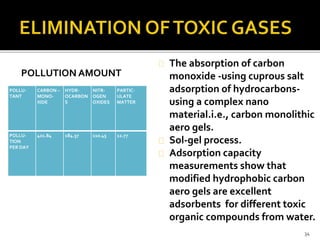
POLLUTION AMOUNT 
POLLU-TANT 
CARBON – 
MONO-XIDE 
HYDR-OCARBON 
S 
NITR-OGEN 
OXIDES 
PARTIC-ULATE 
MATTER 
POLLU-TION 
PER DAY 
421.84 184.37 110.45 12.77 
The absorption of carbon 
monoxide -using cuprous salt 
adsorption of hydrocarbons-using 
a complex nano 
material.i.e., carbon monolithic 
aero gels. 
Sol-gel process. 
Adsorption capacity 
measurements show that 
modified hydrophobic carbon 
aero gels are excellent 
adsorbents for different toxic 
organic compounds from water. 
34
FLEXIBLE DISPLAY 
DIRT NON-STICKY WALL 
OIL REPELENT METAL 
WATER RESISATANT SURFACE 
35
36
Because of their small particle size, nano 
particles have the potential to negatively 
affect the respiratory and digestive tracks 
and the skin or eye surface thus exposes 
workers to hazards. 
▪ 
Small production volumes and high cost 
remain the main barriers to the use of 
nanotechnology . 
37
Nano-science and nanotechnology help seed 
construction related nano-technological 
development. 
Nanotechnology has its biggest impact on 
the field of civil engineering. 
38
[1] Mann, S. (2006). “Nanotechnology and Construction,” 
Nanoforum Report. www.nanoforum.org, May 30, 
2008. 
[2] Balaguru, P. N., “Nanotechnology and Concrete: 
Background, Opportunities and Challenges.” Proceedings 
of the International Conference – Application of Technology 
in Concrete Design, Scotland, UK, p.113-122, 
2005. 
[3] ARI News (2005). “Nanotechnology in Construction – One 
of the Top Ten Answers to World’s Biggest 
Problems.” 
www.aggregateresearch.com/article.asp?id=6279, June 1, 
2007. 
39
40

nano technology in civil engineering

  • 1.
  • 2.
    PRESENTATION BY, JERRYPAUL VARGHESE REG.NO:11021149 SNGIST 2 GUIDED BY: SHINE JOB SENIOR TUTOR DEPT. OF CIVIL ENGINEERING SNGIST
  • 3.
    Introduction Introduction tonano materials Applications in civil engineering • Concrete • Steel • High strength bolts • Nanotech in glass • Fire and heat protection  Nanotechnology in other disciplines  Introductions to some new technology using nanotehnology  Conclusion  References 3
  • 4.
     Nanotechnology dealswith understanding, controlling and manipulating the matter at the level of individual atoms and molecules at the range of 0.1-100nm. “Nanotechnology is an enabling technology that allows us to develop materials with improved or totally new properties”  A nanometer is a billionth of a meter. At the length scale of the nanometer ,10-9m,the properties of the material actually become affected. NANOTECHNOLOGY IN CIVIL ENGINEERING 4
  • 5.
     Nano particle:particle with at least one dimension<100nm.  Quantum dots if they are small enough (< 10nm) such that jumps in energy levels occur . (fig.1)  Nano composite: Produced by adding nano particle to a bulk material to improve the bulk materials properties. (fig.2) 5 1. • Nano particles 2. • Nano composites 3. • Carbon Nano tubes (CNT) 4. • Titanium oxide(TiO2) NANOTECHNOLOGY IN CIVIL ENGINEERING
  • 6.
    6 Fig.1 Fig.2 NANOTECHNOLOGY IN CIVIL ENGINEERING Nano composite
  • 7.
  • 8.
     White pigment.  Can oxidize organic materials , so added to paints, cements, windows, tiles, or other products for sterilizing, deodorizing and anti-fouling properties.  In outdoor building, materials can substantially reduce concentrations of airborne pollutants.  Additionally, as TiO2 is exposed to UV light, it becomes increasingly hydrophilic, thus it can be used in windows. NANOTECHNOLOGY IN CIVIL ENGINEERING 8
  • 9.
  • 10.
     Cylindrical with nanometer diameter.  Several millimeters in length .  Have 5 times the young’s modulus and  8 times (theoretically 100 times)the strength of steel whilst being 1/6th the density.  Thermal conduction is also very high among the tube axis. NANOTECHNOLOGY IN CIVIL ENGINEERING 10
  • 11.
  • 12.
     CONSTRUCTION Inevitably be a beneficiary  Already is in the fields of concrete, steel and Glass, and many more.  Concrete is stronger ,more durable and more easily placed:  Steel is made tougher:  Glass is self-cleaning.  Paints are made more insulating and water repelling. NANOTECHNOLOGY IN CIVIL ENGINEERING 12
  • 13.
  • 14.
     Concrete-mixture ofcement, sand(fine aggregate) and water.  As concrete is most usable. Require to improve.  Mechanical behavior of concrete materials depends on phenomena that occur on a micro and nanoscale. NANOTECHNOLOGY IN CIVIL ENGINEERING 14
  • 15.
    Nanotechnology can modify:the molecular structure of concrete material to improve the materials properties. Nano-concrete: “a concrete made with Portland cement particles that are less than 500 nano-meters as the cementing agent”. 15 Bulk properties Mechanical performance. Volume stability Durability Sustainability of concrete NANOTECHNOLOGY IN CIVIL ENGINEERING
  • 16.
    NANO-SILICA: Particle packingin concrete improved by using nano-silica which leads to the densification of the micro and nano structure resulting in improved mechanical properties Nano- silica adding to cement based materials can: Refine pore structure Strength enhancement Reducing cal-leaching Increasing durability Accelerating hydration NANOTECHNOLOGY IN CIVIL ENGINEERING 16
  • 17.
     Average sizeof Portland cement particle is about 50 microns. In thinner products for faster setting time, micro cement with maximum particle size of about 5 microns is being used. Hydration tests indicated that the nano-cement had a more rapid hydration rate 17
  • 18.
    Can be usedas an excellent reflective coating. Hydrophilic and therefore gives self cleaning properties to surfaces to which it is applied. Rain water is attracted to the surface and forms sheets . The resulting concrete ,already used in projects around the world has a white color that retains its whiteness very effectively unlike the stained building of the material’s pioneering past. 18
  • 19.
    The addition ofsmall amounts (1%wt)of CNT’s can improve the mechanical properties of samples consisting of the main Portland cement phase and water. Oxidized multi-walled nano tubes (MWNT’s) show the best improvements both in compressive strength(+25N/mm2) and flexural strength(+8N/mm2)compared to the samples without the reinforcement. A number of investigations have been carried out for developing smart concrete using carbon fibers. 19
  • 20.
  • 21.
    Fatigue leads tothe structural failure of steel subject to cyclic loading, such as in bridge or towers. Stress risers are responsible for initiating cracks from which fatigue failure results and research has shown that the addition of copper nanoparticle reduces the surface unevenness of steel which then limits the number of stress risers. Advancements in this technology lead to increased safety, less need for monitoring and more efficient materials use in construction prone to fatigue issues. 21
  • 22.
    Above 75 deg.Fa,regularsteel starts to lose its structural integrity ,and at 1100 F, steel loses 50% of its strength. With nano scale copper particles ,this formula could maintain structural integrity at temperatures up to 1000 F. The new steel allows ultra-high strength to be combined with good formability, corrosion resistance and a good surface finish. 22
  • 23.
    Cementite phase ofsteel to a Nano-size has produced stronger cables. A stronger cable material reduces cost, period of constructon ,especially in suspension bridges. Sustainability is also enhanced by the use of higher cable strength as this leads to a more efficient use of materials. 23
  • 24.
    The capacity ofhigh strength bolts is realized generally through quenching and tempering The microstructures consists of tempered martensite. Vanadium and molybdenum nanoparticles delays the problems associated with high strength bolts and also improving the steel’s micro- structure 24
  • 25.
    Sandvik nanoflex 1.Produced by Sandvik Materials Technology  MMFX2 steel 1. Produced by MMFX steel corp. 25
  • 26.
    TiO2 is usedin nanoparticle form to coat glazing since it has sterilizing and anti-fouling properties. Catalyzing reactions-breakdown organic pollutants, volatile organic compounds and bacterial membranes. It is hydrophilic and this attraction to water forms sheets out of rain drops which then wash off the dirt particles broken down in the previous process. Glass incorporation this self cleaning technology is available on the market today. 26
  • 27.
    SELF CLEANING GLASSES. Major problems facing :Light and heat entering through glazing-rain drops-organic pollutants-volatile organic compounds and bacterial membranes. 27
  • 28.
    Fire-protective glass •Achieved by using a clear instumescent layer sandwiched between glass panels (an interlayer) formed of fumed silica(SIO2) Nanoparticle which turns into a rigid and opaque fire shield when heated. 28
  • 29.
    For heat protection:thin film coatings developed which are spectrally sensitive surface applications for window glass and filter out unwanted I.R frequencies of light .(passive solution) As an active solution, thermo chromatic technologies are being studied which react to temperature and provide insulation to give protection from heating whilst maintaining adequate lighting. 29
  • 30.
  • 31.
    Wood is alsocomprised of nanotubes or nano fibrils -lignocelluloses are twice as strong as steel . Lignocelluloses surfaces at the nanoscale could open new opportunities for such things as self-sterilizing surfaces, internal self-repair, and electronic lignocelluloses devices. 31
  • 32.
    Currently,however,research in theseAreas appears limited. Researchers have developed highly water repellent coating based on the actions of lotus leaf as a result of the incorporation of silica and alumina nanoparticles and hydrophobic polymers . 32
  • 33.
    Applied to paints-insulating properties-produced by the addition of nano-sized cells - giving very limited paths for thermal conduction (R values are double for insulating foam),are currently available. This type of paint is used ,for corrosion protection under insulation since it Is hydrophobic and repels water from the metal pipe and can also protect metal from sat water attack. 33
  • 34.
    POLLUTION AMOUNT POLLU-TANT CARBON – MONO-XIDE HYDR-OCARBON S NITR-OGEN OXIDES PARTIC-ULATE MATTER POLLU-TION PER DAY 421.84 184.37 110.45 12.77 The absorption of carbon monoxide -using cuprous salt adsorption of hydrocarbons-using a complex nano material.i.e., carbon monolithic aero gels. Sol-gel process. Adsorption capacity measurements show that modified hydrophobic carbon aero gels are excellent adsorbents for different toxic organic compounds from water. 34
  • 35.
    FLEXIBLE DISPLAY DIRTNON-STICKY WALL OIL REPELENT METAL WATER RESISATANT SURFACE 35
  • 36.
  • 37.
    Because of theirsmall particle size, nano particles have the potential to negatively affect the respiratory and digestive tracks and the skin or eye surface thus exposes workers to hazards. ▪ Small production volumes and high cost remain the main barriers to the use of nanotechnology . 37
  • 38.
    Nano-science and nanotechnologyhelp seed construction related nano-technological development. Nanotechnology has its biggest impact on the field of civil engineering. 38
  • 39.
    [1] Mann, S.(2006). “Nanotechnology and Construction,” Nanoforum Report. www.nanoforum.org, May 30, 2008. [2] Balaguru, P. N., “Nanotechnology and Concrete: Background, Opportunities and Challenges.” Proceedings of the International Conference – Application of Technology in Concrete Design, Scotland, UK, p.113-122, 2005. [3] ARI News (2005). “Nanotechnology in Construction – One of the Top Ten Answers to World’s Biggest Problems.” www.aggregateresearch.com/article.asp?id=6279, June 1, 2007. 39
  • 40.

Editor's Notes

  • #3 Grt priv For semi on the topic NANO ON ce concentratin to its apps As I ws colectng th infrmations…I found its numerous in count ,bt due to the lited time for prsnttion I would like to give a strong base of knowledge abt nanotech applications in ce .in this presentation I have included
  • #25 Martn- carbonn steel with rapid coolin..crystls formed.austenite