NANOTECHNOLOGY IN CIVIL
ENGINEERING AND
CONSTRUCTION
PIYUSH P BAGDE
2ND SEMESTER
ME-CIVIL (CONSTRUCTION MANAGEMENT)
IMPERIAL COLLEGE OF ENGINEERING AND RESEARCH,
WAGHOLI, PUNE
WHAT IS NANO
TECHNOLOGY ?
• Nanotechnology is the use of very small particles of material
either by themselves or by their manipulation to create new
large scale materials.
• Nanotechnology is the re-engineering of materials by
controlling the matter at the atomic level.
• The properties of materials are dramatically affected under a
scale of Nano meter [10-9 meter].
CONSTRUCTION INDUSTRY &
NANOTECHNOLOGY
Nanomaterials offer many improved performance
properties for adhesives, concrete, coatings, flooring,
glass, lighting equipment, plumbing fixtures and other
construction products.
Construction Industry has undergone tremendous
change in the past two centuries. What affected it most
was the industrial revolution and its resultant outcome
in terms of
steel,
cement and
other building materials.
The twentieth century saw further refinement in the
same with even more sophisticated techniques and
devices. Now, it has to move in the next phase where
inputs are less and lighter, they are smooth and
sturdier; they are cost effective, cleaner and
sustainable. It has to move towards more
CONSTRUCTION INDUSTRY &
NANOTECHNOLOGY
Nanomaterials in Different
Construction Materials
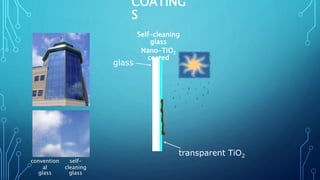
Various
Protective
Nanocoating
COATING
S
convention
al
glass
self-
cleaning
glass
Self-cleaning
glass
Nano-TiO2
coated
glass
transparent TiO2
PHOTOVOLTAIC
S
•Predominant photovoltaic
material is silicon, but an
emerging technology
involves the use of dye-
sensitized nano-TiO2.
•Large surface area of Nano
TiO2 greatly increases
photovoltaic efficiency.
•Also has potential for lower
material and processing
costs relative to conventional
solar cells.
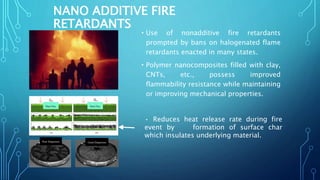
NANO ADDITIVE FIRE
RETARDANTS
•Use of nonadditive fire retardants
prompted by bans on halogenated flame
retardants enacted in many states.
•Polymer nanocomposites filled with clay,
CNTs, etc., possess improved
flammability resistance while maintaining
or improving mechanical properties.
Poor Dispersion Good Dispersion
Heat Flux Heat Flux
• Reduces heat release rate during fire
event by formation of surface char
which insulates underlying material.
VARIOUS NANOMATERIALS IN BUILDING
MATERIALS
• i) Titanium dioxide (TiO2)
• ii) Carbon Nanotubes
(CNT’s)
• iii) Nano silica(ns)
• iv) Poly-carboxylates
• v) Nano Zro2, etc.
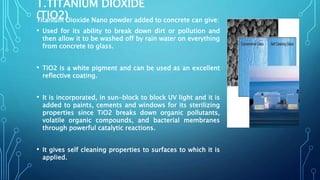
1.TITANIUM DIOXIDE
(TIO2)Titanium Dioxide Nano powder added to concrete can give:
• Used for its ability to break down dirt or pollution and
then allow it to be washed off by rain water on everything
from concrete to glass.
• TiO2 is a white pigment and can be used as an excellent
reflective coating.
• It is incorporated, in sun-block to block UV light and it is
added to paints, cements and windows for its sterilizing
properties since TiO2 breaks down organic pollutants,
volatile organic compounds, and bacterial membranes
through powerful catalytic reactions.
• It gives self cleaning properties to surfaces to which it is
applied.
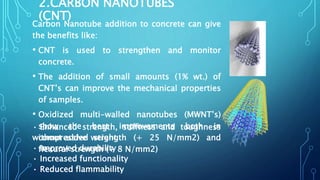
2.CARBON NANOTUBES
(CNT)
Carbon Nanotube addition to concrete can give
the benefits like:
• CNT is used to strengthen and monitor
concrete.
• The addition of small amounts (1% wt.) of
CNT’s can improve the mechanical properties
of samples.
• Oxidized multi-walled nanotubes (MWNT’s)
show the best improvements both in
compressive strength (+ 25 N/mm2) and
flexural strength (+ 8 N/mm2)
• Enhanced strength, stiffness and toughness
without added weight
• Improved durability
• Increased functionality
• Reduced flammability
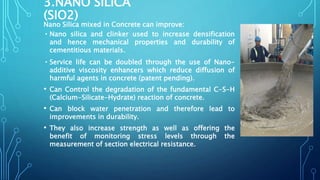
3.NANO SILICA
(SIO2)
Nano Silica mixed in Concrete can improve:
•Nano silica and clinker used to increase densification
and hence mechanical properties and durability of
cementitious materials.
•Service life can be doubled through the use of Nano-
additive viscosity enhancers which reduce diffusion of
harmful agents in concrete (patent pending).
• Can Control the degradation of the fundamental C-S-H
(Calcium-Silicate-Hydrate) reaction of concrete.
• Can block water penetration and therefore lead to
improvements in durability.
• They also increase strength as well as offering the
benefit of monitoring stress levels through the
measurement of section electrical resistance.
BY APPLYING NANO TECHNOLOGY IN
CONSTRUCTION INDUSTRY OUR MOTHER EARTH
WILL BE,
CLEAN AND
THANKYO
U

Nanotechnology in civil engineering and construction

  • 1.
    NANOTECHNOLOGY IN CIVIL ENGINEERINGAND CONSTRUCTION PIYUSH P BAGDE 2ND SEMESTER ME-CIVIL (CONSTRUCTION MANAGEMENT) IMPERIAL COLLEGE OF ENGINEERING AND RESEARCH, WAGHOLI, PUNE
  • 2.
    WHAT IS NANO TECHNOLOGY? • Nanotechnology is the use of very small particles of material either by themselves or by their manipulation to create new large scale materials. • Nanotechnology is the re-engineering of materials by controlling the matter at the atomic level. • The properties of materials are dramatically affected under a scale of Nano meter [10-9 meter].
  • 3.
    CONSTRUCTION INDUSTRY & NANOTECHNOLOGY Nanomaterialsoffer many improved performance properties for adhesives, concrete, coatings, flooring, glass, lighting equipment, plumbing fixtures and other construction products. Construction Industry has undergone tremendous change in the past two centuries. What affected it most was the industrial revolution and its resultant outcome in terms of steel, cement and other building materials. The twentieth century saw further refinement in the same with even more sophisticated techniques and devices. Now, it has to move in the next phase where inputs are less and lighter, they are smooth and sturdier; they are cost effective, cleaner and sustainable. It has to move towards more
  • 4.
    CONSTRUCTION INDUSTRY & NANOTECHNOLOGY Nanomaterialsin Different Construction Materials Various Protective Nanocoating
  • 5.
  • 6.
    PHOTOVOLTAIC S •Predominant photovoltaic material issilicon, but an emerging technology involves the use of dye- sensitized nano-TiO2. •Large surface area of Nano TiO2 greatly increases photovoltaic efficiency. •Also has potential for lower material and processing costs relative to conventional solar cells.
  • 7.
    NANO ADDITIVE FIRE RETARDANTS •Useof nonadditive fire retardants prompted by bans on halogenated flame retardants enacted in many states. •Polymer nanocomposites filled with clay, CNTs, etc., possess improved flammability resistance while maintaining or improving mechanical properties. Poor Dispersion Good Dispersion Heat Flux Heat Flux • Reduces heat release rate during fire event by formation of surface char which insulates underlying material.
  • 8.
    VARIOUS NANOMATERIALS INBUILDING MATERIALS • i) Titanium dioxide (TiO2) • ii) Carbon Nanotubes (CNT’s) • iii) Nano silica(ns) • iv) Poly-carboxylates • v) Nano Zro2, etc.
  • 9.
    1.TITANIUM DIOXIDE (TIO2)Titanium DioxideNano powder added to concrete can give: • Used for its ability to break down dirt or pollution and then allow it to be washed off by rain water on everything from concrete to glass. • TiO2 is a white pigment and can be used as an excellent reflective coating. • It is incorporated, in sun-block to block UV light and it is added to paints, cements and windows for its sterilizing properties since TiO2 breaks down organic pollutants, volatile organic compounds, and bacterial membranes through powerful catalytic reactions. • It gives self cleaning properties to surfaces to which it is applied.
  • 10.
    2.CARBON NANOTUBES (CNT) Carbon Nanotubeaddition to concrete can give the benefits like: • CNT is used to strengthen and monitor concrete. • The addition of small amounts (1% wt.) of CNT’s can improve the mechanical properties of samples. • Oxidized multi-walled nanotubes (MWNT’s) show the best improvements both in compressive strength (+ 25 N/mm2) and flexural strength (+ 8 N/mm2) • Enhanced strength, stiffness and toughness without added weight • Improved durability • Increased functionality • Reduced flammability
  • 11.
    3.NANO SILICA (SIO2) Nano Silicamixed in Concrete can improve: •Nano silica and clinker used to increase densification and hence mechanical properties and durability of cementitious materials. •Service life can be doubled through the use of Nano- additive viscosity enhancers which reduce diffusion of harmful agents in concrete (patent pending). • Can Control the degradation of the fundamental C-S-H (Calcium-Silicate-Hydrate) reaction of concrete. • Can block water penetration and therefore lead to improvements in durability. • They also increase strength as well as offering the benefit of monitoring stress levels through the measurement of section electrical resistance.
  • 12.
    BY APPLYING NANOTECHNOLOGY IN CONSTRUCTION INDUSTRY OUR MOTHER EARTH WILL BE, CLEAN AND
  • 13.