SUBMITTED TO :
AR. SUSHMA BAJRACHARYA
PRESENTED BY :
LAXMI TWANABASU (740116)
MANDIRA KC (740119)
PRIYANKA CHAUDHARY (740127)
RISHNA THAPA (740130)
SANGITA ADHIKARI (740138)
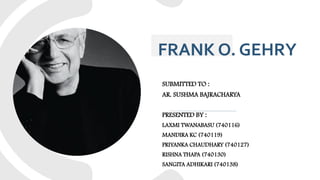
FRANK O. GEHRY
INTRODUCTION
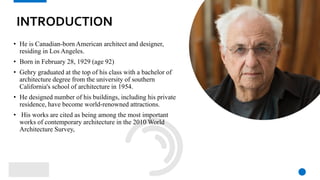
• He is Canadian-born American architect and designer,
residing in Los Angeles.
• Born in February 28, 1929 (age 92)
• Gehry graduated at the top of his class with a bachelor of
architecture degree from the university of southern
California's school of architecture in 1954.
• He designed number of his buildings, including his private
residence, have become world-renowned attractions.
• His works are cited as being among the most important
works of contemporary architecture in the 2010 World
Architecture Survey,
ARCHITECTURAL STYLE
• His works fall under Deconstructivism architectural style.
• Although Frank Gehry does not personally associate with the
movement, critics primarily consider his design philosophy to be
deconstructivism.
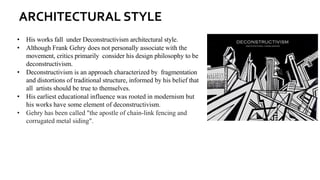
• Deconstructivism is an approach characterized by fragmentation
and distortions of traditional structure, informed by his belief that
all artists should be true to themselves.
• His earliest educational influence was rooted in modernism but
his works have some element of deconstructivism.
• Gehry has been called "the apostle of chain-link fencing and
corrugated metal siding".
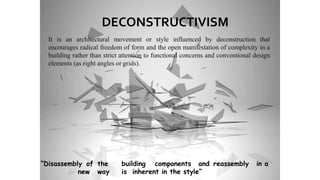
It is an architectural movement or style influenced by deconstruction that
encourages radical freedom of form and the open manifestation of complexity in a
building rather than strict attention to functional concerns and conventional design
elements (as right angles or grids).
DECONSTRUCTIVISM
“Disassembly of the building components and reassembly in a
new way is inherent in the style”
DESIGN FEATURES
• Gehry's deconstructivist architecture is like jazz music.
• He creates a language of architecture by improvising and making ''something'' distinctive with the
components of architecture.
• Gehry intends to create disharmony and visual disorientation.
• His forms are a fusion of sculpture.
• Gehry uses skewed geometry and creates heterogeneous, non-rectilinear, and curvilinear forms that are
distorted, dislocated, and continuously deformed.
• Form doesn't follow function in Gehry's hands, too. Gehry's forms break with the assumptions of their
functions.
• Irregular geometry is a means of formal aesthetic in Gehry's buildings.
• Structure is essential for Gehry's architecture where form and structure become one.
• Gehry strips the walls, breaks down the parts of the structure, and exposes them.
• Then, he puts together those fragmented pieces in a new order that appears disorganized and chaotic.
• The controlled chaos is his way of deconstructing harmony in architecture.
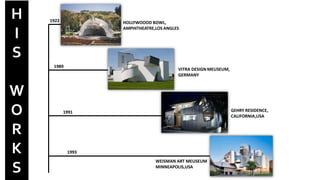
HOLLYWOOOD BOWL,
AMPHITHEATRE,LOS ANGLES
WEISMAN ART MEUSEUM
MINNEAPOLIS,USA
GEHRY RESIDENCE,
CALIFORNIA,USA
VITRA DESIGN MEUSEUM,
GERMANY
1993
1991
1989
1922
H
I
S
W
O
R
K
S
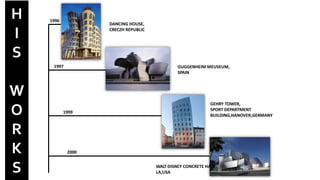
2000
1999
1997
1996
DANCING HOUSE,
CRECZH REPUBLIC
GUGGENHEIM MEUSEUM,
SPAIN
WALT DISNEY CONCRETE HALL ,
LA,USA
GEHRY TOWER,
SPORT DEPARTMENT
BUILDING,HANOVER,GERMANY
H
I
S
W
O
R
K
S
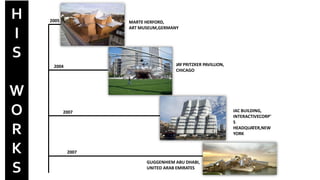
2007
2007
2004
2005
JAY PRITZKER PAVILLION,
CHICAGO
MARTE HERFORD,
ART MUSEUM,GERMANY
GUGGENHIEM ABU DHABI,
UNITED ARAB EMIRATES
IAC BUILDING,
INTERACTIVECORP’
S
HEADQUATER,NEW
YORK
H
I
S
W
O
R
K
S
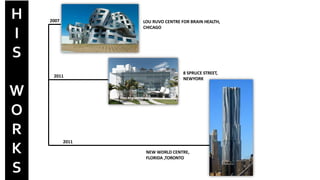
2011
2011
2007 LOU RUVO CENTRE FOR BRAIN HEALTH,
CHICAGO
8 SPRUCE STREET,
NEWYORK
NEW WORLD CENTRE,
FLORIDA ,TORONTO
H
I
S
W
O
R
K
S
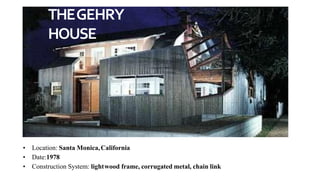
THEGEHRY
HOUSE
• Location: Santa Monica,California
• Date:1978
• Construction System: lightwood frame, corrugated metal, chain link
INTRODUCTION
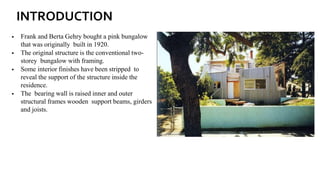
▪ Frank and Berta Gehry bought a pink bungalow
that was originally built in 1920.
▪ The original structure is the conventional two-
storey bungalow with framing.
▪ Some interior finishes have been stripped to
reveal the support of the structure inside the
residence.
▪ The bearing wall is raised inner and outer
structural frames wooden support beams, girders
and joists.
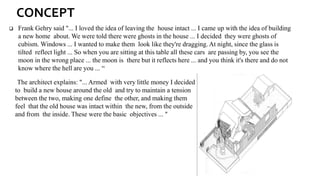
❑ Frank Gehry said "... I loved the idea of leaving the house intact ... I came up with the idea of building
a new home about. We were told there were ghosts in the house ... I decided they were ghosts of
cubism. Windows ... I wanted to make them look like they're dragging. At night, since the glass is
tilted reflect light ... So when you are sitting at this table all these cars are passing by, you see the
moon in the wrong place ... the moon is there but it reflects here ... and you think it's there and do not
know where the hell are you ... “
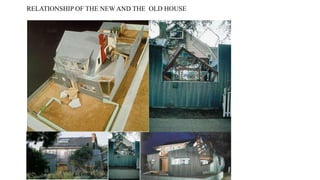
The architect explains: "... Armed with very little money I decided
to build a new house around the old and try to maintain a tension
between the two, making one define the other, and making them
feel that the old house was intact within the new, from the outside
and from the inside. These were the basic objectives ... "
CONCEPT
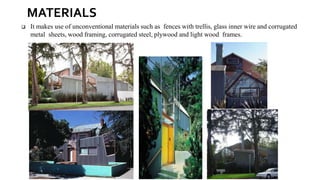
❑ It makes use of unconventional materials such as fences with trellis, glass inner wire and corrugated
metal sheets, wood framing, corrugated steel, plywood and light wood frames.
MATERIALS
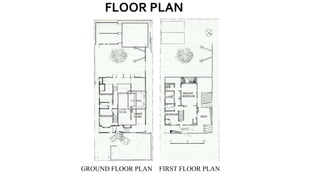
FLOOR PLAN
GROUND FLOOR PLAN FIRST FLOOR PLAN
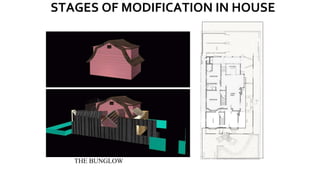
THE BUNGLOW
STAGES OF MODIFICATION IN HOUSE
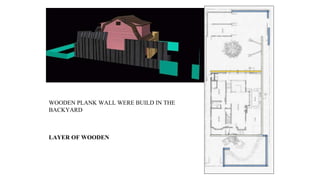
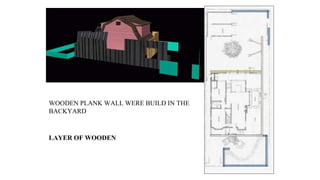
WOODEN PLANK WALL WERE BUILD IN THE
BACKYARD
LAYER OF WOODEN
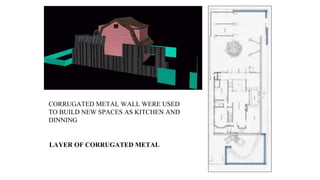
CORRUGATED METAL WALL WERE USED
TO BUILD NEW SPACES AS KITCHEN AND
DINNING
LAYER OF CORRUGATED METAL
WOODEN PLANK WALL WERE BUILD IN THE
BACKYARD
LAYER OF WOODEN
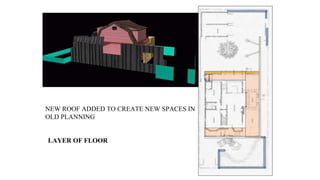
LAYER OF FLOOR
NEW ROOF ADDED TO CREATE NEW SPACES IN
OLD PLANNING
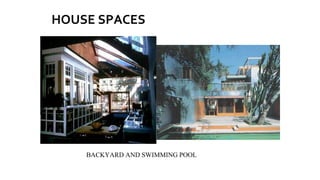
HOUSE SPACES
BACKYARD AND SWIMMING POOL
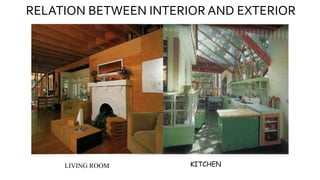
RELATION BETWEEN INTERIOR AND EXTERIOR
LIVING ROOM KITCHEN
RELATIONSHIP OF THE NEW AND THE OLD HOUSE
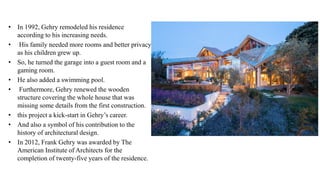
• In 1992, Gehry remodeled his residence
according to his increasing needs.
• His family needed more rooms and better privacy
as his children grew up.
• So, he turned the garage into a guest room and a
gaming room.
• He also added a swimming pool.
• Furthermore, Gehry renewed the wooden
structure covering the whole house that was
missing some details from the first construction.
• this project a kick-start in Gehry’s career.
• And also a symbol of his contribution to the
history of architectural design.
• In 2012, Frank Gehry was awarded by The
American Institute of Architects for the
completion of twenty-five years of the residence.
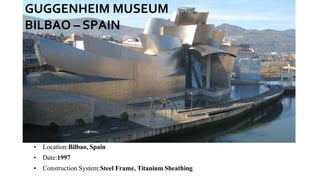
• Location:Bilbao, Spain
• Date:1997
• Construction System:Steel Frame, Titanium Sheathing
GUGGENHEIM MUSEUM
BILBAO – SPAIN
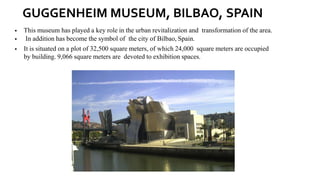
GUGGENHEIM MUSEUM, BILBAO, SPAIN
▪ This museum has played a key role in the urban revitalization and transformation of the area.
▪ In addition has become the symbol of the city of Bilbao, Spain.
▪ It is situated on a plot of 32,500 square meters, of which 24,000 square meters are occupied
by building. 9,066 square meters are devoted to exhibition spaces.
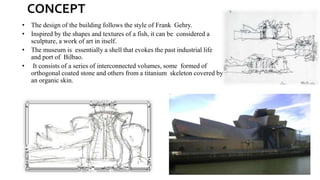
CONCEPT
• The design of the building follows the style of Frank Gehry.
• Inspired by the shapes and textures of a fish, it can be considered a
sculpture, a work of art in itself.
• The museum is essentially a shell that evokes the past industrial life
and port of Bilbao.
• It consists of a series of interconnected volumes, some formed of
orthogonal coated stone and others from a titanium skeleton covered by
an organic skin.
CONCEPTUAL SKETCHES
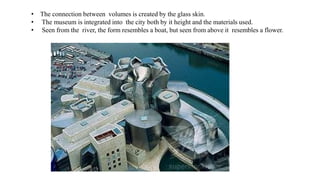
• The connection between volumes is created by the glass skin.
• The museum is integrated into the city both by it height and the materials used.
• Seen from the river, the form resembles a boat, but seen from above it resembles a flower.
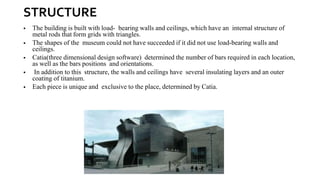
STRUCTURE
▪ The building is built with load- bearing walls and ceilings, which have an internal structure of
metal rods that form grids with triangles.
▪ The shapes of the museum could not have succeeded if it did not use load-bearing walls and
ceilings.
▪ Catia(three dimensional design software) determined the number of bars required in each location,
as well as the bars positions and orientations.
▪ In addition to this structure, the walls and ceilings have several insulating layers and an outer
coating of titanium.
▪ Each piece is unique and exclusive to the place, determined by Catia.
MATERIALS
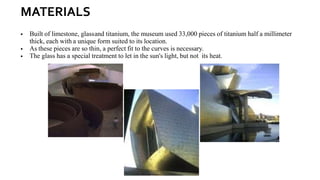
▪ Built of limestone, glassand titanium, the museum used 33,000 pieces of titanium half a millimeter
thick, each with a unique form suited to its location.
▪ As these pieces are so thin, a perfect fit to the curves is necessary.
▪ The glass has a special treatment to let in the sun's light, but not its heat.
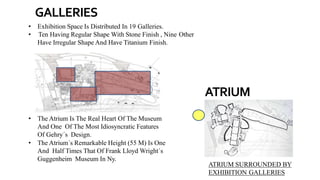
ATRIUM SURROUNDED BY
EXHIBITION GALLERIES
• The Atrium Is The Real Heart Of The Museum
And One Of The Most Idiosyncratic Features
Of Gehry´s Design.
• The Atrium´s Remarkable Height (55 M) Is One
And Half Times That Of Frank Lloyd Wright´s
Guggenheim Museum In Ny.
• Exhibition Space Is Distributed In 19 Galleries.
• Ten Having Regular Shape With Stone Finish , Nine Other
Have Irregular Shape And Have Titanium Finish.
GALLERIES
ATRIUM
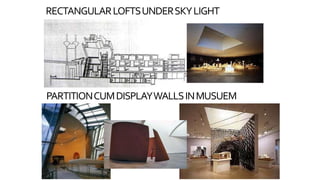
PARTITIONCUMDISPLAYWALLSINMUSUEM
RECTANGULARLOFTSUNDERSKYLIGHT
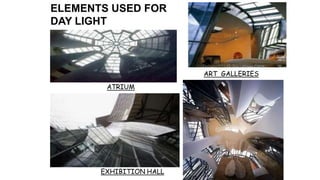
ATRIUM
ART GALLERIES
EXHIBITION HALL
ELEMENTS USED FOR
DAY LIGHT
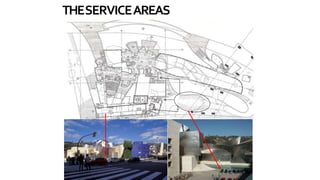
THESERVICEAREAS
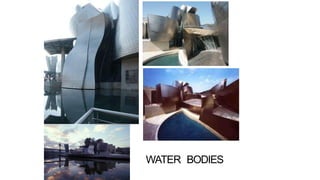
WATER BODIES
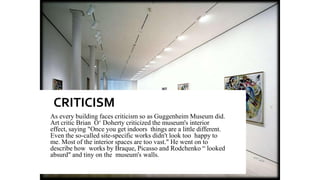
CRITICISM
As every building faces criticism so as Guggenheim Museum did.
Art critic Brian O‘ Doherty criticized the museum's interior
effect, saying "Once you get indoors things are a little different.
Even the so-called site-specific works didn't look too happy to
me. Most of the interior spaces are too vast." He went on to
describe how works by Braque, Picasso and Rodchenko “ looked
absurd" and tiny on the museum's walls.
REFERENCE
 Guggenheim Bilbao Museum. Come in and plan your visit (guggenheim-bilbao.eus)
 Frank Gehry | Biography, Architecture, Buildings, Guggenheim Museum Bilbao, Pritzker
Pavilion, Style, & Facts | BritannicaFrank Gehry House in Santa Monica (First Residence) |
ArchEyes
 Gehry Residence / Gehry Partners | ArchDaily
 Frank Gehry By Caroline Evensen Lazo
 The Building | Guggenheim Museum Bilbao (guggenheim-bilbao.eus)
THANK YOU !!!!!

740130_Group8_Deconstructivism_Frank o GEHRY.pdf

  • 1.
    SUBMITTED TO : AR.SUSHMA BAJRACHARYA PRESENTED BY : LAXMI TWANABASU (740116) MANDIRA KC (740119) PRIYANKA CHAUDHARY (740127) RISHNA THAPA (740130) SANGITA ADHIKARI (740138) FRANK O. GEHRY
  • 2.
    INTRODUCTION • He isCanadian-born American architect and designer, residing in Los Angeles. • Born in February 28, 1929 (age 92) • Gehry graduated at the top of his class with a bachelor of architecture degree from the university of southern California's school of architecture in 1954. • He designed number of his buildings, including his private residence, have become world-renowned attractions. • His works are cited as being among the most important works of contemporary architecture in the 2010 World Architecture Survey,
  • 3.
    ARCHITECTURAL STYLE • Hisworks fall under Deconstructivism architectural style. • Although Frank Gehry does not personally associate with the movement, critics primarily consider his design philosophy to be deconstructivism. • Deconstructivism is an approach characterized by fragmentation and distortions of traditional structure, informed by his belief that all artists should be true to themselves. • His earliest educational influence was rooted in modernism but his works have some element of deconstructivism. • Gehry has been called "the apostle of chain-link fencing and corrugated metal siding".
  • 4.
    It is anarchitectural movement or style influenced by deconstruction that encourages radical freedom of form and the open manifestation of complexity in a building rather than strict attention to functional concerns and conventional design elements (as right angles or grids). DECONSTRUCTIVISM “Disassembly of the building components and reassembly in a new way is inherent in the style”
  • 5.
    DESIGN FEATURES • Gehry'sdeconstructivist architecture is like jazz music. • He creates a language of architecture by improvising and making ''something'' distinctive with the components of architecture. • Gehry intends to create disharmony and visual disorientation. • His forms are a fusion of sculpture. • Gehry uses skewed geometry and creates heterogeneous, non-rectilinear, and curvilinear forms that are distorted, dislocated, and continuously deformed. • Form doesn't follow function in Gehry's hands, too. Gehry's forms break with the assumptions of their functions. • Irregular geometry is a means of formal aesthetic in Gehry's buildings. • Structure is essential for Gehry's architecture where form and structure become one. • Gehry strips the walls, breaks down the parts of the structure, and exposes them. • Then, he puts together those fragmented pieces in a new order that appears disorganized and chaotic. • The controlled chaos is his way of deconstructing harmony in architecture.
  • 6.
    HOLLYWOOOD BOWL, AMPHITHEATRE,LOS ANGLES WEISMANART MEUSEUM MINNEAPOLIS,USA GEHRY RESIDENCE, CALIFORNIA,USA VITRA DESIGN MEUSEUM, GERMANY 1993 1991 1989 1922 H I S W O R K S
  • 7.
    2000 1999 1997 1996 DANCING HOUSE, CRECZH REPUBLIC GUGGENHEIMMEUSEUM, SPAIN WALT DISNEY CONCRETE HALL , LA,USA GEHRY TOWER, SPORT DEPARTMENT BUILDING,HANOVER,GERMANY H I S W O R K S
  • 8.
    2007 2007 2004 2005 JAY PRITZKER PAVILLION, CHICAGO MARTEHERFORD, ART MUSEUM,GERMANY GUGGENHIEM ABU DHABI, UNITED ARAB EMIRATES IAC BUILDING, INTERACTIVECORP’ S HEADQUATER,NEW YORK H I S W O R K S
  • 9.
    2011 2011 2007 LOU RUVOCENTRE FOR BRAIN HEALTH, CHICAGO 8 SPRUCE STREET, NEWYORK NEW WORLD CENTRE, FLORIDA ,TORONTO H I S W O R K S
  • 10.
    THEGEHRY HOUSE • Location: SantaMonica,California • Date:1978 • Construction System: lightwood frame, corrugated metal, chain link
  • 11.
    INTRODUCTION ▪ Frank andBerta Gehry bought a pink bungalow that was originally built in 1920. ▪ The original structure is the conventional two- storey bungalow with framing. ▪ Some interior finishes have been stripped to reveal the support of the structure inside the residence. ▪ The bearing wall is raised inner and outer structural frames wooden support beams, girders and joists.
  • 12.
    ❑ Frank Gehrysaid "... I loved the idea of leaving the house intact ... I came up with the idea of building a new home about. We were told there were ghosts in the house ... I decided they were ghosts of cubism. Windows ... I wanted to make them look like they're dragging. At night, since the glass is tilted reflect light ... So when you are sitting at this table all these cars are passing by, you see the moon in the wrong place ... the moon is there but it reflects here ... and you think it's there and do not know where the hell are you ... “ The architect explains: "... Armed with very little money I decided to build a new house around the old and try to maintain a tension between the two, making one define the other, and making them feel that the old house was intact within the new, from the outside and from the inside. These were the basic objectives ... " CONCEPT
  • 13.
    ❑ It makesuse of unconventional materials such as fences with trellis, glass inner wire and corrugated metal sheets, wood framing, corrugated steel, plywood and light wood frames. MATERIALS
  • 14.
    FLOOR PLAN GROUND FLOORPLAN FIRST FLOOR PLAN
  • 15.
    THE BUNGLOW STAGES OFMODIFICATION IN HOUSE
  • 16.
    WOODEN PLANK WALLWERE BUILD IN THE BACKYARD LAYER OF WOODEN
  • 17.
    CORRUGATED METAL WALLWERE USED TO BUILD NEW SPACES AS KITCHEN AND DINNING LAYER OF CORRUGATED METAL
  • 18.
    WOODEN PLANK WALLWERE BUILD IN THE BACKYARD LAYER OF WOODEN
  • 19.
    LAYER OF FLOOR NEWROOF ADDED TO CREATE NEW SPACES IN OLD PLANNING
  • 20.
  • 21.
    RELATION BETWEEN INTERIORAND EXTERIOR LIVING ROOM KITCHEN
  • 22.
    RELATIONSHIP OF THENEW AND THE OLD HOUSE
  • 23.
    • In 1992,Gehry remodeled his residence according to his increasing needs. • His family needed more rooms and better privacy as his children grew up. • So, he turned the garage into a guest room and a gaming room. • He also added a swimming pool. • Furthermore, Gehry renewed the wooden structure covering the whole house that was missing some details from the first construction. • this project a kick-start in Gehry’s career. • And also a symbol of his contribution to the history of architectural design. • In 2012, Frank Gehry was awarded by The American Institute of Architects for the completion of twenty-five years of the residence.
  • 24.
    • Location:Bilbao, Spain •Date:1997 • Construction System:Steel Frame, Titanium Sheathing GUGGENHEIM MUSEUM BILBAO – SPAIN
  • 25.
    GUGGENHEIM MUSEUM, BILBAO,SPAIN ▪ This museum has played a key role in the urban revitalization and transformation of the area. ▪ In addition has become the symbol of the city of Bilbao, Spain. ▪ It is situated on a plot of 32,500 square meters, of which 24,000 square meters are occupied by building. 9,066 square meters are devoted to exhibition spaces.
  • 26.
    CONCEPT • The designof the building follows the style of Frank Gehry. • Inspired by the shapes and textures of a fish, it can be considered a sculpture, a work of art in itself. • The museum is essentially a shell that evokes the past industrial life and port of Bilbao. • It consists of a series of interconnected volumes, some formed of orthogonal coated stone and others from a titanium skeleton covered by an organic skin.
  • 27.
  • 28.
    • The connectionbetween volumes is created by the glass skin. • The museum is integrated into the city both by it height and the materials used. • Seen from the river, the form resembles a boat, but seen from above it resembles a flower.
  • 29.
    STRUCTURE ▪ The buildingis built with load- bearing walls and ceilings, which have an internal structure of metal rods that form grids with triangles. ▪ The shapes of the museum could not have succeeded if it did not use load-bearing walls and ceilings. ▪ Catia(three dimensional design software) determined the number of bars required in each location, as well as the bars positions and orientations. ▪ In addition to this structure, the walls and ceilings have several insulating layers and an outer coating of titanium. ▪ Each piece is unique and exclusive to the place, determined by Catia.
  • 30.
    MATERIALS ▪ Built oflimestone, glassand titanium, the museum used 33,000 pieces of titanium half a millimeter thick, each with a unique form suited to its location. ▪ As these pieces are so thin, a perfect fit to the curves is necessary. ▪ The glass has a special treatment to let in the sun's light, but not its heat.
  • 31.
    ATRIUM SURROUNDED BY EXHIBITIONGALLERIES • The Atrium Is The Real Heart Of The Museum And One Of The Most Idiosyncratic Features Of Gehry´s Design. • The Atrium´s Remarkable Height (55 M) Is One And Half Times That Of Frank Lloyd Wright´s Guggenheim Museum In Ny. • Exhibition Space Is Distributed In 19 Galleries. • Ten Having Regular Shape With Stone Finish , Nine Other Have Irregular Shape And Have Titanium Finish. GALLERIES ATRIUM
  • 32.
  • 33.
  • 34.
  • 35.
  • 36.
    CRITICISM As every buildingfaces criticism so as Guggenheim Museum did. Art critic Brian O‘ Doherty criticized the museum's interior effect, saying "Once you get indoors things are a little different. Even the so-called site-specific works didn't look too happy to me. Most of the interior spaces are too vast." He went on to describe how works by Braque, Picasso and Rodchenko “ looked absurd" and tiny on the museum's walls.
  • 37.
    REFERENCE  Guggenheim BilbaoMuseum. Come in and plan your visit (guggenheim-bilbao.eus)  Frank Gehry | Biography, Architecture, Buildings, Guggenheim Museum Bilbao, Pritzker Pavilion, Style, & Facts | BritannicaFrank Gehry House in Santa Monica (First Residence) | ArchEyes  Gehry Residence / Gehry Partners | ArchDaily  Frank Gehry By Caroline Evensen Lazo  The Building | Guggenheim Museum Bilbao (guggenheim-bilbao.eus)
  • 38.