Phonetics labelling the symbols
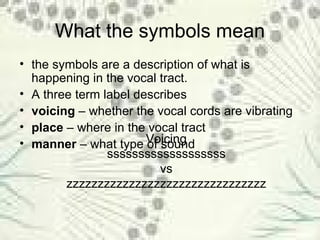
What the symbols mean the symbols are a description of what is happening in the vocal tract. A three term label describes voicing  – whether the vocal cords are vibrating   place  – where in the vocal tract manner  – what type of sound Voicing sssssssssssssssssss vs zzzzzzzzzzzzzzzzzzzzzzzzzzzzzzzz
Fred Phoneme
vocal tract front to back  lips (labial, bilabial) teeth (dental labiodental alveolar ridge - behind the top teeth (hard) palate  - the highest part of the roof of the mouth velum – after the hard palate, where it goes soft again – the raises up and down to block or allow air into the nose. uvula - the dangly end of the velum pharynx the area between the back end of the tongue (tongue root) and the back wall of the mouth. this cavity is above the larynx the voice box with the vocal cords
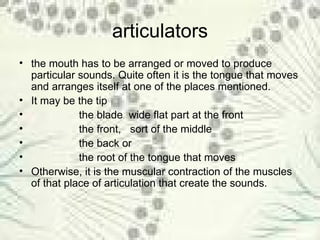
articulators the mouth has to be arranged or moved to produce particular sounds. Quite often it is the tongue that moves and arranges itself at one of the places mentioned.  It may be the tip  the blade  wide flat part at the front the front,  sort of the middle  the back or  the root of the tongue that moves Otherwise, it is the muscular contraction of the muscles of that place of articulation that create the sounds.
manner - stops Oral stops are created when we block air from being released out of our mouth at some place along the vocal tract.  For example [p] and [b] are stops created with both lips – bilabial stops. 3 stages: closing stage – lips come together holding stage  - held together so air pressure  builds up release stage  the lips are moved apart and    the air rushes out making the  sound
other stops Stops can be made dental,  alveolar,  palatal,  velar , pharyngeal and  glottal  (at the vocal cords)  can be voiced and voiceless (Italics appear in English)  p b                         ʔ Glottal stop in some dialects of English replaces [t] and is common in Polynesian languages ‘
nasal stops Oral stops block the air and then release it out the mouth. But if we block the airflow in our mouth we can still release it out our nose, creating a nasal sound. We let the air out our nose by lowering the velum. This creates a passageway to our nasal cavity and the air is released from our nostrils the blocking of the oral cavity can occur at the same places: bilabial labiodental dental aleveolar palatal velar and uvular  m  ɱ  n   n  ɳ     ŋ  
fricatives If stops create complete blockage, they are related to fricatives, Fricatives create  narrowing  but  not   blocking  of the passage of air through the vocal tract.  Fricative  refers to the noisiness due to the friction in the narrowed space.  The same places can be used to create the narrowing.  labiodental ,  alveolar , palatal, velar, uvular and  glottal f v  s z                     Other important fricatives are the post-alveolar   ʃ and  ʒ and the interdental fricatives - tongue between teeth  θ  ð
when a stop meets a fricative an affricate is born ch ur ch  and  j u dg e the first part of sound is a stop, but in the release phase the articulators do not move away suddenly but move to a position where there is still a narrow gap for the air to move noisily through i.e. fricative The place of the stop and the place of the fricative are roughly the same: ʧ voiceless alveolar-palatal affricate ʤ voiced alveolar-palatal affricate others are [ts] [pf]
Approximants Fricatives narrow the passageway of air coming through the vocal tract. Approximants are similar but the air comes out smoothly – without the noisy friction. central vs lateral approximants. centre of the mouth vs sides of the mouth [l] is a lateral. Tongue raises to the alveolar ridge, but air escapes around the sides of the tongue. [r] of upside down r is also an alveolar approximant. It is central because the tongue is pointing towards the centre of the alveolar ridge
Approximants (2) English has two glides or semi-vowels  [j] this symbol is called yod. It is a palatal sound and  [w] This is sound is complex as two different parts of the mouth are used to create it. The tongue glides away from the velum and the lips are rounded – labio-velar
trrrrrills rolling your rs  tongue raises and falls away and raises to the alveolar ridge [r] do it just once and you have a flap bilabial trills in Melanesia Uvular trills
retroflexible! Retroflex always appears as a place but a cross between a place and a manner. Bend backwards – tongue curls up further than with other consonants so you can get retroflex stops, fricatives, affricates, nasals all the symbols have a tail which points to the right                   
The major classes Sometimes whole groups sounds behave the same way in language Sometimes all the alveolars will demonstrate a similar behaviour Sometimes all the stops will behave the same way. Aspiration in English Park the car under the tarp! Guard the boat, Dad! [ p ʰ  t ʰ  k ʰ] but not [bʰ dʰ gʰ] Other times, broader categories interact with sounds a similar way.
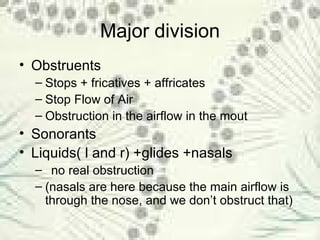
Major division Obstruents Stops + fricatives + affricates Stop Flow of Air Obstruction in the airflow in the mout Sonorants Liquids( l and r) +glides +nasals no real obstruction (nasals are here because the main airflow is through the nose, and we don’t obstruct that)

Consonants 2

  • 1.
  • 2.
  • 3.
    What the symbolsmean the symbols are a description of what is happening in the vocal tract. A three term label describes voicing – whether the vocal cords are vibrating place – where in the vocal tract manner – what type of sound Voicing sssssssssssssssssss vs zzzzzzzzzzzzzzzzzzzzzzzzzzzzzzzz
  • 4.
  • 5.
    vocal tract frontto back lips (labial, bilabial) teeth (dental labiodental alveolar ridge - behind the top teeth (hard) palate - the highest part of the roof of the mouth velum – after the hard palate, where it goes soft again – the raises up and down to block or allow air into the nose. uvula - the dangly end of the velum pharynx the area between the back end of the tongue (tongue root) and the back wall of the mouth. this cavity is above the larynx the voice box with the vocal cords
  • 6.
    articulators the mouthhas to be arranged or moved to produce particular sounds. Quite often it is the tongue that moves and arranges itself at one of the places mentioned. It may be the tip the blade wide flat part at the front the front, sort of the middle the back or the root of the tongue that moves Otherwise, it is the muscular contraction of the muscles of that place of articulation that create the sounds.
  • 7.
    manner - stopsOral stops are created when we block air from being released out of our mouth at some place along the vocal tract. For example [p] and [b] are stops created with both lips – bilabial stops. 3 stages: closing stage – lips come together holding stage - held together so air pressure builds up release stage the lips are moved apart and the air rushes out making the sound
  • 8.
    other stops Stopscan be made dental, alveolar, palatal, velar , pharyngeal and glottal (at the vocal cords) can be voiced and voiceless (Italics appear in English)  p b         ʔ Glottal stop in some dialects of English replaces [t] and is common in Polynesian languages ‘
  • 9.
    nasal stops Oralstops block the air and then release it out the mouth. But if we block the airflow in our mouth we can still release it out our nose, creating a nasal sound. We let the air out our nose by lowering the velum. This creates a passageway to our nasal cavity and the air is released from our nostrils the blocking of the oral cavity can occur at the same places: bilabial labiodental dental aleveolar palatal velar and uvular  m ɱ n  n ɳ  ŋ 
  • 10.
    fricatives If stopscreate complete blockage, they are related to fricatives, Fricatives create narrowing but not blocking of the passage of air through the vocal tract. Fricative refers to the noisiness due to the friction in the narrowed space. The same places can be used to create the narrowing. labiodental , alveolar , palatal, velar, uvular and glottal f v s z        Other important fricatives are the post-alveolar ʃ and ʒ and the interdental fricatives - tongue between teeth θ  ð
  • 11.
    when a stopmeets a fricative an affricate is born ch ur ch and j u dg e the first part of sound is a stop, but in the release phase the articulators do not move away suddenly but move to a position where there is still a narrow gap for the air to move noisily through i.e. fricative The place of the stop and the place of the fricative are roughly the same: ʧ voiceless alveolar-palatal affricate ʤ voiced alveolar-palatal affricate others are [ts] [pf]
  • 12.
    Approximants Fricatives narrowthe passageway of air coming through the vocal tract. Approximants are similar but the air comes out smoothly – without the noisy friction. central vs lateral approximants. centre of the mouth vs sides of the mouth [l] is a lateral. Tongue raises to the alveolar ridge, but air escapes around the sides of the tongue. [r] of upside down r is also an alveolar approximant. It is central because the tongue is pointing towards the centre of the alveolar ridge
  • 13.
    Approximants (2) Englishhas two glides or semi-vowels [j] this symbol is called yod. It is a palatal sound and [w] This is sound is complex as two different parts of the mouth are used to create it. The tongue glides away from the velum and the lips are rounded – labio-velar
  • 14.
    trrrrrills rolling yourrs tongue raises and falls away and raises to the alveolar ridge [r] do it just once and you have a flap bilabial trills in Melanesia Uvular trills
  • 15.
    retroflexible! Retroflex alwaysappears as a place but a cross between a place and a manner. Bend backwards – tongue curls up further than with other consonants so you can get retroflex stops, fricatives, affricates, nasals all the symbols have a tail which points to the right       
  • 16.
    The major classesSometimes whole groups sounds behave the same way in language Sometimes all the alveolars will demonstrate a similar behaviour Sometimes all the stops will behave the same way. Aspiration in English Park the car under the tarp! Guard the boat, Dad! [ p ʰ t ʰ k ʰ] but not [bʰ dʰ gʰ] Other times, broader categories interact with sounds a similar way.
  • 17.
    Major division ObstruentsStops + fricatives + affricates Stop Flow of Air Obstruction in the airflow in the mout Sonorants Liquids( l and r) +glides +nasals no real obstruction (nasals are here because the main airflow is through the nose, and we don’t obstruct that)