Airstream Mechanisms  Modes of Phonation Organs of Speech Segmental Articulation
The Sounds of Language Phonetics
The Sound Producing System
 
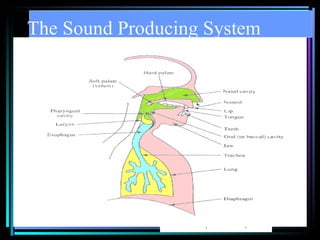
Speech organs Sagittal section of the vocal tract (Techmer 1880) [From: Dan Jurafsky slide] Nasal Cavity Oral Cavity Larynx: vocal folds in it Pharynx Trachea: the windpipe Lung: supply airstream
 
Airstream Mechanisms
Airstream process: The ways in which the lung (or the closed glottis, even the tongue)  pushes air out or sucks it in during speech. Egressive sounds: air is pushed out. Ingreessive sounds: air is sucked in. Phonation process: The actions of the vocal folds. Articulatory process: The movements of the tongue and the lips interacting with the roof of the mouth and the pharynx. Including the oro-nasal process. Speech production mechanism
Airstream Mechanisms 3 Airstream Mechanisms:  Lung airflow (pulmonic airflow mechanism) Glottalic airflow Velaric airflow
Airstream Mechanisms  Pulmonic Airstream Mechanism  air is pushed out of the lungs by downward movement of rib cage and/or upward movement of diaphragm Plosives stops made with an egressive pulmonic airstream  these are our familiar stops, e.g. [p, t, k]
Airstream Mechanisms Glottalic we can move different bodies of air  move a closed glottis up, you’ll push air out of the mouth  move closed glottis down, air will be sucked into the mouth
Airstream Mechanisms Two Types of Glottalic Airstream Mechanism Glottalic Egressive Airstream Glottalic Ingressive Airstream
Airstream Mechanisms Glottalic Egressive Airstream glottis acts as a kind of piston  compressing air in the pharynx  compressed air released when tongue body is lowered, i.e. when stop is released Glottalic egressive sound [k’] These sounds are also called EJECTIVES Hausa and Lakota are just two languages with ejectives.
Airstream Mechanisms Glottalic Ingressive Sounds glottis moves downward  sucking air inwards  but the glottis is not completely closed  some pulmonic air is still being pushed out  keeping the vocal cords vibrating Bilabial implosive Glottalic ingressive stops are also called IMPLOSIVES Sindhi is an example of a language with implosives
Airstream Mechanisms Velaric Airstream Mechanism this is the mechanism used to make clicks!!  they involve trapping a body of air rarefying it (adding a pinch of salt for taste)  and then releasing it, resulting in a click
 
Larynx and Voice
 
Anatomy of the larynx
Modes of Phonation Phonation :larynx function as a source  Larynx function: (1) generate airstream (2) serve as an articulator Phonation modes are categories in which laryngeal muscles manipulate the folds
Voicing/phonation
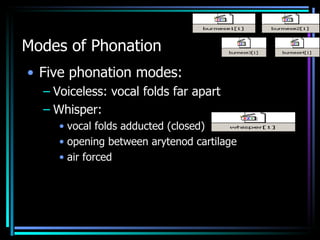
Modes of Phonation Five phonation modes: Voiceless: vocal folds far apart Whisper:  vocal folds adducted (closed)  opening between arytenod cartilage air forced
Modes of Phonation Breathy: incomplete close of glottalic cycle  Muscle of arytenoids remain apart Voice: Vibration of vocal folds Creak: Low frequency vibration of vocal folds Folds open briefly Vibration is irregular from cycle to cycle Glottal stop  Combinatory Phonation Modes:  Breathy + Creaky  creak accompanied by breathy leakage
Voice Onset Time (VOT) refers to the relationship between the onset of voicing and the release of a closure  so, aspirated consonants have a large VOT
Other Organs of Speech Production and Classification of Speech Sounds
 
The Vocal Tract
 
English Consonants


Place of Articulation Plosives: bilabial alveolar velar (palatal)


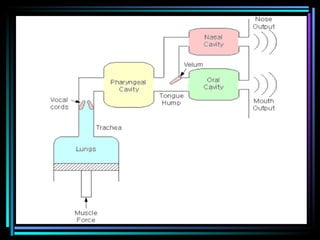
Speech Production oral & nasal cavities larynx lungs


How much constriction? plosive: completely blocked fricative: partly blocked approximant: slightly hindered nasalization Does the air flow through both the nose and the mouth, or just the mouth? Consonants: 3 phonetic features
 
 
Vowels Chart
English Vowels


Phonetics

  • 1.
    Airstream Mechanisms Modes of Phonation Organs of Speech Segmental Articulation
  • 2.
    The Sounds ofLanguage Phonetics
  • 3.
  • 4.
  • 5.
    Speech organs Sagittalsection of the vocal tract (Techmer 1880) [From: Dan Jurafsky slide] Nasal Cavity Oral Cavity Larynx: vocal folds in it Pharynx Trachea: the windpipe Lung: supply airstream
  • 6.
  • 7.
  • 8.
    Airstream process: Theways in which the lung (or the closed glottis, even the tongue) pushes air out or sucks it in during speech. Egressive sounds: air is pushed out. Ingreessive sounds: air is sucked in. Phonation process: The actions of the vocal folds. Articulatory process: The movements of the tongue and the lips interacting with the roof of the mouth and the pharynx. Including the oro-nasal process. Speech production mechanism
  • 9.
    Airstream Mechanisms 3Airstream Mechanisms: Lung airflow (pulmonic airflow mechanism) Glottalic airflow Velaric airflow
  • 10.
    Airstream Mechanisms Pulmonic Airstream Mechanism air is pushed out of the lungs by downward movement of rib cage and/or upward movement of diaphragm Plosives stops made with an egressive pulmonic airstream these are our familiar stops, e.g. [p, t, k]
  • 11.
    Airstream Mechanisms Glottalicwe can move different bodies of air move a closed glottis up, you’ll push air out of the mouth move closed glottis down, air will be sucked into the mouth
  • 12.
    Airstream Mechanisms TwoTypes of Glottalic Airstream Mechanism Glottalic Egressive Airstream Glottalic Ingressive Airstream
  • 13.
    Airstream Mechanisms GlottalicEgressive Airstream glottis acts as a kind of piston compressing air in the pharynx compressed air released when tongue body is lowered, i.e. when stop is released Glottalic egressive sound [k’] These sounds are also called EJECTIVES Hausa and Lakota are just two languages with ejectives.
  • 14.
    Airstream Mechanisms GlottalicIngressive Sounds glottis moves downward sucking air inwards but the glottis is not completely closed some pulmonic air is still being pushed out keeping the vocal cords vibrating Bilabial implosive Glottalic ingressive stops are also called IMPLOSIVES Sindhi is an example of a language with implosives
  • 15.
    Airstream Mechanisms VelaricAirstream Mechanism this is the mechanism used to make clicks!! they involve trapping a body of air rarefying it (adding a pinch of salt for taste) and then releasing it, resulting in a click
  • 16.
  • 17.
  • 18.
  • 19.
  • 20.
    Modes of PhonationPhonation :larynx function as a source Larynx function: (1) generate airstream (2) serve as an articulator Phonation modes are categories in which laryngeal muscles manipulate the folds
  • 21.
  • 22.
    Modes of PhonationFive phonation modes: Voiceless: vocal folds far apart Whisper: vocal folds adducted (closed) opening between arytenod cartilage air forced
  • 23.
    Modes of PhonationBreathy: incomplete close of glottalic cycle Muscle of arytenoids remain apart Voice: Vibration of vocal folds Creak: Low frequency vibration of vocal folds Folds open briefly Vibration is irregular from cycle to cycle Glottal stop Combinatory Phonation Modes: Breathy + Creaky creak accompanied by breathy leakage
  • 24.
    Voice Onset Time(VOT) refers to the relationship between the onset of voicing and the release of a closure so, aspirated consonants have a large VOT
  • 25.
    Other Organs ofSpeech Production and Classification of Speech Sounds
  • 26.
  • 27.
  • 28.
  • 29.
  • 30.
  • 31.
  • 32.
  • 33.
  • 34.
  • 35.
  • 36.
  • 37.
    Place of ArticulationPlosives: bilabial alveolar velar (palatal)
  • 38.
  • 39.
  • 40.
  • 41.
  • 42.
  • 43.
  • 44.
  • 45.
  • 46.
  • 47.
  • 48.
  • 49.
  • 50.
    Speech Production oral& nasal cavities larynx lungs
  • 51.
  • 52.
  • 53.
  • 54.
  • 55.
  • 56.
  • 57.
  • 58.
  • 59.
  • 60.
  • 61.
    How much constriction?plosive: completely blocked fricative: partly blocked approximant: slightly hindered nasalization Does the air flow through both the nose and the mouth, or just the mouth? Consonants: 3 phonetic features
  • 62.
  • 63.
  • 64.
  • 65.
  • 66.
  • 67.
  • 68.
  • 69.
  • 70.
  • 71.
  • 72.
  • 73.
  • 74.
  • 75.
  • 76.
  • 77.
  • 78.
  • 79.
  • 80.
  • 81.