Performance Measurement Framework
Shared framework of indicators
Impact Areas Guiding Question Indicator
Livelihood and Well Being
Are the basic needs of the
farmers being met?
Food Security: Access to sufficient
food
Income
Assets
Perceived Well-Being
Gender
What are women’s roles and
benefits in this crop?
Women’s participation in crop
Equitable Access to Training
Participation in Decision-Making
Environmental
Performance
Is the land well stewarded? Adoption of conservation practices
Farm Productivity
Are farmers realizing the
potential of their farm?
Adoption of good ag practices
Estimated Productivity
Crop Revenue or Net Income
Access to Services
Do farmers have access to
services?
Access to credit, training and inputs
Are farmers using these
services?
Use of credit, training, and inputs
Trading Relationships
Are farmers experiencing
good trading relationships?
TBD
What is a shared approach?
• A common framework of indicators and metrics to
help guide the practitioner.
• A suite of indicators to pick what’s appropriate. Not a
single set of indicators.
• Shared approach implies committing to use the same
indicators and metrics when asking the same
questions.
Why a shared approach?
From shared questions about farmers to shared
approach for:
• Greater efficiency and effectiveness
• Reduced burden on suppliers and farmers
• More effective community learning
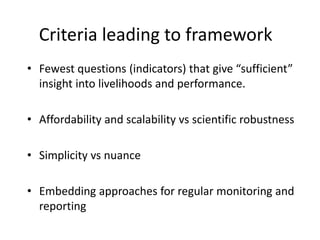
Criteria leading to framework
• Fewest questions (indicators) that give “sufficient”
insight into livelihoods and performance.
• Affordability and scalability vs scientific robustness
• Simplicity vs nuance
• Embedding approaches for regular monitoring and
reporting
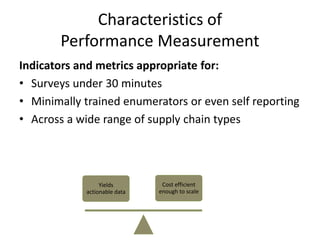
Characteristics of
Performance Measurement
Indicators and metrics appropriate for:
• Surveys under 30 minutes
• Minimally trained enumerators or even self reporting
• Across a wide range of supply chain types
Yields
actionable data
Cost efficient
enough to scale
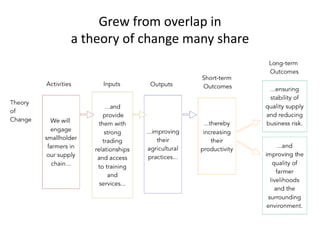
Grew from overlap in
a theory of change many share
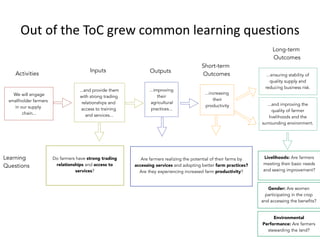
Out of the ToC grew common learning questions
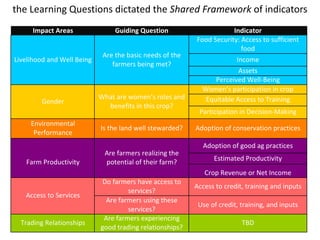
the Learning Questions dictated the Shared Framework of indicators
Impact Areas Guiding Question Indicator
Livelihood and Well Being
Are the basic needs of the
farmers being met?
Food Security: Access to sufficient
food
Income
Assets
Perceived Well-Being
Gender
What are women’s roles and
benefits in this crop?
Women’s participation in crop
Equitable Access to Training
Participation in Decision-Making
Environmental
Performance
Is the land well stewarded? Adoption of conservation practices
Farm Productivity
Are farmers realizing the
potential of their farm?
Adoption of good ag practices
Estimated Productivity
Crop Revenue or Net Income
Access to Services
Do farmers have access to
services?
Access to credit, training and inputs
Are farmers using these
services?
Use of credit, training, and inputs
Trading Relationships
Are farmers experiencing
good trading relationships?
TBD
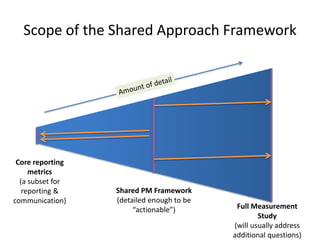
Scope of the Shared Approach Framework
Core reporting
metrics
(a subset for
reporting &
communication)
Shared PM Framework
(detailed enough to be
“actionable”) Full Measurement
Study
(will usually address
additional questions)
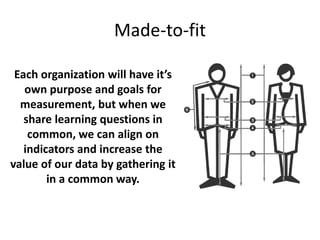
Made-to-fit
Each organization will have it’s
own purpose and goals for
measurement, but when we
share learning questions in
common, we can align on
indicators and increase the
value of our data by gathering it
in a common way.
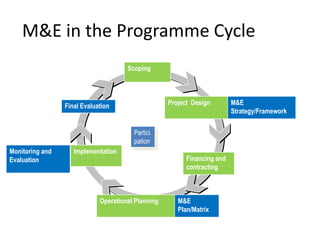
M&E in the Programme Cycle
Financing and
contracting
Final Evaluation
Implementation
Scoping
Project Design M&E
Strategy/Framework
Operational Planning M&E
Plan/Matrix
Partici
pation
Monitoring and
Evaluation
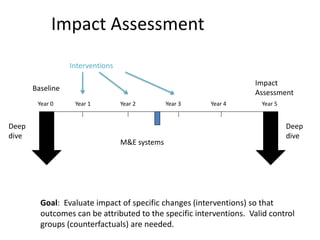
Impact Assessment
Year 1 Year 2 Year 3 Year 4 Year 5
M&E systems
Deep
dive
Deep
dive
Year 0
Baseline
Impact
Assessment
Interventions
Goal: Evaluate impact of specific changes (interventions) so that
outcomes can be attributed to the specific interventions. Valid control
groups (counterfactuals) are needed.
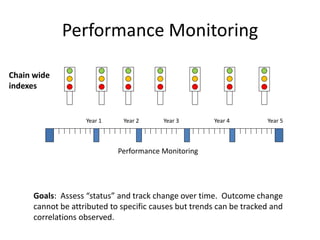
Performance Monitoring
Year 1 Year 2 Year 3 Year 4 Year 5
Performance Monitoring
Chain wide
indexes
Goals: Assess “status” and track change over time. Outcome change
cannot be attributed to specific causes but trends can be tracked and
correlations observed.
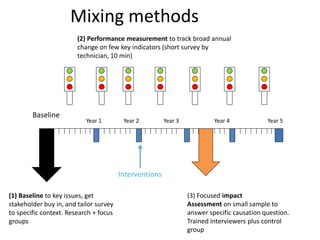
Mixing methods
Year 1 Year 2 Year 3 Year 4 Year 5
(2) Performance measurement to track broad annual
change on few key indicators (short survey by
technician, 10 min)
Baseline
(1) Baseline to key issues, get
stakeholder buy in, and tailor survey
to specific context. Research + focus
groups
Interventions
(3) Focused impact
Assessment on small sample to
answer specific causation question.
Trained interviewers plus control
group
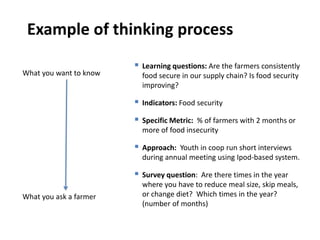
Example of thinking process
 Learning questions: Are the farmers consistently
food secure in our supply chain? Is food security
improving?
 Indicators: Food security
 Specific Metric: % of farmers with 2 months or
more of food insecurity
 Approach: Youth in coop run short interviews
during annual meeting using Ipod-based system.
 Survey question: Are there times in the year
where you have to reduce meal size, skip meals,
or change diet? Which times in the year?
(number of months)
What you want to know
What you ask a farmer
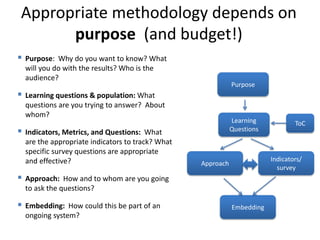
Appropriate methodology depends on
purpose (and budget!)
 Purpose: Why do you want to know? What
will you do with the results? Who is the
audience?
 Learning questions & population: What
questions are you trying to answer? About
whom?
 Indicators, Metrics, and Questions: What
are the appropriate indicators to track? What
specific survey questions are appropriate
and effective?
 Approach: How and to whom are you going
to ask the questions?
 Embedding: How could this be part of an
ongoing system?
Purpose
Learning
Questions
ToC
Approach
Indicators/
survey
Embedding
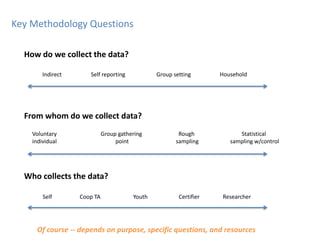
Of course -- depends on purpose, specific questions, and resources
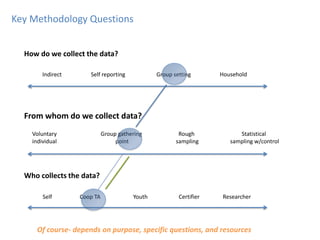
Key Methodology Questions
How do we collect the data?
From whom do we collect data?
Who collects the data?
Self reporting Group settingIndirect Household
Group gathering
point
Rough
sampling
Voluntary
individual
Statistical
sampling w/control
Coop TA YouthSelf Certifier Researcher
Of course -- depends on purpose, specific questions, and resources
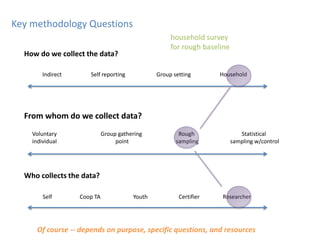
Key methodology Questions
How do we collect the data?
Who collects the data?
Self reporting Group settingIndirect Household
Group gathering
point
Rough
sampling
Voluntary
individual
Statistical
sampling w/control
Coop TA YouthSelf Certifier Researcher
household survey
for rough baseline
From whom do we collect data?
Of course- depends on purpose, specific questions, and resources
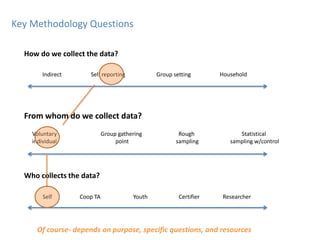
Key Methodology Questions
How do we collect the data?
Who collects the data?
Self reporting Group settingIndirect Household
Group gathering
point
Rough
sampling
Voluntary
individual
Statistical
sampling w/control
Coop TA YouthSelf Certifier Researcher
From whom do we collect data?
Of course- depends on purpose, specific questions, and resources
Key Methodology Questions
How do we collect the data?
Who collects the data?
Self reporting Group settingIndirect Household
Group gathering
point
Rough
sampling
Voluntary
individual
Statistical
sampling w/control
Coop TA YouthSelf Certifier Researcher
From whom do we collect data?

Masterclass Performance Measurement Framework

  • 1.
  • 2.
    Shared framework ofindicators Impact Areas Guiding Question Indicator Livelihood and Well Being Are the basic needs of the farmers being met? Food Security: Access to sufficient food Income Assets Perceived Well-Being Gender What are women’s roles and benefits in this crop? Women’s participation in crop Equitable Access to Training Participation in Decision-Making Environmental Performance Is the land well stewarded? Adoption of conservation practices Farm Productivity Are farmers realizing the potential of their farm? Adoption of good ag practices Estimated Productivity Crop Revenue or Net Income Access to Services Do farmers have access to services? Access to credit, training and inputs Are farmers using these services? Use of credit, training, and inputs Trading Relationships Are farmers experiencing good trading relationships? TBD
  • 3.
    What is ashared approach? • A common framework of indicators and metrics to help guide the practitioner. • A suite of indicators to pick what’s appropriate. Not a single set of indicators. • Shared approach implies committing to use the same indicators and metrics when asking the same questions.
  • 4.
    Why a sharedapproach? From shared questions about farmers to shared approach for: • Greater efficiency and effectiveness • Reduced burden on suppliers and farmers • More effective community learning
  • 5.
    Criteria leading toframework • Fewest questions (indicators) that give “sufficient” insight into livelihoods and performance. • Affordability and scalability vs scientific robustness • Simplicity vs nuance • Embedding approaches for regular monitoring and reporting
  • 6.
    Characteristics of Performance Measurement Indicatorsand metrics appropriate for: • Surveys under 30 minutes • Minimally trained enumerators or even self reporting • Across a wide range of supply chain types Yields actionable data Cost efficient enough to scale
  • 7.
    Grew from overlapin a theory of change many share
  • 8.
    Out of theToC grew common learning questions
  • 9.
    the Learning Questionsdictated the Shared Framework of indicators Impact Areas Guiding Question Indicator Livelihood and Well Being Are the basic needs of the farmers being met? Food Security: Access to sufficient food Income Assets Perceived Well-Being Gender What are women’s roles and benefits in this crop? Women’s participation in crop Equitable Access to Training Participation in Decision-Making Environmental Performance Is the land well stewarded? Adoption of conservation practices Farm Productivity Are farmers realizing the potential of their farm? Adoption of good ag practices Estimated Productivity Crop Revenue or Net Income Access to Services Do farmers have access to services? Access to credit, training and inputs Are farmers using these services? Use of credit, training, and inputs Trading Relationships Are farmers experiencing good trading relationships? TBD
  • 11.
    Scope of theShared Approach Framework Core reporting metrics (a subset for reporting & communication) Shared PM Framework (detailed enough to be “actionable”) Full Measurement Study (will usually address additional questions)
  • 12.
    Made-to-fit Each organization willhave it’s own purpose and goals for measurement, but when we share learning questions in common, we can align on indicators and increase the value of our data by gathering it in a common way.
  • 13.
    M&E in theProgramme Cycle Financing and contracting Final Evaluation Implementation Scoping Project Design M&E Strategy/Framework Operational Planning M&E Plan/Matrix Partici pation Monitoring and Evaluation
  • 14.
    Impact Assessment Year 1Year 2 Year 3 Year 4 Year 5 M&E systems Deep dive Deep dive Year 0 Baseline Impact Assessment Interventions Goal: Evaluate impact of specific changes (interventions) so that outcomes can be attributed to the specific interventions. Valid control groups (counterfactuals) are needed.
  • 15.
    Performance Monitoring Year 1Year 2 Year 3 Year 4 Year 5 Performance Monitoring Chain wide indexes Goals: Assess “status” and track change over time. Outcome change cannot be attributed to specific causes but trends can be tracked and correlations observed.
  • 16.
    Mixing methods Year 1Year 2 Year 3 Year 4 Year 5 (2) Performance measurement to track broad annual change on few key indicators (short survey by technician, 10 min) Baseline (1) Baseline to key issues, get stakeholder buy in, and tailor survey to specific context. Research + focus groups Interventions (3) Focused impact Assessment on small sample to answer specific causation question. Trained interviewers plus control group
  • 17.
    Example of thinkingprocess  Learning questions: Are the farmers consistently food secure in our supply chain? Is food security improving?  Indicators: Food security  Specific Metric: % of farmers with 2 months or more of food insecurity  Approach: Youth in coop run short interviews during annual meeting using Ipod-based system.  Survey question: Are there times in the year where you have to reduce meal size, skip meals, or change diet? Which times in the year? (number of months) What you want to know What you ask a farmer
  • 18.
    Appropriate methodology dependson purpose (and budget!)  Purpose: Why do you want to know? What will you do with the results? Who is the audience?  Learning questions & population: What questions are you trying to answer? About whom?  Indicators, Metrics, and Questions: What are the appropriate indicators to track? What specific survey questions are appropriate and effective?  Approach: How and to whom are you going to ask the questions?  Embedding: How could this be part of an ongoing system? Purpose Learning Questions ToC Approach Indicators/ survey Embedding
  • 19.
    Of course --depends on purpose, specific questions, and resources Key Methodology Questions How do we collect the data? From whom do we collect data? Who collects the data? Self reporting Group settingIndirect Household Group gathering point Rough sampling Voluntary individual Statistical sampling w/control Coop TA YouthSelf Certifier Researcher
  • 20.
    Of course --depends on purpose, specific questions, and resources Key methodology Questions How do we collect the data? Who collects the data? Self reporting Group settingIndirect Household Group gathering point Rough sampling Voluntary individual Statistical sampling w/control Coop TA YouthSelf Certifier Researcher household survey for rough baseline From whom do we collect data?
  • 21.
    Of course- dependson purpose, specific questions, and resources Key Methodology Questions How do we collect the data? Who collects the data? Self reporting Group settingIndirect Household Group gathering point Rough sampling Voluntary individual Statistical sampling w/control Coop TA YouthSelf Certifier Researcher From whom do we collect data?
  • 22.
    Of course- dependson purpose, specific questions, and resources Key Methodology Questions How do we collect the data? Who collects the data? Self reporting Group settingIndirect Household Group gathering point Rough sampling Voluntary individual Statistical sampling w/control Coop TA YouthSelf Certifier Researcher From whom do we collect data?