


3/30/2022
The main
issues in this
presentation
• The meaning of indicators, types of
indicators, and characteristics of a
good indicators
• The techniques and strategies used
to implement monitoring and
evaluation activities
• The core steps in monitoring and
evaluation
• Monitoring and Evaluation Tools and
Methods
3/30/2022
What is
indicator?
• An indicator is a specific, observable and
measurable characteristic that can be used to show
changes or progress a program is making toward
achieving a specific outcome.
• It should be defined in precise, unambiguous
terms that describe clearly and exactly what is
being measured. Where practical, it is measured.
• The change measured by the indicator should
represent progress that the program hopes to
make.
• Indicators do not specify a particular level of
achievement. The words “improved”, “increased”,
or “decreased” do not belong in an indicator.
3/30/2022
Types
of
indica
tors
can be categorized in a number of different
ways, depending on why they are being categorized.
• There are two general approaches to defining types of
indicators that are particularly useful in monitoring and
evaluation.
• The first is based on thematic similarities among
indicators; the second is based on the relative role and/or
effect that an indicator has in/on the response something
else.
• The most important point about the types of indicators is
how crucial it is to use a range of different types in a given
set in order to get a balanced perspective.
• It is advisable using different types of indicators in
monitoring and evaluation.
• Regarding this, some of core types of indicators are listed
below as follows:
3/30/2022
Types of indicators…continued
• Input indicators: What resources are required?
• These indicators measure the means or the resources
employed to facilitate the satisfaction of needs and,
hence, reaching development objectives.
• Examples in education would include the number of
teachers, school buildings, teaching materials
supplies, and the cost and level of expenditures
(public and private) on education.
• Since absolute numbers may not be very indicative
for policy decisions, input indicators are often
specified as some match of supply and demand
variables, such as pupil/teacher ratios and average
cost per pupil.
3/30/2022
Types of indicators…continued
• Access indicators: What demand factors affecting the
students teaching and learning?
• These indicators identify demand factors of potential
users and would comprise variables that determine the use
and accessibility of the supplied services.
• Examples of this type of indicators in education are the
geographical distance to school facilities, family and
cultural background of students, foregone earnings of
individuals and households, and direct private costs of
education (fees, utensils, uniforms, etc.).
• Some of these demand factors are essential in textbook
analyses of the economics of education.
3/30/2022
Types of indicators…continued
• Activity Indicators: What your project does?
• Activity indicators are essential in order to understand the
extent to which a project was delivered as planned, and to
highlight obstacles to implementation.
• By describing the various project components in specific and
measurable terms, including the resources required and
individuals responsible for various tasks, activity indicators
provide an important project management tool.
• They are most valuable when you are able to connect a given
set of activities to a particular output or outcome.
3/30/2022
Output Indicators: What your project produces?
• Output indicators describe the delivery of products,
including, but not limited to: the providing training and technical
assistance; creating standards and legislative documents;
investing in buildings and infrastructure; and hiring staff
required to implement a project.
• When combined with measures of inputs and activities,
output indicators can provide measures of economy and
efficiency, describing the relationship between investments
in a project and products.
• Output indicators, as defined here, try to measure to what
extent such immediate objectives are achieved.
3/30/2022
Outcome Indicators: What your project achieves?
• Well-designed outcome indicators are important
mechanisms for ensuring transparency and accountability,
describing the return on donor investments and the benefits that
a project delivers.
• Effective outcome indicators typically combine quantitative
and qualitative measures, describing the number of people
benefitting from a project and the nature of those benefits.
• For example, outcome indicators for a crime reduction
project may include changes in the number of people
experiencing violent crime (a quantitative indicator) alongside
perceptions of public safety (a qualitative indicator).
3/30/2022
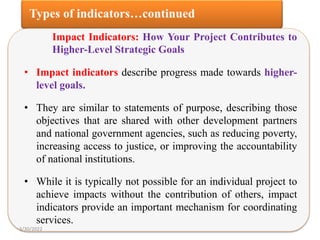
Impact Indicators: How Your Project Contributes to
Higher-Level Strategic Goals
• Impact indicators describe progress made towards higher-
level goals.
• They are similar to statements of purpose, describing those
objectives that are shared with other development partners
and national government agencies, such as reducing poverty,
increasing access to justice, or improving the accountability
of national institutions.
• While it is typically not possible for an individual project to
achieve impacts without the contribution of others, impact
indicators provide an important mechanism for coordinating
services.
3/30/2022
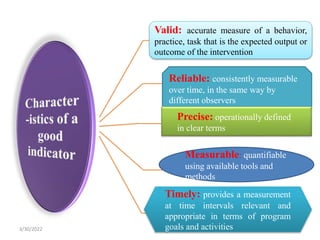
Measurable: quantifiable
using available tools and
methods
Valid: accurate measure of a behavior,
practice, task that is the expected output or
outcome of the intervention
Reliable: consistently measurable
over time, in the same way by
different observers
Precise: operationally defined
in clear terms
Timely: provides a measurement
at time intervals relevant and
appropriate in terms of program
goals and activities
3/30/2022
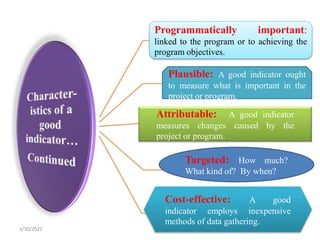
Targeted: How much?
What kind of? By when?
Programmatically important:
linked to the program or to achieving the
program objectives.
Plausible: A good indicator ought
to measure what is important in the
project or program.
Attributable: A good indicator
measures changes caused by the
project or program.
Cost-effective: A good
indicator employs inexpensive
methods of data gathering.
3/30/2022
How are monitoring and evaluation
activities implemented?
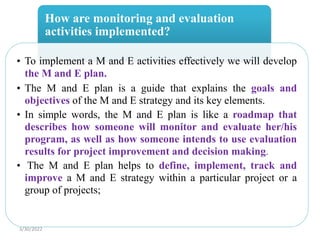
• To implement a M and E activities effectively we will develop
the M and E plan.
• The M and E plan is a guide that explains the goals and
objectives of the M and E strategy and its key elements.
• In simple words, the M and E plan is like a roadmap that
describes how someone will monitor and evaluate her/his
program, as well as how someone intends to use evaluation
results for project improvement and decision making.
• The M and E plan helps to define, implement, track and
improve a M and E strategy within a particular project or a
group of projects;
3/30/2022
How are monitoring and evaluation
activities implemented?...Continued
• Let’s take a look at what these ‘steps,’ ‘elements’ and
‘activities’ entail:
• A proposed timeline for M and E
• Relevant M and E questions to ask at different stages of the
project life cycle
• Using different methodologies
• An effective implementation strategy
• Expected results
• Defining who would implement the various components of
the Monitoring and Evaluation plan
3/30/2022
How are monitoring and evaluation
activities implemented?...Continued
• Appropriate Monitoring and Evaluation tools for data
collection
• Identifying where data would be stored and how it would
be analyzed
• Defining how Monitoring and Evaluation findings would
be reported to donors, stakeholders and internal staff
members to ensure project improvement, transparency and
data-driven decision making
• Other required resources and capacities
3/30/2022
How are monitoring and evaluation
activities implemented?...Continued
• When should we design the M and E plan?
• M and E plan should be created right in the beginning when the project
interventions are being planned.
• Planning project interventions and designing the M and E strategy
should go hand in hand.
• It is important to involve project managers, evaluators, donors, and other
stakeholders in the designing of the M and E plan, as stakeholder
involvement in the early phase ensures the applicability and sustainability
of M and E activities.
• The idea is to identify opportunities and barriers as a team in the planning
stage with a focus on problem-solving and maximizing impact.
3/30/2022
How are M and E activities
implemented?...Continued
• Step-by-step guide to designing the M and Evaluation plan
• Developing M and E plan is a dynamic and multi-faceted process.
• It involves merging and connecting different elements of M and E into one
holistic system.
• It is recommended to design the M and E work plan in a manner that it’s
flexible so adjustments could be made anytime within the context of the work
plan to account for issues that may arise during the M and E process.
• Before we begin, it is essential to understand the rationale behind developing
the M and E plan, the key elements that will be included and the steps
required in developing it.
• Below, we have attempted to break down these elements into different steps for
more clarity
3/30/2022
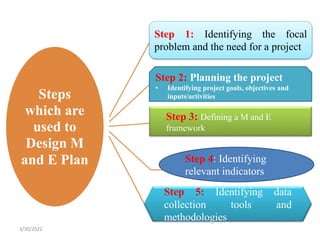
Steps
which are
used to
Design M
and E Plan Step 4: Identifying
relevant indicators
Step 1: Identifying the focal
problem and the need for a project
Step 2: Planning the project
• Identifying project goals, objectives and
inputs/activities
Step 3: Defining a M and E
framework
Step 5: Identifying data
collection tools and
methodologies
3/30/2022
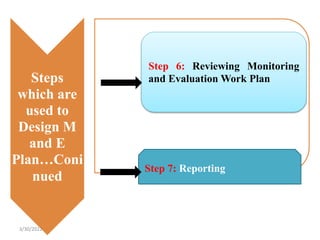
Steps
which are
used to
Design M
and E
Plan…Coni
nued
Step 6: Reviewing Monitoring
and Evaluation Work Plan
Step 7: Reporting
3/30/2022
What
are the
steps
in M
and E?
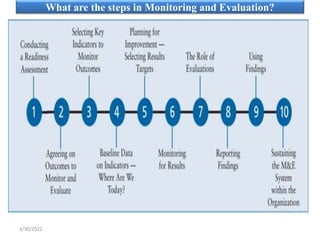
• Step 1: Conducting a readiness assessment
• A readiness assessment is like constructing
the foundation for a building.
• A good foundation provides support for all
that is above it. It is below ground, not seen,
but critical.
• Measuring readiness is a systematic analysis
of an organization’s ability to undertake a
transformational process or change.
• A readiness assessment identifies the
potential challenges that might arise when
implementing new procedures, structures, and
processes within a current organizational
context
3/30/2022
What are
the steps
in M and
E?...CO
NTINUE
D
• Step 2: Agreeing on outcomes to monitor
and evaluate
• Setting goals is part of the governmental
decision making process at every level.
• All governments have goals although not
all have M and E capacity.
• Assuming that a country or organization is
in fact in a position to move forward in
building a results-based M and E system,
the next step is to choose and agree on the
outcomes (derived from the goals) to
monitor and evaluate.
3/30/2022
What are
the steps
in M and
E?...CO
NTINUE
D
• Step 3: Selecting key indicators to
monitor outcomes
• Indicator development is a core activity
in building a results-based monitoring and
evaluation system.
• Indicator development drives all
subsequent data collection, analysis, and
reporting.
• There are also important political and
methodological considerations involved
in creating good, effective indicators.
3/30/2022
What are
the steps
in M and
E?...CO
NTINUE
D
• Step 4: Baseline data on indicators-
where are we today?
• Baselines are the first critical measurement
of the indicators.
• Baselines are derived from the expected
outcomes and indicators.
• A performance baseline is information i.e.
qualitative or quantitative that provides
data at the beginning of, or just prior to, the
monitoring period.
• The baseline is used as a starting point,
or guide, by which to monitor future
performance.
3/30/2022
What are
the steps
in M and
E?...CO
NTINUE
D
• Step 5: Planning for
Improvement-Selecting Results
and Targets
• A target is a specified objective that
indicates the number, timing and
location of that which is to be
realized.
• The target is what the situation is
expected to be at the end of a
program or activity.
3/30/2022
What are
the steps
in M and
E?...CO
NTINUE
D
• Step 6: Monitoring for results
• There are two key types of M which are
implementation M and results M.
• Implementation M tracks the means and
strategies (that is, those inputs, activities,
and outputs found in annual or
multiyear work plans) used to achieve a
given outcomes. These means and
strategies are supported by the use of
management tools, including budgetary
resources, staffing, and activity planning.
• Results M includes policy M, program M,
and project M.
3/30/2022
What are
the steps
in M and
E?...CO
NTINUE
D
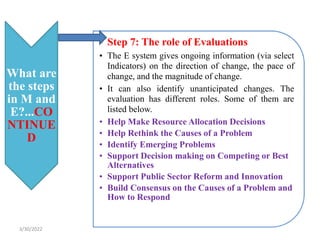
• Step 7: The role of Evaluations
• The E system gives ongoing information (via select
Indicators) on the direction of change, the pace of
change, and the magnitude of change.
• It can also identify unanticipated changes. The
evaluation has different roles. Some of them are
listed below.
• Help Make Resource Allocation Decisions
• Help Rethink the Causes of a Problem
• Identify Emerging Problems
• Support Decision making on Competing or Best
Alternatives
• Support Public Sector Reform and Innovation
• Build Consensus on the Causes of a Problem and
How to Respond
3/30/2022
What are
the steps
in M and
E?...CO
NTINUE
D
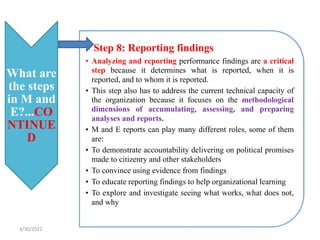
• Step 8: Reporting findings
• Analyzing and reporting performance findings are a critical
step because it determines what is reported, when it is
reported, and to whom it is reported.
• This step also has to address the current technical capacity of
the organization because it focuses on the methodological
dimensions of accumulating, assessing, and preparing
analyses and reports.
• M and E reports can play many different roles, some of them
are:
• To demonstrate accountability delivering on political promises
made to citizenry and other stakeholders
• To convince using evidence from findings
• To educate reporting findings to help organizational learning
• To explore and investigate seeing what works, what does not,
and why
3/30/2022
What are
the steps
in M and
E?...CO
NTINUE
D
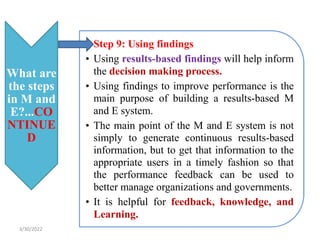
• Step 9: Using findings
• Using results-based findings will help inform
the decision making process.
• Using findings to improve performance is the
main purpose of building a results-based M
and E system.
• The main point of the M and E system is not
simply to generate continuous results-based
information, but to get that information to the
appropriate users in a timely fashion so that
the performance feedback can be used to
better manage organizations and governments.
• It is helpful for feedback, knowledge, and
Learning.
3/30/2022
What are
the steps
in M and
E?...CO
NTINUE
D
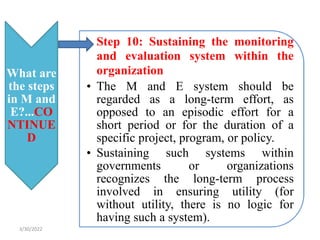
• Step 10: Sustaining the monitoring
and evaluation system within the
organization
• The M and E system should be
regarded as a long-term effort, as
opposed to an episodic effort for a
short period or for the duration of a
specific project, program, or policy.
• Sustaining such systems within
governments or organizations
recognizes the long-term process
involved in ensuring utility (for
without utility, there is no logic for
having such a system).
3/30/2022
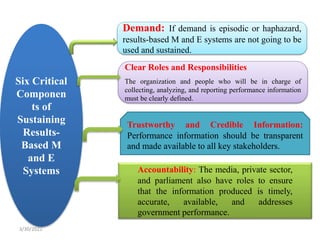
Demand: If demand is episodic or haphazard,
results-based M and E systems are not going to be
used and sustained.
Trustworthy and Credible Information:
Performance information should be transparent
and made available to all key stakeholders.
Accountability: The media, private sector,
and parliament also have roles to ensure
that the information produced is timely,
accurate, available, and addresses
government performance.
Six Critical
Componen
ts of
Sustaining
Results-
Based M
and E
Systems
Clear Roles and Responsibilities
The organization and people who will be in charge of
collecting, analyzing, and reporting performance information
must be clearly defined.
3/30/2022
What are the steps in Monitoring and Evaluation?
3/30/2022
• After creating M and E indicators, it is
time to identify and collect relevant data
and prepare data collecting tools to
demonstrate the actual results of the
project interventions against our
indicators.
• M and E experts recommend involving the
project team and stakeholders in the
discussion to make the process more
participatory.
3/30/2022
• Before collecting data, it is a good idea to
discuss these questions as a team:
• Will the data be qualitative, quantitative,
or a combination of the two/mixed?
• What baseline data already exists?
• What are the most relevant methods and
tools to collect new data?
• How will the collected data be recorded?
• How and when will the data be analyzed?
• Who will be responsible for data
collection and analysis?
3/30/2022
• Some common types of data collection
tools are as follows:
• Surveys
• Questionnaires
• Focus groups discussion
• Case studies
• Interviews
• Workshops
• Content analysis of materials etc.
3/30/2022
•
3/30/2022

Monitoring and Evaluation.ppt

  • 1.
  • 2.
    The main issues inthis presentation • The meaning of indicators, types of indicators, and characteristics of a good indicators • The techniques and strategies used to implement monitoring and evaluation activities • The core steps in monitoring and evaluation • Monitoring and Evaluation Tools and Methods 3/30/2022
  • 3.
    What is indicator? • Anindicator is a specific, observable and measurable characteristic that can be used to show changes or progress a program is making toward achieving a specific outcome. • It should be defined in precise, unambiguous terms that describe clearly and exactly what is being measured. Where practical, it is measured. • The change measured by the indicator should represent progress that the program hopes to make. • Indicators do not specify a particular level of achievement. The words “improved”, “increased”, or “decreased” do not belong in an indicator. 3/30/2022
  • 4.
    Types of indica tors can be categorizedin a number of different ways, depending on why they are being categorized. • There are two general approaches to defining types of indicators that are particularly useful in monitoring and evaluation. • The first is based on thematic similarities among indicators; the second is based on the relative role and/or effect that an indicator has in/on the response something else. • The most important point about the types of indicators is how crucial it is to use a range of different types in a given set in order to get a balanced perspective. • It is advisable using different types of indicators in monitoring and evaluation. • Regarding this, some of core types of indicators are listed below as follows: 3/30/2022
  • 5.
    Types of indicators…continued •Input indicators: What resources are required? • These indicators measure the means or the resources employed to facilitate the satisfaction of needs and, hence, reaching development objectives. • Examples in education would include the number of teachers, school buildings, teaching materials supplies, and the cost and level of expenditures (public and private) on education. • Since absolute numbers may not be very indicative for policy decisions, input indicators are often specified as some match of supply and demand variables, such as pupil/teacher ratios and average cost per pupil. 3/30/2022
  • 6.
    Types of indicators…continued •Access indicators: What demand factors affecting the students teaching and learning? • These indicators identify demand factors of potential users and would comprise variables that determine the use and accessibility of the supplied services. • Examples of this type of indicators in education are the geographical distance to school facilities, family and cultural background of students, foregone earnings of individuals and households, and direct private costs of education (fees, utensils, uniforms, etc.). • Some of these demand factors are essential in textbook analyses of the economics of education. 3/30/2022
  • 7.
    Types of indicators…continued •Activity Indicators: What your project does? • Activity indicators are essential in order to understand the extent to which a project was delivered as planned, and to highlight obstacles to implementation. • By describing the various project components in specific and measurable terms, including the resources required and individuals responsible for various tasks, activity indicators provide an important project management tool. • They are most valuable when you are able to connect a given set of activities to a particular output or outcome. 3/30/2022
  • 8.
    Output Indicators: Whatyour project produces? • Output indicators describe the delivery of products, including, but not limited to: the providing training and technical assistance; creating standards and legislative documents; investing in buildings and infrastructure; and hiring staff required to implement a project. • When combined with measures of inputs and activities, output indicators can provide measures of economy and efficiency, describing the relationship between investments in a project and products. • Output indicators, as defined here, try to measure to what extent such immediate objectives are achieved. 3/30/2022
  • 9.
    Outcome Indicators: Whatyour project achieves? • Well-designed outcome indicators are important mechanisms for ensuring transparency and accountability, describing the return on donor investments and the benefits that a project delivers. • Effective outcome indicators typically combine quantitative and qualitative measures, describing the number of people benefitting from a project and the nature of those benefits. • For example, outcome indicators for a crime reduction project may include changes in the number of people experiencing violent crime (a quantitative indicator) alongside perceptions of public safety (a qualitative indicator). 3/30/2022
  • 10.
    Impact Indicators: HowYour Project Contributes to Higher-Level Strategic Goals • Impact indicators describe progress made towards higher- level goals. • They are similar to statements of purpose, describing those objectives that are shared with other development partners and national government agencies, such as reducing poverty, increasing access to justice, or improving the accountability of national institutions. • While it is typically not possible for an individual project to achieve impacts without the contribution of others, impact indicators provide an important mechanism for coordinating services. 3/30/2022
  • 11.
    Measurable: quantifiable using availabletools and methods Valid: accurate measure of a behavior, practice, task that is the expected output or outcome of the intervention Reliable: consistently measurable over time, in the same way by different observers Precise: operationally defined in clear terms Timely: provides a measurement at time intervals relevant and appropriate in terms of program goals and activities 3/30/2022
  • 12.
    Targeted: How much? Whatkind of? By when? Programmatically important: linked to the program or to achieving the program objectives. Plausible: A good indicator ought to measure what is important in the project or program. Attributable: A good indicator measures changes caused by the project or program. Cost-effective: A good indicator employs inexpensive methods of data gathering. 3/30/2022
  • 13.
    How are monitoringand evaluation activities implemented? • To implement a M and E activities effectively we will develop the M and E plan. • The M and E plan is a guide that explains the goals and objectives of the M and E strategy and its key elements. • In simple words, the M and E plan is like a roadmap that describes how someone will monitor and evaluate her/his program, as well as how someone intends to use evaluation results for project improvement and decision making. • The M and E plan helps to define, implement, track and improve a M and E strategy within a particular project or a group of projects; 3/30/2022
  • 14.
    How are monitoringand evaluation activities implemented?...Continued • Let’s take a look at what these ‘steps,’ ‘elements’ and ‘activities’ entail: • A proposed timeline for M and E • Relevant M and E questions to ask at different stages of the project life cycle • Using different methodologies • An effective implementation strategy • Expected results • Defining who would implement the various components of the Monitoring and Evaluation plan 3/30/2022
  • 15.
    How are monitoringand evaluation activities implemented?...Continued • Appropriate Monitoring and Evaluation tools for data collection • Identifying where data would be stored and how it would be analyzed • Defining how Monitoring and Evaluation findings would be reported to donors, stakeholders and internal staff members to ensure project improvement, transparency and data-driven decision making • Other required resources and capacities 3/30/2022
  • 16.
    How are monitoringand evaluation activities implemented?...Continued • When should we design the M and E plan? • M and E plan should be created right in the beginning when the project interventions are being planned. • Planning project interventions and designing the M and E strategy should go hand in hand. • It is important to involve project managers, evaluators, donors, and other stakeholders in the designing of the M and E plan, as stakeholder involvement in the early phase ensures the applicability and sustainability of M and E activities. • The idea is to identify opportunities and barriers as a team in the planning stage with a focus on problem-solving and maximizing impact. 3/30/2022
  • 17.
    How are Mand E activities implemented?...Continued • Step-by-step guide to designing the M and Evaluation plan • Developing M and E plan is a dynamic and multi-faceted process. • It involves merging and connecting different elements of M and E into one holistic system. • It is recommended to design the M and E work plan in a manner that it’s flexible so adjustments could be made anytime within the context of the work plan to account for issues that may arise during the M and E process. • Before we begin, it is essential to understand the rationale behind developing the M and E plan, the key elements that will be included and the steps required in developing it. • Below, we have attempted to break down these elements into different steps for more clarity 3/30/2022
  • 18.
    Steps which are used to DesignM and E Plan Step 4: Identifying relevant indicators Step 1: Identifying the focal problem and the need for a project Step 2: Planning the project • Identifying project goals, objectives and inputs/activities Step 3: Defining a M and E framework Step 5: Identifying data collection tools and methodologies 3/30/2022
  • 19.
    Steps which are used to DesignM and E Plan…Coni nued Step 6: Reviewing Monitoring and Evaluation Work Plan Step 7: Reporting 3/30/2022
  • 20.
    What are the steps in M andE? • Step 1: Conducting a readiness assessment • A readiness assessment is like constructing the foundation for a building. • A good foundation provides support for all that is above it. It is below ground, not seen, but critical. • Measuring readiness is a systematic analysis of an organization’s ability to undertake a transformational process or change. • A readiness assessment identifies the potential challenges that might arise when implementing new procedures, structures, and processes within a current organizational context 3/30/2022
  • 21.
    What are the steps inM and E?...CO NTINUE D • Step 2: Agreeing on outcomes to monitor and evaluate • Setting goals is part of the governmental decision making process at every level. • All governments have goals although not all have M and E capacity. • Assuming that a country or organization is in fact in a position to move forward in building a results-based M and E system, the next step is to choose and agree on the outcomes (derived from the goals) to monitor and evaluate. 3/30/2022
  • 22.
    What are the steps inM and E?...CO NTINUE D • Step 3: Selecting key indicators to monitor outcomes • Indicator development is a core activity in building a results-based monitoring and evaluation system. • Indicator development drives all subsequent data collection, analysis, and reporting. • There are also important political and methodological considerations involved in creating good, effective indicators. 3/30/2022
  • 23.
    What are the steps inM and E?...CO NTINUE D • Step 4: Baseline data on indicators- where are we today? • Baselines are the first critical measurement of the indicators. • Baselines are derived from the expected outcomes and indicators. • A performance baseline is information i.e. qualitative or quantitative that provides data at the beginning of, or just prior to, the monitoring period. • The baseline is used as a starting point, or guide, by which to monitor future performance. 3/30/2022
  • 24.
    What are the steps inM and E?...CO NTINUE D • Step 5: Planning for Improvement-Selecting Results and Targets • A target is a specified objective that indicates the number, timing and location of that which is to be realized. • The target is what the situation is expected to be at the end of a program or activity. 3/30/2022
  • 25.
    What are the steps inM and E?...CO NTINUE D • Step 6: Monitoring for results • There are two key types of M which are implementation M and results M. • Implementation M tracks the means and strategies (that is, those inputs, activities, and outputs found in annual or multiyear work plans) used to achieve a given outcomes. These means and strategies are supported by the use of management tools, including budgetary resources, staffing, and activity planning. • Results M includes policy M, program M, and project M. 3/30/2022
  • 26.
    What are the steps inM and E?...CO NTINUE D • Step 7: The role of Evaluations • The E system gives ongoing information (via select Indicators) on the direction of change, the pace of change, and the magnitude of change. • It can also identify unanticipated changes. The evaluation has different roles. Some of them are listed below. • Help Make Resource Allocation Decisions • Help Rethink the Causes of a Problem • Identify Emerging Problems • Support Decision making on Competing or Best Alternatives • Support Public Sector Reform and Innovation • Build Consensus on the Causes of a Problem and How to Respond 3/30/2022
  • 27.
    What are the steps inM and E?...CO NTINUE D • Step 8: Reporting findings • Analyzing and reporting performance findings are a critical step because it determines what is reported, when it is reported, and to whom it is reported. • This step also has to address the current technical capacity of the organization because it focuses on the methodological dimensions of accumulating, assessing, and preparing analyses and reports. • M and E reports can play many different roles, some of them are: • To demonstrate accountability delivering on political promises made to citizenry and other stakeholders • To convince using evidence from findings • To educate reporting findings to help organizational learning • To explore and investigate seeing what works, what does not, and why 3/30/2022
  • 28.
    What are the steps inM and E?...CO NTINUE D • Step 9: Using findings • Using results-based findings will help inform the decision making process. • Using findings to improve performance is the main purpose of building a results-based M and E system. • The main point of the M and E system is not simply to generate continuous results-based information, but to get that information to the appropriate users in a timely fashion so that the performance feedback can be used to better manage organizations and governments. • It is helpful for feedback, knowledge, and Learning. 3/30/2022
  • 29.
    What are the steps inM and E?...CO NTINUE D • Step 10: Sustaining the monitoring and evaluation system within the organization • The M and E system should be regarded as a long-term effort, as opposed to an episodic effort for a short period or for the duration of a specific project, program, or policy. • Sustaining such systems within governments or organizations recognizes the long-term process involved in ensuring utility (for without utility, there is no logic for having such a system). 3/30/2022
  • 30.
    Demand: If demandis episodic or haphazard, results-based M and E systems are not going to be used and sustained. Trustworthy and Credible Information: Performance information should be transparent and made available to all key stakeholders. Accountability: The media, private sector, and parliament also have roles to ensure that the information produced is timely, accurate, available, and addresses government performance. Six Critical Componen ts of Sustaining Results- Based M and E Systems Clear Roles and Responsibilities The organization and people who will be in charge of collecting, analyzing, and reporting performance information must be clearly defined. 3/30/2022
  • 31.
    What are thesteps in Monitoring and Evaluation? 3/30/2022
  • 32.
    • After creatingM and E indicators, it is time to identify and collect relevant data and prepare data collecting tools to demonstrate the actual results of the project interventions against our indicators. • M and E experts recommend involving the project team and stakeholders in the discussion to make the process more participatory. 3/30/2022
  • 33.
    • Before collectingdata, it is a good idea to discuss these questions as a team: • Will the data be qualitative, quantitative, or a combination of the two/mixed? • What baseline data already exists? • What are the most relevant methods and tools to collect new data? • How will the collected data be recorded? • How and when will the data be analyzed? • Who will be responsible for data collection and analysis? 3/30/2022
  • 34.
    • Some commontypes of data collection tools are as follows: • Surveys • Questionnaires • Focus groups discussion • Case studies • Interviews • Workshops • Content analysis of materials etc. 3/30/2022
  • 35.