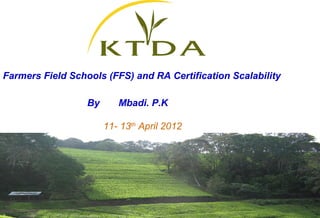

Farmers Field Schools (FFS) and RA Certification Scalability

                  By      Mbadi. P.K

                       11- 13th April 2012
CONTENTS
• 1. Introduction
   (KTDA Brief History, Mission/Vision and structure)


• 2. The sustainable agriculture Project
      (RA certification and FFS Scalability)

• 3. Achievements

• 4. Challenges
BRIEF HISTORY
• Tea was introduced in Kenya in 1903.
• Smallholder cultivation started in 1950’s
• Special Crops Development Authority established in
  1960.
• Kenya Tea Development Authority Established in 1964
  with 2 factories
• Kenya Tea Development Agency incorporated on 15th
  June, 2000 with 45 factories.
• The Agency currently manages all the 65 tea factories
  600,000 small-scale tea farmers
KTDA’S Mission 


• To provide effective management services to the tea sector
  for efficient production, processing and marketing of high
  quality teas and investing in related profitable ventures for
  the benefit of the shareholders and other stakeholders.


KTDA’S Vision
• To be the leading management and marketing
  company of high quality tea products in the world.
KTDA Organization Structure

                         KTDA Board
       12 Elected Farmers representatives from 12 Zones


                    The Factories Boards
                 Six Farmers representatives


                    Leaf collection centres
                 Five Farmers representatives


       600,000 farmers from the 65 factories catchments
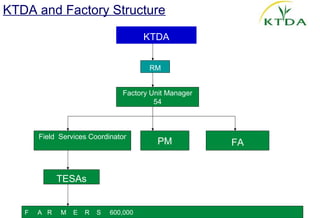
KTDA and Factory Structure

                                       KTDA


                                       RM


                                Factory Unit Manager
                                         54


       Field Services Coordinator
                                          PM           FA


             TESAs


   F   A R   M   E   R   S   600,000
Sustainable Agriculture Project
• In 2006 KTDA and Unilever with funding from DFID initiated a pilot
  project on sustainable agriculture practices using Farmers field school
  extension methodology among small scale tea growers, in 4 Pilot
  factories.

• Due to the success of the pilot project, KTDA with Funding from IDH
  and Dutch Embassy (Nairobi) is rolling out the FFS methodology to all
  its factories as a program to promote sustainable agriculture,
  empower farmers and improve extension services.


• KTDA, in collaboration with Rainforest Alliance, Unilever and other tea
  packers, has trained and certified 36 factories in 2010 and 2011 on
  sustainable agriculture practices
Project Objectives
• Train and certify on the Rainforest Alliance (RA) program

• Train extension staff on FFS methodology for all KTDA
  factories
• Support FFS up-scaling program for two years

• Study wood fuel consumption reduction best practice, in
  partnership with other actors in the tea sector

• Study FFS and certification programs to determine and
  share best practice system design for scaling up for training
  activities
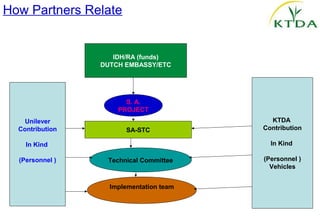
How Partners Relate


                    IDH/RA (funds)
                 DUTCH EMBASSY/ETC


                       S. A.
                     PROJECT
    Unilever                               KTDA 
  Contribution         SA-STC            Contribution

    In Kind                                In Kind 

  (Personnel )    Technical Committee    (Personnel )
                                           Vehicles


                   Implementation team
APPROACH
 TWO STREAMS OF ACTIVITIES
 – RA Certification of factories according to Market demand
 We use lead farmer model and sensitization methods to drive this


 – Farmer Field Schools (FFS)- Extension methodology
    • Training of TESAs an FSCs as Facilitators--Complete
    • Rolling out of FFS in all factories- On going
    • Up scaling FFS by 2015
    • Backstopping
    • Study and Design Up scaling process
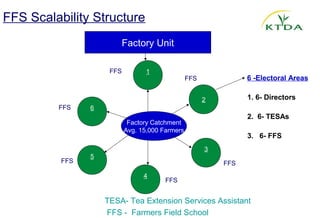
FFS Scalability Structure
                           Factory Unit

                     FFS          1
                                                 FFS              6 -Electoral Areas


                                                       2          1. 6- Directors
         FFS    6
                                                                  2.  6- TESAs
                            Factory Catchment
                           Avg. 15,000 Farmers
                                                                  3.   6- FFS
                                                       3
                5
          FFS                                              FFS
                                 4
                                        FFS


                    TESA- Tea Extension Services Assistant
                    FFS - Farmers Field School
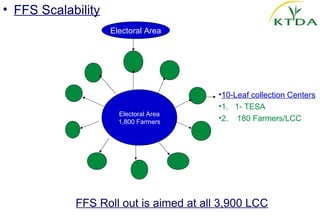
• FFS Scalability
                    Electoral Area


                                        •10-Leaf collection Centers
                                        •1. 1- TESA
                      Electoral Area
                      1,800 Farmers
                                        •2. 180 Farmers/LCC


            FFS Roll out is aimed at all 3,900 LCC
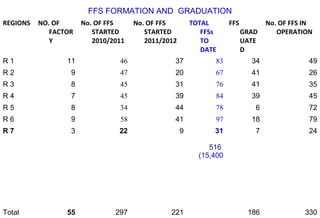
FFS FORMATION AND GRADUATION
REGIONS   NO. OF      No. OF FFS     No. OF FFS         TOTAL       FFS          No. OF FFS IN
             FACTOR      STARTED        STARTED            FFSs           GRAD      OPERATION
             Y           2010/2011      2011/2012          TO             UATE
                                                           DATE           D
R1               11             46              37            83            34               49
R2                9             47              20            67            41               26
R3                8             45              31            76            41               35
R4                7             45              39            84            39               45
R5                8             34              44            78             6               72
R6                9             58              41            97            18               79
R 7               3             22                  9         31             7               24

                                                             516
                                                          (15,400


Total            55            297             221                         186             330
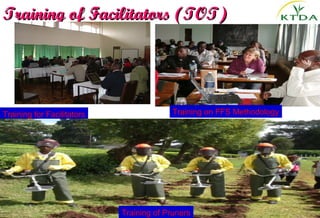
Training of Facilitators (TOT)


Training for Facilitators                 Training on FFS Methodology


                            Training of Pruners
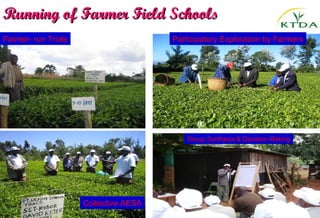
Running of Farmer Field Schools
Farmer- run Trials                     Participatory Exploration by Farmers


                                           Group Synthesis & Decision Making


                     Collective AESA
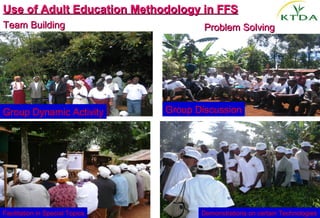
Use of Adult Education Methodology in FFS
Team Building                            Problem Solving


Group Dynamic Activity           Group Discussion


Facilitation in Special Topics          Demonstrations on certain Technologies
Achievements
1.   Increase in  yield by up to 15% 

2.   Improved health of both  farmers and workers due to use of PPE

3.   Healthy Environment.

4.   Increased income due to diversification of farming 

5.   Continued production of high quality teas

6.   Adoption of New technology is very high

7.   Farmers feel empowered and can teach other farmers

8.   Use the FFS graduates as lead farmers to train and inspect others farmers farms 

     during RA certification

9.   Improved market demand on RA certified teas
Summary of challenges 
1.   Lack of capacity ( Facilitators) to accelerate the formation and 
     running of FFS to reach all the buying centers

2.   Low education level of the farmers

3.   Competition with other initiatives

4.   Absenteeism from classes due to other family matters 

5.   Gender balancing.

6.   Cultural and beliefs among different cultures

7.   Lack of enough fund to support the up scaling

8.   Decreasing smallholder farm sizes.

9.   High cost of compliance –eg Audit Fee and PPE costs
                                                                         18
THANK
 YOU!
        19
        19

Scaling inclusive agri food markets: Farmer Field Schools and certification.

  • 1.
    Farmers Field Schools(FFS) and RA Certification Scalability By Mbadi. P.K 11- 13th April 2012
  • 2.
    CONTENTS • 1. Introduction (KTDA Brief History, Mission/Vision and structure) • 2. The sustainable agriculture Project (RA certification and FFS Scalability) • 3. Achievements • 4. Challenges
  • 3.
    BRIEF HISTORY • Teawas introduced in Kenya in 1903. • Smallholder cultivation started in 1950’s • Special Crops Development Authority established in 1960. • Kenya Tea Development Authority Established in 1964 with 2 factories • Kenya Tea Development Agency incorporated on 15th June, 2000 with 45 factories. • The Agency currently manages all the 65 tea factories 600,000 small-scale tea farmers
  • 4.
    KTDA’S Mission  • Toprovide effective management services to the tea sector for efficient production, processing and marketing of high quality teas and investing in related profitable ventures for the benefit of the shareholders and other stakeholders. KTDA’S Vision • To be the leading management and marketing company of high quality tea products in the world.
  • 5.
    KTDA Organization Structure KTDA Board 12 Elected Farmers representatives from 12 Zones The Factories Boards Six Farmers representatives Leaf collection centres Five Farmers representatives 600,000 farmers from the 65 factories catchments
  • 6.
    KTDA and FactoryStructure KTDA RM Factory Unit Manager 54 Field Services Coordinator PM FA TESAs F A R M E R S 600,000
  • 7.
    Sustainable Agriculture Project •In 2006 KTDA and Unilever with funding from DFID initiated a pilot project on sustainable agriculture practices using Farmers field school extension methodology among small scale tea growers, in 4 Pilot factories. • Due to the success of the pilot project, KTDA with Funding from IDH and Dutch Embassy (Nairobi) is rolling out the FFS methodology to all its factories as a program to promote sustainable agriculture, empower farmers and improve extension services. • KTDA, in collaboration with Rainforest Alliance, Unilever and other tea packers, has trained and certified 36 factories in 2010 and 2011 on sustainable agriculture practices
  • 8.
    Project Objectives • Trainand certify on the Rainforest Alliance (RA) program • Train extension staff on FFS methodology for all KTDA factories • Support FFS up-scaling program for two years • Study wood fuel consumption reduction best practice, in partnership with other actors in the tea sector • Study FFS and certification programs to determine and share best practice system design for scaling up for training activities
  • 9.
    How Partners Relate IDH/RA (funds) DUTCH EMBASSY/ETC S. A. PROJECT Unilever KTDA  Contribution SA-STC Contribution In Kind  In Kind  (Personnel ) Technical Committee (Personnel ) Vehicles Implementation team
  • 10.
    APPROACH TWO STREAMSOF ACTIVITIES – RA Certification of factories according to Market demand We use lead farmer model and sensitization methods to drive this – Farmer Field Schools (FFS)- Extension methodology • Training of TESAs an FSCs as Facilitators--Complete • Rolling out of FFS in all factories- On going • Up scaling FFS by 2015 • Backstopping • Study and Design Up scaling process
  • 11.
    FFS Scalability Structure Factory Unit FFS 1 FFS  6 -Electoral Areas 2  1. 6- Directors FFS 6  2.  6- TESAs Factory Catchment Avg. 15,000 Farmers  3.   6- FFS 3 5 FFS FFS 4 FFS TESA- Tea Extension Services Assistant FFS - Farmers Field School
  • 12.
    • FFS Scalability Electoral Area •10-Leaf collection Centers •1. 1- TESA Electoral Area 1,800 Farmers •2. 180 Farmers/LCC FFS Roll out is aimed at all 3,900 LCC
  • 13.
    FFS FORMATION ANDGRADUATION REGIONS NO. OF No. OF FFS No. OF FFS TOTAL FFS No. OF FFS IN FACTOR STARTED STARTED FFSs GRAD OPERATION Y 2010/2011 2011/2012 TO UATE DATE D R1 11 46 37 83 34 49 R2 9 47 20 67 41 26 R3 8 45 31 76 41 35 R4 7 45 39 84 39 45 R5 8 34 44 78 6 72 R6 9 58 41 97 18 79 R 7 3 22 9 31 7 24 516 (15,400 Total 55 297 221 186 330
  • 14.
    Training of Facilitators(TOT) Training for Facilitators Training on FFS Methodology Training of Pruners
  • 15.
    Running of FarmerField Schools Farmer- run Trials Participatory Exploration by Farmers Group Synthesis & Decision Making Collective AESA
  • 16.
    Use of Adult Education Methodology in FFS Team Building Problem Solving Group Dynamic Activity Group Discussion Facilitation in Special Topics Demonstrations on certain Technologies
  • 17.
    Achievements 1. Increase in  yield by up to 15%  2. Improved health of both  farmers and workers due to use of PPE 3. Healthy Environment. 4. Increased income due to diversification of farming  5. Continued production of high quality teas 6. Adoption of New technology is very high 7. Farmers feel empowered and can teach other farmers 8. Use the FFS graduates as lead farmers to train and inspect others farmers farms  during RA certification 9. Improved market demand on RA certified teas
  • 18.
    Summary of challenges  1. Lack of capacity ( Facilitators) to accelerate the formation and  running of FFS to reach all the buying centers 2. Low education level of the farmers 3. Competition with other initiatives 4. Absenteeism from classes due to other family matters  5. Gender balancing. 6. Cultural and beliefs among different cultures 7. Lack of enough fund to support the up scaling 8. Decreasing smallholder farm sizes. 9. High cost of compliance –eg Audit Fee and PPE costs 18
  • 19.