Secondary or O-Level physics
~Dr Lalit kishore
The Plenum School, HP
Mass
 The amount of matter in an object is called mass
 Mass is a fundamental physical quantity besides
length, time, luminosity, temperature, electric
 SI unit of mass is kilogram
 The standard 1 kg mass is being kept at the
International Bureau of Standards in Paris which is
universally accepted for calibration all the National
Bureau of Standards or Standards Institutes in various
countries for calibration or marking of their mass
measures
Gravity
 The pull of the Earth is called gravity or
gravitational force
 Under free fall, gravity increases the velocity of the
dropped object in every successive time interval or
gravity as a downward force toward the earth
accelerates an object dropped from a height.
 The acceleration caused by gravity is called the
acceleration due to gravity denoted by ‘g’
 Galileo found that all bodies take the same time to
come to ground when dropped from same which
was verified by feather and coin experiment of free
fall in a vacuum tube
Weight as another name of
gravitational force
 The average value of g is 9.81 metres per second square
which is a constant value
 However, for fair approximation ‘g’ is taken as 10 metres per
second square which is a constant value
 The force caused by gravity on 1 kg mass is approximately
10 N
 Gravity/gravitational force is also called “weight”
 Gravity/gravitational force on 1 kg mass = 10 N
 Or, weight of 1 kg mass = 10 N
 Or, acceleration due to gravity = 10 N / kg or 10 m per second
square
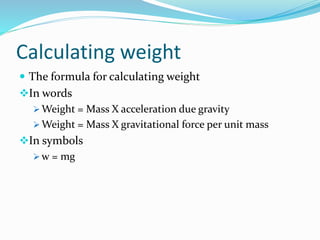
Calculating weight
 The formula for calculating weight
In words
 Weight = Mass X acceleration due gravity
 Weight = Mass X gravitational force per unit mass
In symbols
 w = mg
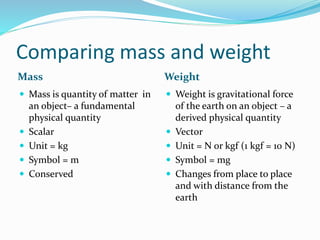
Comparing mass and weight
Mass Weight
 Mass is quantity of matter in
an object– a fundamental
physical quantity
 Scalar
 Unit = kg
 Symbol = m
 Conserved
 Weight is gravitational force
of the earth on an object – a
derived physical quantity
 Vector
 Unit = N or kgf (1 kgf = 10 N)
 Symbol = mg
 Changes from place to place
and with distance from the
earth
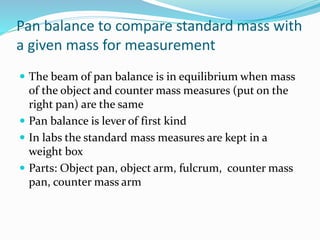
Pan balance to compare standard mass with
a given mass for measurement
 The beam of pan balance is in equilibrium when mass
of the object and counter mass measures (put on the
right pan) are the same
 Pan balance is lever of first kind
 In labs the standard mass measures are kept in a
weight box
 Parts: Object pan, object arm, fulcrum, counter mass
pan, counter mass arm

Mass, weight and gravity.pptx

  • 1.
    Secondary or O-Levelphysics ~Dr Lalit kishore The Plenum School, HP
  • 2.
    Mass  The amountof matter in an object is called mass  Mass is a fundamental physical quantity besides length, time, luminosity, temperature, electric  SI unit of mass is kilogram  The standard 1 kg mass is being kept at the International Bureau of Standards in Paris which is universally accepted for calibration all the National Bureau of Standards or Standards Institutes in various countries for calibration or marking of their mass measures
  • 3.
    Gravity  The pullof the Earth is called gravity or gravitational force  Under free fall, gravity increases the velocity of the dropped object in every successive time interval or gravity as a downward force toward the earth accelerates an object dropped from a height.  The acceleration caused by gravity is called the acceleration due to gravity denoted by ‘g’  Galileo found that all bodies take the same time to come to ground when dropped from same which was verified by feather and coin experiment of free fall in a vacuum tube
  • 4.
    Weight as anothername of gravitational force  The average value of g is 9.81 metres per second square which is a constant value  However, for fair approximation ‘g’ is taken as 10 metres per second square which is a constant value  The force caused by gravity on 1 kg mass is approximately 10 N  Gravity/gravitational force is also called “weight”  Gravity/gravitational force on 1 kg mass = 10 N  Or, weight of 1 kg mass = 10 N  Or, acceleration due to gravity = 10 N / kg or 10 m per second square
  • 5.
    Calculating weight  Theformula for calculating weight In words  Weight = Mass X acceleration due gravity  Weight = Mass X gravitational force per unit mass In symbols  w = mg
  • 6.
    Comparing mass andweight Mass Weight  Mass is quantity of matter in an object– a fundamental physical quantity  Scalar  Unit = kg  Symbol = m  Conserved  Weight is gravitational force of the earth on an object – a derived physical quantity  Vector  Unit = N or kgf (1 kgf = 10 N)  Symbol = mg  Changes from place to place and with distance from the earth
  • 7.
    Pan balance tocompare standard mass with a given mass for measurement  The beam of pan balance is in equilibrium when mass of the object and counter mass measures (put on the right pan) are the same  Pan balance is lever of first kind  In labs the standard mass measures are kept in a weight box  Parts: Object pan, object arm, fulcrum, counter mass pan, counter mass arm