BIOANALYTICAL TECHNIQUES
ASSIGNMENT
ASSIGNMENT TOWARDS PARTIAL FULFILMENT OF
2nd Internal Examination
ASSIGNMENT REPORT FOR SEMESTER –IV
M.Sc. ZOOLOGY(2ND year)
NAME-AKANKSHA ROUT
REG. NO.-190705180139
SECTION – B
CAMPUS –BBSR
GUIDED BY- Mr. Bibhudutta Mishra
MASS SPECTROMETRY
IN BIOANALYSIS
Akanksha Rout
Centurion University Of Technology and Management , BBSR
Core Course-Bioanalytical techniques
M.Sc Zoology (4th semester)
2019-2021
Sec B
Registration no:190705180139
CONTENTS
1. • INTRODUCTION
2. • BASIC PRINCIPLE
3. • ADVANTAGES AND DISADVANTAGES
4. • INSTRUMENTATION
5. • APPLICATIONS
6. • CONCLUSION
7. • ACKNOWLEDGEMENT
WHAT IS MASS SPECTROSCOPY???
1.INTRODUCTION
• Mass spectrometry is apowerful analytical techniqueused toquantify known materials, to
identifyunknown compoundswithin a sample and toelucidate the structure and chemical propertiesof
different molecules.
• Thus, it is the study of the charged molecules and fragment ions produced from a sample exposed to
ionizing conditions and also of the relative intensity spectrum which results from the correlation of the
ions with theirmass to charge ratio.
• A micro-analytical technique requiring only a fewnano-moles of the sample to obtain characteristic
information pertaining to the structure and molecular weight ofanalyte. This technique basically
studies theeffect of ionizing energy on molecules.
• → Now a day's mass spectrometry isused in manyareasincludingpharmaceutical,
clinical, geological, biotechnology and environmental.
• This unique concept was first introduced by scientists : Sir J. J. Thomson & Wilhelm Wien in
1898.
2. PRINCIPLE
ADVANTAGES DISADVANTAGES
• Molecular weight &
formula analysis
• Sample destruction
• Qualitative and
Quantitative analysis
• Sample always desired
to be in the gaseous
form.
• Less amount of sample is
taken.
• Complex and expensive
or high cost not cost
effective
• Less than 1 minute for
analysis.
• Should maintain vacuum
throughout the process.
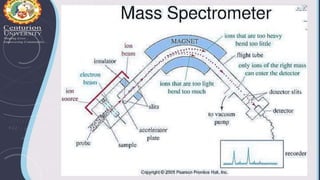
INSTRUMENTATION
WHAT IS MASS SPECTROMETER???
INSTRUMENT
INSTRUMENTATION
WHAT ARE ITS COMPONENTS????
INSTRUMENT
CONCLUSION
• Mass spectrometry is thus, used for the study of charged
molecules and fragment ions.
• Thus, it is useful for the identification of an unknown compound.
APPLICATIONS
Molecular weight , formula and elemental composition
and determination
Identification of an unknown compound
Distinction between cis and trans isomers
Identification of fragmentation patterns
Impurity detection
As LC-MS in analysis of proteins
CONCLUSION
• Mass spectrometry is thus, used for the study of charged molecules and
fragment ions.
• Thus, it is useful for the identification of an unknown compound.
• Thus, showing its high applicability and usage in the field of :
 Trace Gas Analysis
 Pharmaceutical Industry
 Space exploration
 Forensic Toxicology
 Archaeological Dating
ACKNOWLEDGEMENT
I would like to express my special thanks of gratitude to my Dean Dr.
Yashaswi Nayak as well as the HoD Dr. Sitaram Swain (Head of the
Department) as well as our subject teacher Mr. Bibhudutta Mishra who gave
me the golden opportunity to do this wonderful project on the topic Mass
Spectroscopy, which also helped me in doing a lot of research and it helped to
know about so many new things.
I am really thankful to them.
Secondly I would also like a thank my Department friends who helped me
lot in finishing this project within the limited time and resources.It helped me
increase my knowledge and skills.
*THANKS AGAIN TO ALL WHO SUPPORTED*
Mass spectroscopy

Mass spectroscopy

  • 1.
    BIOANALYTICAL TECHNIQUES ASSIGNMENT ASSIGNMENT TOWARDSPARTIAL FULFILMENT OF 2nd Internal Examination ASSIGNMENT REPORT FOR SEMESTER –IV M.Sc. ZOOLOGY(2ND year) NAME-AKANKSHA ROUT REG. NO.-190705180139 SECTION – B CAMPUS –BBSR GUIDED BY- Mr. Bibhudutta Mishra
  • 2.
    MASS SPECTROMETRY IN BIOANALYSIS AkankshaRout Centurion University Of Technology and Management , BBSR Core Course-Bioanalytical techniques M.Sc Zoology (4th semester) 2019-2021 Sec B Registration no:190705180139
  • 3.
    CONTENTS 1. • INTRODUCTION 2.• BASIC PRINCIPLE 3. • ADVANTAGES AND DISADVANTAGES 4. • INSTRUMENTATION 5. • APPLICATIONS 6. • CONCLUSION 7. • ACKNOWLEDGEMENT
  • 4.
    WHAT IS MASSSPECTROSCOPY??? 1.INTRODUCTION • Mass spectrometry is apowerful analytical techniqueused toquantify known materials, to identifyunknown compoundswithin a sample and toelucidate the structure and chemical propertiesof different molecules. • Thus, it is the study of the charged molecules and fragment ions produced from a sample exposed to ionizing conditions and also of the relative intensity spectrum which results from the correlation of the ions with theirmass to charge ratio. • A micro-analytical technique requiring only a fewnano-moles of the sample to obtain characteristic information pertaining to the structure and molecular weight ofanalyte. This technique basically studies theeffect of ionizing energy on molecules. • → Now a day's mass spectrometry isused in manyareasincludingpharmaceutical, clinical, geological, biotechnology and environmental. • This unique concept was first introduced by scientists : Sir J. J. Thomson & Wilhelm Wien in 1898.
  • 5.
  • 7.
    ADVANTAGES DISADVANTAGES • Molecularweight & formula analysis • Sample destruction • Qualitative and Quantitative analysis • Sample always desired to be in the gaseous form. • Less amount of sample is taken. • Complex and expensive or high cost not cost effective • Less than 1 minute for analysis. • Should maintain vacuum throughout the process.
  • 8.
    INSTRUMENTATION WHAT IS MASSSPECTROMETER??? INSTRUMENT
  • 9.
    INSTRUMENTATION WHAT ARE ITSCOMPONENTS???? INSTRUMENT
  • 10.
    CONCLUSION • Mass spectrometryis thus, used for the study of charged molecules and fragment ions. • Thus, it is useful for the identification of an unknown compound.
  • 11.
    APPLICATIONS Molecular weight ,formula and elemental composition and determination Identification of an unknown compound Distinction between cis and trans isomers Identification of fragmentation patterns Impurity detection As LC-MS in analysis of proteins
  • 12.
    CONCLUSION • Mass spectrometryis thus, used for the study of charged molecules and fragment ions. • Thus, it is useful for the identification of an unknown compound. • Thus, showing its high applicability and usage in the field of :  Trace Gas Analysis  Pharmaceutical Industry  Space exploration  Forensic Toxicology  Archaeological Dating
  • 13.
    ACKNOWLEDGEMENT I would liketo express my special thanks of gratitude to my Dean Dr. Yashaswi Nayak as well as the HoD Dr. Sitaram Swain (Head of the Department) as well as our subject teacher Mr. Bibhudutta Mishra who gave me the golden opportunity to do this wonderful project on the topic Mass Spectroscopy, which also helped me in doing a lot of research and it helped to know about so many new things. I am really thankful to them. Secondly I would also like a thank my Department friends who helped me lot in finishing this project within the limited time and resources.It helped me increase my knowledge and skills. *THANKS AGAIN TO ALL WHO SUPPORTED*

Editor's Notes

  • #9 REFRENCES: Slide share and spectroscopyeurope.com
  • #10 REFERENCES:BOOK BY D.Edoff
  • #11 REFERENCES:BOOK BY D.Edoff
  • #12 REFERENCES:BOOK BY D.Edoff
  • #13 REFERENCES:BOOK BY D.Edoff
  • #14 REFERENCES:BOOK BY D.Edoff
  • #15 REFERENCES:BOOK BY D.Edoff