Shri Shivaji Education Society Amravati’s
J.D.Patil Sangludkar Mahavidyalaya,
Daryapur.
Mass Spectrometry
Rahul G.Sawarkar
M.Sc. GATE, SET.
Assistant Professor
Content
Introduction
Principle
Instrumentation
Process Of Sample Introduction
Direct Vapour Inlet
Gas Chromatography
Direct Insertion Probe
Ionisation Techniques
Electron Ionisation (EI)
Chemical Ionisation (CI)
Field Desorption (FD)
Fast atom Bombardment (FAB)
Applications
Refrences
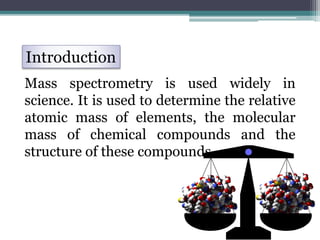
Mass spectrometry is used widely in
science. It is used to determine the relative
atomic mass of elements, the molecular
mass of chemical compounds and the
structure of these compounds
Introduction
Sample compound converted to vapours
Energetic e- beam (70eV) bombarded on the vapours.
Ionization of the sample –
M + e- M+ + 2 e-
Fragmentation of molecular ions.
Mass analyzer ( seperation of ions)
m/e values and the mass spectrum.
Principle
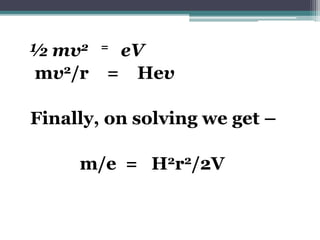
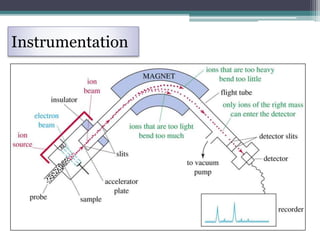
½ mv2 = eV
mv2/r = Hev
Finally, on solving we get –
m/e = H2r2/2V
Instrumentation
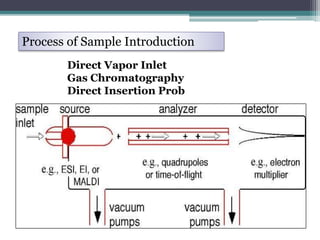
Process of Sample Introduction
Direct Vapor Inlet
Gas Chromatography
Direct Insertion Prob
Produces M+. radical cation giving molecular weight
ā—— Produces abundant fragment ions
ā—— Energetic process. A heated filament emits
electrons which are accelerated by a potential
difference of usually 70eV into the sample chamber.
Ionisation of the sample occurs by removal of an
electron from the molecule thus generating a
positively charged ion with one unpaired electron.
M + e M+. + 2e-
Ionisation Technique
1) Electron Ionisation
2) Chemical Ionisation
Development from EI
Same compound classes as EI
Gives molecular weight
Softer ionisation technique
Produces M+H+ ions or M - H- ions
Used to produce more abundant molecular ions
when the molecule under investigation
fragments using EI
Primary ion
CH4 + e CH4+. + 2e-
CH4+ CH3+ +H.
Secondary ions
CH4+ + CH4 CH5+ + CH3
CH3+ + CH4 C2H5+ +H2
Proton donation
CH5+ + M CH4 + MH+
3)Field Desorption
• The sample is deposited onto the emitter and the
emitter is biased to a high potential (several
kilovolts) and a current is passed through the
emitter to heat up the filament. Mass spectra are
acquired as the emitter current is gradually
increased and the sample is evaporated from the
emitter into the gas phase.
4) Fast Atom Bombadment
Used for large compounds with low volatility (eg
peptides, proteins, carbohydrates)
ā—— Solid or liquid sample is mixed with a non-volatile
matrix (eg glycerol, crown ethers, nitrobenzyl
alcohol)
ā—— Immobilised matrix is bombarded with a fast
beam
of Argon or Xenon atoms. Charged sample ions are
ejected from the matrix and extracted into the mass
analysers
ā—— Gives M+H+ or M+Na+ ions
ā—— Choosing correct matrix is difficult
It has wide applications.Some of important ones
are mentioned below-
1.Molecular mass determination,
2.Isotope detection,
3.Distinguish between cis & trans-
isomers,
Applications
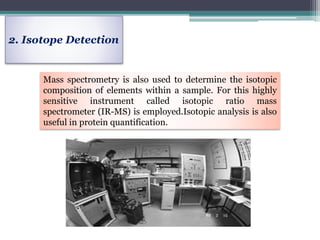
2. Isotope Detection
Mass spectrometry is also used to determine the isotopic
composition of elements within a sample. For this highly
sensitive instrument called isotopic ratio mass
spectrometer (IR-MS) is employed.Isotopic analysis is also
useful in protein quantification.
3.Distinction Between cis & trans- isomers
This technique can successfully distinguish
between the cis and trans isomers of a
compound. Both the ions give mass spectra
but the spectra of trans isomers is more
intense. Also the dehydration fragment of the
cis isomer is stronger than that of trans
isomers and thus they can be identified
separately.
Ex: 2-Butene
Conclusion:-
Mass spectrometry is a very
powerful analytical technique
which is being rapidly
employed for the structural
determination of large no. of
compounds.
Refrences
1) Introduction to SPECTROSCOPY
(third edition)
By-Donald L. Pavia
Gary M. Lampaman
George S.Kriz
2) Organic Spectroscopy
(third edition)
By- William Kemp
3)Organic Spectroscopy Principles and Application
(second edition)
By-Jag Mohan
4) Instrumental Methods Of Chemical Analysis.
By- Gurudeep R.Chatwal
Sham K.Anand
Thank You.....

Mass Spectrometry.pptx

  • 1.
    Shri Shivaji EducationSociety Amravati’s J.D.Patil Sangludkar Mahavidyalaya, Daryapur. Mass Spectrometry Rahul G.Sawarkar M.Sc. GATE, SET. Assistant Professor
  • 2.
    Content Introduction Principle Instrumentation Process Of SampleIntroduction Direct Vapour Inlet Gas Chromatography Direct Insertion Probe Ionisation Techniques Electron Ionisation (EI) Chemical Ionisation (CI) Field Desorption (FD) Fast atom Bombardment (FAB) Applications Refrences
  • 3.
    Mass spectrometry isused widely in science. It is used to determine the relative atomic mass of elements, the molecular mass of chemical compounds and the structure of these compounds Introduction
  • 4.
    Sample compound convertedto vapours Energetic e- beam (70eV) bombarded on the vapours. Ionization of the sample – M + e- M+ + 2 e- Fragmentation of molecular ions. Mass analyzer ( seperation of ions) m/e values and the mass spectrum. Principle
  • 5.
    ½ mv2 =eV mv2/r = Hev Finally, on solving we get – m/e = H2r2/2V
  • 6.
  • 7.
    Process of SampleIntroduction Direct Vapor Inlet Gas Chromatography Direct Insertion Prob
  • 8.
    Produces M+. radicalcation giving molecular weight ā—— Produces abundant fragment ions ā—— Energetic process. A heated filament emits electrons which are accelerated by a potential difference of usually 70eV into the sample chamber. Ionisation of the sample occurs by removal of an electron from the molecule thus generating a positively charged ion with one unpaired electron. M + e M+. + 2e- Ionisation Technique 1) Electron Ionisation
  • 9.
    2) Chemical Ionisation Developmentfrom EI Same compound classes as EI Gives molecular weight Softer ionisation technique Produces M+H+ ions or M - H- ions Used to produce more abundant molecular ions when the molecule under investigation fragments using EI
  • 10.
    Primary ion CH4 +e CH4+. + 2e- CH4+ CH3+ +H. Secondary ions CH4+ + CH4 CH5+ + CH3 CH3+ + CH4 C2H5+ +H2 Proton donation CH5+ + M CH4 + MH+
  • 11.
    3)Field Desorption • Thesample is deposited onto the emitter and the emitter is biased to a high potential (several kilovolts) and a current is passed through the emitter to heat up the filament. Mass spectra are acquired as the emitter current is gradually increased and the sample is evaporated from the emitter into the gas phase.
  • 12.
    4) Fast AtomBombadment Used for large compounds with low volatility (eg peptides, proteins, carbohydrates) ā—— Solid or liquid sample is mixed with a non-volatile matrix (eg glycerol, crown ethers, nitrobenzyl alcohol) ā—— Immobilised matrix is bombarded with a fast beam of Argon or Xenon atoms. Charged sample ions are ejected from the matrix and extracted into the mass analysers ā—— Gives M+H+ or M+Na+ ions ā—— Choosing correct matrix is difficult
  • 13.
    It has wideapplications.Some of important ones are mentioned below- 1.Molecular mass determination, 2.Isotope detection, 3.Distinguish between cis & trans- isomers, Applications
  • 16.
    2. Isotope Detection Massspectrometry is also used to determine the isotopic composition of elements within a sample. For this highly sensitive instrument called isotopic ratio mass spectrometer (IR-MS) is employed.Isotopic analysis is also useful in protein quantification.
  • 17.
    3.Distinction Between cis& trans- isomers This technique can successfully distinguish between the cis and trans isomers of a compound. Both the ions give mass spectra but the spectra of trans isomers is more intense. Also the dehydration fragment of the cis isomer is stronger than that of trans isomers and thus they can be identified separately. Ex: 2-Butene
  • 18.
    Conclusion:- Mass spectrometry isa very powerful analytical technique which is being rapidly employed for the structural determination of large no. of compounds.
  • 19.
    Refrences 1) Introduction toSPECTROSCOPY (third edition) By-Donald L. Pavia Gary M. Lampaman George S.Kriz 2) Organic Spectroscopy (third edition) By- William Kemp 3)Organic Spectroscopy Principles and Application (second edition) By-Jag Mohan 4) Instrumental Methods Of Chemical Analysis. By- Gurudeep R.Chatwal Sham K.Anand
  • 20.