MASS SPECTROMETRY
Mass spectrometry allows us to determine the molecular mass and
the molecular formula of a compound, as well as certain structural
features of the compound.
MASS SPECTROMETRY - PRINCIPLE
• In mass spectrometry, a small sample of a compound is introduced
into an instrument called a mass spectrometer, where it is vaporized
and then ionized as a result of an electron’s being removed from
each molecule. Ionization can be accomplished in several ways.
• The most common method bombards the vaporized molecules with
a beam of high-energy electrons. The energy of the electron beam
can be varied, but a beam of about 70 electron volts (eV) is
commonly used.
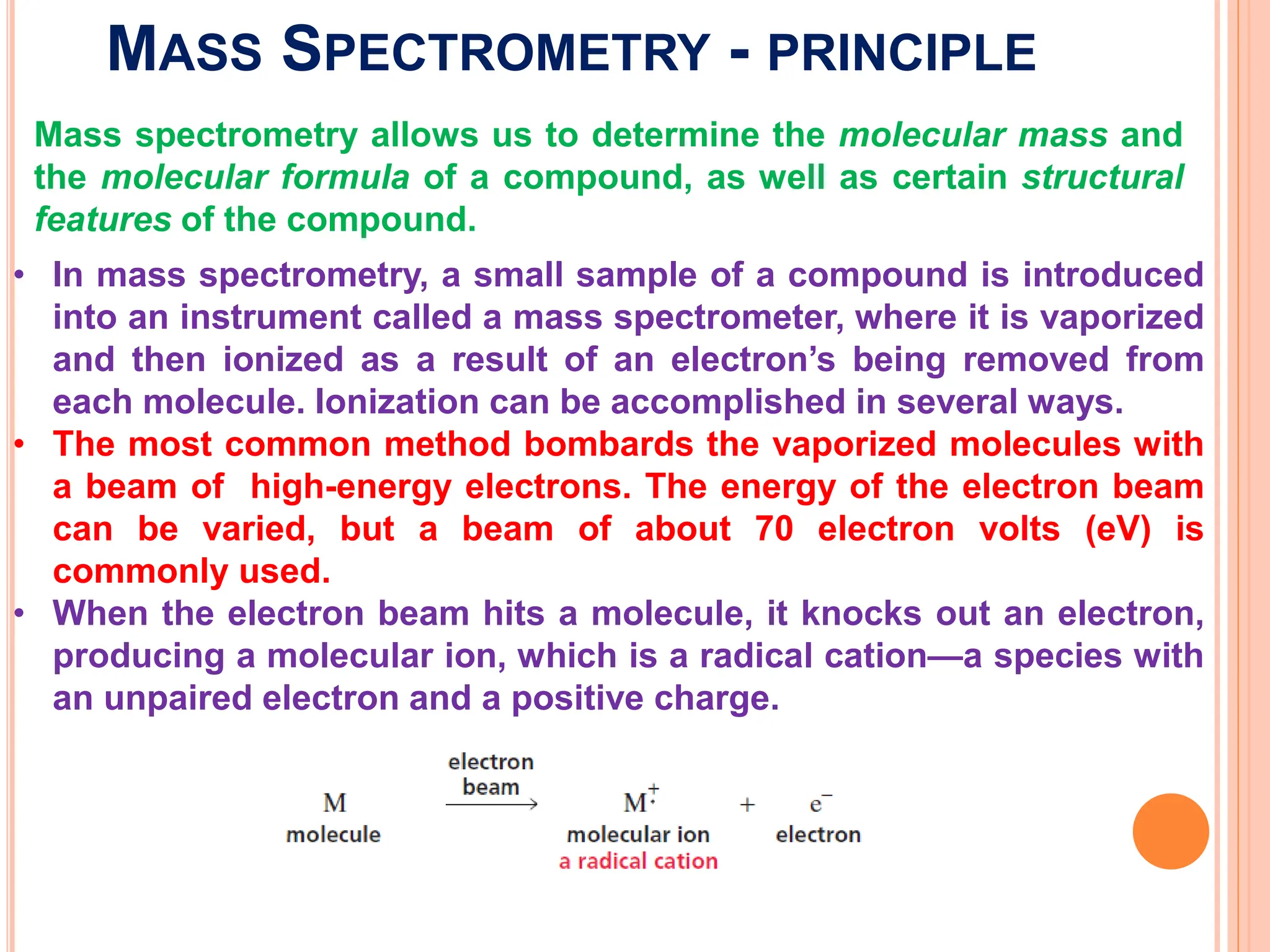
• When the electron beam hits a molecule, it knocks out an electron,
producing a molecular ion, which is a radical cation—a species with
an unpaired electron and a positive charge.
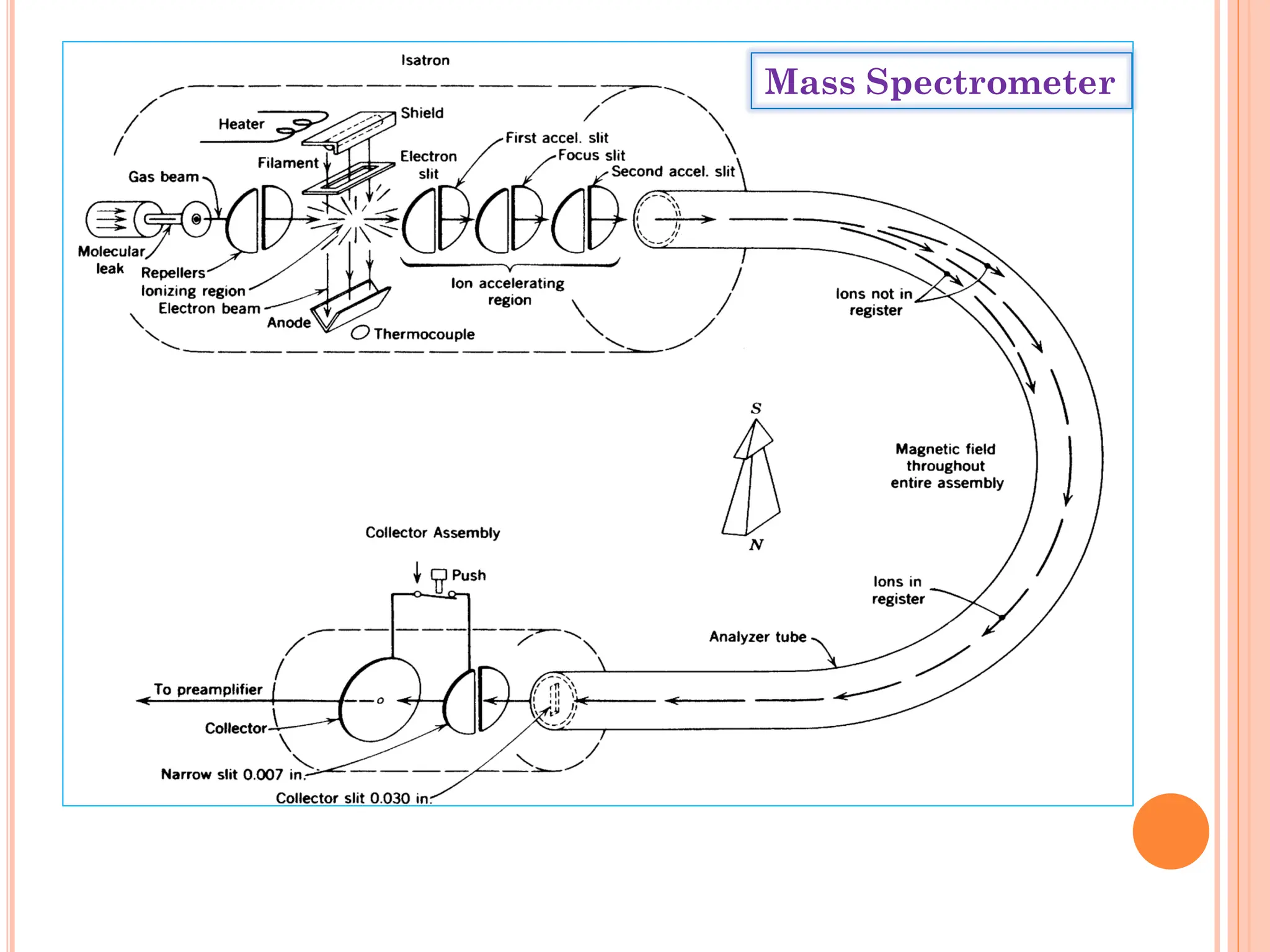
Mass Spectrometer
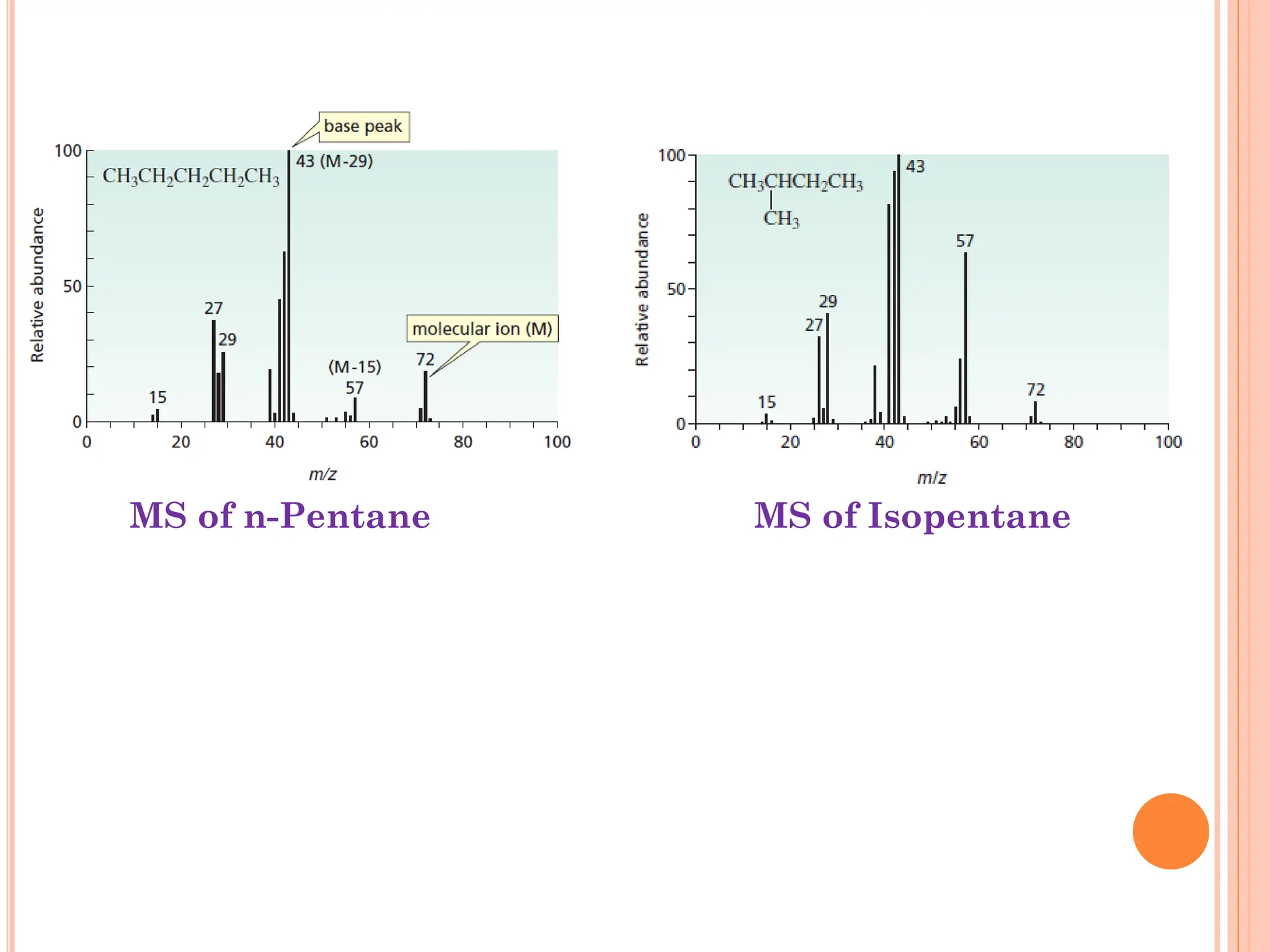
Molecular ion peak: Molecular weight of the compound
Base Peak
MS of n-Pentane
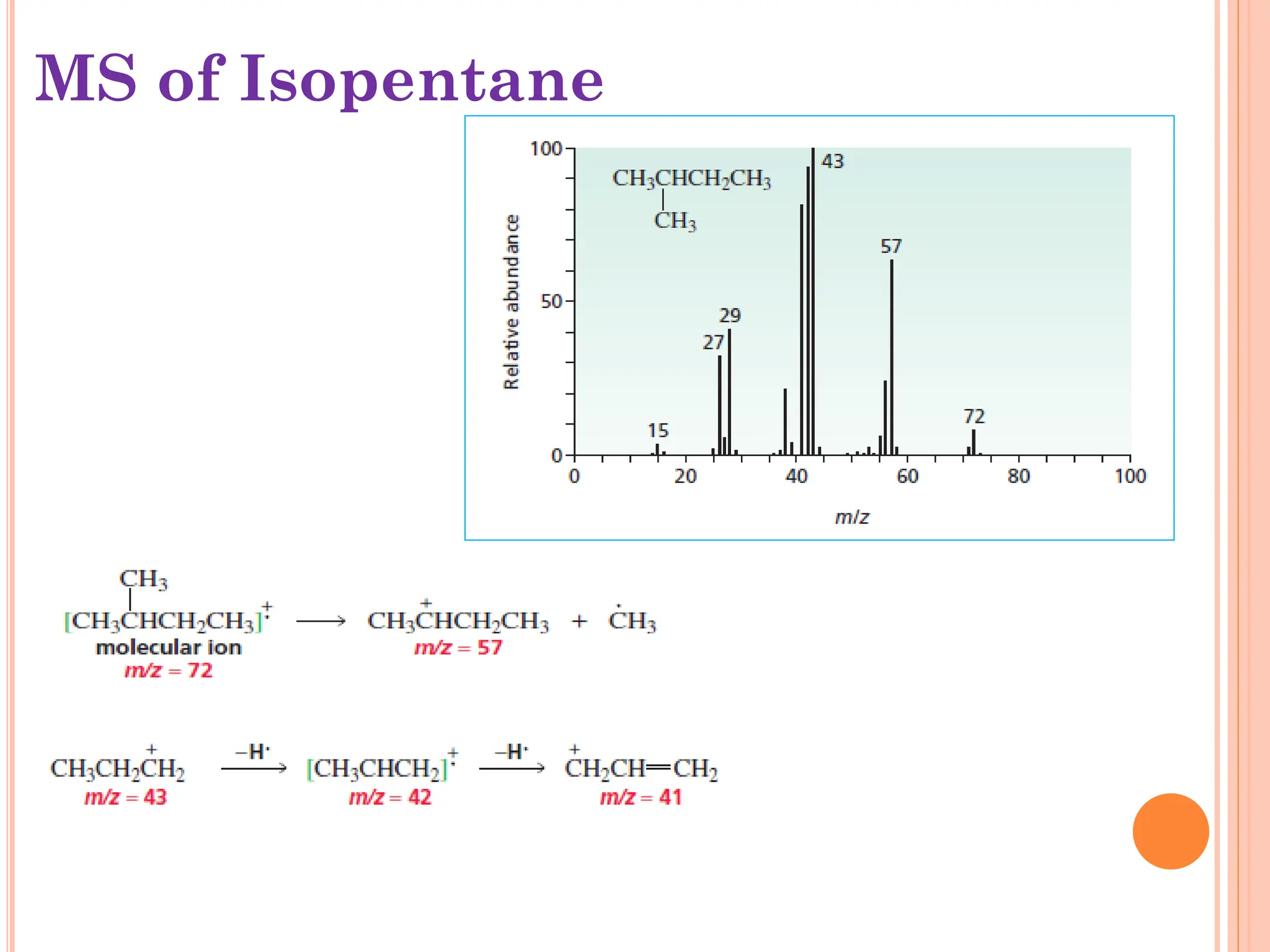
MS of Isopentane
MS of n-Pentane MS of Isopentane
Isotope Peaks: [M+1]
[M+2]
Calculating the Relative Abundance of
Isotope Peaks
Calculating the Relative Abundance of
Isotope Peaks
Applications of Isotope Peaks
(i) To calculate the number of CARBON atoms
(ii) To calculate the number of halogens like Cl & Br
M+2 peak 3:1 Chlorine
M+2 peak 1:1 Bromine
Rules For Fragmentation in MS
MS of n-Pentane MS of Isopentane
Rules For Fragmentation in MS
McLafferty Rearrangement
Arene
MS of NAPHTHALENE C10H8
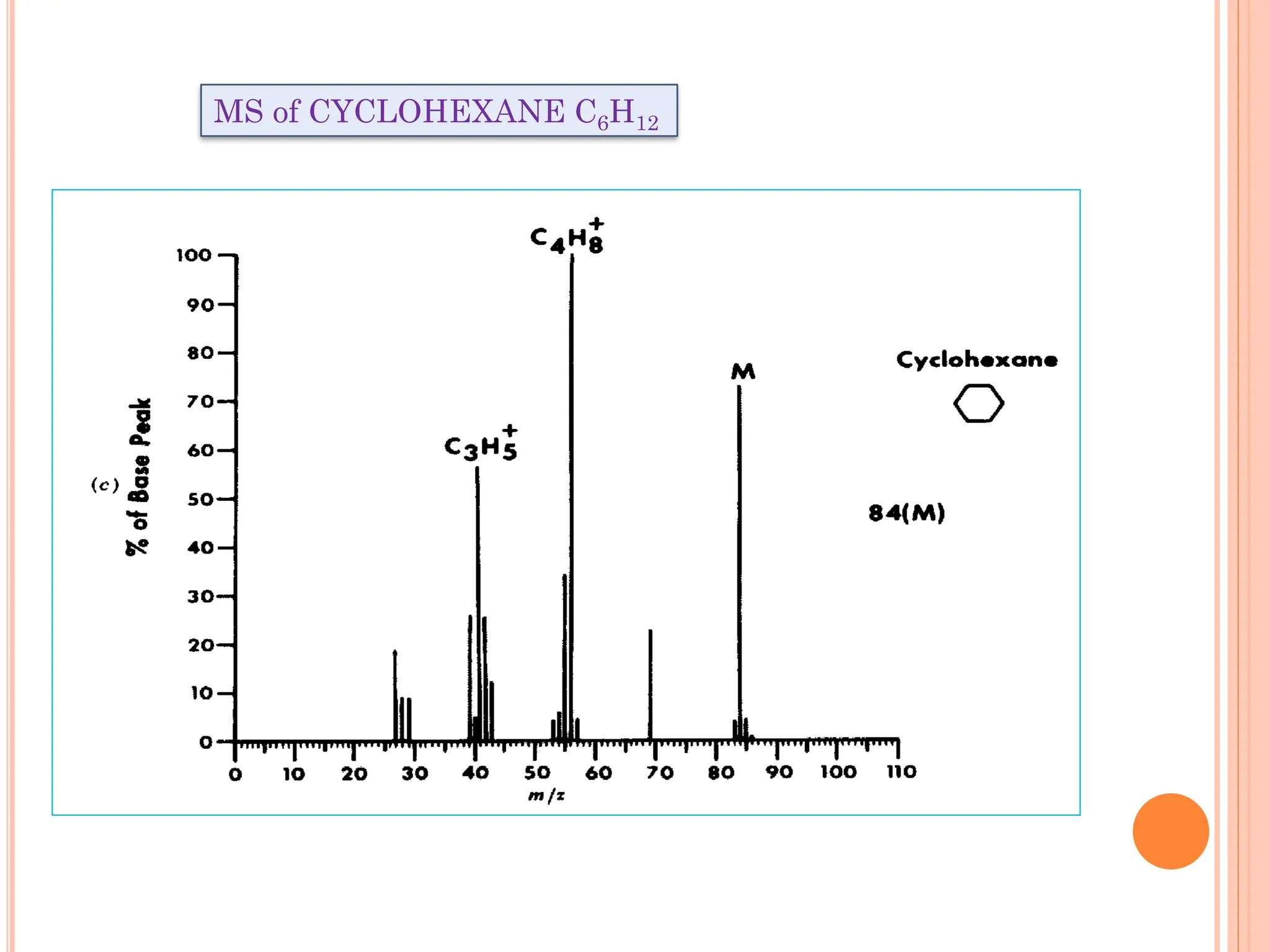
MS of CYCLOHEXANE C6H12
MS OF MYRCENE
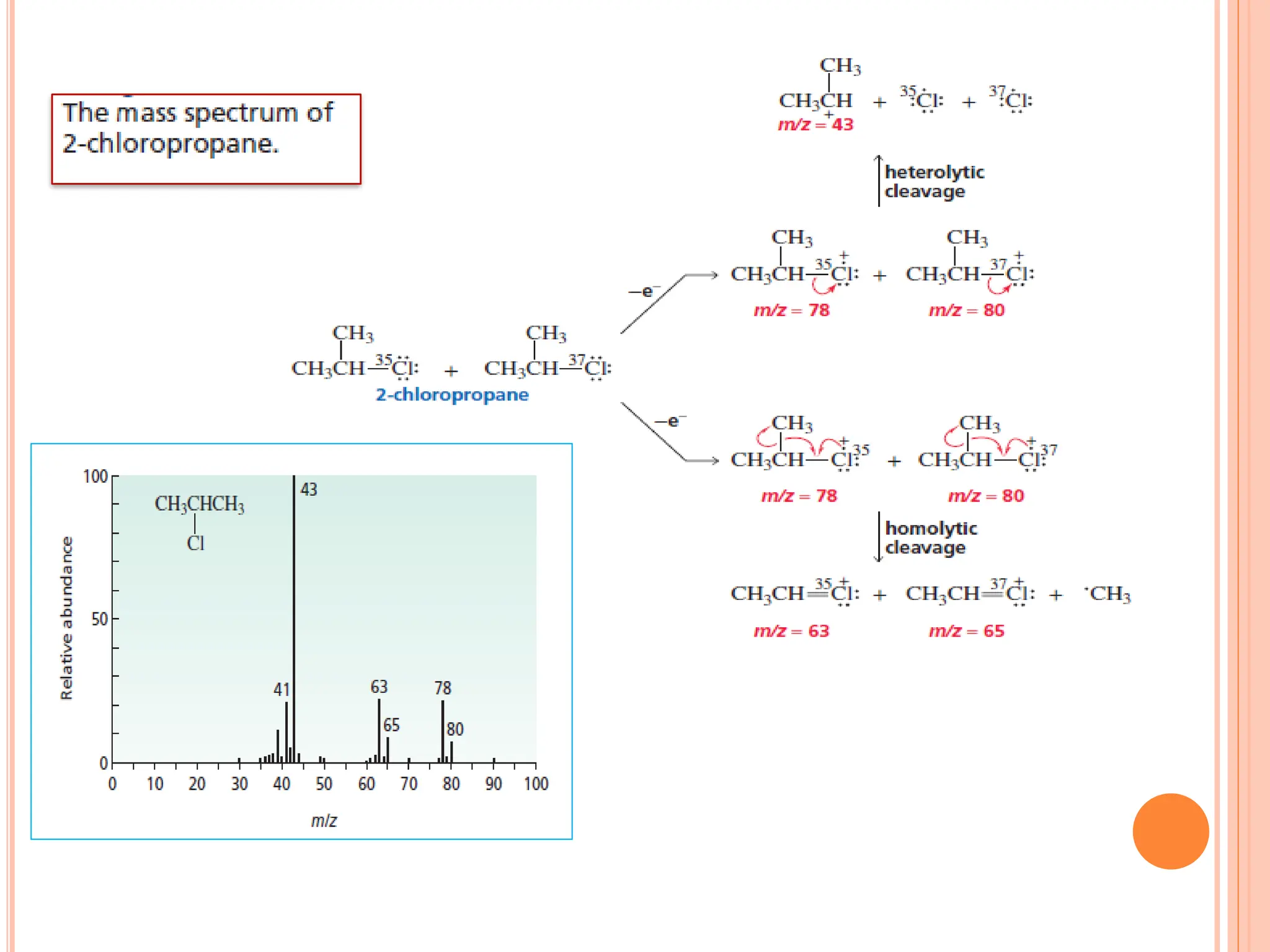
Alkyl Halide
Intensities of isotopic peaks
(Relative to the Molecular ion peak)
for combinations of Bromine and Chlorine
MS Ethyl sec-butyl ether
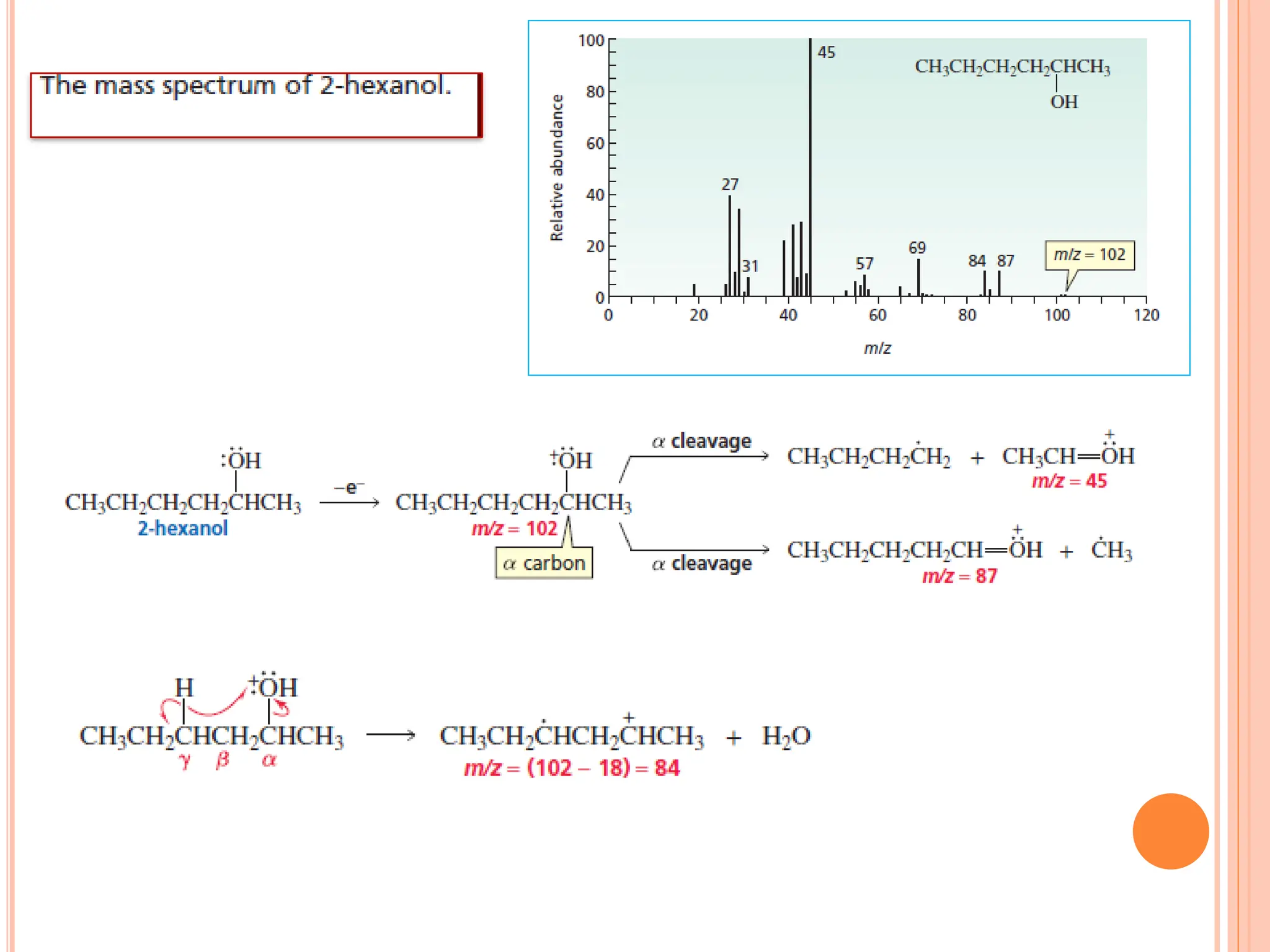
MS of Isomers of Pentanol
MS of o-Ethylphenol
MS of Nonal
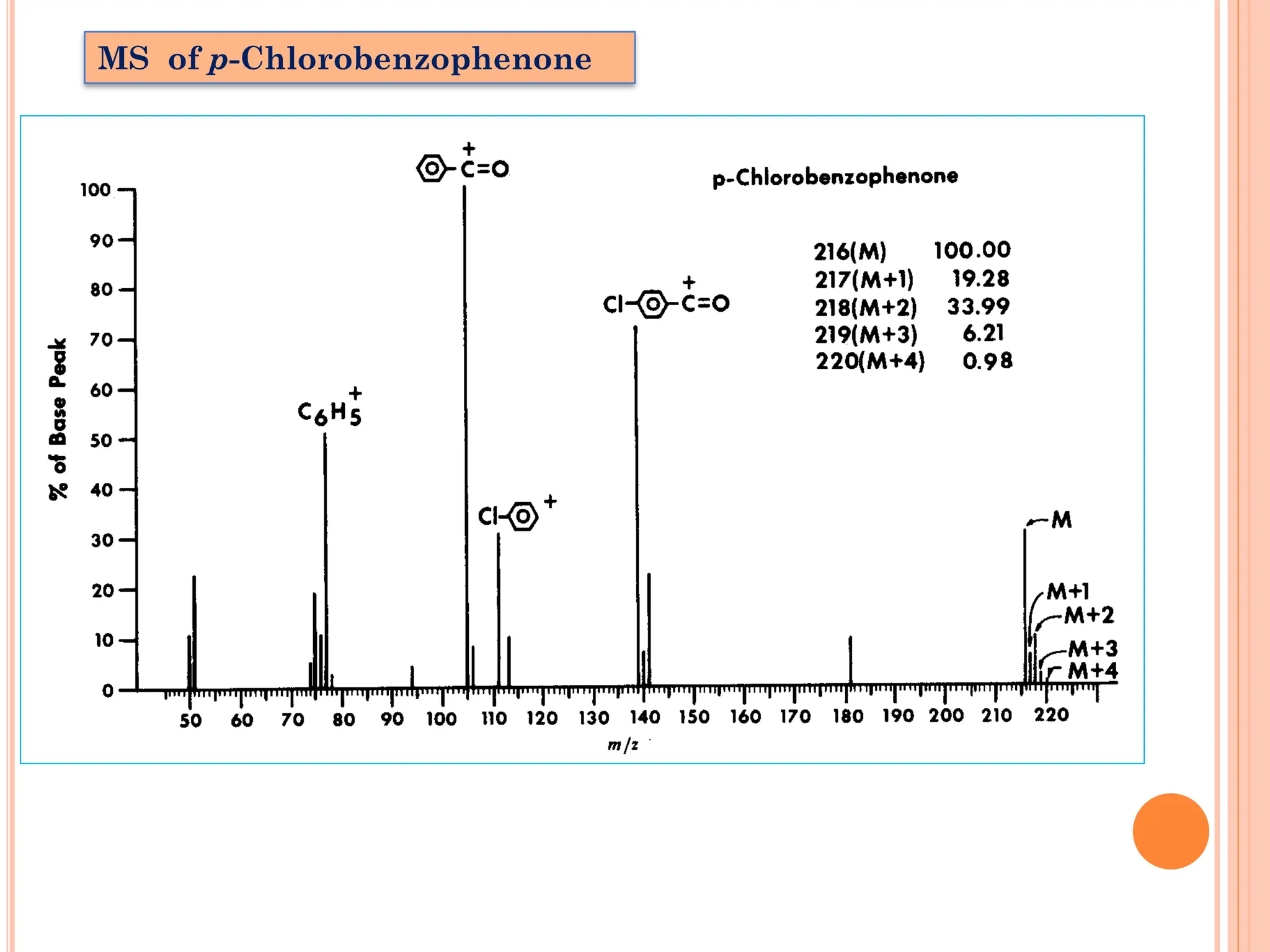
MS of p-Chlorobenzophenone
MS of Hexanoic acid
MS of METHYL OCTANOATE
Components Of A Mass Spectrometer
Ionisation Ion Detection
Ion Separation
Ion Source Mass Analyser Detector
Electron Ionisation (EI)
Chemical Ionisation (CI)
Fast Atom Bombardment (FAB)
Electrospray Ionisation (ESI)
Matrix-Assisted Laserdesorption/
Ionisation (MALDI)
Quadrupole
Magnetic Sector Field
Electric Sector Field
Time-Of-Flight (TOF)
Ion Trap
Electron Multiplier
Multichannel plate
Faraday Cup
IONIZATION TECHNIQUES
EI: Electron Impact
CI: Chemical Ionization
FAB: Fast Atom Bombardment
ESI-TOF: Electron Spray Ionization
MALDI-MALDI: Matrix Assisted Laser Desorption/Ionization
Chemical Ionization (CI)
The vapourized sample is introduced in to the mass
spectropeter with an excess of a ‘reagent’ gas (commonly) at
a pressure of about 1 torr.
The excess carrier gas is ionized by electron impact to the
primary ions CH4.+ and CH3
+. These react with the excess
methane to give secondary ions.
Field Desorption (FD)
Stable molecular ions are obtained from a sample of low
volatility, which is placed on the anode of a pair of electrodes,
between which there is an intense electric field.
Desorption occurs, and molecular and quasimolecular ions are
produced with insufficient internal energy for extensive
fragmentation.
Usually the major peak represents the [M+H]+ ion.
Synthetic polymers with molecular weights on the order of
10,000 Da have been analyzed, but there is a much lower
molecular weight limit for polar biopolymers.
Mass Spectrometry.pdf

Mass Spectrometry.pdf